-
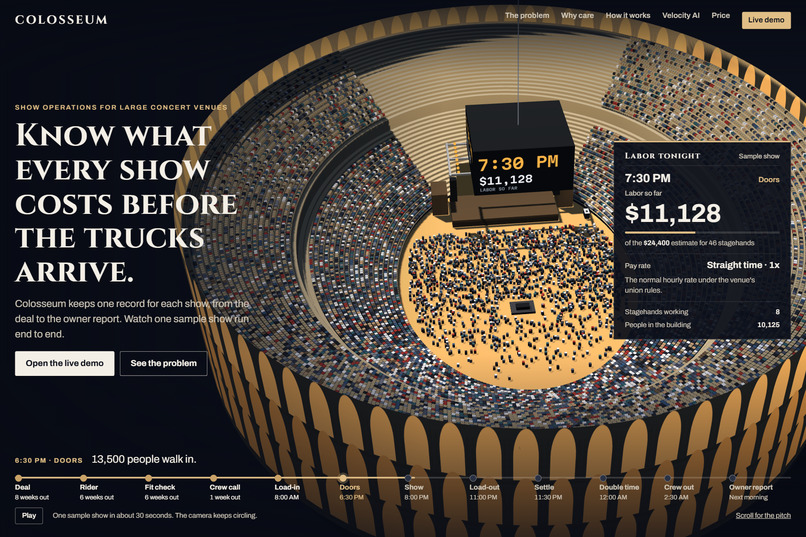
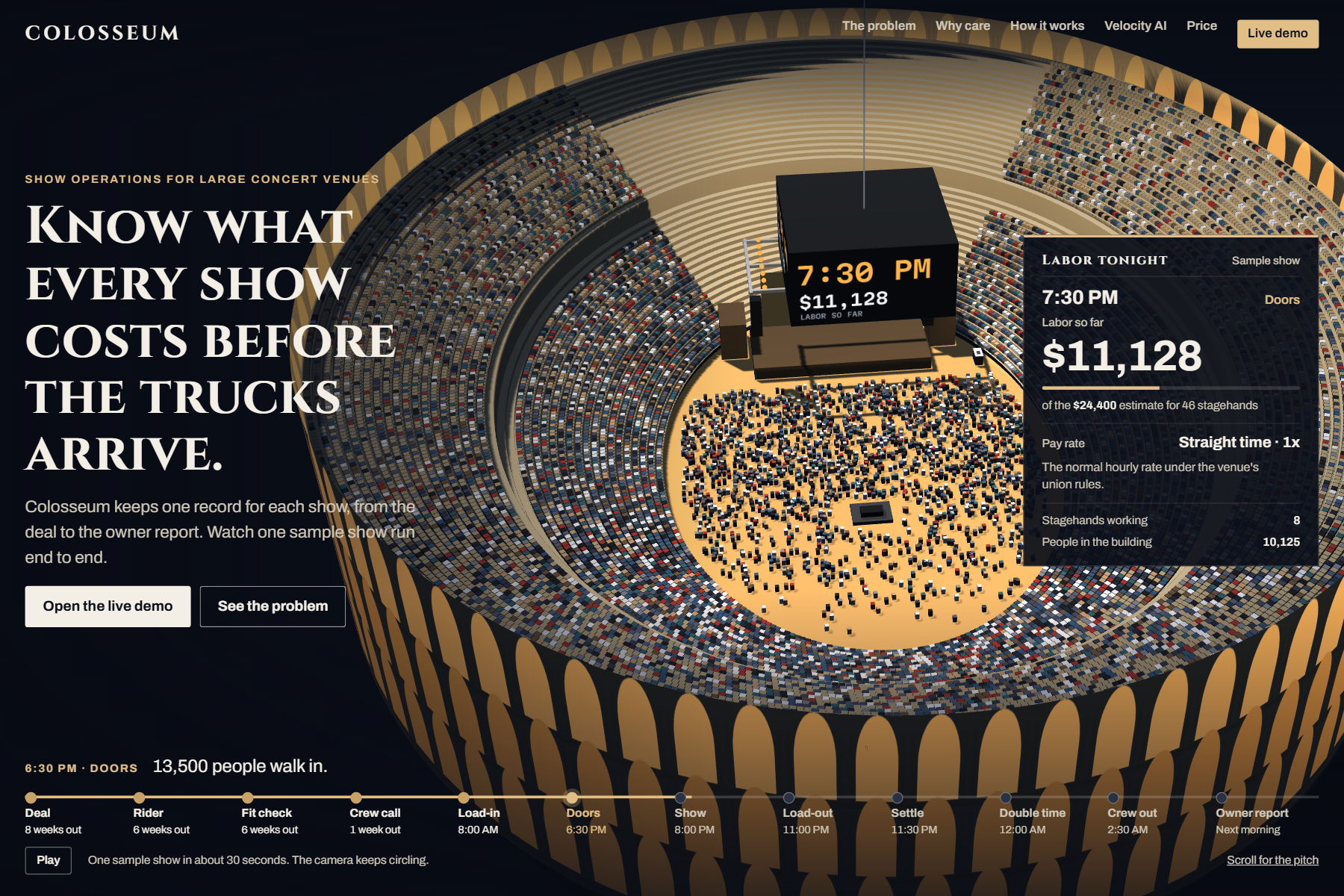
The pitch page: a 3D arena on show night
Inspiration
Our team consists of concert lovers who are passionate about music. We've noticed an increase in our generation's love for in-person events, especially music festivals and concerts. One of our team members is a concert videographer himself, and he's noticed how chaotic and confusing the entire venue space is. He's witnessed firsthand the difficulties and complexities that lie within the concert venue planning sphere. For a rapidly scaling industry with increasing popularity, the best way to solve the issues is by implementing software that can automate the complex processes and issues that production managers face
What it does
Colosseum keeps one record for each show, from the booking email to the owner's report.
- The venue drops in the booking email. Colosseum reads the deal, ticket scaling, and production needs from it and creates the show.
- Colosseum checks the tour's rider against the building: power by service, rigging load, stage size, docks, and curfew. An AI reader is built to fill the rider fields from the PDF, each tied to the page it came from.
- Colosseum builds the crew calls and schedule from the advance and prices it with the venue's union rules.
- If the day runs late, the new labor cost shows in one click, and Colosseum drafts a change notice that asks the tour to approve the cost before it happens.
- At settlement, ticket counts and labor flow in, and the settlement shows who pays each extra cost: the venue, the show, or the artist.
- The owner report for the city or university comes from the same settled shows.
How we built it
- Next.js 16, React and TypeScript, with Zustand for state and Tailwind and shadcn components for the interface.
- The money and labor rules are plain tested functions: 1,184 unit tests pass in Vitest. Two Playwright scripts click through the demo in a browser, and all 138 checks pass on the live build.
- Claude (Anthropic API) has two narrow jobs: to read a rider PDF into a 12-field form, with a page and a quote for each number, and to answer questions about the saved shows in the dashboard's question bar, in one or two sentences.
Challenges we ran into
Union labor rules change from building to building, and one late truck can trip several rules at once: overtime, a minimum call, and a night rate. We checked our engine against published rate sheets and wrote down where it does not match yet. Approvals were harder than we expected. "The venue approved the spend" and "the tour agreed to be charged" are different decisions, and a settlement that mixes them up charges the wrong party.
Accomplishments that we are proud of
- A working app: sample shows run through every step, from the booking email to the owner report.
- Each role within the concert planning sphere has their own dashboard personalized with their own data that's relevant to their position specifically.
- Being able to simplify and portray the workstream with such complex demands and data between the artist's wants and the limitations of the venue
- Tested rules compute every money total in the app, and the app flags a saved labor cost that no longer matches it.
- Every number on our pitch page has a source, or is labeled as our estimate or as sample data.
What we learned
- A rider can pass on total power and still not fit, because arenas supply power as separate services.
- While building, communication between team members is extremely important.
- How to make an industry with such repetitive and complex tasks automated and assisted by AI to improve its workflow.
- In the sample presenter contract we read, a cost over the estimate is the buyer's to pay unless it is approved in writing before it happens.
- Velocity AI's simulated buyers called $5,000 to $15,000 a year worth exploring and said that higher prices required stronger evidence.
What is next for Colosseum
Our next steps are to ship this product into the real world with real concert venues. We believe that there's a real need for this product and that event planners would really benefit from having a tool like this. Additionally, we want to create an API tool where you can just prompt an AI with specific inquiries and have it draw from all the relevant data so that you don't have to ask the production manager for information. You can instead just prompt the AI based on the data it has. Eventually, we'd also like to implement end-to-end event planning for smaller-scale events. Our first goal is to get a tactical wedge because we believe that addressing a larger issue will allow our software to be stress-tested and improved at a larger scale.
Built With
- anthropic-claude
- css3
- html5
- javascript
- next.js
- papaparse
- playwright
- react
- react-pdf
- recharts
- shadcn-ui
- tailwindcss
- three.js
- typescript
- velocity-ai
- vercel
- vitest
- zod
- zustand
