-
-
Built with Codex and GPT-5.6, supported by dated commits, tests, public evidence, and reproducible deployment.
-
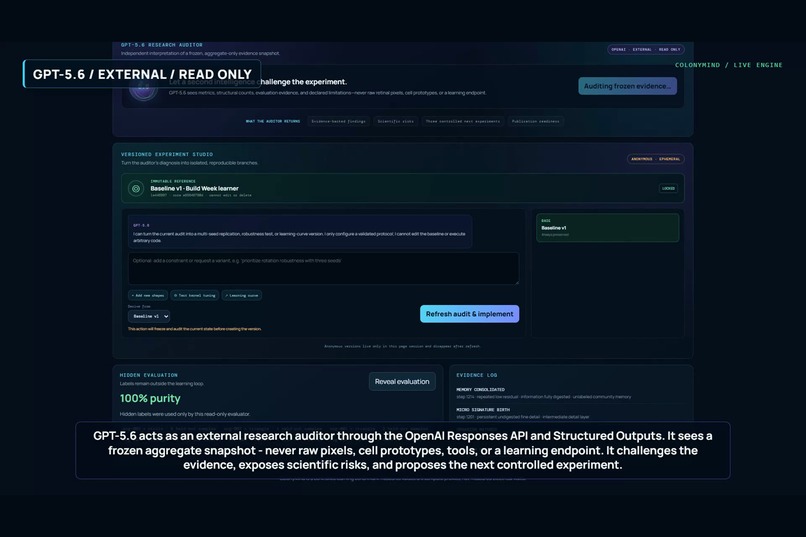
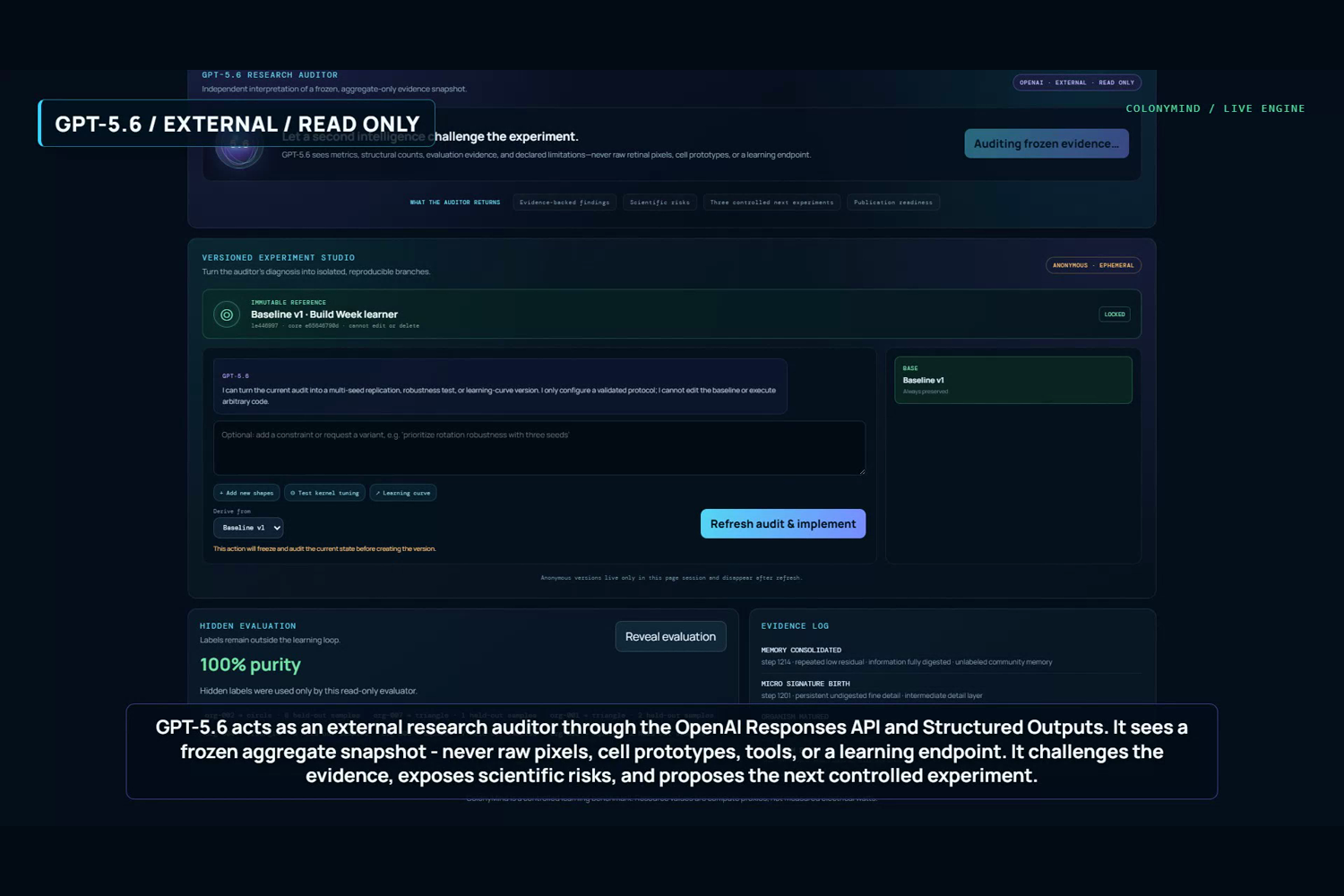
GPT-5.6 Research Auditor: frozen aggregate evidence, read only, with learner state preserved.
-
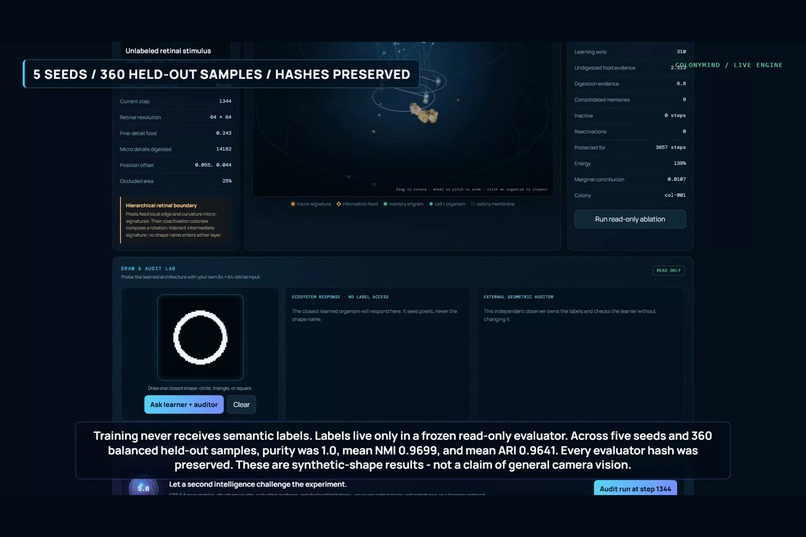
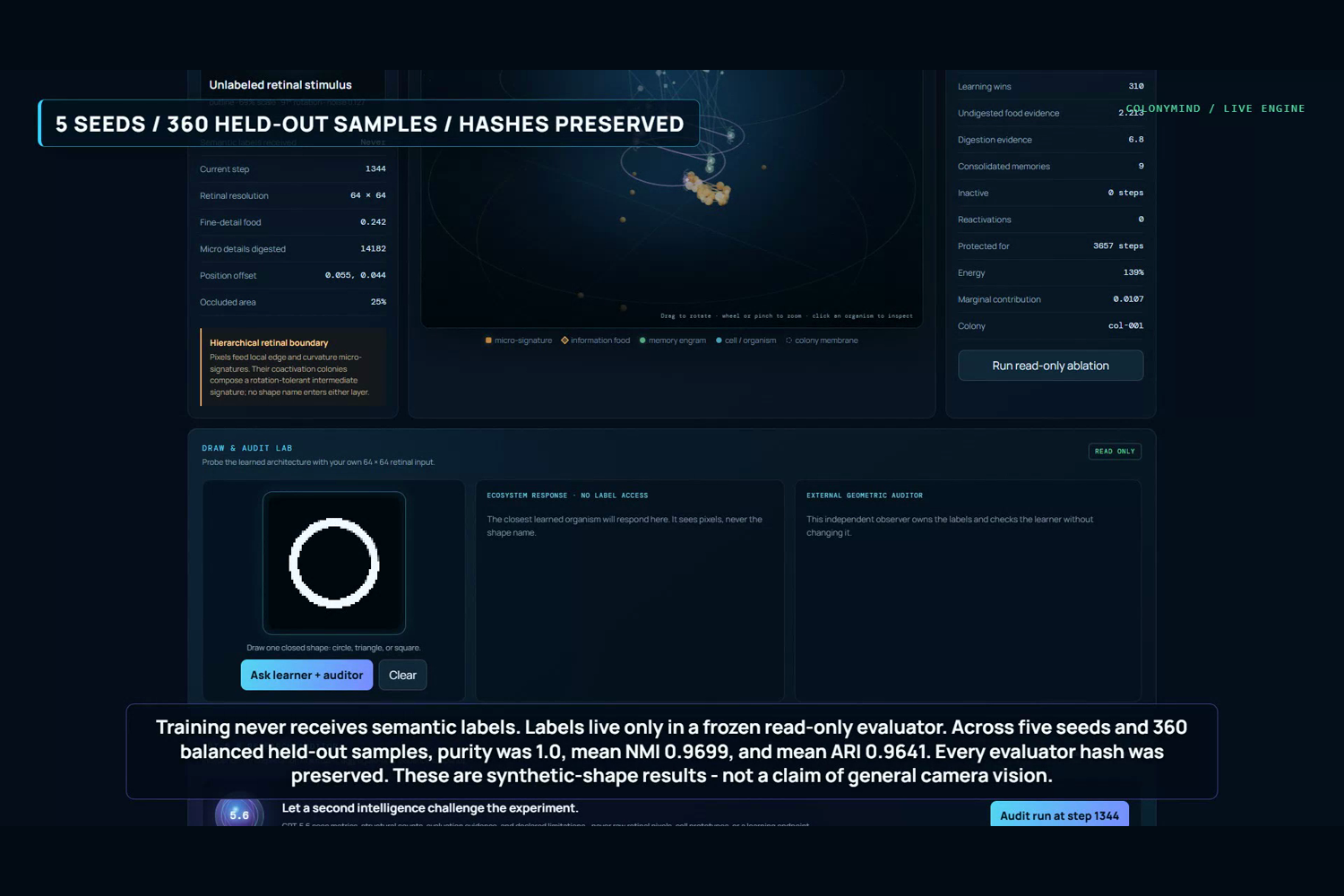
Draw & Audit: human-drawn input is checked without sending semantic labels into training.
-
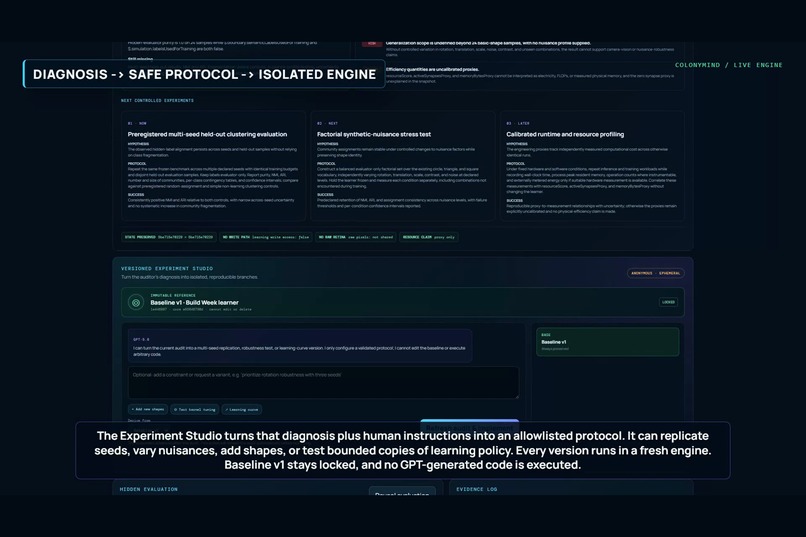
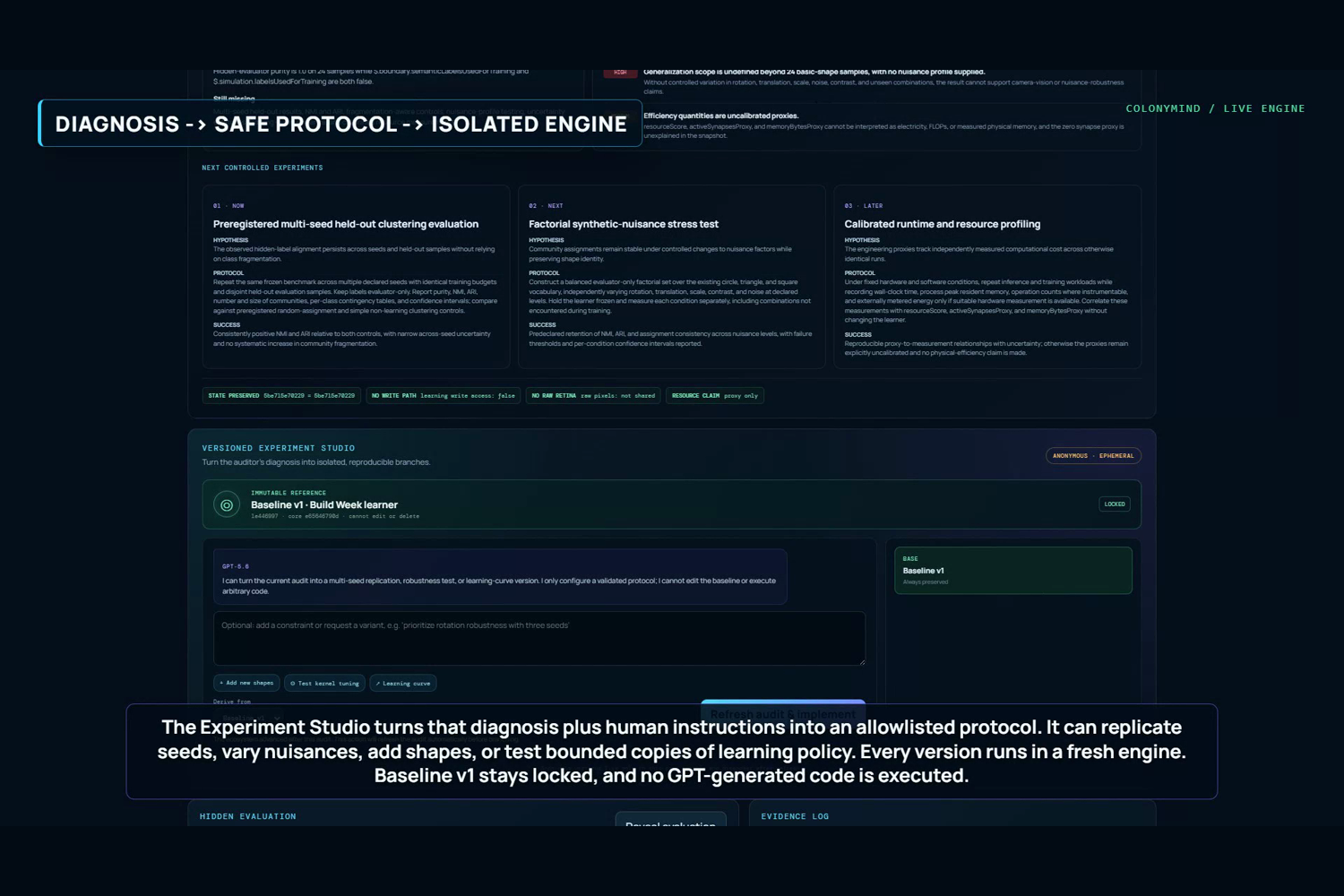
Versioned Experiment Studio: isolated protocols while Baseline v1 remains locked.
-
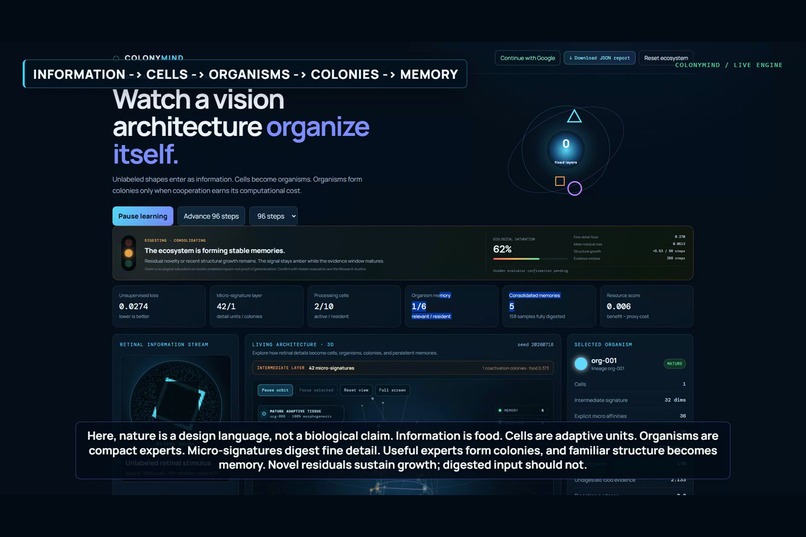
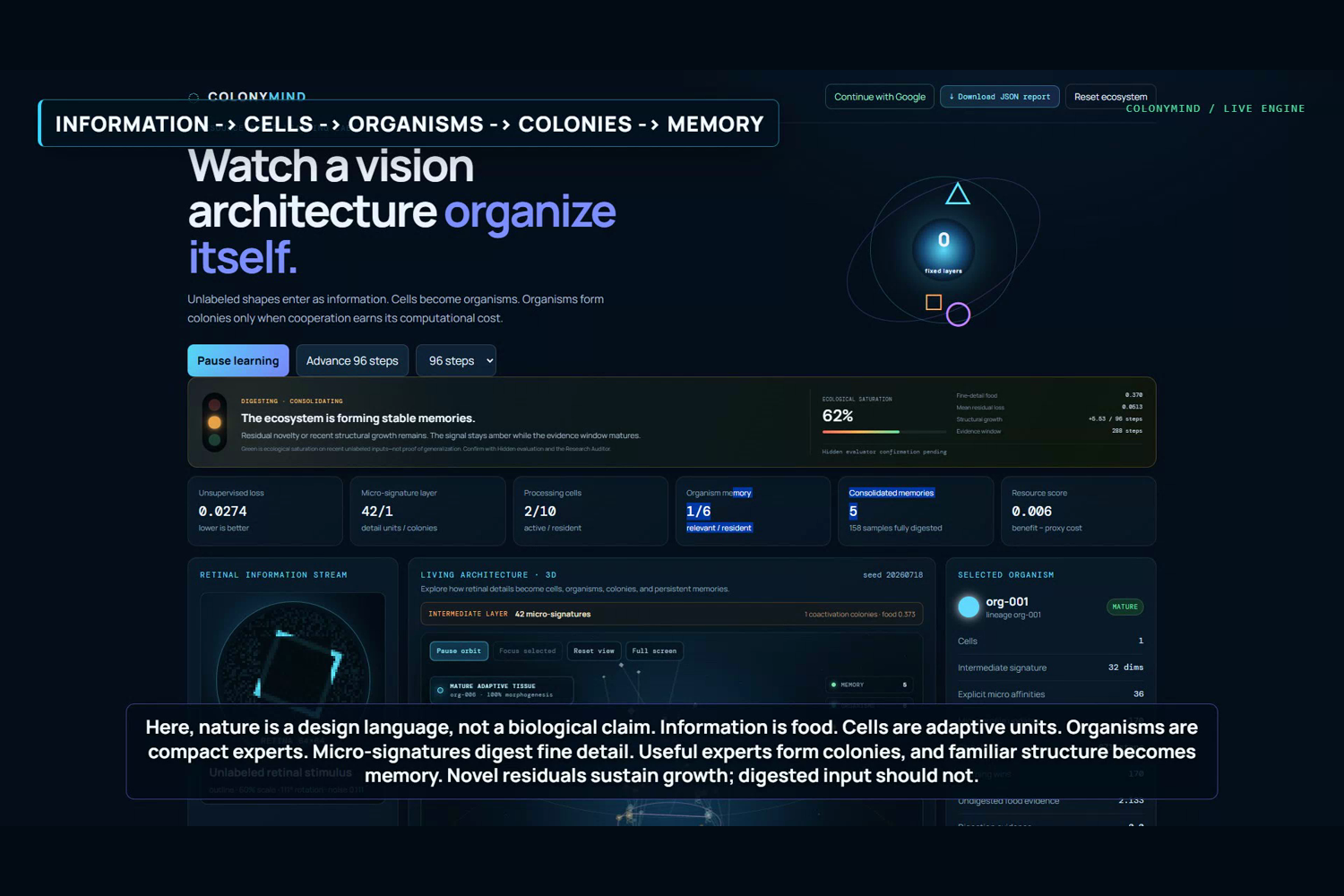
Learning by foraging: retinal residuals recruit cells, organisms, and micro-signatures.
Inspiration
Most visual learners begin with their architecture already decided: layers, width, and capacity are chosen before the first image arrives. ColonyMind asks a different question: what if a learner had to earn new structure from the information it could not yet explain?
Nature gave us a useful design language. Unfamiliar information behaves like food. Cells become small adaptive units. Cells form organism-like local experts. Useful organisms cooperate as colonies, and familiar structure consolidates into memory. These are functional software analogies, not claims that the system is literally alive.
Circles, triangles, and squares are our wind tunnel, not our destination. They create a controlled setting where growth, specialization, mistakes, and memory can be inspected before moving toward complex visual patterns.
What it does
ColonyMind is an inspectable, label-free, self-structuring visual learner. Shapes enter through a 64 x 64 retina with changes in rotation, scale, position, noise, occlusion, and filled or outline rendering. The learner never receives a shape name.
Residual information acts as food. Persistent novelty can recruit cells, form small organism networks, activate fine-detail micro-signatures, and create colonies when cooperation is useful. Familiar input is consolidated into persistent memory, reducing the pressure to keep growing. A red-amber-green digestion indicator makes that process understandable without pretending that green means general intelligence.
Users can rotate and zoom the live 3D architecture, inspect one organism and its lineage, draw a new shape in Draw & Audit, run a frozen hidden-label evaluation, download a structured evidence report, and ask GPT-5.6 to challenge the experiment.
How we built it
The learning core is a deterministic Python and NumPy engine exposed through FastAPI. A React, TypeScript, and Three.js interface renders the engine's live state as retina, cells, organisms, tissue, colonies, micro-signatures, and memory. The visualization is not a prerecorded simulation layered over a classifier.
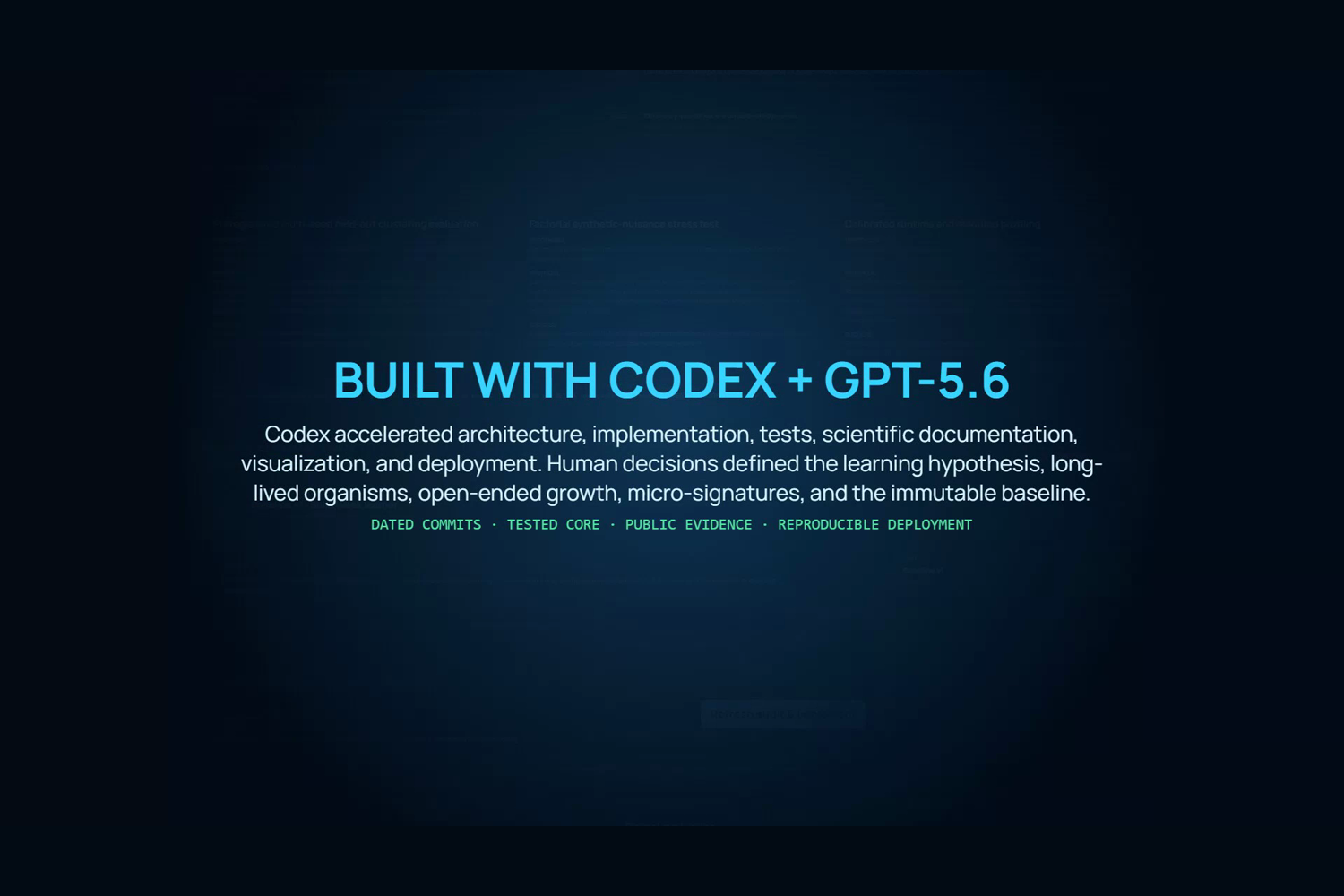
Codex accelerated architecture, implementation, tests, visualization, scientific documentation, evidence analysis, and VPS deployment throughout Build Week. We used it as an engineering collaborator while retaining the key scientific and product decisions: long-lived organisms, demand-driven growth, the intermediate micro-signature layer, the resource ledger, and an immutable baseline.
GPT-5.6 Sol powers the functional Research Auditor through the OpenAI Responses API and Structured Outputs. It receives only a frozen aggregate snapshot: metrics, structural counts, evaluation evidence, and declared limitations. It receives no raw retinal pixels, cell prototypes, tools, mutable engine reference, or learning endpoint. Before and after hashes verify that the audit did not modify the learner.
The Versioned Experiment Studio converts an auditor proposal plus optional human instructions into a schema-validated, allowlisted protocol. Each version runs in a fresh isolated engine. Baseline v1 remains locked, and no GPT-generated code is executed.
Challenges we ran into
Our first organisms died too quickly to accumulate useful knowledge, so we introduced long-lived resident organisms whose survival depends on sustained learning contribution. The original retina was too coarse, so we increased it to 64 x 64 and added filled and outline stimuli.
The most revealing failure was that circles were confused with squares. Global shape information was not enough. We added an intermediate layer of local edge and curvature micro-signatures, allowing fine details to become food for specialists before they were composed into higher-level organisms and colonies.
The broader challenge was scientific honesty. A beautiful biological metaphor is not evidence. We had to isolate labels, preserve deterministic state, test multiple seeds, control fragmentation, and distinguish an engineering resource proxy from measured FLOPs, memory, electrical energy, or carbon savings.
Accomplishments that we're proud of
The micro-signature layer corrected the original circle/square failure and made the learning process substantially more stable. In our checked-in five-seed benchmark, every seed trained for 240 steps and was evaluated on 72 balanced held-out samples. Purity was 1.000 across all five seeds, mean NMI was 0.9699, mean ARI was 0.9641, and mean fragmentation was 1.2. Every evaluator state hash was preserved.
We are equally proud of the boundaries around those numbers. They are evidence for organization on a controlled three-shape benchmark, not proof of natural image recognition, camera generalization, or superior energy efficiency.
The project also delivers a zero-to-colony learning journey, interactive 3D inspection, hidden-label read-only evaluation, Draw & Audit, organism ablation, downloadable JSON evidence, a GPT-5.6 scientific audit, and reproducible versioned experiments without putting the baseline at risk.
What we learned
Bio-inspired design becomes useful only when every metaphor maps to an observable mechanism. Food must correspond to residual information. Growth must respond to persistent novelty. Cooperation must earn its cost. Memory must reduce repeated adaptation on familiar input.
We also learned that inspectability and evidence must evolve together. A living 3D visualization can explain what the system is doing, but controlled evaluations, ablations, multiple seeds, state hashes, and explicit limitations are what make the explanation credible.
What's next for ColonyMind
The next experiments will compare ColonyMind with matched fixed-capacity and label-free baselines while directly measuring wall-clock time, peak memory, compute utilization, and physical energy. We will also test nuisance robustness, unseen shapes, composite forms, textures, and natural image patches.
Only after those controlled steps will we extend the retina toward opt-in camera streams with privacy-preserving local preprocessing. The long-term goal is not another large fixed vision model. It is a transparent learning architecture that can restructure itself, preserve what it knows, and justify the resources it asks to use.


Log in or sign up for Devpost to join the conversation.