-
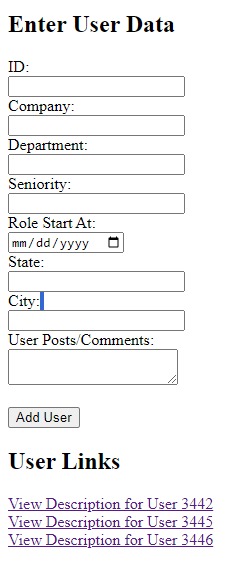
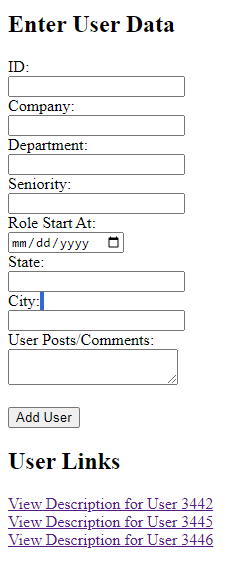
Page you see when opening
-

AI generated description for user 3442
-

Updated description upon new comment
-

Description of newly created user with no history
-

Irrelevant comment leaves no impact on generated text blurb.




Inspiration
As ChatGPT has taken over the world over the past couple years, our interest in LLMs was naturally piqued, to the point where both of us are currently attending Rice University to further study machine learning and data science. Of course, the opportunity to work hands on with its API for a practical implementation was one we seized, and we were inspired by the various other uses of LLMs we saw online over the past couple years.
What it does
The code first took some of the user data from the provided Collide data and used it to create a table of user information, as well as some of the posts and comments of the user. It then uses this data to generate a webpage with links to each of the user's profiles. Clicking on the user's link takes you to their page where a short blurb generated using AI provides you with a description of the user, the information being compiled from the user's profile information as well as their post and comment history. Only relevant information is included. The software also allows for the creation of new users as well as posts and comments, allowing you to see the AI adapt to constantly changing information regarding the users of Collide and update the descriptions using this changing information.
How we built it
For the backend, python was used, utilizing the OpenAI API in order to generate the Ai text blurbs. Javascript was used to code the functionality of the frontend, and very basic HTML was used to design the UI. Flask was utilized to connect the python backend to javascript.
Challenges we ran into
The biggest challenge was first figuring out how to utilize the OpenAI API. Since it is a relatively new resource, changes and updates were made to it frequently, making finding proper documentation and answers to our issues difficult to track down. Eventually, we found that downgrading to an older version of OpenAI was a good solution to this issue, as we did not need to utilize all the new features of the API for this project.
Accomplishments that we're proud of
I think we are very proud of getting all the parts working together. Basically, the only necessary addition to this software is integrating it with Collide proper, and it can be considered fully functional. Creating the pipeline back and forth between the HTML, Javascript, and Python was tough to set up but very rewarding to see in action after we got it working.
What we learned
We learned how to use OpenAI's API to integrate AI generation into software, and how to push the results of the AI Generation to a front end display. This is very useful knowledge for CS and DS students to know in this day and age.
What's next for Collide User Profile AI Generation
I believe the two biggest improvements which could be made to the software are scalability and adding likes/dislikes to the algorithm which generates the user blurb. Making the code more efficient so that it can run faster in an environment with lots of data to parse, like Collide, is vital to making it work. Also, factoring what posts the user likes and dislikes into the equation can help improve the information conveyed in the user summary.

Log in or sign up for Devpost to join the conversation.