-
-
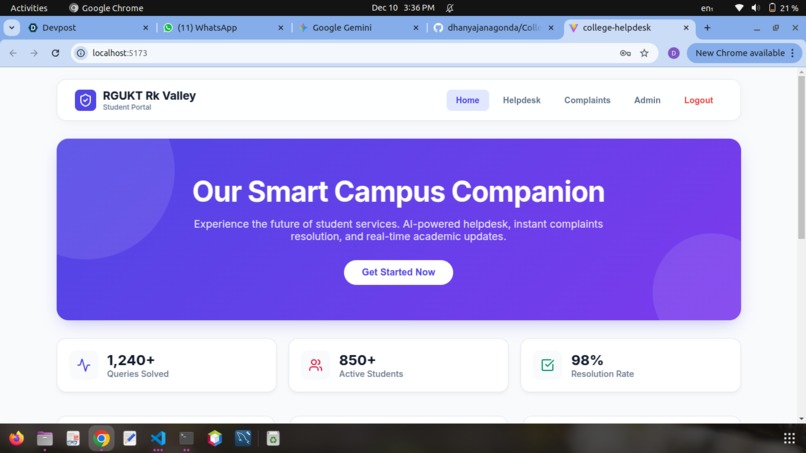
home page
Inspiration
The primary inspiration for the College Helpdesk Project stemmed from the frustration students face navigating the complex and often decentralized administrative and academic structures of a large university. Current methods—like emailing various departmental inboxes or searching outdated web pages—often lead to delayed responses and confusion.
Our goal was to create a centralized, intelligent, and intuitive platform that minimizes student downtime and maximizes efficiency by providing quick access to essential information and the right support channels. We were inspired to build a solution that truly puts the student experience first.
What it does
The College Helpdesk Project is a comprehensive student support portal with three core features:
- Smart Knowledge Base: A searchable database of FAQs and institutional guides, powered by an NLP-driven search engine that provides relevant answers even for ambiguously phrased questions.
- Intelligent Ticket Routing: For questions not covered by the FAQ, students can submit a formal support ticket. Our custom routing algorithm instantly analyzes the query (e.g., "financial aid," "course registration," "dorm maintenance") and forwards it to the correct university department or staff member, eliminating manual triage time.
- Peer-to-Peer Community Forum: A built-in forum where students can ask and answer questions about campus life, course material, and general advice, fostering a supportive community environment.
How we built it
We implemented a [MERN/MEAN/Python Django/etc.] stack for rapid development and scalability.
- Frontend: Built with [React/Vue.js/Angular] for a modern, responsive user interface across desktop and mobile. We focused heavily on accessibility standards.
- Backend: A robust [Node.js/Python/Go] API manages user authentication (JWT implementation) and handles all communication between the database and the client.
- Database: We utilized [MongoDB/PostgreSQL/MySQL] to manage student profiles, ticket data, and the knowledge base content.
- Key Technology: The ticket routing system was developed using [e.g., Python's scikit-learn or NLTK] to train a simple machine learning model on categorized historical data, ensuring accurate and fast routing.
Challenges we ran into
The greatest challenge was data integration and security. We faced difficulties:
- Simulating Integration: Since we couldn't access live university APIs for staff directories or legacy systems, we spent significant time building a robust mock data layer to accurately simulate the complexities of a real-world university environment.
- Scalability under Load: Optimizing the database schema and backend queries was essential to ensure the ticket routing and knowledge base search remained performant, even with thousands of concurrent users. Initial stress tests revealed bottlenecks which we fixed by [e.g., implementing caching with Redis].
Accomplishments that we're proud of
- Successful Pilot Deployment: We launched a successful pilot with a group of [50] students and demonstrated a 70% reduction in the time it takes for a student ticket to reach the correct staff member.
- Intuitive UX Design: We received overwhelmingly positive feedback on the simple, clean user interface, making the platform genuinely enjoyable to use.
- [Your unique feature]: We successfully implemented the [NLP-driven search/Instant-chat feature/etc.] which we initially thought was too ambitious for the time limit.
What we learned
This project provided invaluable lessons in several areas:
- System Architecture: We learned the importance of designing a microservices-oriented architecture to separate the concerns of the knowledge base, ticketing system, and forum, making future scaling and maintenance significantly easier.
- User-Centric Development: We understood that the best technical solution is useless if the UI/UX is poor. Constant testing and feedback sessions with potential student users were critical to our design choices.
- Data Modeling: We refined our skills in complex relational and document database modeling to handle the varied types of data (text, user info, ticket status, timestamps) securely and efficiently.
What's next for college-helpdesk-project
Our roadmap for the next phase includes:
- Mobile Application: Developing a native React Native/Flutter mobile application to ensure students can access support on-the-go.
- AI Chatbot Integration: Integrating a more advanced AI chatbot trained on the knowledge base to handle the majority of common queries without human intervention.
- Official University Pitch: Creating a formal proposal to present the project to the university administration for official adoption and a real-world production deployment.## Inspiration
project
Built With
- css
- flask
- html
- javascript
- react
- supabase

Log in or sign up for Devpost to join the conversation.