-
-
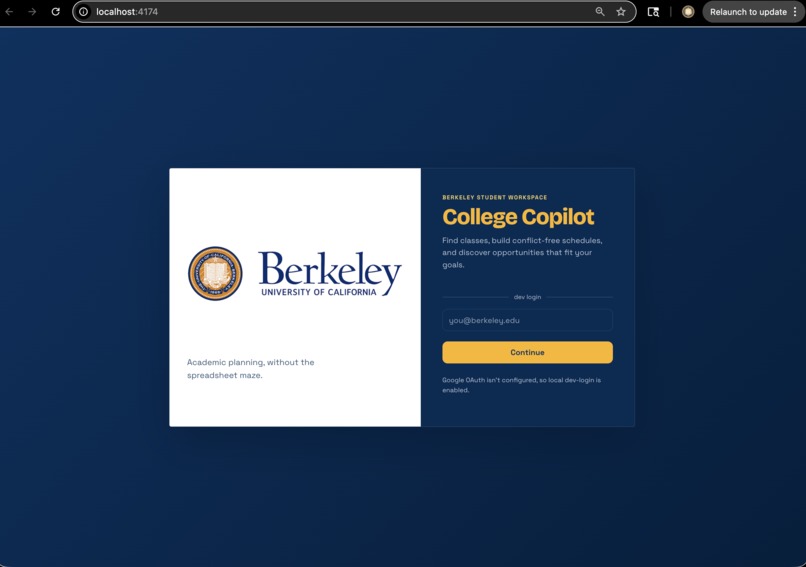
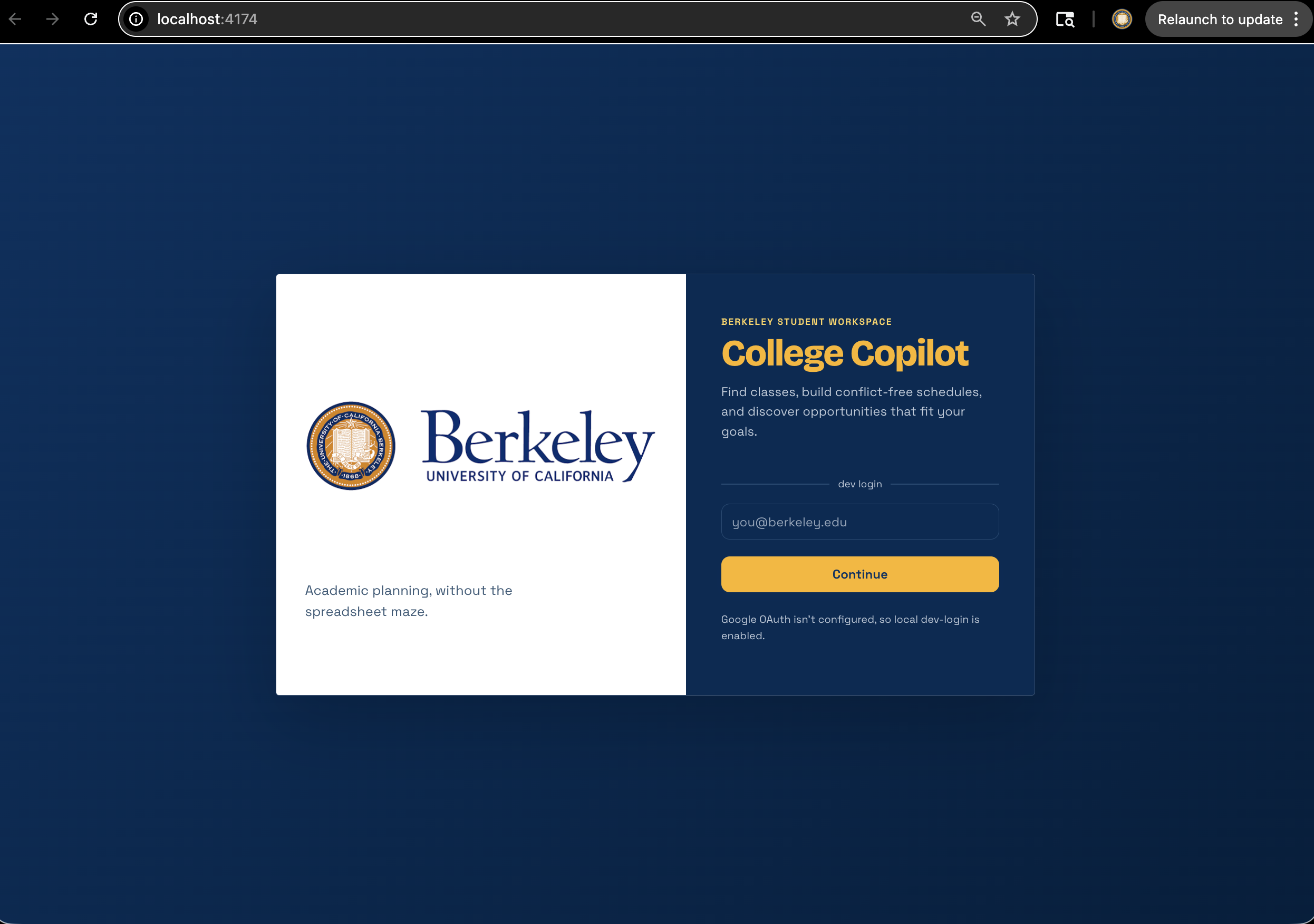
Title Page
-
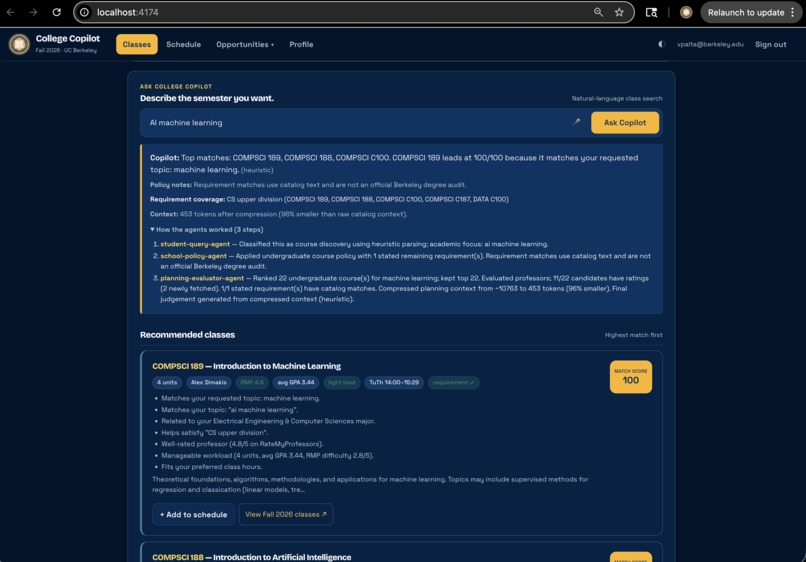
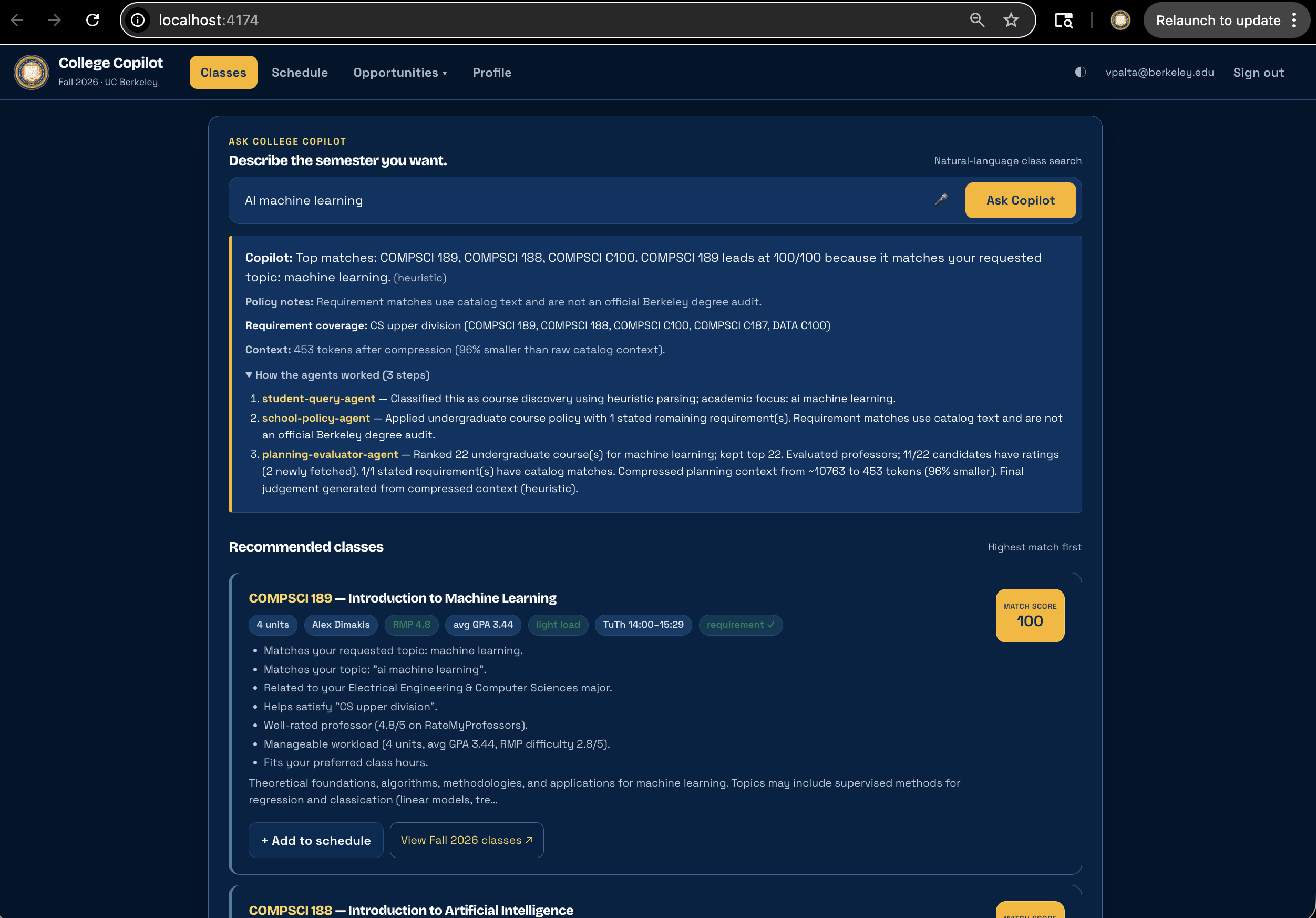
Course Search
-
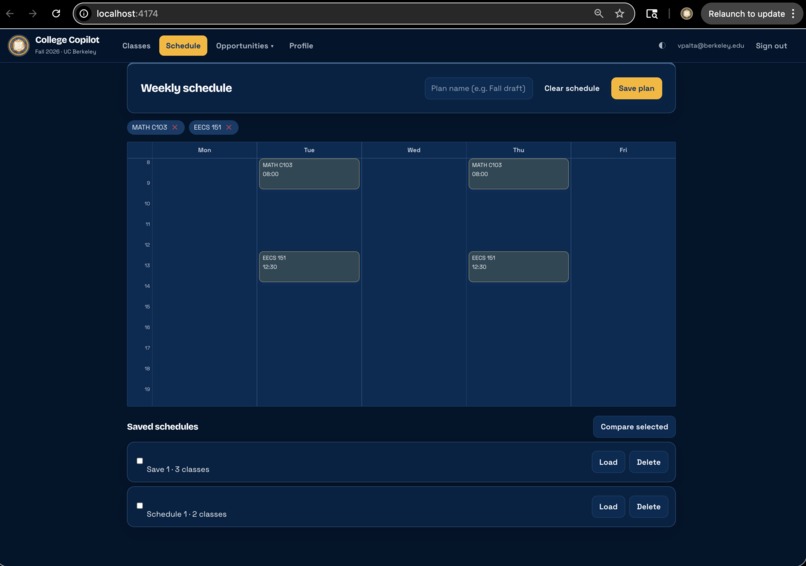
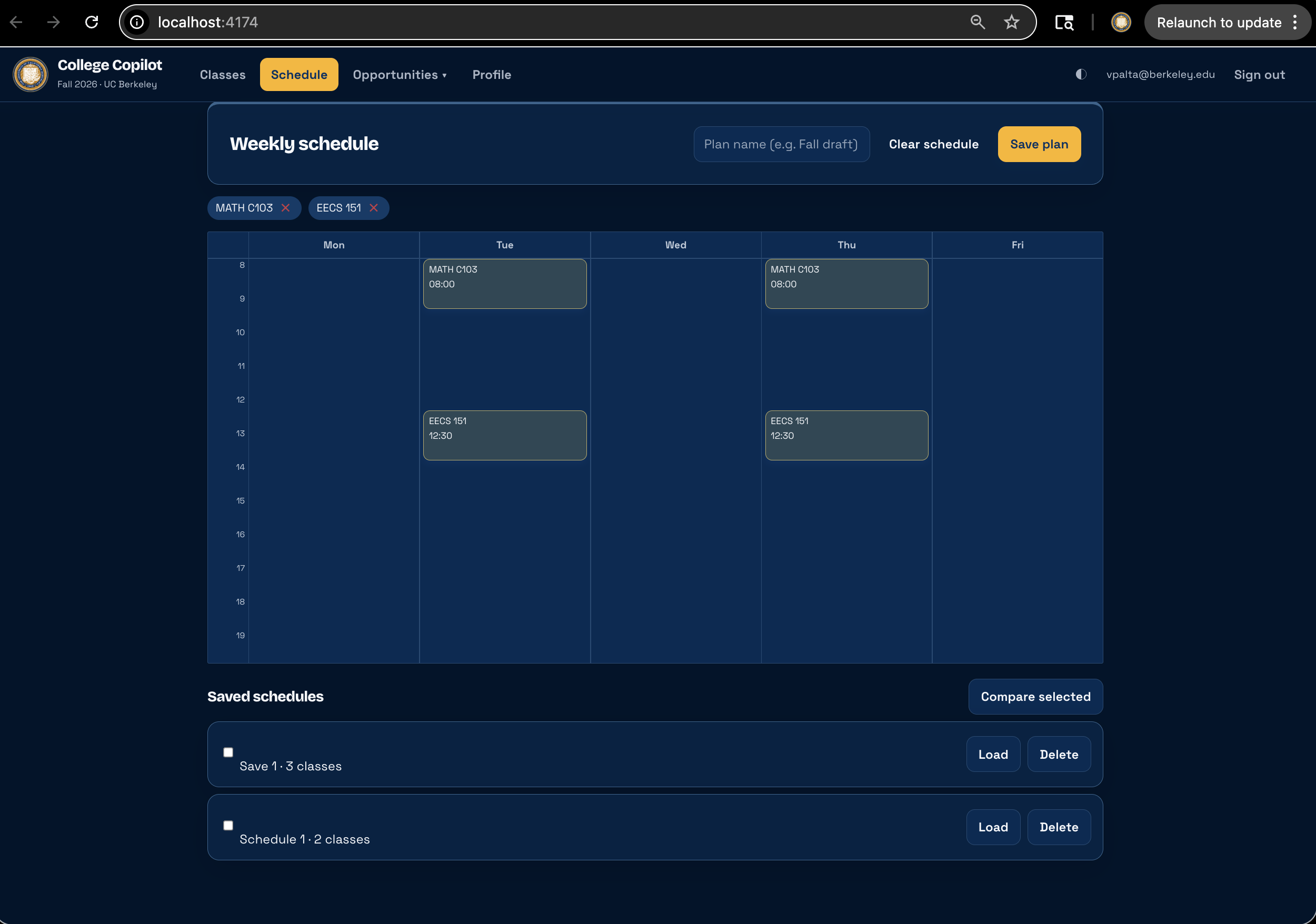
Schedule Planner
-
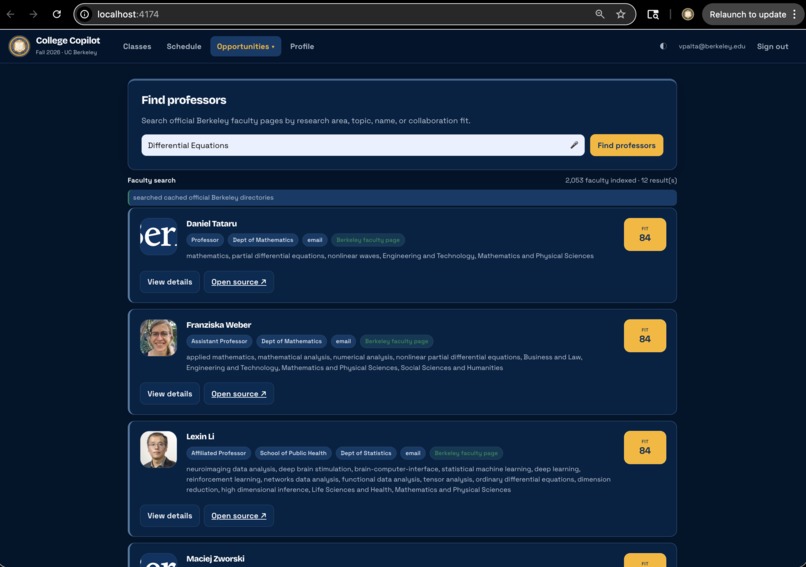
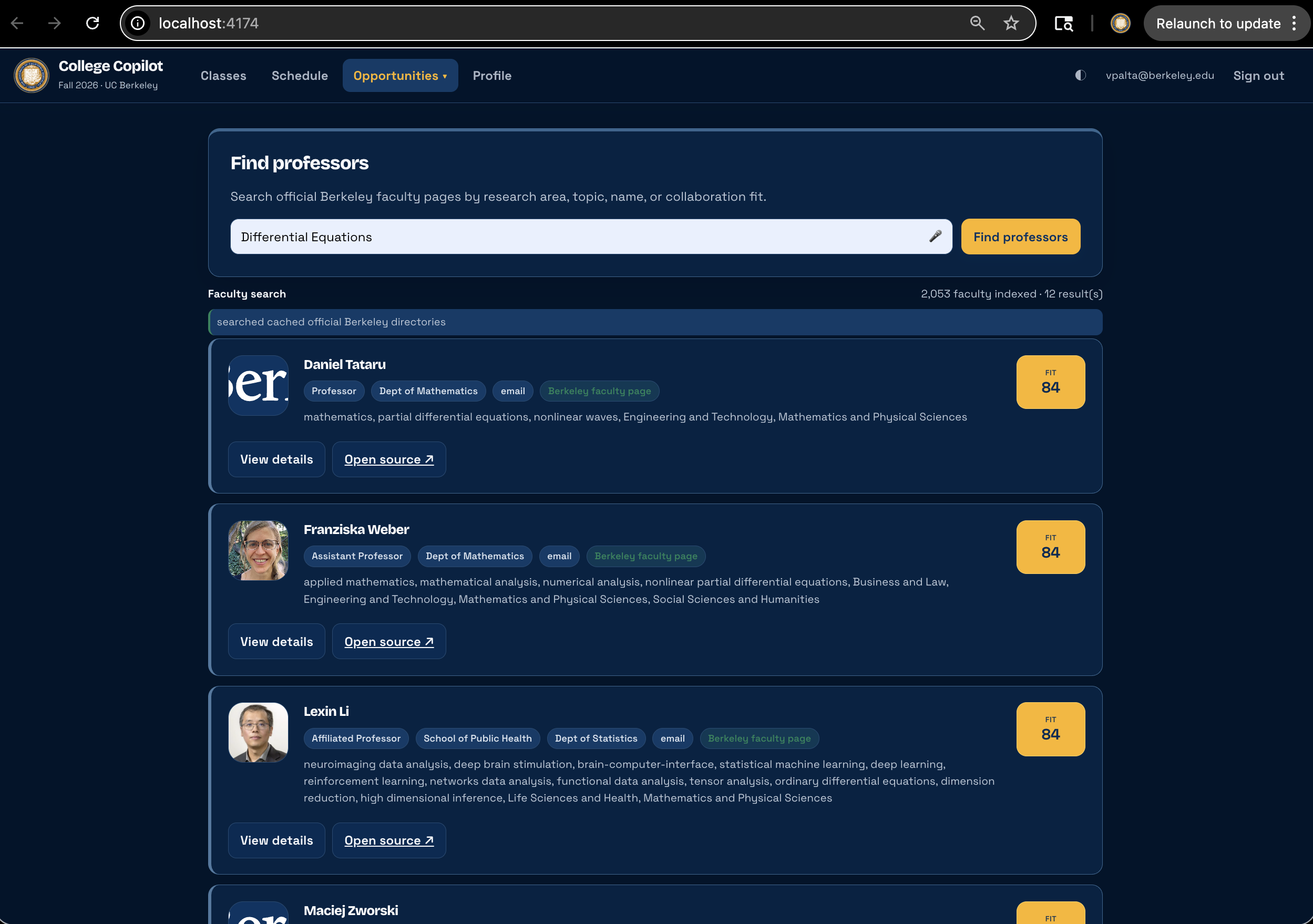
Find Professor
Inspiration
Getting into UC Berkeley is hard, but then navigating through it can be even harder. After earning a place at a top public university, students face scattered course catalogs, outdated opportunity pages, professor directories, and job boards. They may know what they want to become without knowing which classes to take, whom to work with, or which opportunities are actually relevant.
College Copilot turns that information overload into a personalized path from coursework to research to industry. Clone the repository, sign in, describe your goals and constraints, and explore Berkeley resources from one local workspace. A guided demo video is published!
College Copilot began as three ideas from three Berkeley students. Two freshmen proposed course planning and professor/research discovery; a junior proposed an industry-opportunity assistant. We realized these were not separate issues, but rather they are three stages of the same student journey.
Our iterations moved the project away from a single all-purpose chatbot. We separated each workflow into narrow agents, moved scoring and schedule conflicts into testable deterministic code, added compressed context and execution traces, introduced keyless fallbacks, and required human approval for outreach. The architecture reflects the decisions and constraints we encountered, not just an interface placed around an LLM.
What it does
- Plan courses: Rank Berkeley classes against remaining requirements, interests, professor ratings, workload, time constraints, and open seats.
- Find research: Discover professors, labs, and undergraduate research opportunities, then prepare outreach for the student to review.
- Explore industry: Normalize job postings, digest qualifications, generate resume-tailoring prompts, and identify possible networking leads.
- Explain every result: Show fit scores, evidence, warnings, and an agent trace instead of returning an unexplained answer.
How we built it
We built College Copilot as three connected agent systems: course planning, research discovery, and industry opportunities. TypeScript and Express power the backend, SQLite stores user data, and Redis supports semantic vector retrieval and short-term agent memory. Claude interprets student goals and explains recommendations, while deterministic code handles ranking, requirement matching, workload evaluation, and schedule conflicts. Additionally, the UI has Deepgram for all text fields to improve accessibility for users. The frontend presents evidence, warnings, and agent traces so students can understand each recommendation.
Challenges we ran into
University information is fragmented across course catalogs, faculty directories, research pages, and job boards, often using inconsistent or outdated formats. We also had to preserve recommendation quality without sending enormous datasets to an LLM. Coordinating specialized agents, isolating user data, handling unavailable external services, and preventing automated outreach required careful architectural boundaries. We addressed these challenges with normalized schemas, compressed context packets, deterministic fallbacks, and explicit human approval for consequential actions.
Accomplishments that we're proud of
We are proud that College Copilot connects three stages of the student journey instead of solving only one isolated task. The system produces explainable course rankings, searches research and industry opportunities, prepares outreach without sending it, and reports measurable context-compression statistics. Redis is used beyond caching for semantic course retrieval and per-user agent memory. Most importantly, the project transforms our three original ideas into one coherent tool focused on educational access and economic opportunity.
What we learned
We learned that effective AI systems should not ask an LLM to do everything. Deterministic tools are better for filtering, scoring, conflict detection, and enforcing constraints; language models are most useful for understanding intent and communicating results. We also learned that access to information is not the same as access to opportunity. Institutional knowledge must be organized, personalized, and actionable before it can genuinely help students.
What's next for College Copilot
Our next ambitious feature is a Living Opportunity Graph connecting student goals, courses, prerequisites, skills, professors, labs, research programs, internships, and jobs. We hope to collaborate with CalCentral and official UC Berkeley departments to integrate verified academic requirements, enrollment information, deadlines, and advising resources. This would allow College Copilot to provide current, source-backed guidance while complementing, rather than replacing, official advisers.
College Copilot could grow into a real product for incoming freshmen, beginning at Berkeley and expanding through university-specific data partnerships. Investment would help us build secure institutional integrations, production infrastructure, adviser-reviewed evaluations, and a scalable university adapter system. Its long-term potential is trusted advising infrastructure that gives every student access to the guidance and opportunities currently available mainly through strong personal networks.
Built With
- anthropic-claude-api
- claude-code
- css
- express.js
- google-oauth
- html
- node.js
- redis
- sqlite
- typescript
- zod


Log in or sign up for Devpost to join the conversation.