-
-
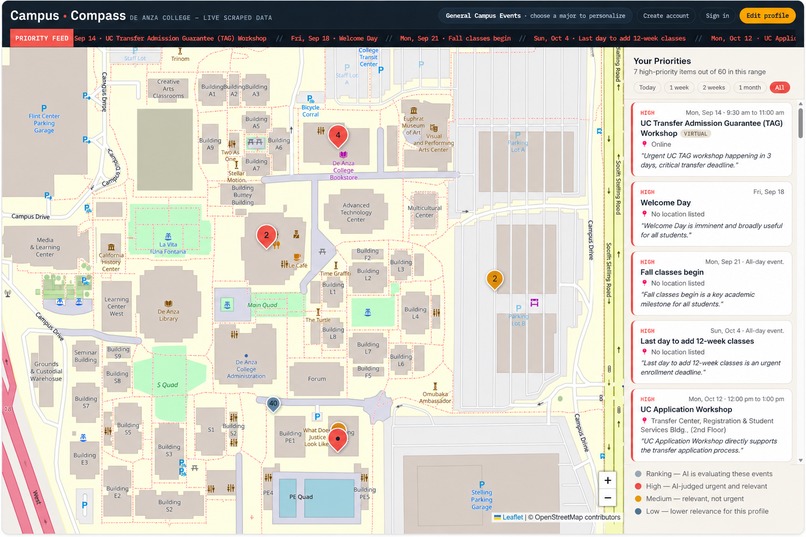
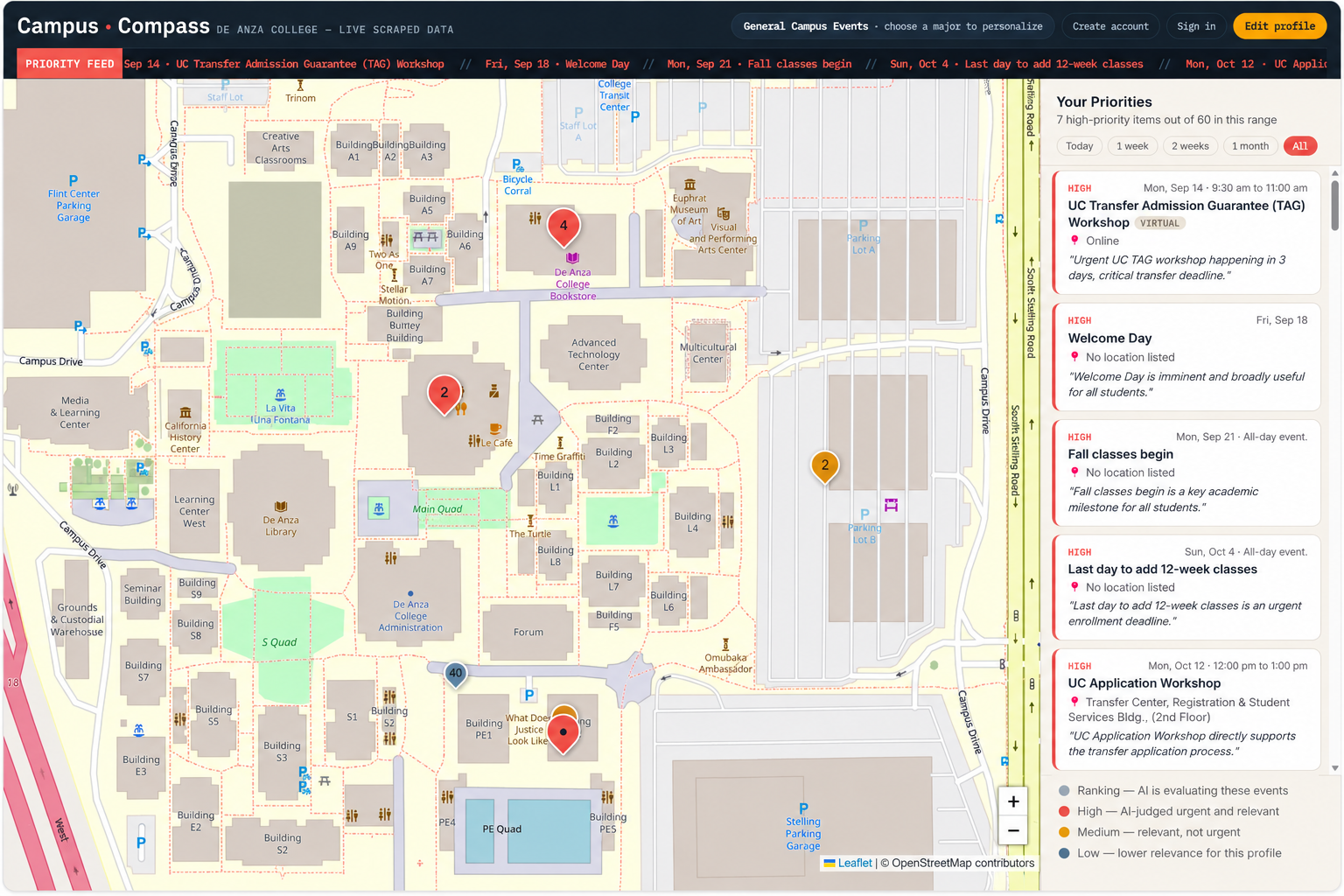
Campus Compass maps campus events and ranks them by priority, helping students quickly see what is happening, where, and what matters most.
-
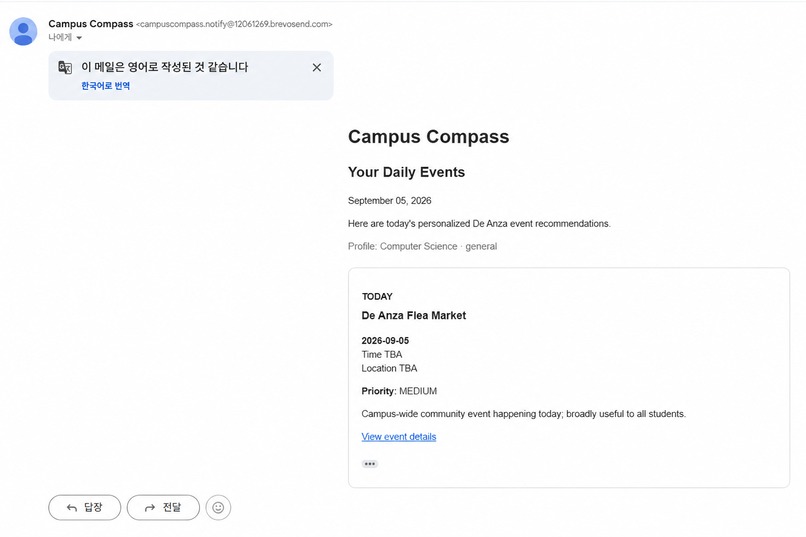
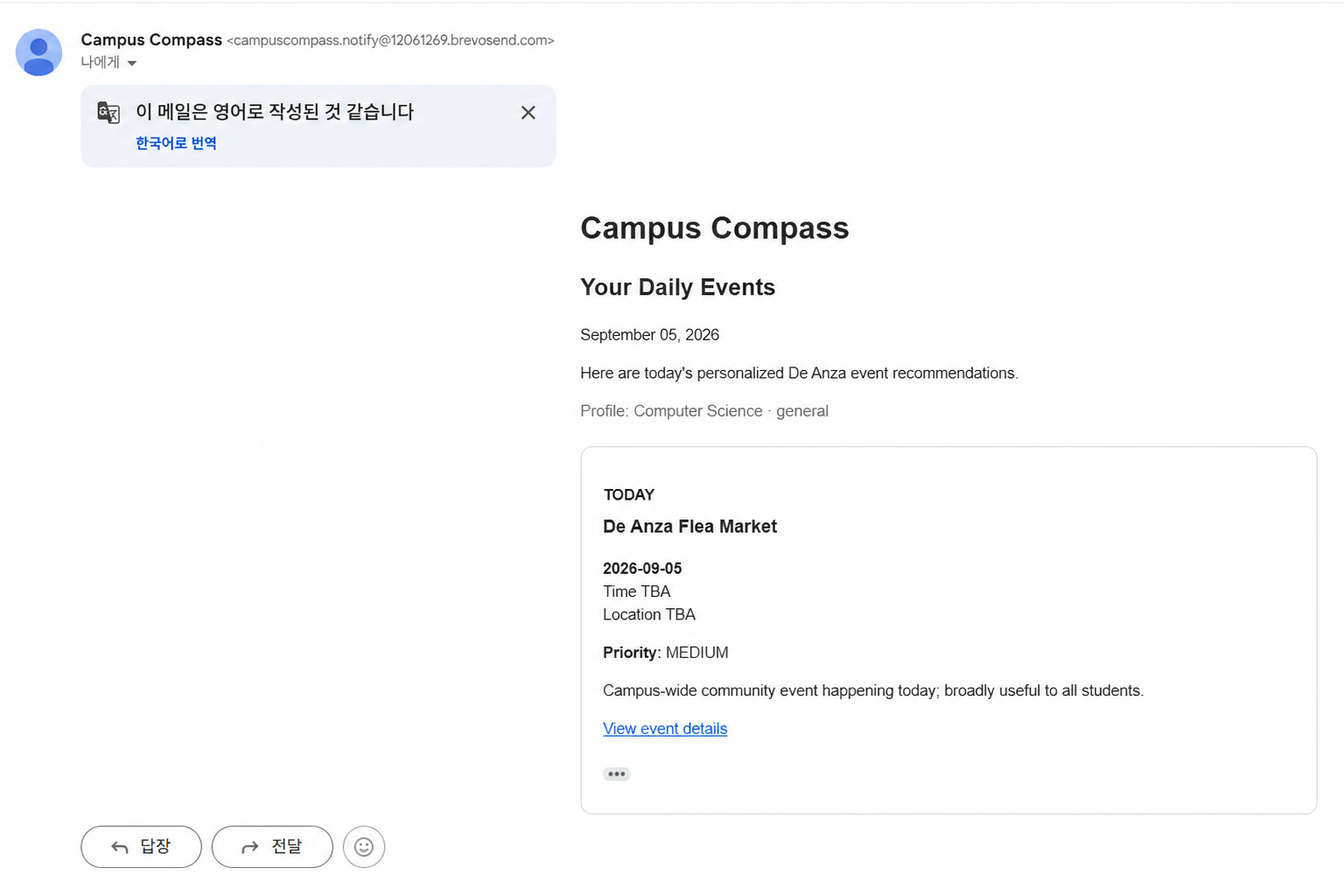
Students can subscribe to personalized daily emails to stay updated on relevant campus opportunities without checking multiple webpages.
-
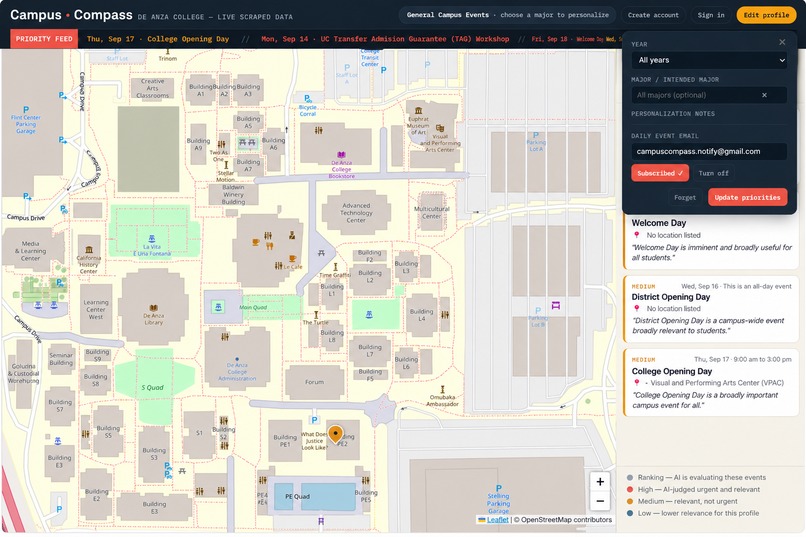
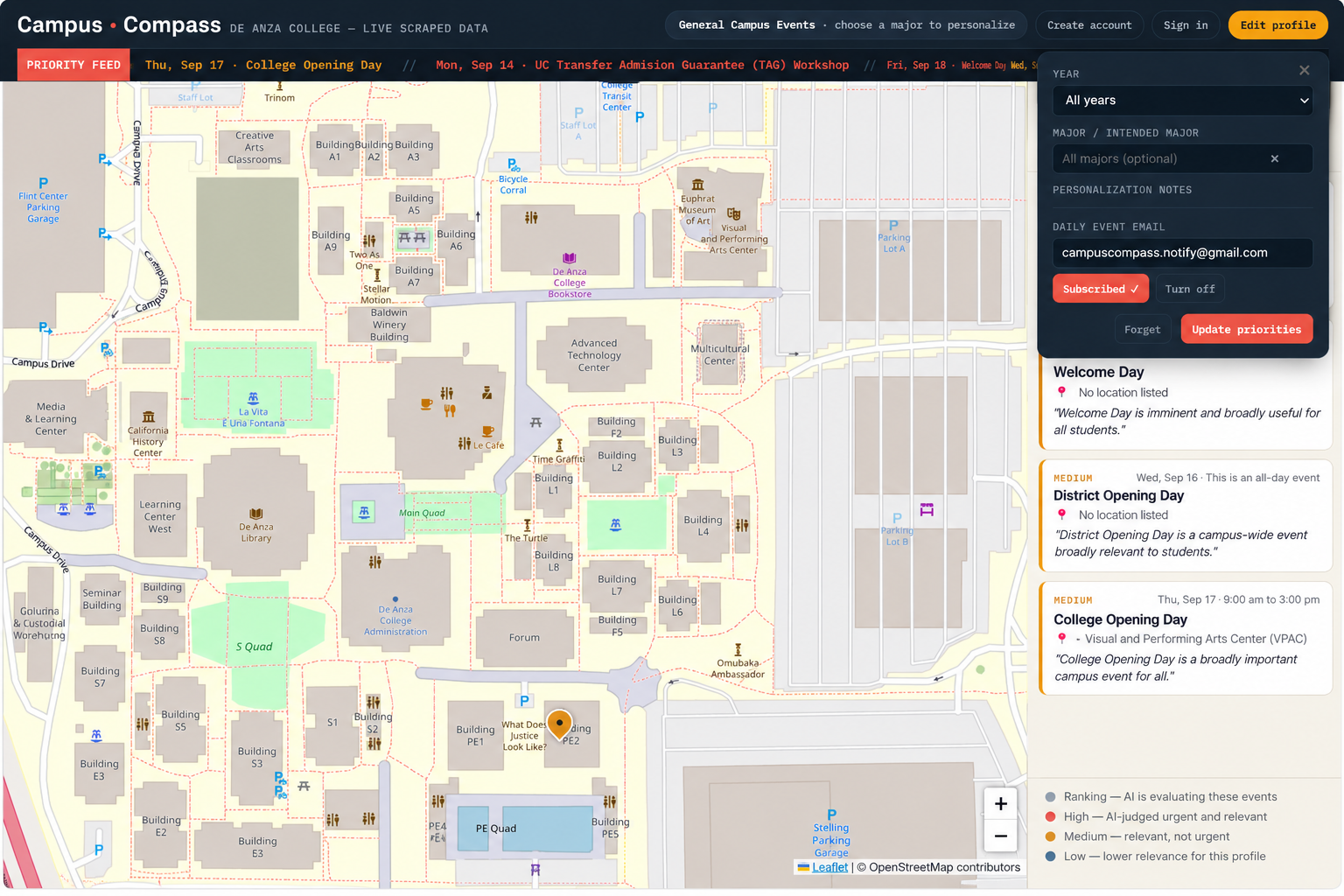
Students can update their year, major, and email preferences to personalize event rankings while keeping general campus events visible.
-
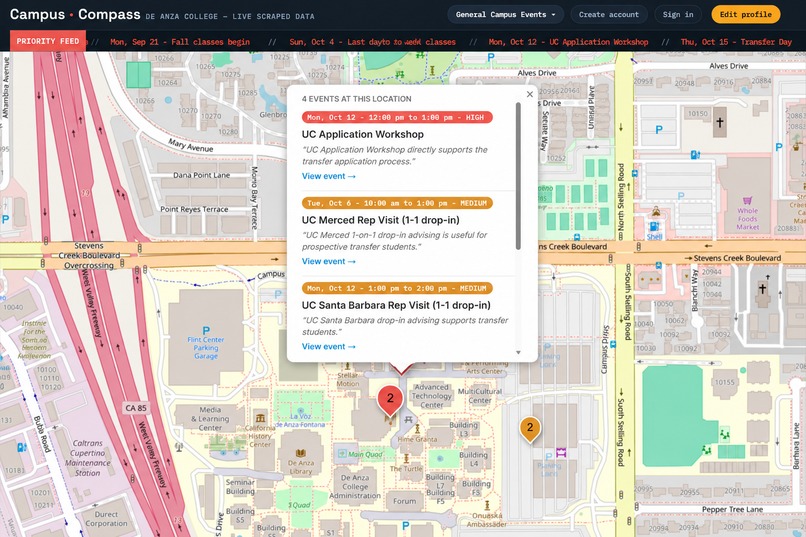
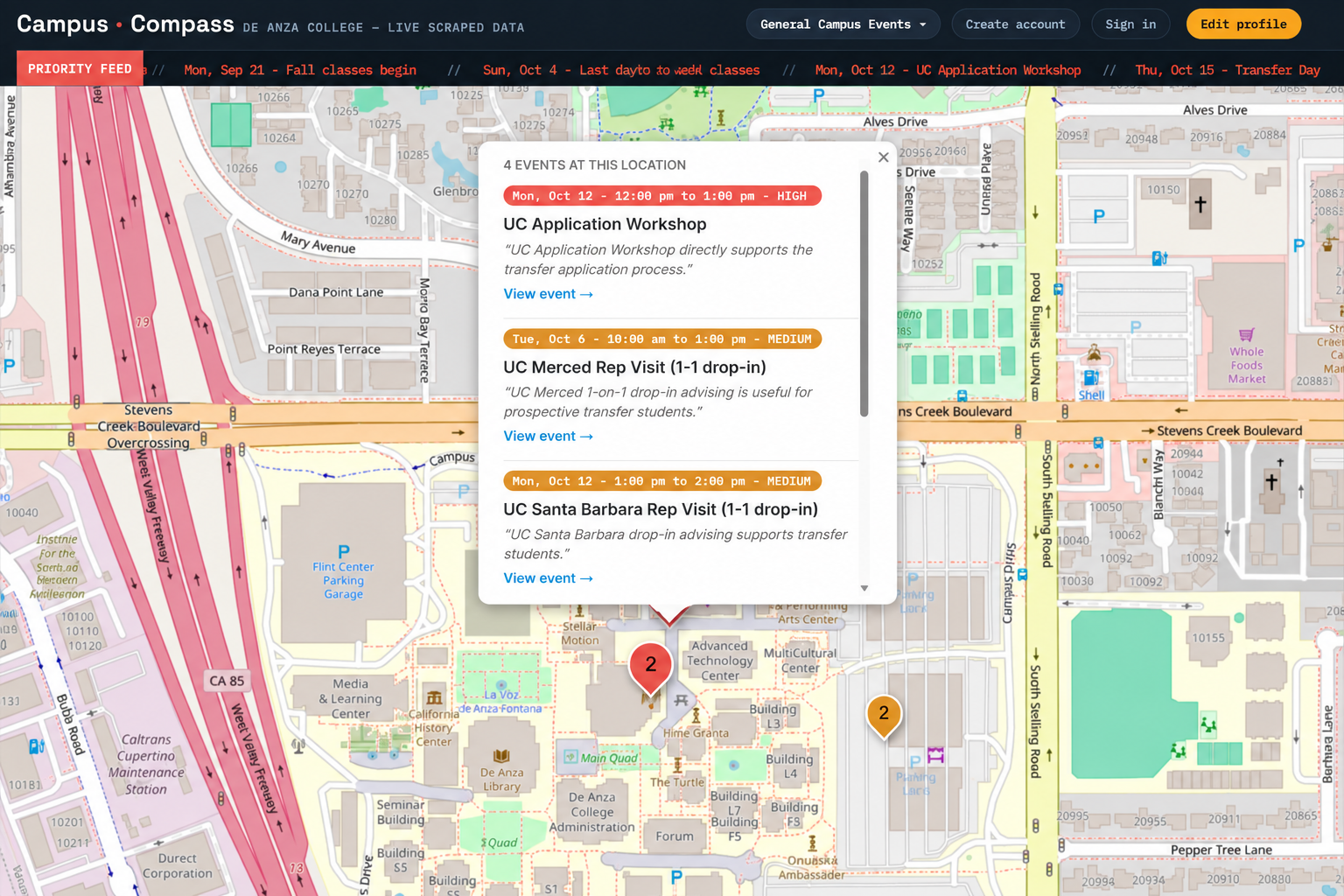
Students can click a map marker to view events at that location, including dates, priority levels, and personalized event details.
Inspiration
We started Campus Compass because we noticed how easy it is for students to miss important events on campus.
At De Anza College, event information is spread across many different webpages and departments. Transfer workshops might be listed on one page, career events on another, and other student activities somewhere else entirely. Some events are also difficult to find unless students already know exactly where to look.
Because of this, students can miss useful opportunities simply because they never saw the information.
We wanted to create one place where students could easily discover campus events, understand when and where they are happening, and find the events that are most relevant to them.
What it does
Campus Compass brings campus event information together into a single platform.
Instead of searching through multiple school webpages, students can browse events in one place and see where they are happening through an interactive campus map.
Students can also enter information such as their major. Campus Compass uses that information to prioritize events that may be especially useful to them while still showing important general opportunities such as transfer information, registration events, scholarships, workshops, and campus deadlines.
Students can also subscribe to email updates so they do not have to constantly check different webpages for new opportunities. Campus Compass can send relevant event information directly to students, helping them stay aware of upcoming events and opportunities they might otherwise miss.
Our goal is not to hide events from students, but to help them quickly notice the opportunities that matter most.
How we built it
We built Campus Compass as a web application using Python and Flask.
We created a pipeline that collects event information from multiple De Anza College webpages and stores the event data in a SQLite database. The events are then processed and displayed through the Campus Compass interface.
We also built a campus map that connects events with their locations so students can quickly understand both what is happening and where it is happening.
For personalization, we developed a ranking system that considers a student's major area. Instead of matching events only to an exact major, we group related majors into broader academic areas so that students can still discover relevant opportunities outside of a very narrow category.
We also experimented with AI based event prioritization using the Strands Agents SDK and Amazon Bedrock to help determine which events may be most useful to each student.
To help students stay updated without repeatedly checking the website, we implemented an email subscription system that can deliver campus event information directly to subscribed students.
Challenges we ran into
One of our biggest challenges was that adding a new feature rarely affected only one part of the project. As Campus Compass grew, a feature that worked correctly on its own could unexpectedly cause bugs somewhere else in the system. This meant that finishing a feature was often not the end of the task. We had to repeatedly test other parts of the application, find new issues, and adjust how different components worked together.
We also found team coordination more challenging than expected. Different team members sometimes had different priorities for what should be built first. Some of us wanted to stabilize existing features before adding more functionality, while others wanted to implement new ideas earlier. Learning how to discuss these priorities, divide responsibilities, and agree on what was most important within a limited amount of time became an important part of the project.
Another challenge was deciding how much complexity actually helped the user. For example, we originally included interests as part of our personalization system, but later realized that asking students for more information did not necessarily make the experience better. We decided to remove that input and simplify the experience while continuing to personalize events based on information such as a student's major.
Accomplishments that we're proud of
We are proud that Campus Compass grew from a simple idea into a working platform that connects several different systems together.
We built a pipeline capable of collecting events from multiple De Anza College resources and presenting them in one place. We also connected those events to an interactive campus map, created account and personalization features, and built an email subscription system that can send event information directly to students.
We are especially proud that the different parts of the project work together as one experience. Event collection, storage, ranking, the web interface, the campus map, user accounts, and email notifications all serve the same goal of making campus opportunities easier to discover.
We are also proud that we were willing to change our original ideas when we found a simpler approach. Instead of trying to keep every feature we initially planned, we removed features that added unnecessary complexity and focused on the parts that we believed would provide more value to students.
What we learned
One of the biggest things we learned was how much AI tools can accelerate the process of building software. Throughout the development of Campus Compass, AI helped us write and understand code, debug problems, learn unfamiliar technologies, and experiment with ideas much faster.
This experience made us realize that as tools make implementation more accessible, simply being able to build a feature may become less of a barrier. An increasingly important challenge is deciding what should be built in the first place and how technology can actually help people.
Throughout the project, we began thinking less about how many features we could add and more about questions such as: Does this feature actually help students? Does it make information easier to find? Does it reduce unnecessary work for the user?
We also learned that adding more features does not always make a product better. Sometimes simplifying a system, removing unnecessary inputs, or improving how existing features work together can create more value than adding something new.
Finally, we learned how important communication and prioritization are when building something as a team. Technical decisions, feature priorities, and different ideas all need to be discussed and coordinated. Building Campus Compass taught us that creating a useful product requires not only code, but also clear problem solving, teamwork, and an understanding of what users actually need.
What's next for Campus Compass
Our next goal is to expand Campus Compass beyond De Anza College.
Right now, the project focuses on helping De Anza students discover campus events more easily, but the same problem exists at many other colleges. Event information is often spread across different department websites, calendars, and student resources, making it difficult for students to find everything in one place.
In the future, we want to add more colleges and universities to Campus Compass so that students from many different schools can use the platform.
Our long term vision is to build a scalable campus event discovery platform where students can select their school, find important events in one place, and receive personalized recommendations based on their major and academic goals.
Ultimately, we hope Campus Compass can become a platform used across many campuses, helping more students discover opportunities they might otherwise miss.
Built With
- amazon-web-services
- amazonbedrock
- beautiful-soup
- ccs
- flask
- googleauth
- javascript
- python
- sqlite
- strandsagents
- webscraping

Log in or sign up for Devpost to join the conversation.