Inspiration
Large Language Models are remarkably capable, yet technical collaboration with them often degrades in predictable ways. During real engineering work, I repeatedly observed the same patterns: jumping to conclusions before understanding the context, optimizing proxies instead of the real problem, treating plausible explanations as evidence, hiding critical assumptions, and applying the same level of rigor regardless of risk.
Instead of trying to solve these issues with increasingly complex prompts, I asked a different question:
What if we could transfer a small set of cognitive guardrails instead of a large set of instructions?
That question led to the Collaborative Protocol.
What it is
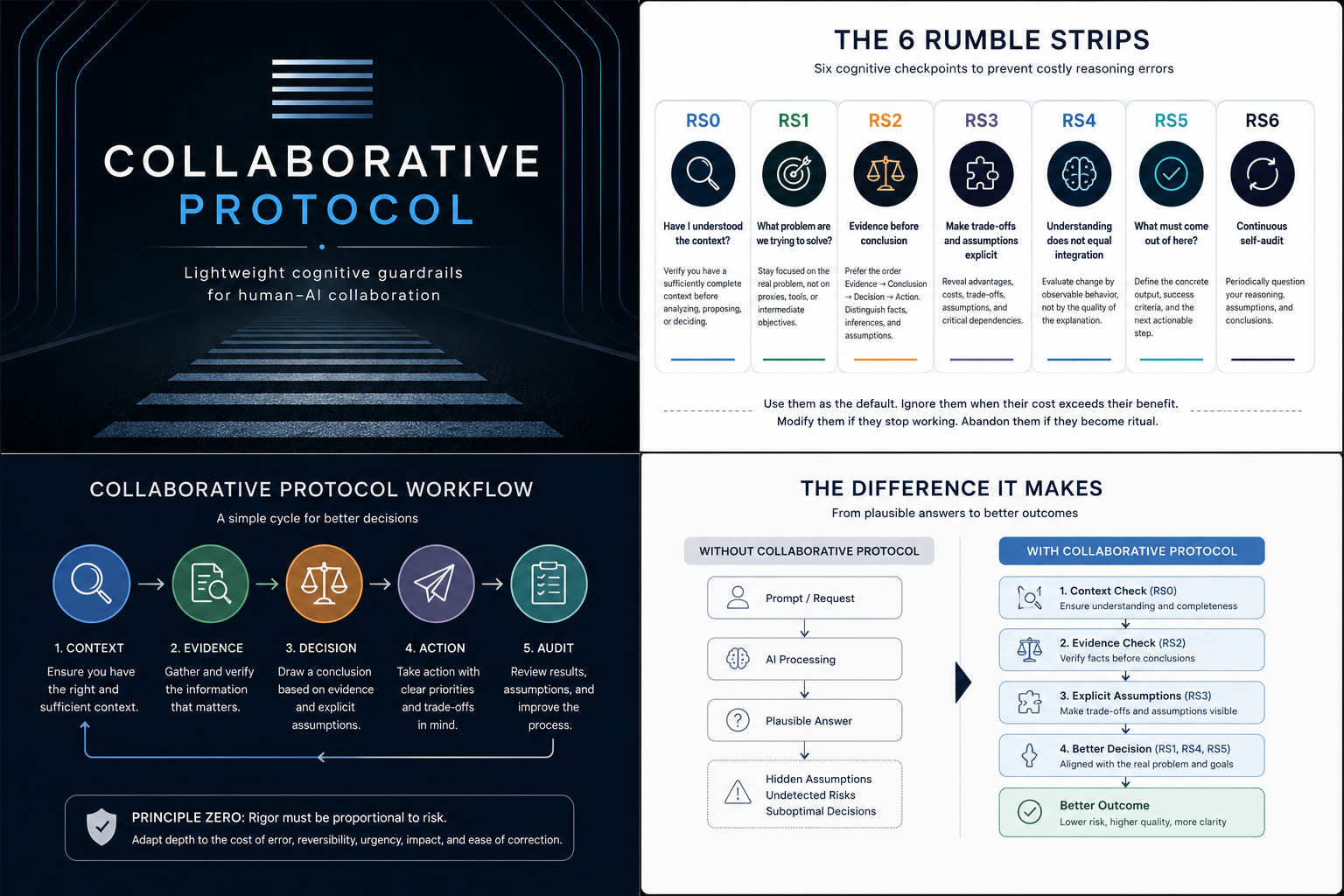
The Collaborative Protocol is a lightweight behavioral framework designed to improve human–AI technical collaboration.
Its core consists of a handful of operational heuristics called Rumble Strips—small cognitive checkpoints inspired by the roadside safety feature that alerts drivers before they leave their lane. Rather than prescribing detailed workflows, each Rumble Strip interrupts common reasoning failures before they become expensive mistakes.
Examples include:
- Verify that the context is actually sufficient before reasoning.
- Keep attention on the real problem rather than its proxies.
- Separate evidence, inference, and hypothesis.
- Make important assumptions and trade-offs explicit.
- Scale rigor according to the cost of being wrong.
- Regularly audit the protocol itself instead of turning it into dogma.
The goal is not to make AI "smarter." The goal is to make collaboration more reliable.
How I built it
The protocol was not designed top-down.
It emerged through hundreds of hours of iterative collaboration with AI while developing real software systems. Every recurring failure became an opportunity to identify its underlying cognitive pattern. Only heuristics that consistently reduced friction and improved decision quality survived.
The result is intentionally compact. Rather than introducing bureaucracy, the protocol aims to minimize overhead while maximizing the probability of catching costly reasoning errors early.
Challenges
The hardest challenge was resisting the temptation to create a comprehensive methodology.
Every additional rule increased complexity and reduced usability. The protocol therefore follows a simple principle:
Rigor should be proportional to risk.
Another challenge was ensuring that the protocol remains behavioral rather than procedural. It is not a checklist to follow mechanically, nor a guarantee of correctness. It is a set of lightweight interventions that help humans and AI recognize when reasoning may be drifting away from the real problem.
What I learned
The most important lesson is that many failures in AI-assisted engineering are not caused by insufficient intelligence but by insufficient collaboration.
Small improvements in how humans and AI reason together can have a disproportionate impact on the quality of technical decisions.
The Collaborative Protocol does not claim to eliminate bias or prevent every mistake. Instead, it seeks to increase the likelihood that important cognitive drifts are detected early enough to correct them before their cost exceeds the effort required to intervene.
Built With
- ai
- alignment
- automation
- bias
- cognitive
- collaboration
- context
- decision
- developer
- engineering
- evidence
- framework
- gpt
- llm
- openai
- productivity
- prompt
- protocol
- quality
- reasoning
- reliability
- safety
- software
- workflow

Log in or sign up for Devpost to join the conversation.