-
spacetimedb integration testing
Inspiration
Our inspiration came from a critical and often overlooked global health challenge: protecting the integrity of the vaccine cold chain. We learned that billions of dollars worth of temperature-sensitive vaccines are lost annually due to failures in logistics and monitoring. The existing systems are reactive, only alerting stakeholders after a failure has occurred. This isn't just a financial problem; it's a public health crisis that puts lives at risk. We were inspired to build a proactive solution that could prevent spoilage before it happens, ensuring life-saving vaccines reach the people who need them.
What it does
ColdTrace is a live, intelligent logistics platform that provides end-to-end oversight of the vaccine supply chain. It moves beyond simple tracking by predicting risks and providing instantaneous alerts.
Live Integrity Dashboard: Our map-based user interface shows the real-time location, temperature, and status of every shipment.
Instantaneous, Multi-Party Alerts: When a temperature deviation occurs, our system instantly triggers alerts for all relevant stakeholders—the driver, the warehouse, and logistics headquarters—simultaneously.
Predictive Risk Analysis: Using the Gemini API, ColdTrace analyzes routes against real-time weather, traffic, and historical data to flag shipments at high risk of a future temperature excursion.
Automated Intelligence Reporting: Gemini generates daily summary reports highlighting potential risks, carrier performance, and system-wide integrity metrics, providing a comprehensive overview of the supply chain.
How we built it
Our technical architecture is designed for speed, simplicity, and intelligence.
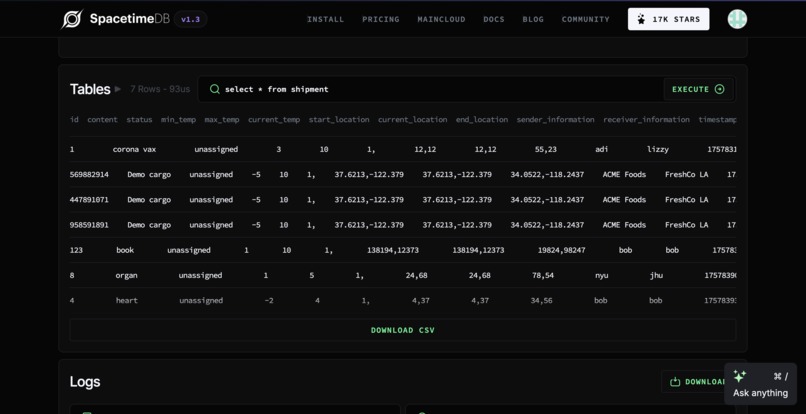
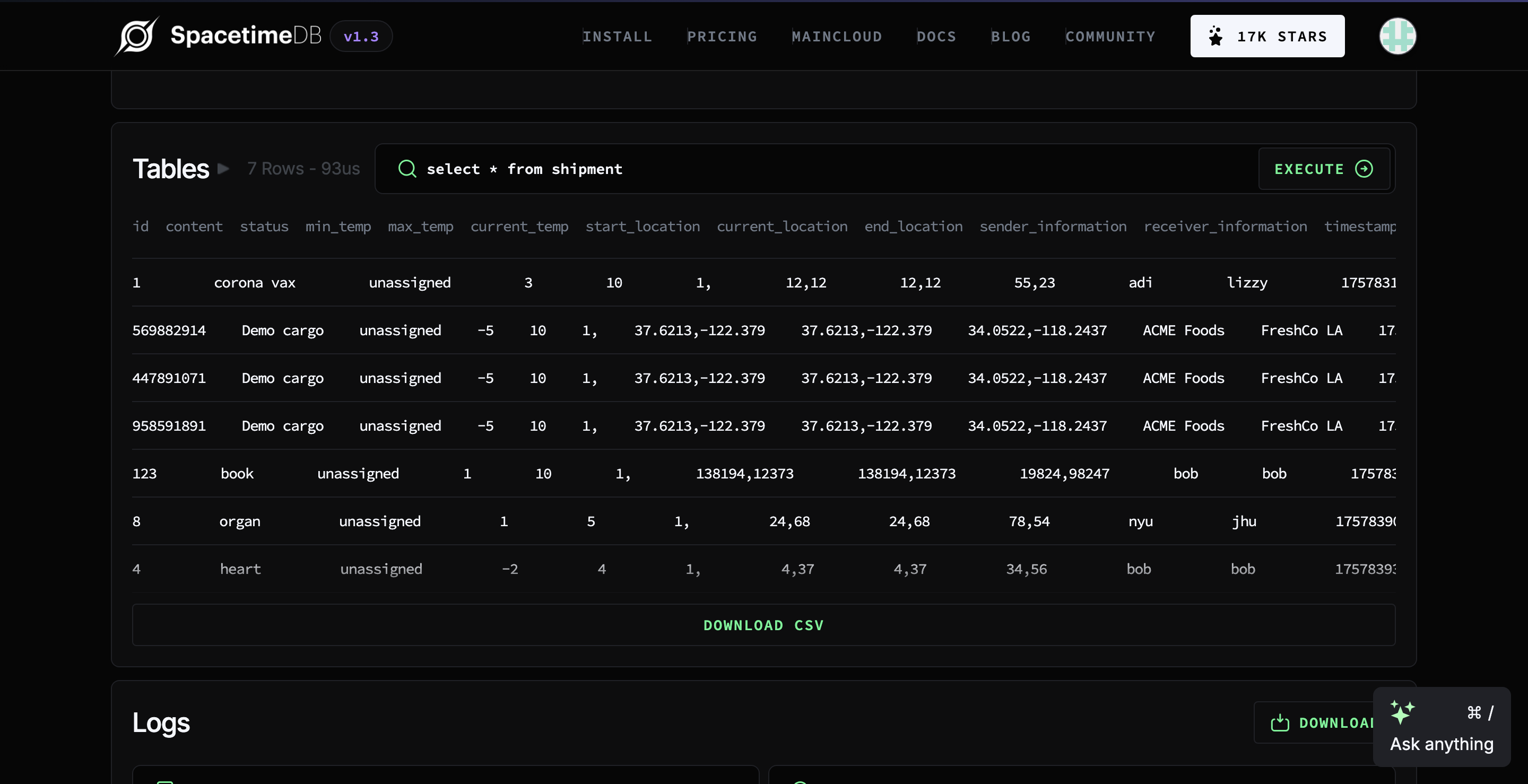
Real-Time Core (SpacetimeDB): We used SpacetimeDB as the central nervous system of our platform. Its ability to unify the database and application server allowed us to manage and synchronize state across all clients with near-zero latency, which is essential for powering our instantaneous alerts.
Intelligence Layer (Gemini API): The Gemini API serves as the proactive brain of our system. It consumes the live data stream from SpacetimeDB and external APIs (like weather services) to provide high-level, predictive analysis. For example, we can ask it to analyze a planned route and determine the probability of a temperature excursion based on real-time and historical data.
Challenges we ran into
We chose an advanced tech stack because the problem demanded it, but this presented some unique challenges.
Adopting a New Technology: SpacetimeDB is a newer technology, so documentation was less extensive than with more established platforms. We had to rely on a lot of experimentation and our own ingenuity to understand how its real-time architecture could be best applied to our problem.
Managing API Costs and Latency: Running continuous, high-volume queries with the Gemini API would be both slow and expensive. We solved this by implementing a "Smart-Call" strategy. We reserved Gemini for high-value, less time-sensitive tasks like pre-journey route analysis and asynchronous daily reporting. The core, time-critical temperature alerts are handled instantly by SpacetimeDB's own logic, which is much faster and more cost-effective.
Accomplishments that we're proud of
We're most proud of successfully integrating two cutting-edge technologies to create a system that is not just reactive but truly predictive. We built a live, compelling demo that showcased instantaneous updates on a dynamic dashboard, proving our concept works in real time. We’re also proud of our strategic use of AI to solve a genuine, high-stakes problem instead of just using it as a novelty. The ability to forecast risk and potentially prevent the loss of critical medical supplies is an accomplishment with massive potential impact.
What we learned
This project taught us the importance of choosing the right tools for the job, even if they are new or complex. We learned that the benefits of a cutting-edge, real-time architecture far outweighed the challenges of a steep learning curve. We also learned how to be strategic with AI—understanding when to use it for high-value analysis versus when to rely on a faster, more direct system for core functionality. This approach allowed us to create a solution that is both intelligent and efficient.
What's next for ColdTrace
The future of ColdTrace is focused on expanding its impact. Our next steps include:
Integration with IoT Hardware: We want to partner with a hardware provider to create a custom, low-cost temperature sensor that seamlessly integrates with our platform.
Expanding to Other Industries: The ColdTrace model can be applied to other temperature-sensitive supply chains, such as food, beverages, and chemicals.
Building a Full-Fledged SaaS Platform: Our long-term vision is to develop ColdTrace into a comprehensive software-as-a-service (SaaS) platform, making our solution accessible to a wider range of logistics companies and health organizations.


Log in or sign up for Devpost to join the conversation.