-
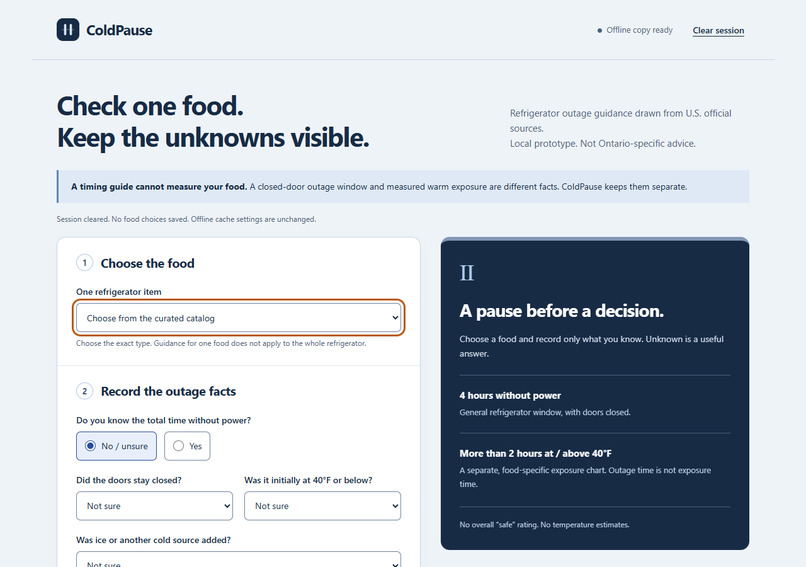
Final local Chrome screenshot of published runtime. Synthetic example; not real-food or professional validation.
-
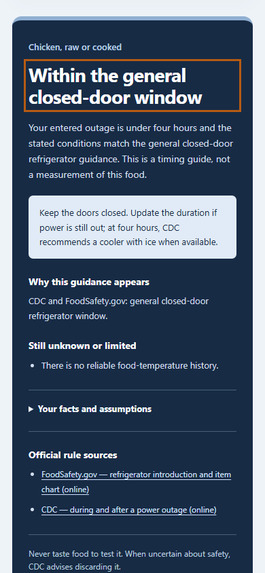
Final local Chrome screenshot of published runtime. Synthetic example; not physical-device testing.
Inspiration
After a power outage, “how long was the power out?” and “how long was this food warm?” are different questions. A later cold reading can make that difference easy to miss. ColdPause gives uncertainty a visible place in the decision.
What it does
Choose an exact food from a ten-item catalog, enter known or unknown conditions, and review item-specific U.S. official guidance. Every result shows its facts, assumptions and source links. Unknown history stays unresolved. Edits remove stale guidance; Clear session erases choices. After a successful first visit and cache confirmation, the app can reload offline in a supported browser.
How it was built
Created during the SafeSpace build window, beginning October 24, 2026. Source-to-rule review came first, using FoodSafety.gov and CDC. A deterministic JavaScript rule engine keeps the general four-hour closed-door outage window separate from the item chart for recorded exposure at or above 40°F for more than two hours. The frontend uses native HTML controls, CSS, local storage and a service worker, with no application dependencies or AI/API calls at runtime. Node.js supports tests; GitHub Pages hosts the static demo.
Challenges, progress and what I learned
Treating unknown as a real outcome was more important than producing a confident-looking answer. Restoration-only cold readings must not erase unknown history, and edits must invalidate old guidance. A mobile screenshot exposed a clarity defect: aligning the full result panel made the caveat and action visible with the headline.
The final local candidate passed 39 non-network tests and 52 Chrome assertions. The public GitHub Pages demo passed 74/74 Chrome checks: 52 functional assertions plus 22 deployment checks for exact assets, MIME types and service-worker scope/cache. These are checks, not 74 separate workflows. GitHub CI passed all 39 tests. Dated verification and limits.
Responsible design and limitations
No temperature inference and no universal “safe” badge. This prototype covers household refrigerator outages and ten exact food entries—not freezers, medicines, infant feeding, commercial use or flood/fire contamination. It provides U.S. official guidance, not Ontario-specific advice, a safety certification, professional food assessment or a replacement for emergency services. All demo facts are synthetic.
Offline reload was tested with Chrome offline emulation after the cache was ready. Screen-reader speech, full WCAG compliance, other browsers, physical phones, physical network disconnection, food/thermometer validation and user studies remain unverified. Storage eviction, browser restart, private mode and the full old-cache upgrade lifecycle are also unverified. Original source pages need a connection and may change. The free demo is intended to remain available through November 24; no uptime guarantee is claimed.
Try the synthetic walkthrough
- Choose milk. Enter 239 outage minutes, closed doors, initially cold, no added cooling, no spoilage signs. Review the conditional closed-door window and its assumptions.
- Edit to 240 minutes: old guidance disappears; review the reached limit. Edit to 241: disposal guidance appears.
- Use 180 outage minutes and recorded warm exposure of 121 minutes: disposal comes from the separate food-exposure chart.
- Select a cold reading only after restoration: earlier exposure remains unknown.
- After “Offline copy ready,” try offline reload, then Clear session. This does not measure food or certify safety.
Team, credits and sources
Solo project by Sharon Basovich. OpenAI Codex assisted with research, implementation, tests, independent agent review and documentation. No AI inference runs in the application. Existing platform components include browser APIs, Node.js and GitHub Pages; there are no application-library dependencies. Gallery images are final local Chrome screenshots of the identical published runtime, using synthetic data—not physical-device or real-food validation.
Guidance is attributed to FoodSafety.gov's power-outage chart and CDC emergency food guidance, reviewed October 24. Exact source-to-rule mapping. No government endorsement or professional approval is claimed.
What's next
Seek qualified food-safety review and usability feedback before broader practical use, then test screen-reader speech, other browsers, physical devices and offline lifecycle edge cases. These are proposed next steps, not completed validation.

Log in or sign up for Devpost to join the conversation.