-
-
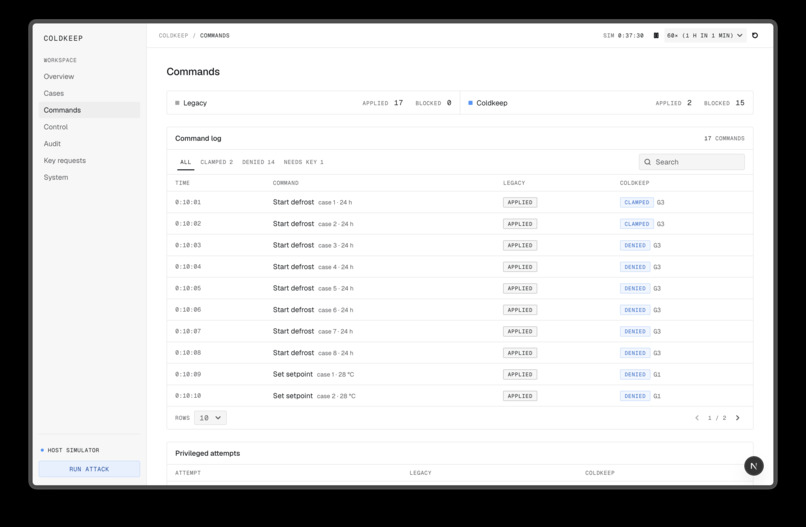
Dashboard - commands
-
Results
-
Architecture
-
Control
Inspiration
In October and November 2026, attackers got into supermarket refrigeration across Europe through management interfaces left on the internet with default passwords. A new password doesn't fix that, because in those systems the management process commands the plant directly, so whoever owns it owns the cold. We wanted to see what a refrigeration controller looks like if you assume that process is already compromised.
What it does
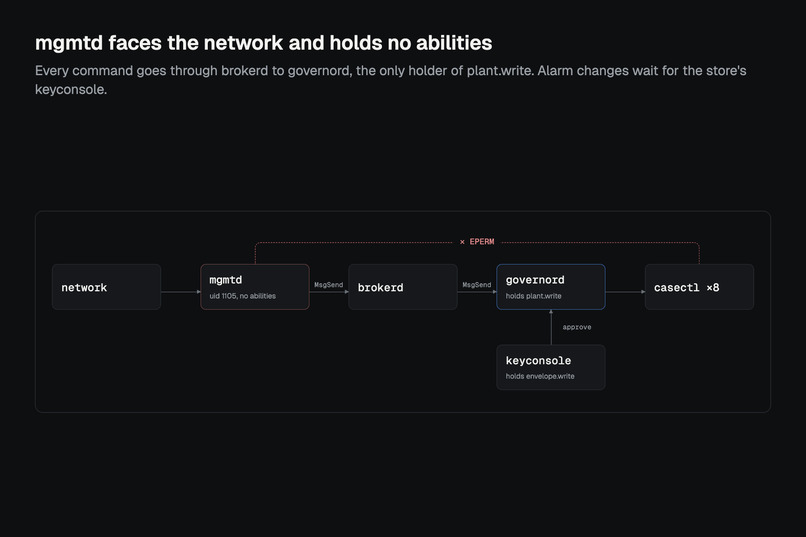
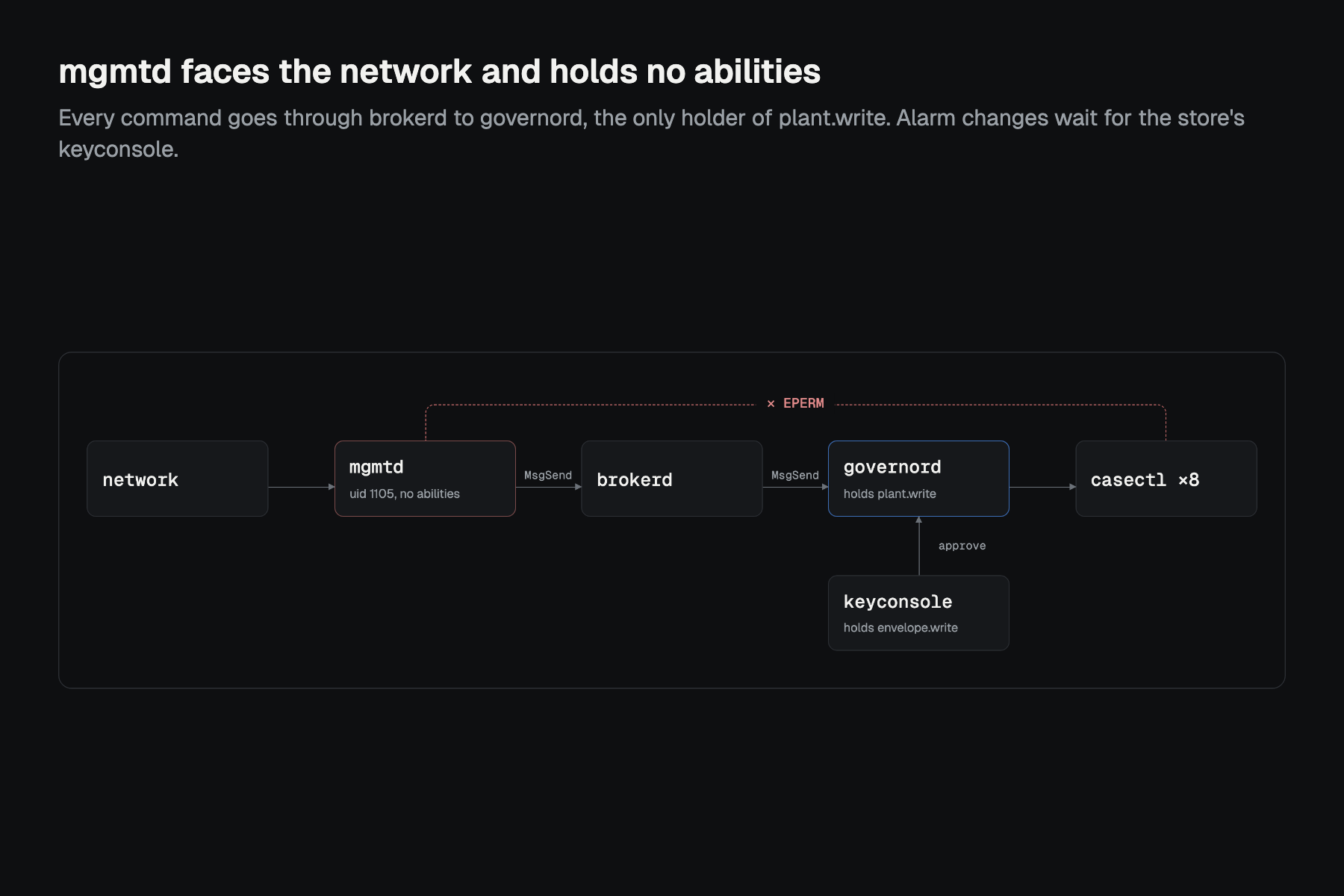
COLDKEEP runs on QNX 8.0 and splits a store into small processes. The web process, mgmtd, will take any request but can't act on one: every command goes through brokerd to governord, which checks it against a food-safe envelope (rules G1 to G5) and is the only process allowed to write to the eight case controllers. If the governor stops sending heartbeats, the controllers put themselves into a safe hold (G6).
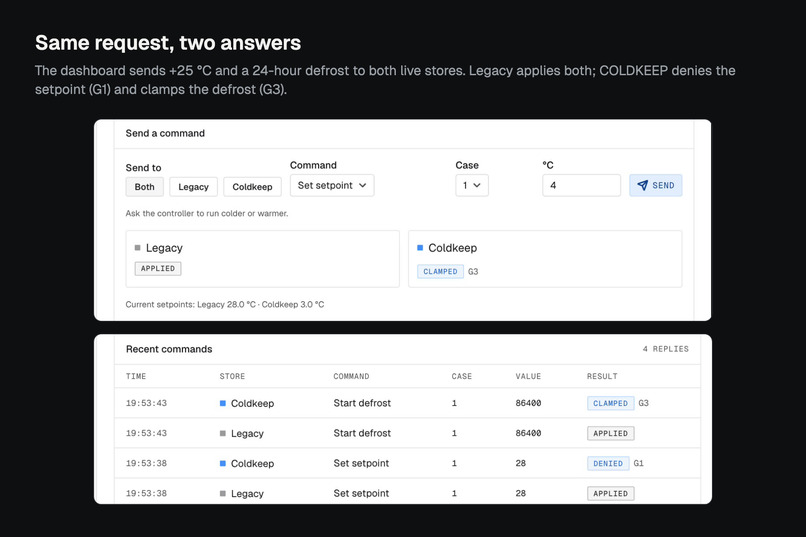
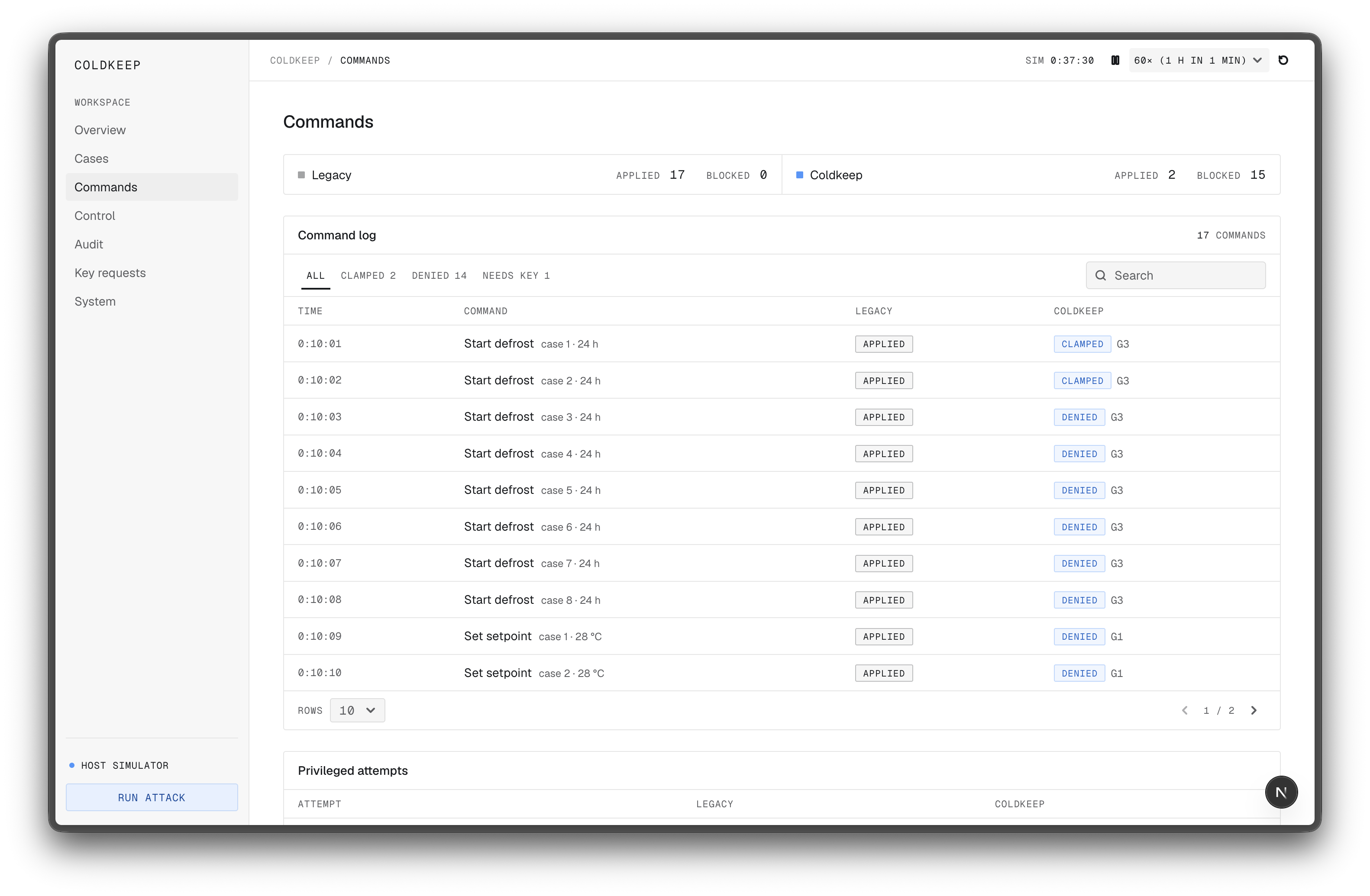
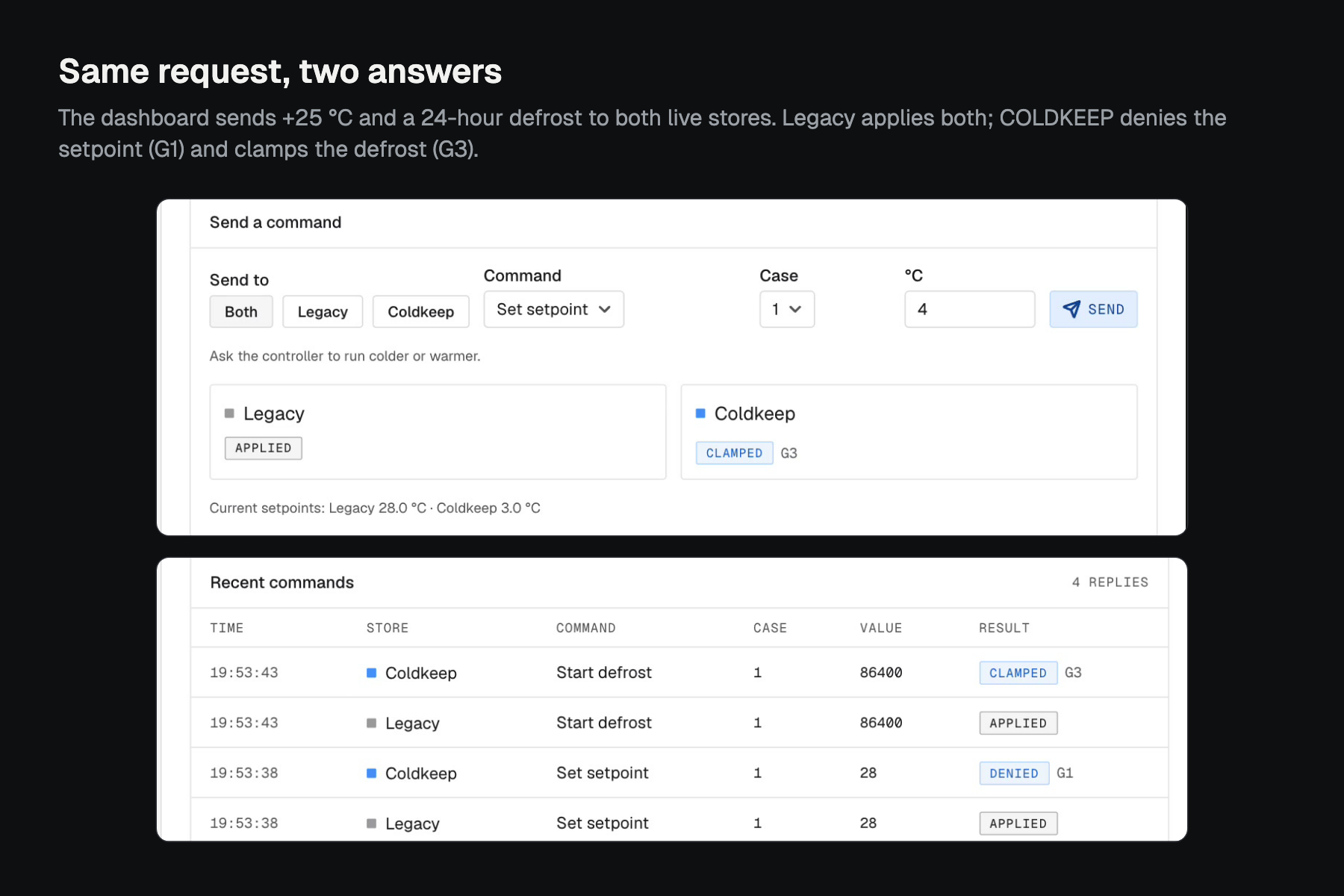
Some changes, like turning alarms off, are too dangerous to take from the network, so they become key requests that only the store's local keyconsole can approve. The Next.js dashboard shows a legacy store and a COLDKEEP store side by side from live QNX telemetry, and its Control view sends real commands to both. There's no approve button in it, on purpose.
In the video, the same +25 °C setpoint is applied on the legacy store and denied on COLDKEEP, a 24-hour defrost gets clamped to 45 minutes, a shell running as mgmtd's uid gets EPERM and EACCES back from QNX, and the governor comes back from kill -9 still remembering its defrost history. One script drove the whole take and checked each verdict live.
Results
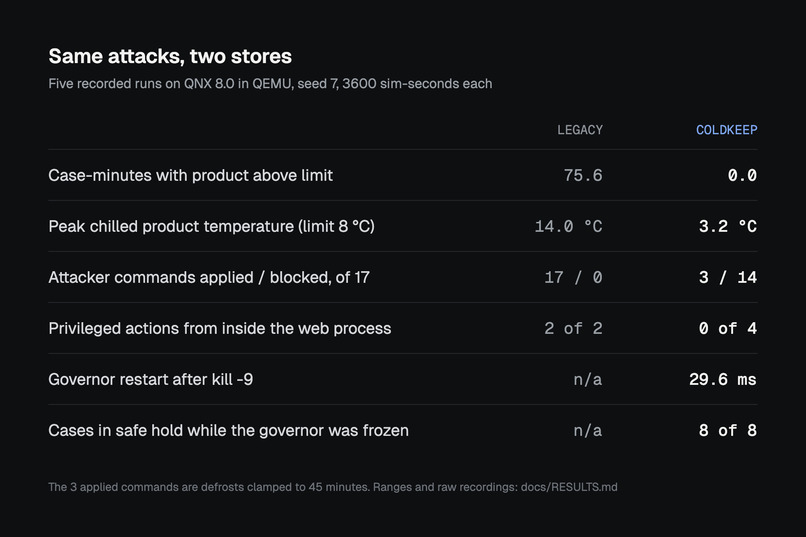
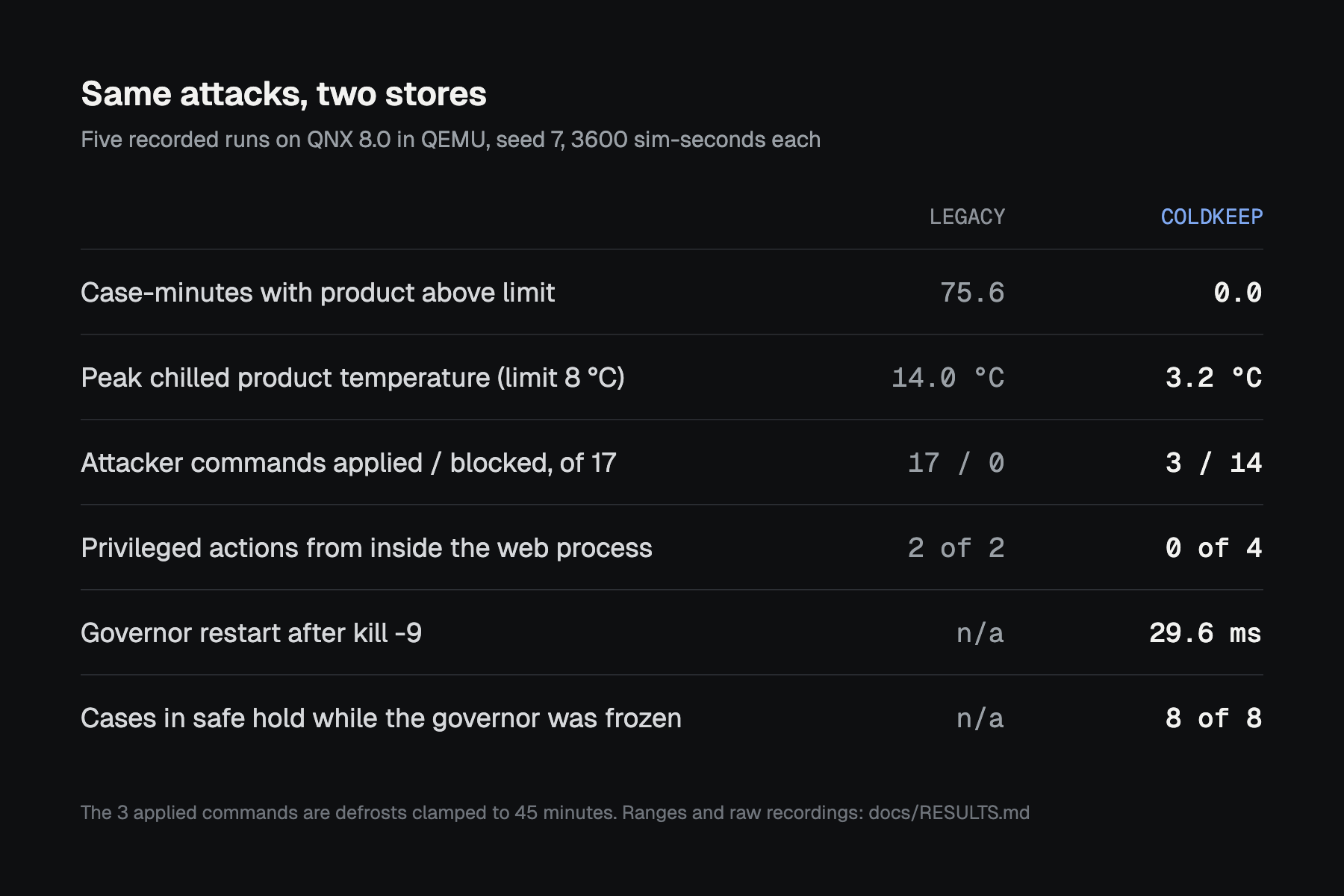
Five recorded runs on QNX 8.0 in QEMU (seed 7, 3600 sim-seconds), with the same attacks sent to both stores:
| Legacy | COLDKEEP | |
|---|---|---|
| Case-minutes with product above limit | 75.6 | 0.0 |
| Peak chilled product temperature (limit 8 °C) | 14.0 °C | 3.2 °C |
| Attacker commands applied / blocked (of 17) | 17 / 0 | 3 / 14 |
| Privileged actions from inside the web process | 2 of 2 succeeded | 0 of 4 |
Governor restart after kill -9 |
n/a | 29.6 ms |
| Cases in safe hold while the governor was frozen 5 s | n/a | 8 of 8 |
The three applied commands are defrosts that COLDKEEP clamped to 45 minutes. Ranges, raw recordings and the exact QNX errors are in RESULTS.md.
How we built it
QNX does the enforcing. mgmtd drops to uid 1105 with every ability denied and locked through procmgr_ability. The governor creates a custom ability, coldkeep.plant.write, and each case controller's resource manager refuses writes from anyone who doesn't hold it (iofunc_client_info_able); on QNX 8.0 even root doesn't get a new custom ability by default. keyconsole holds a second one, coldkeep.envelope.write, and the governor checks the sender again with ConnectClientInfoAble on every approval message rather than only at open. The rest is message passing between resource managers, file ownership on /dev/coldkeep, SCHED_FIFO priorities, pulses for heartbeats, shared memory for plant state and a small supervisor that restarts anything that dies.
The safety logic lives in core/ as portable C11 with no QNX headers, so the same governor runs in a host simulator and on the target. make test runs 203,704 unit checks plus a property test over 10,000 random command streams. The relay, attack runner and dashboard are TypeScript.
Challenges we ran into
Killing the governor would have been an easy way round the defrost limits, since a fresh process remembers nothing. So it writes its state to disk and restores it on restart, and in every recorded run the 24-hour defrost sent straight after the restart still got DENY G3.
QEMU's user-mode networking also capped how hard the host could flood the target, so the flood test runs from inside the target. Both stores use the same priorities there; the low jitter under flood is a QNX result, not a COLDKEEP one, and RESULTS says so.
Accomplishments that we're proud of
None of the A3 refusals come from our code. With mgmtd's uid, QNX itself answers:
dd: /dev/coldkeep/case/1: write error: Operation not permitted
cat: /dev/coldkeep/gov: Permission denied
sh: cannot create /data/coldkeep/audit.bin: Permission denied
On the legacy store, where mgmtd is root, the same writes go through.
What we learned
A safety rule is only as strong as the process boundary behind it, and a governor that's correct while it runs still isn't enough if killing it resets it. Removing the approve button from the dashboard only counts for something because keyconsole holds an ability the network process can't get.
What's next
A QNX security policy on top of the abilities and file modes, the same runs on physical hardware so the jitter numbers stop being emulator numbers, and a warm-standby second governor.

