-
-
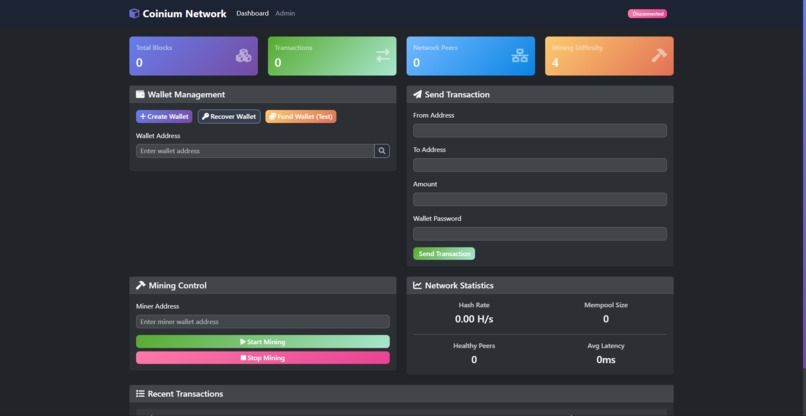
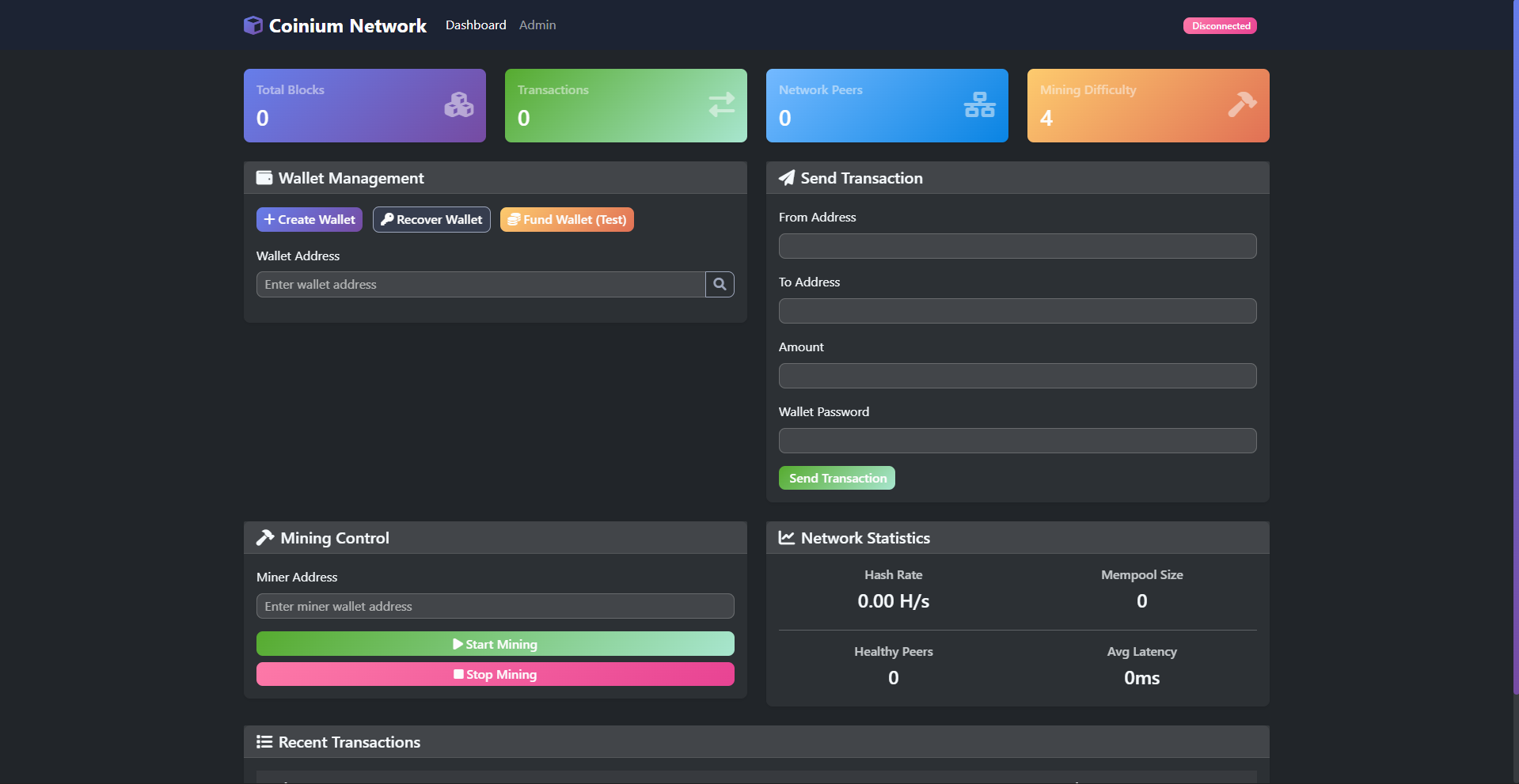
Dashboard Of the Coinium network
Coinium Blockchain Network
Overview
Coinium is a decentralized blockchain network that I designed and implemented from the ground up to explore the internal mechanics of distributed ledger technology. The project simulates a complete blockchain ecosystem, including wallet creation, transaction verification, block mining, and consensus validation. All data is stored persistently using SQLite, ensuring a transparent and verifiable local ledger.
Inspiration
The inspiration behind Coinium came from my interest in understanding how decentralized systems, such as Bitcoin and Ethereum, achieve consensus without centralized control. I aimed to move beyond theoretical understanding and build a functioning blockchain system that mirrors the real-world principles of trustless consensus and cryptographic integrity.
This project originated from a fundamental question:
“Can a blockchain be implemented locally, simulating wallet interactions, mining, and node validation — all without relying on external frameworks?”
That question led to the creation of Coinium, a blockchain simulator and learning framework that captures the essence of decentralized systems.
What I Learned
Developing Coinium from scratch deepened my understanding of blockchain fundamentals and the technical intricacies involved in decentralized networks.
1. Blockchain Data Structures
Each block in the chain contains the index, timestamp, transactions, previous hash, nonce, and computed hash. Example:
{
    "index": 1,
    "timestamp": "2025-10-06T16:00:00Z",
    "transactions": [],
    "previous_hash": "0" * 64,
    "nonce": 0,
    "hash": "<computed SHA256 hash>"
}
This structure enforces immutability through cryptographic linking between blocks.
2. Proof of Work (PoW)
A simplified proof-of-work algorithm was implemented to ensure mining difficulty and network integrity:
$$ H(block_data + nonce) < target $$
This process reinforced my understanding of computational difficulty and the balance between security and efficiency in blockchain design.
3. Cryptography and Wallets
Wallets are generated using RSA key pairs, with private keys for signing and public keys for verification. This process clarified the role of asymmetric encryption and digital signatures in validating ownership and preventing tampering.
4. Consensus Mechanism
Each node verifies the validity of new blocks before appending them, maintaining consensus by comparing chain lengths and validating hashes. This practice demonstrated the principles of Byzantine fault tolerance in decentralized networks.
5. Data Persistence
SQLite was integrated to simulate a persistent ledger across sessions. It offered a reliable and lightweight method to test real-world blockchain data consistency and storage efficiency.
How I Built It
The Coinium Blockchain Network was developed in Python, with the following modular components:
| Module | Description |
|---|---|
blockchain.py |
Handles block creation, hashing, and proof-of-work logic |
wallet.py |
Manages wallet generation, RSA keys, and digital signatures |
transaction.py |
Creates and validates transactions |
node.py |
Simulates peer nodes, handles propagation and validation |
database.py |
Implements SQLite-based persistent ledger |
bot.py |
Telegram Bot interface for user interaction (wallet creation, transaction management, and balance viewing) |
Architecture
[User Wallets] → [Transaction Pool] → [Mining Engine] → [Blockchain Ledger] → [Validation Nodes]
Telegram Bot Interface
The Telegram bot acts as a user-friendly interface, enabling wallet creation, transaction submission, and balance inquiries directly from chat, making the blockchain accessible in real time.
Core Features
- RSA-based wallet system
- Transaction signing and verification
- Proof-of-Work mining algorithm
- Blockchain validation and propagation
- SQLite-based persistent data storage
- Telegram bot interaction for transaction management
Challenges Faced
1. Consensus Synchronization
Synchronizing block validation across multiple simulated nodes required careful management of hash verification and chain length comparison to maintain consistency.
2. Mining Efficiency
Initial mining algorithms were computationally intensive. Optimizing the nonce search and hash calculations significantly improved mining performance.
3. Data Integrity
Concurrent database writes led to conflicts. Implementing transactional locks in SQLite ensured data reliability and consistent chain updates.
4. Security Validation
Ensuring proper digital signature verification demanded precise cryptographic handling. RSA-based signature validation and message integrity checks were refined to prevent unauthorized transactions.
Mathematical Representation
Block Hash
Each block’s hash is computed as:
$$ H_i = SHA256(index_i + timestamp_i + transactions_i + previous_hash_i + nonce_i) $$
Valid Block Condition
A block is considered valid if:
$$ H_i < \text{Target Difficulty} $$
Consensus Rule
The network adopts the Longest Valid Chain rule:
$$ LongestValidChain = \max_{chains}(|chain| \text{ if valid(chain)}) $$
Future Improvements
- Implement peer-to-peer networking using Flask-SocketIO or WebSockets for real-time node synchronization.
- Add a Proof-of-Stake (PoS) option for energy-efficient consensus.
- Create a web-based blockchain explorer with live transaction visualization.
- Extend the platform to support smart contracts and programmable logic execution.
Conclusion
The Coinium Blockchain Network represents a practical implementation of blockchain principles from the ground up. Through this project, I not only understood the theoretical underpinnings of blockchain but also applied them in a functioning environment that demonstrates decentralization, immutability, and cryptographic security.
This project strengthened my expertise in Python, cryptography, and distributed systems, and deepened my appreciation for the complexity behind decentralized networks.
References
- Nakamoto, S. (2008). Bitcoin: A Peer-to-Peer Electronic Cash System.
- Antonopoulos, A. M. (2017). Mastering Bitcoin. O’Reilly Media.
- Narayanan, A., et al. (2016). Bitcoin and Cryptocurrency Technologies. Princeton University Press.

Log in or sign up for Devpost to join the conversation.