-
-

Coin Error Expert Logo Coin Error Expert – AI-powered numismatic analysis and appraisal platform
-
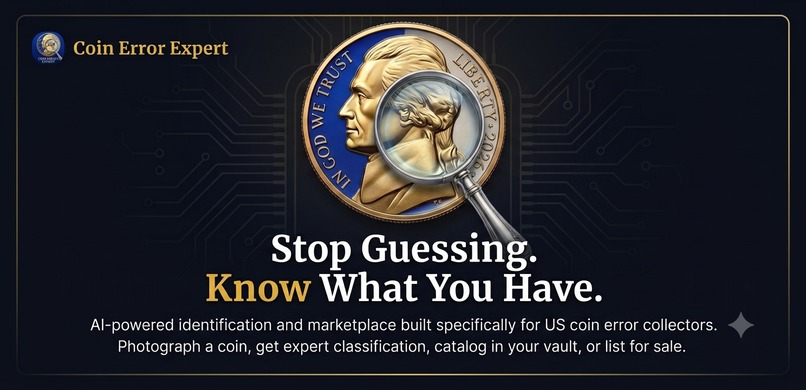
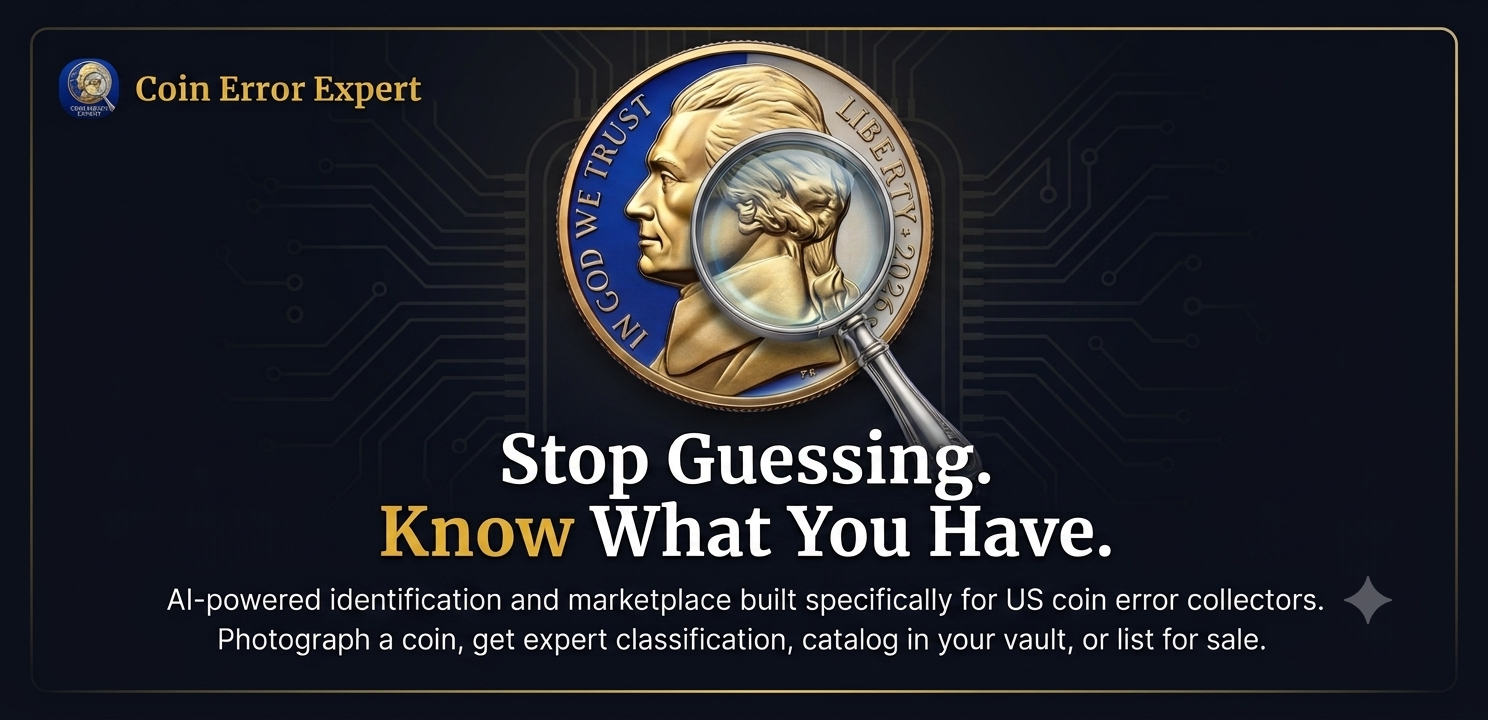
Google Play Store Banner: Official feature banner for the upcoming Google Play Store release.
-
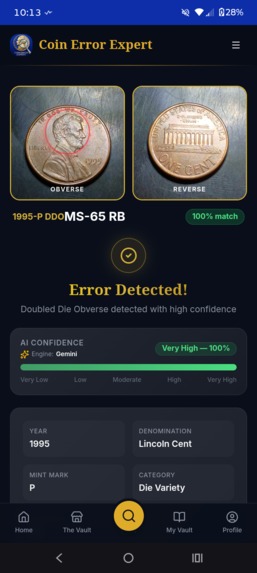
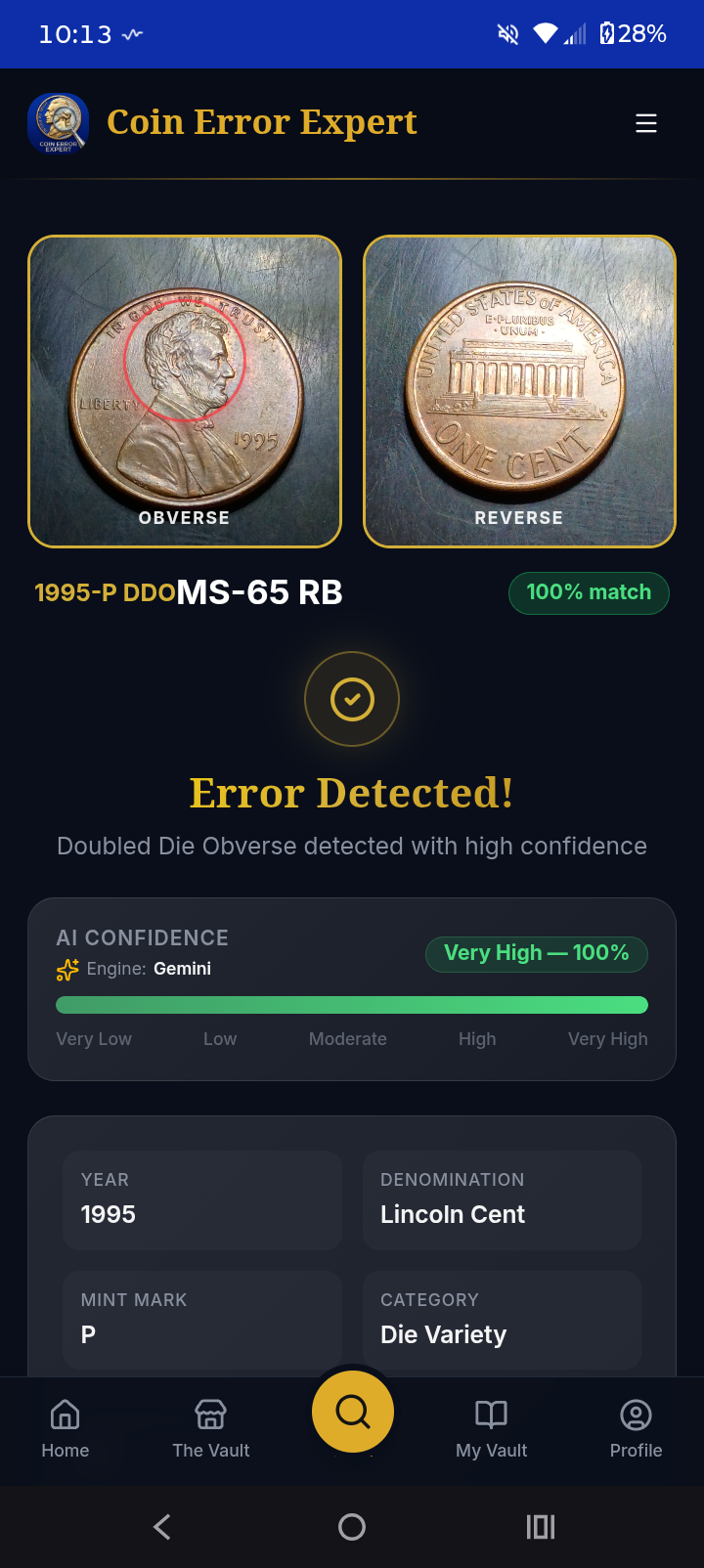
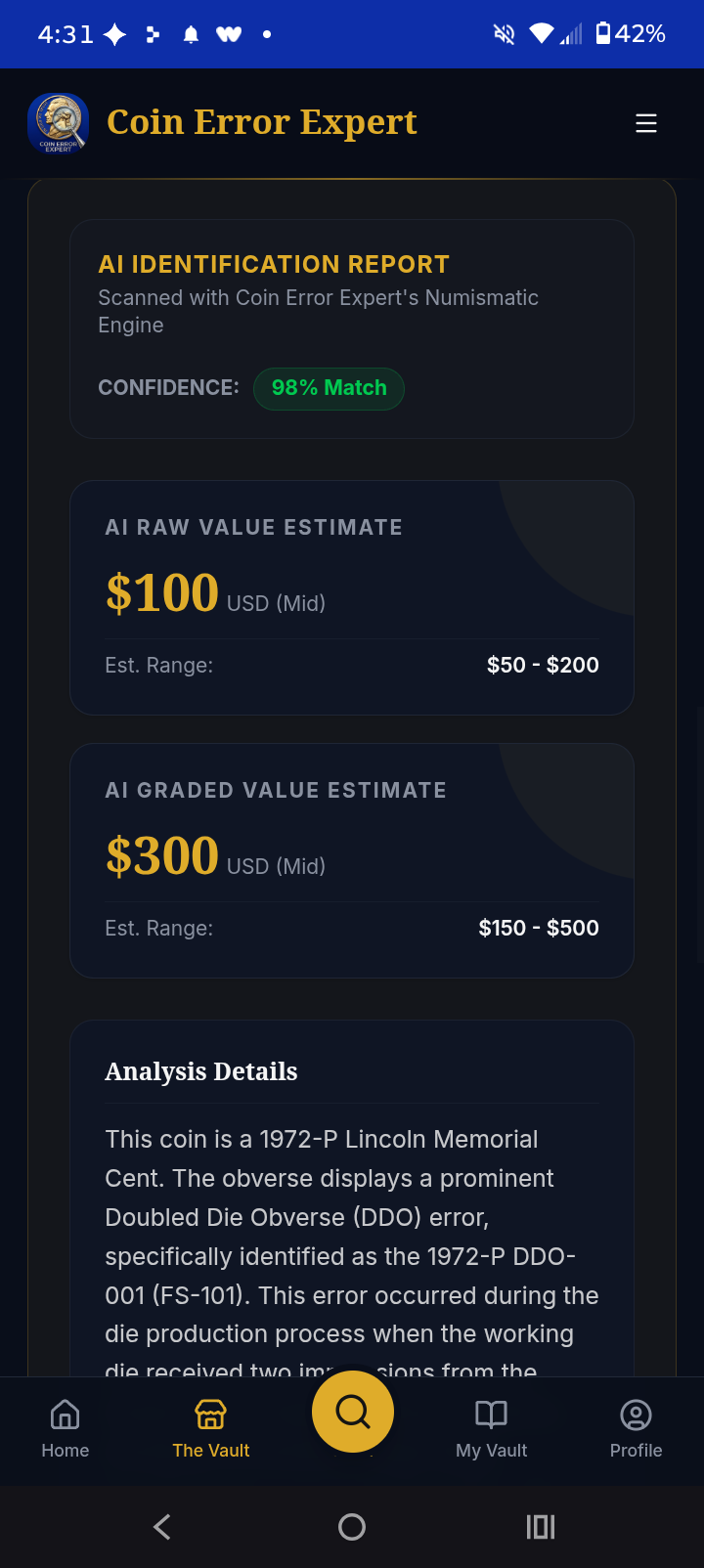
Error Detection View: Real-time error detection powered by explainable Vision AI analysis.
-
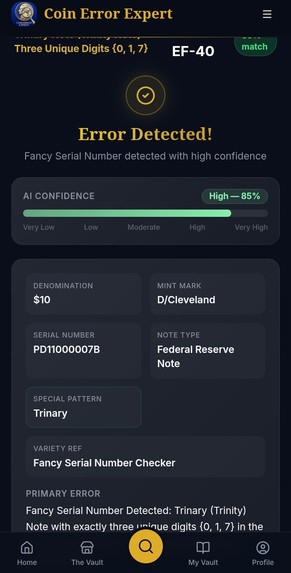
Explainable AI (XAI) Citation: Cross-referencing Variety Vista and Error-Ref to prevent model hallucinations.
-
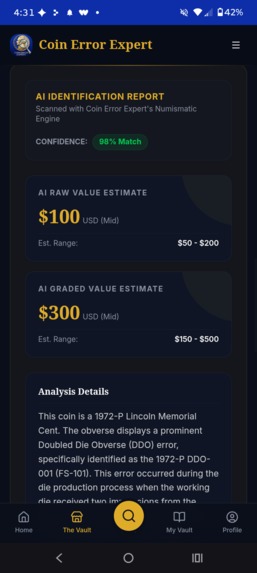
Appraisal Valuation Tiers: Market valuation breakdown showing estimated values for raw, graded, and peak auction tiers.
-
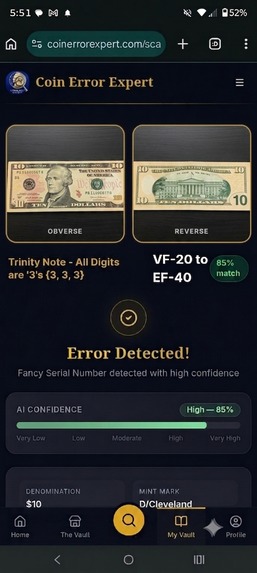
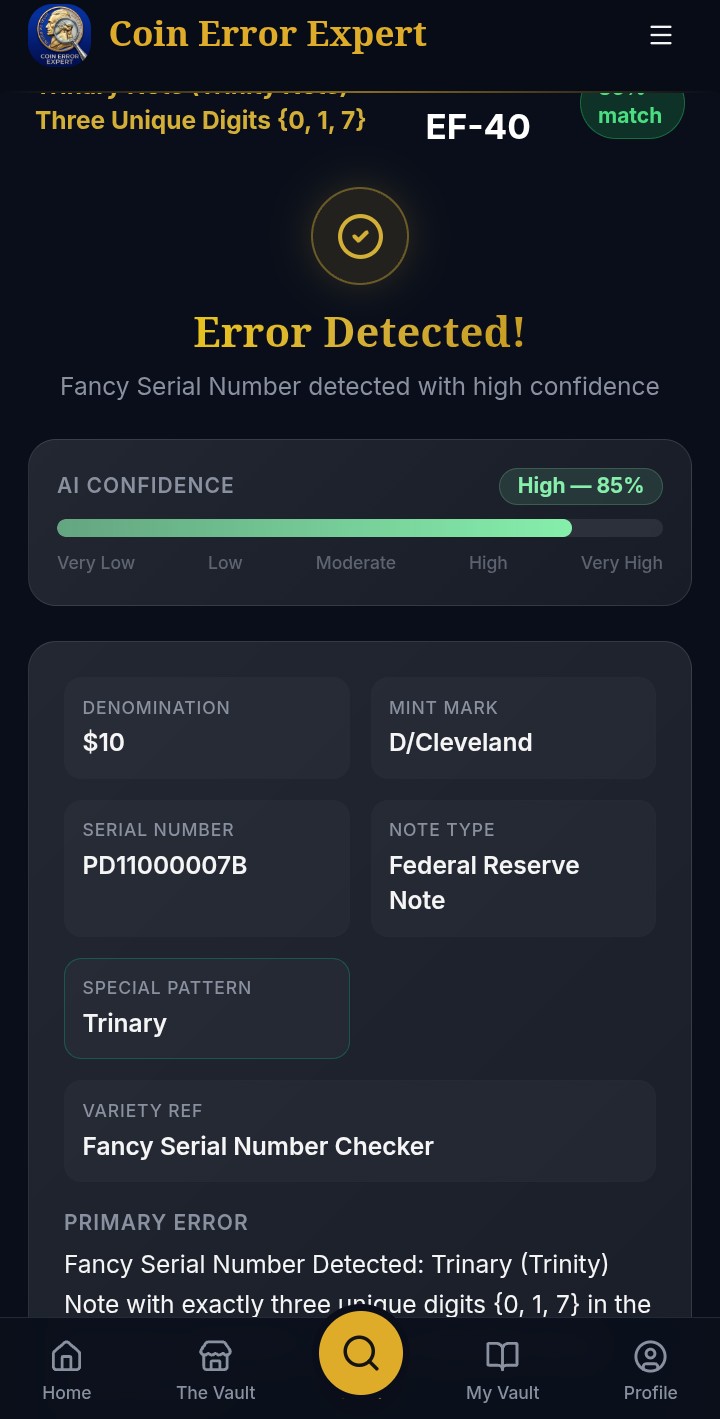
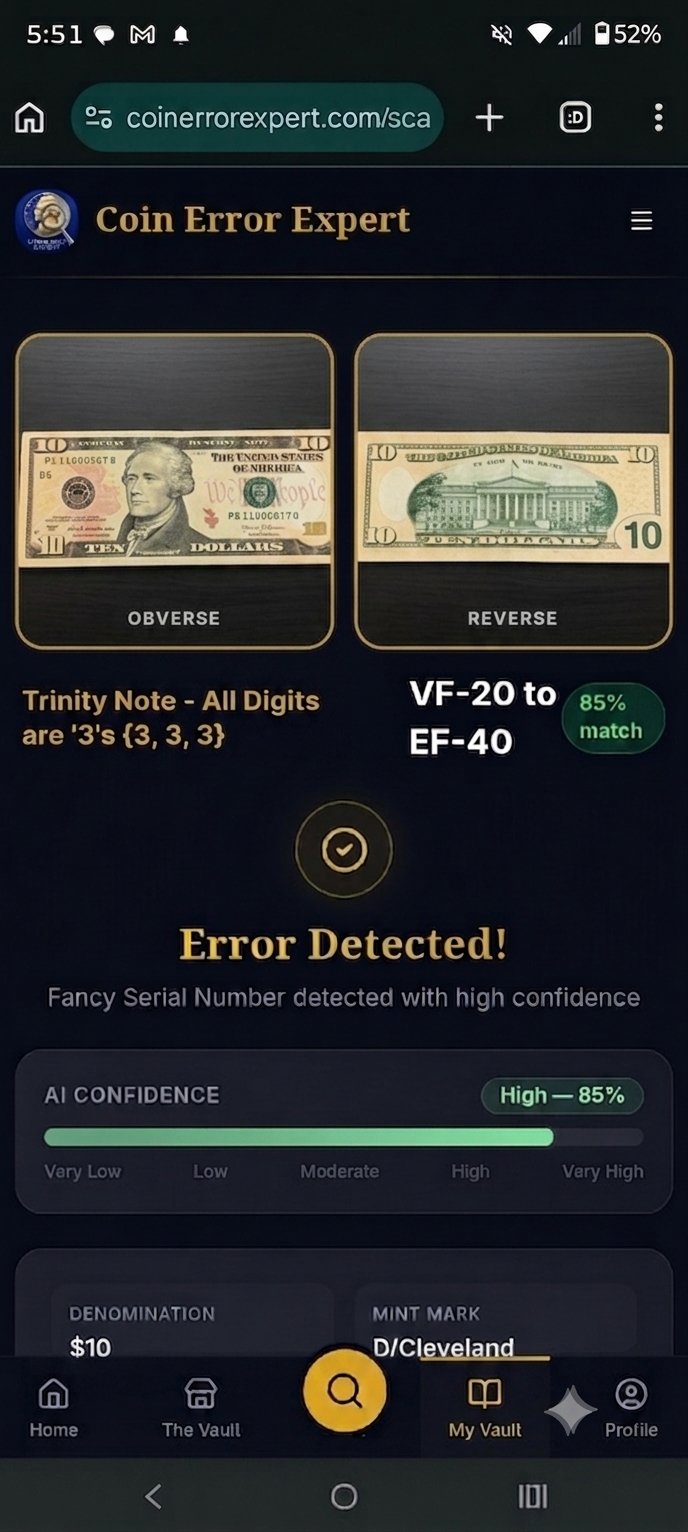
Fancy Serial Number Scanner: Banknote scanning capability detecting fancy collectable serials.
-
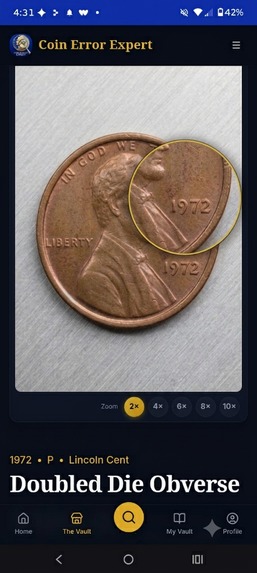
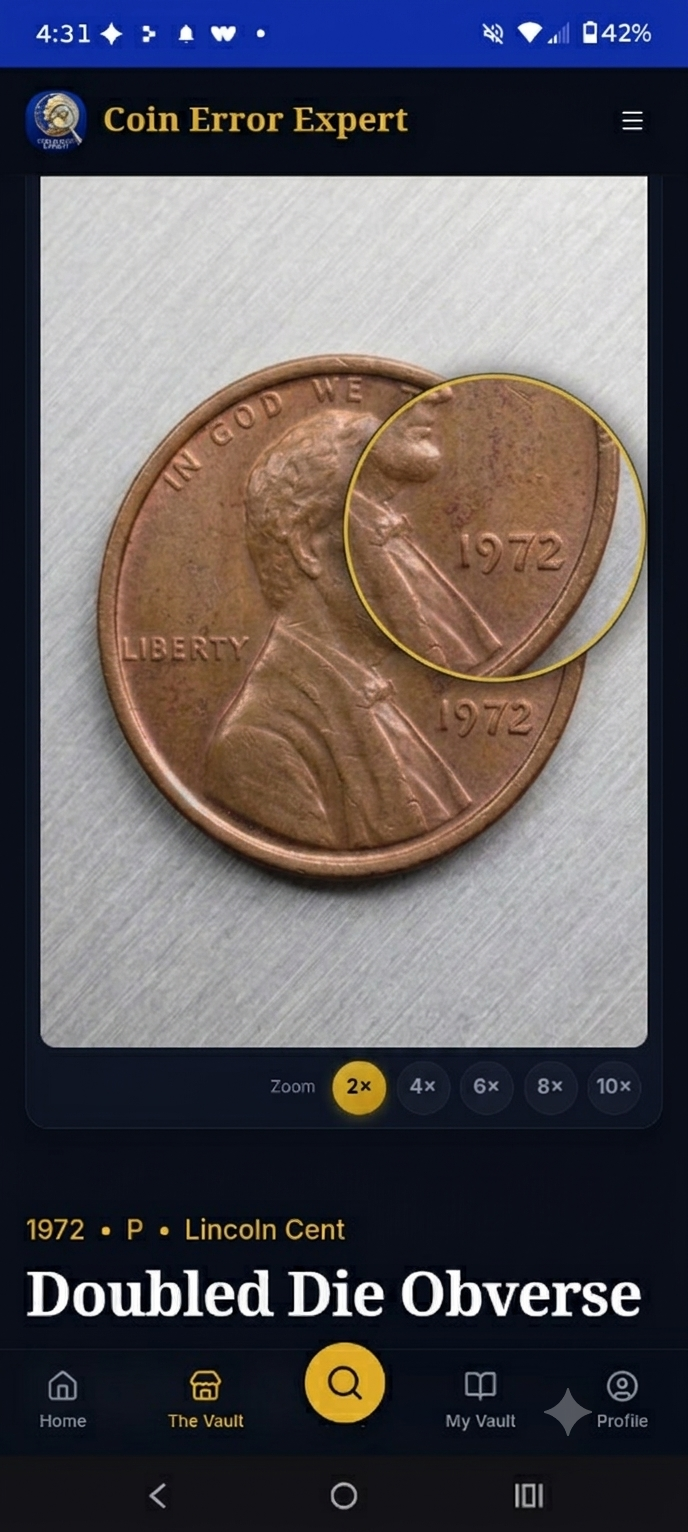
Digital Loupe Feature: Integrated Digital Loupe allowing users to inspect microscopic die markers up close.
-
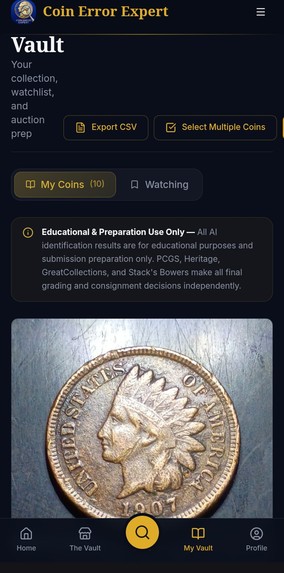
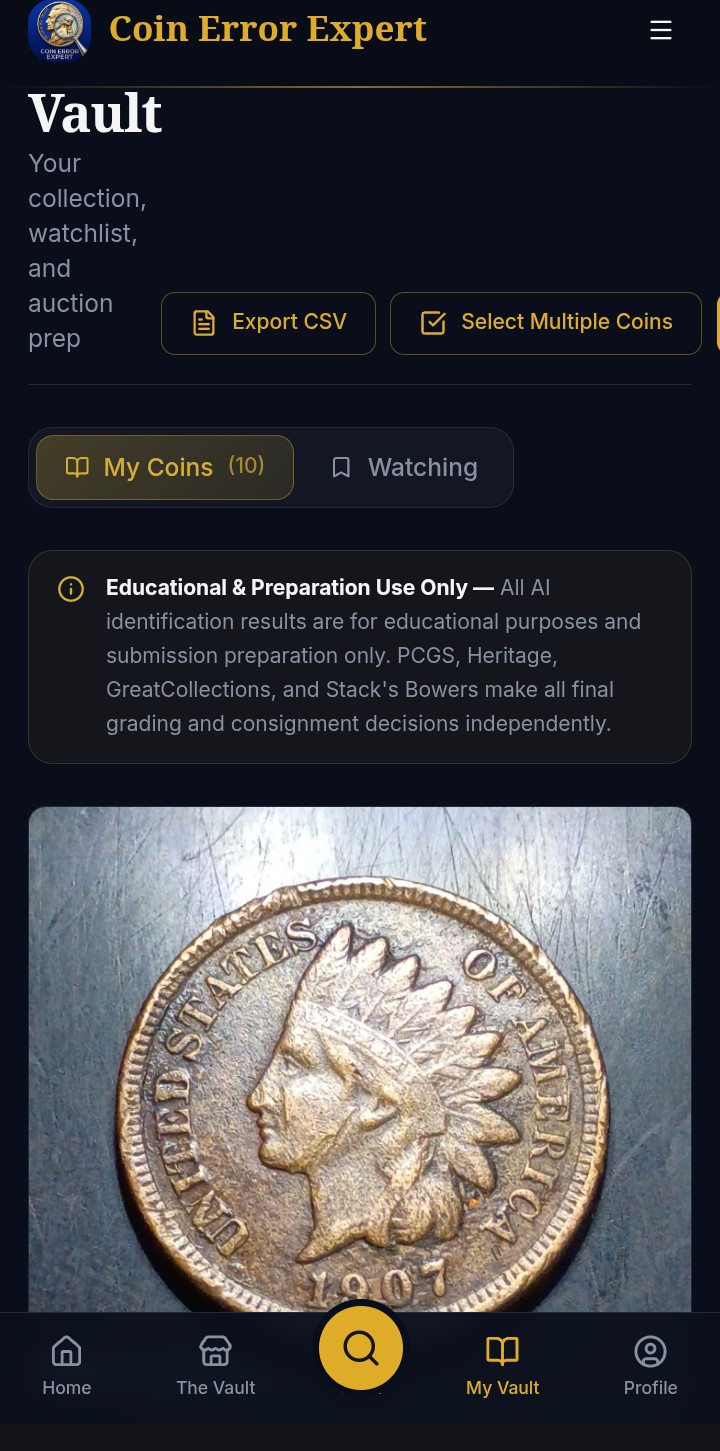
User Vault Management: Private digital vault for cataloging, managing, and tracking appraised items.
-
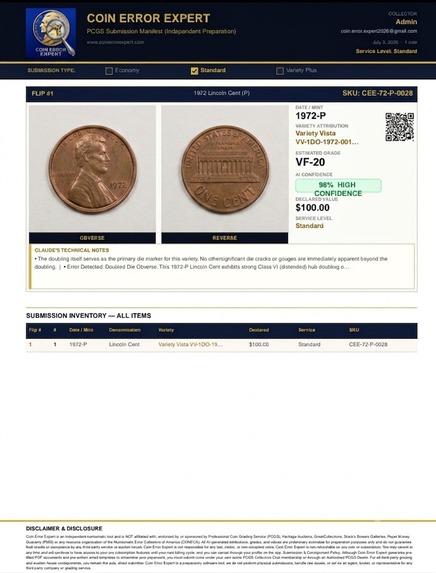
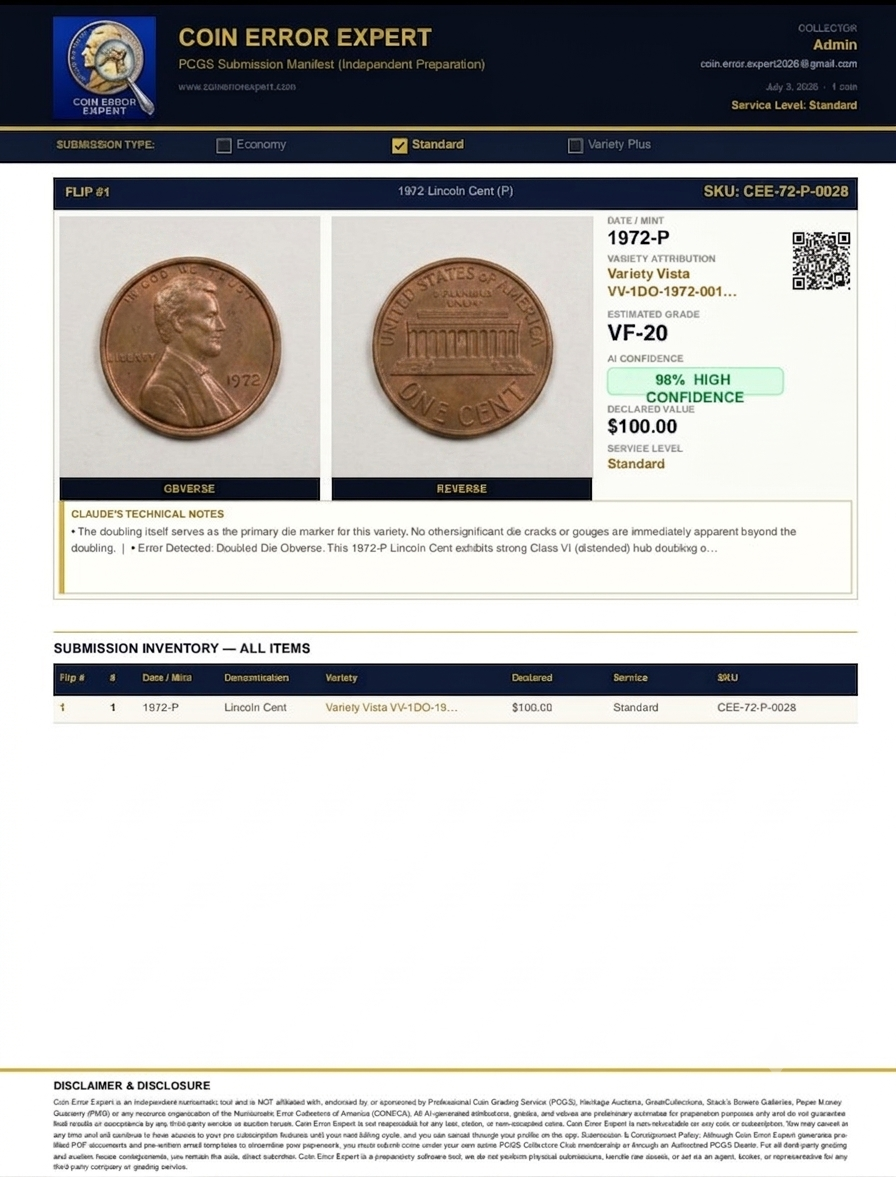
Export & Auction Manifests: QR-embedded PDF manifest generation for submission-ready intake.
-
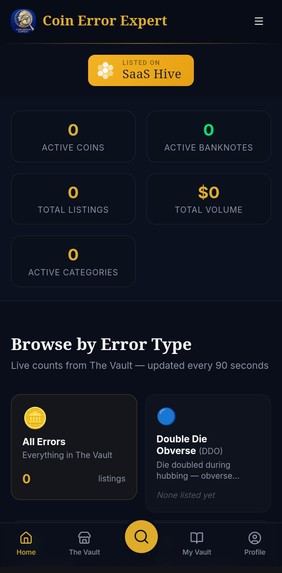
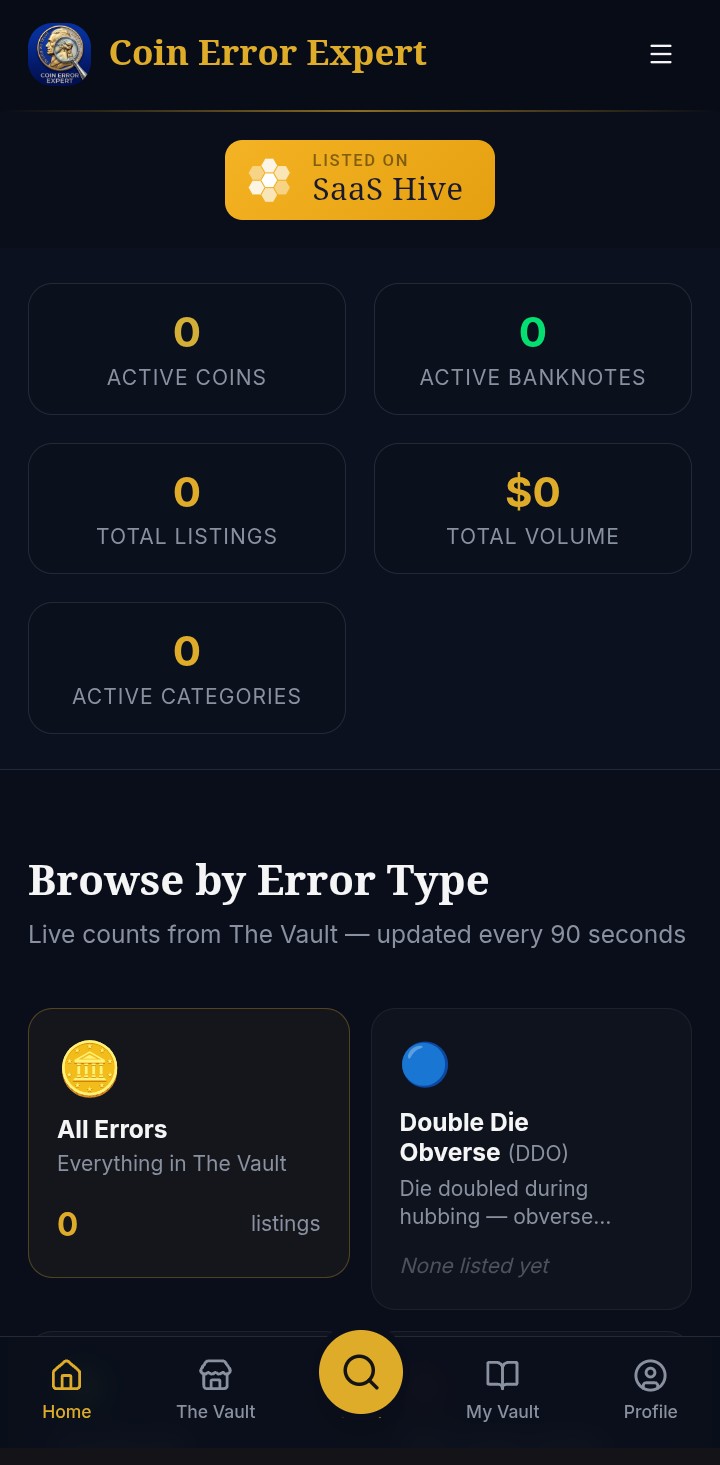
Error Category Explorer: Interactive error taxonomy grid allowing users to browse and filter specific mint error types.
-
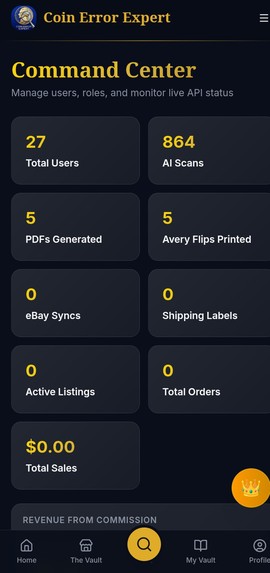
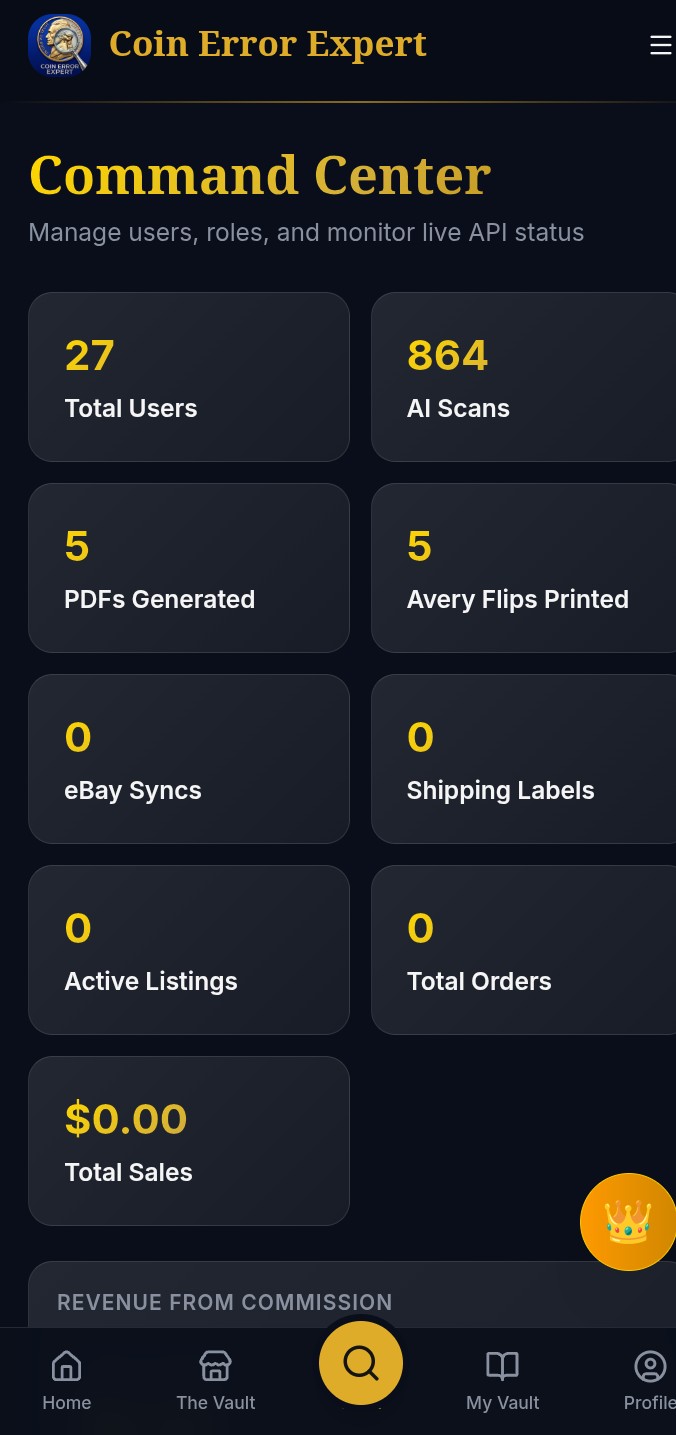
Admin Command Center: Real-time operations metrics tracking total users, sales, Avery flips, PDF manifests, shipping labels, and eBay syncs.
-
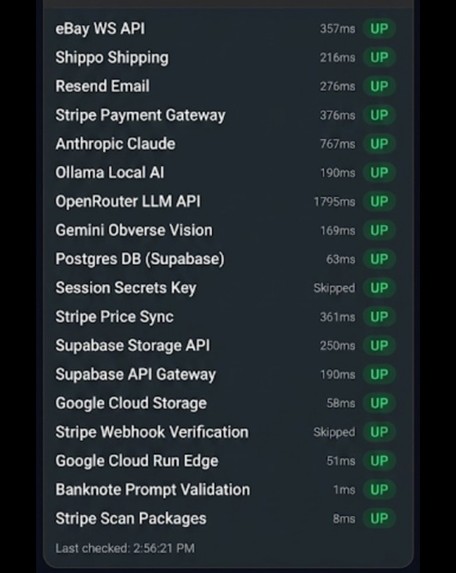
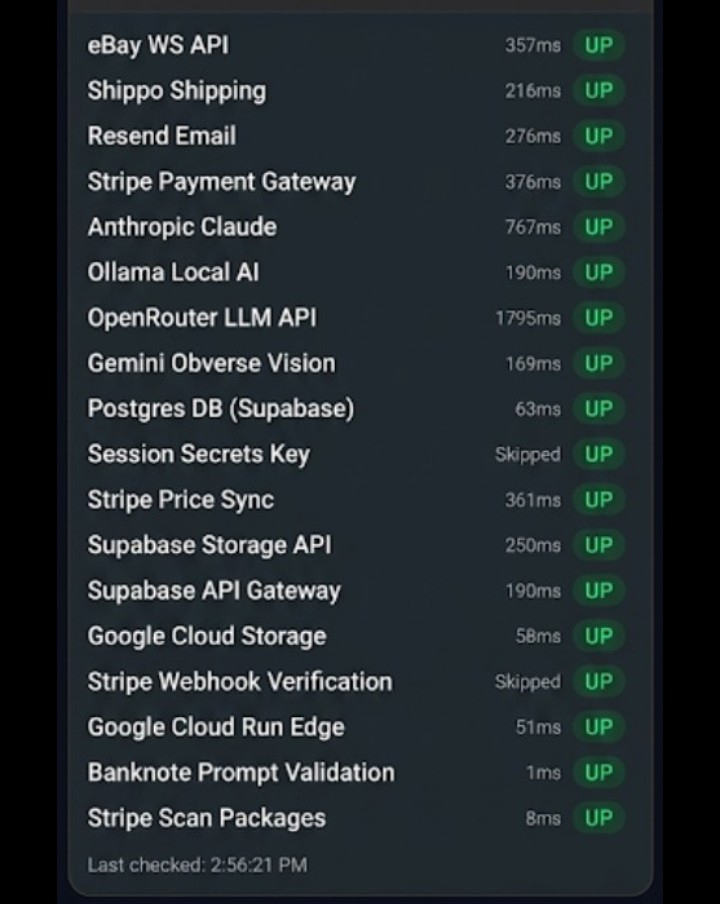
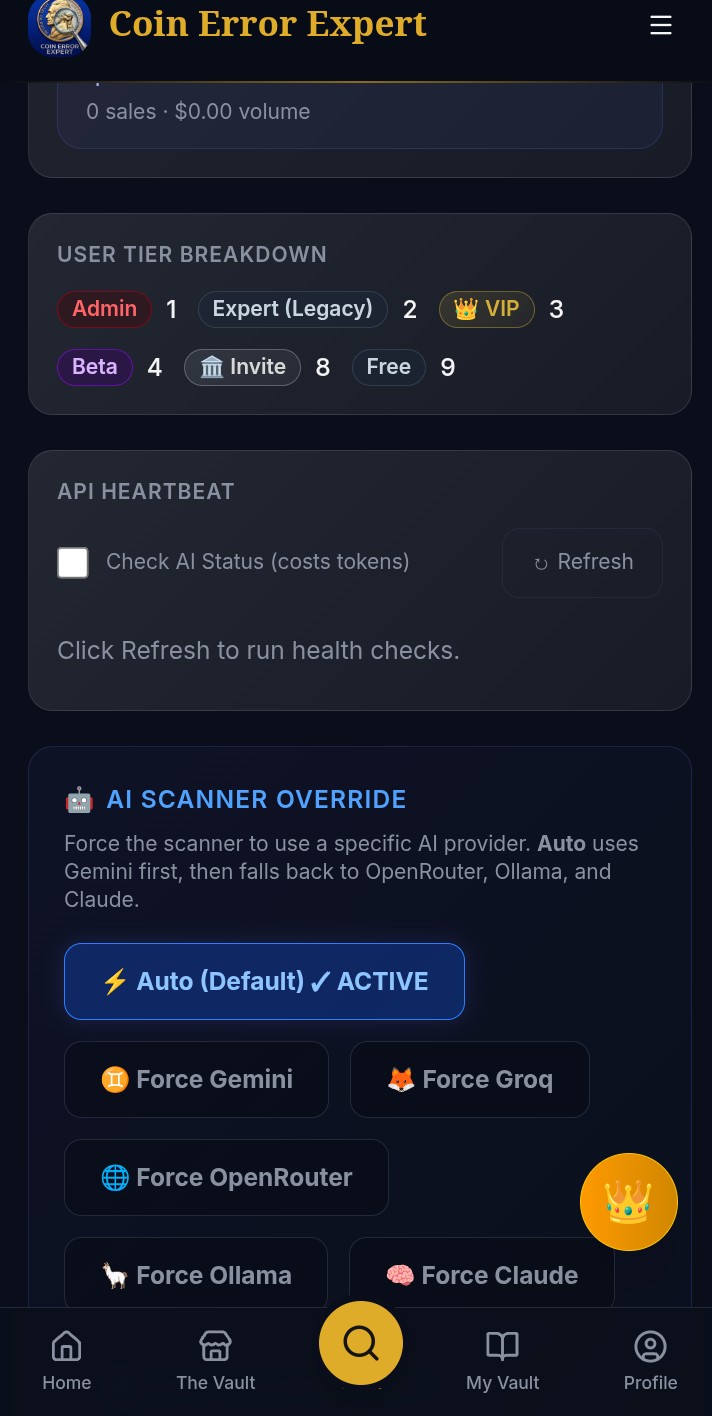
System Health & API Heartbeats: Admin monitoring panel displaying live API health, response times, and system heartbeats.
-
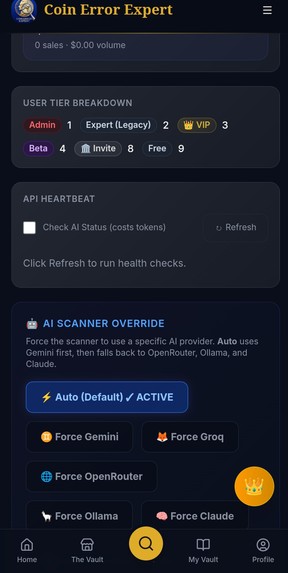
User Tier Analytics: Admin control panel displaying user distribution.
-
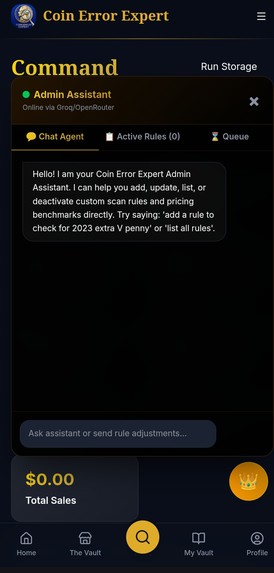
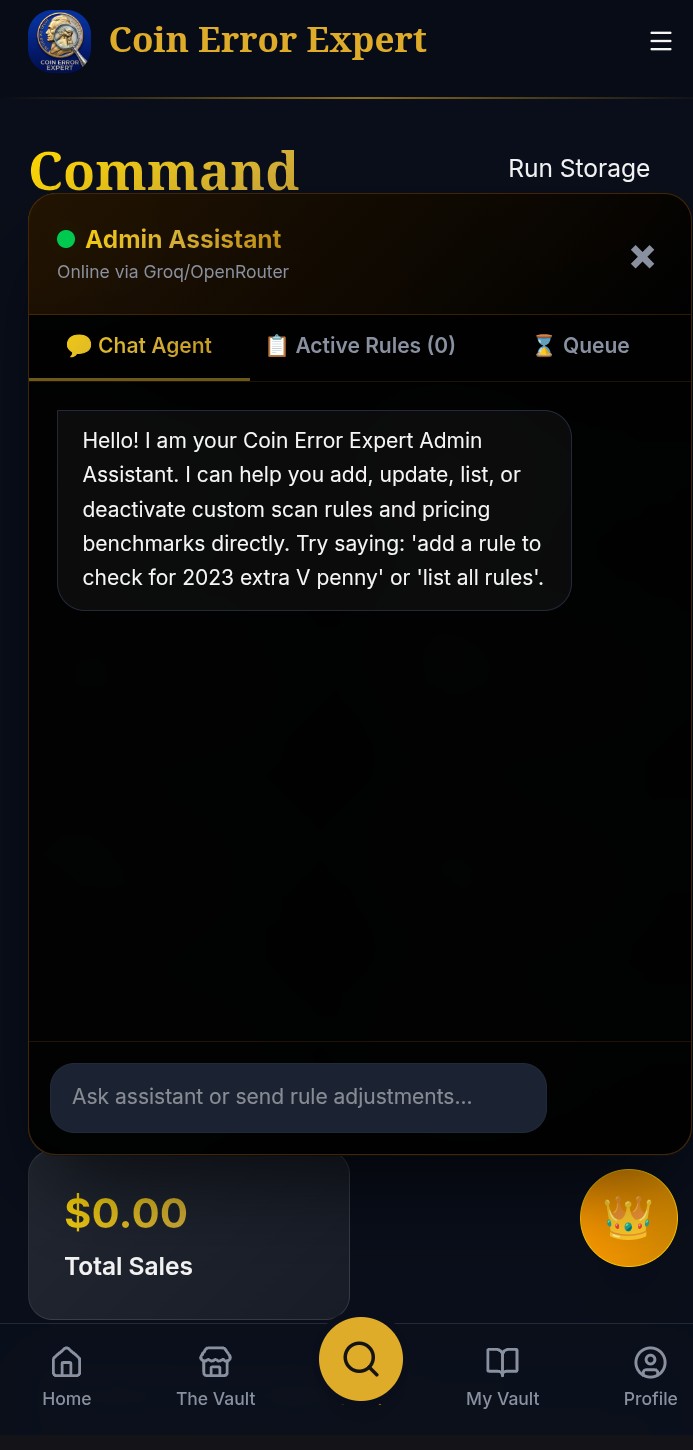
AI DevOps Assistant: Admin control panel with an integrated AI agent that writes code, debugs, and executes live cloud deployments.

Inspiration
My inspiration came from a deeply personal place: the need to take my future into my own hands. I was terminated from my previous job while on medical leave. After two years of unsuccessful job hunting, I realized I could no longer rely on a company to give me a job; I had to build my own future. As a beginner in coin collecting, I had joined several Facebook groups to learn, only to find the community incredibly intimidating. Beginners like me were met with gatekeeping and ridicule just for asking simple questions. Meanwhile, friends kept handing me jars of change because I knew slightly more than they did. The demand was obvious: everyday people want to know if what they hold is valuable, but the traditional avenues are hostile. I wanted to build something that leveled the playing field—an app where absolutely anyone could snap a photo, get an expert analysis, and participate in the hobby without fear, while simultaneously building a scalable business to support myself.
What it does
Coin Error Expert is an autonomous, AI-driven web application that acts as a professional numismatist in your pocket. Users simply snap a photo of the front and back of a coin (or banknote). Under the hood, the app leverages a highly efficient, quota-aware multi-model AI architecture designed to operate at scale with near-zero overhead. First, all images are automatically resized on the client-side before transmission, drastically reducing payload size and API costs. The backend then intelligently cascades through the free tiers of Google's Gemini Vision API, OpenRouter, and Groq for high-speed analysis. To completely future-proof the business against API costs, the codebase also features full integration with Ollama, allowing the system to run locally hosted AI models for free, unlimited processing as hardware scales. Only when all free and local quotas are exhausted does the system seamlessly route traffic to Claude as a paid fallback, ensuring 100% uptime while maximizing profit margins.
A major differentiator of our platform is its authoritative, Explainable AI (XAI). To prevent hallucinations and ensure absolute accuracy, the AI is forced to cross-reference images against industry-standard databases including Variety Vista, Error-Ref, Wexler's, and the Cherrypickers' Guide before returning a report. The AI must 'show its work,' providing detailed, structured logic explaining exactly where the error is based on these references. Furthermore, it is currently the only automated photo scanning application on the market capable of analyzing a banknote and instantly identifying highly niche, valuable 'fancy serial numbers' (like birthday, trinary, or radar notes) that a novice would otherwise overlook. Users can visually verify microscopic details themselves using the marketplace integrated 'Digital Loupe' feature.
The platform also boasts a revolutionary operational architecture: it features a built-in, autonomous AI Developer Assistant accessible only to admins. This autonomous agent can actively write code, fix bugs, and trigger live cloud deployments directly from within the app, allowing a single founder to scale and maintain the software like a full engineering team. Externally, it acts as an end-to-end e-commerce tool. Every scanned item is assigned a unique SKU. Users can save a coin to their digital 'Vault', list it publicly, or seamlessly cross-list it to eBay. Our marketplace is secured by a highly customized Stripe escrow system: when a coin sells, buyer funds are held securely. The shipping fee is released as soon as they print the label, but the seller's revenue (minus platform commission) remains in escrow until the tracking system marks the item as delivered, protecting both parties. For power users, the app generates custom Avery coin flips. For high-value discoveries, the app programmatically generates professional, submission-ready PDF manifests and provides pre-written outreach emails for major auction houses and grading companies (like PCGS or Heritage). The user simply downloads the PDF and copies the email text to send from their own personal email address. These PDFs embed a scannable QR code tied to the coin's SKU, allowing auction houses to remotely verify the AI's step-by-step logic and die markers before the physical coin ever ships. This QR code integration is built specifically to save companies like PCGS and Heritage Auctions massive amounts of time and money during their intake processing. It turns anyone with pocket change into a knowledgeable collector, and scales all the way up to a fully equipped professional dealership.
How we built it
I approached Coin Error Expert as an exercise in building a highly scalable, serverless micro-architecture. The frontend is a Progressive Web App (PWA) built with React and Vite. I specifically chose a mobile-first PWA approach because the core user experience relies heavily on hardware: it is infinitely easier to take a high-quality, close-up photograph of a coin or banknote using a smartphone camera than a desktop webcam. The PWA delivers this seamless native app experience while bypassing app store bottlenecks.
On the backend, I run a Node.js/Express API containerized and hosted on Google Cloud Run for auto-scaling, state-free execution. State and user data are managed by Supabase (PostgreSQL), which allows me to utilize Row Level Security (RLS) policies directly at the database level to ensure user vaults remain strictly private. Image assets are piped directly into Google Cloud Storage. The most complex engineering challenge was the image processing and routing logic. Instead of hardcoding a single Vision AI model, I built a custom API gateway in Node.js that implements a cascading fallback system. It attempts inference via Google's Gemini Vision API, OpenRouter, and Groq first to minimize costs. I implemented robust error-handling and timeout logic to catch rate limits or failures, seamlessly redirecting the payload to Claude only when necessary. To future-proof the application, I also wrote native integration hooks for Ollama, allowing the system to switch to local inference environments as my hardware scales. For the logistics layer, I had to act as a massive API aggregator. The marketplace relies on a complex implementation of Stripe Connect to handle multi-party escrow logic programmatically. When a webhook fires confirming a sale, my server holds the funds, pings the Shippo API to generate a label, and then awaits a 'delivered' webhook from Shippo to trigger the Stripe payout. Finally, the automated submission pipeline dynamically generates PDFs using Node, embeds unique QR codes mapping back to my PostgreSQL UUIDs, and utilizes the Resend API for platform notifications (signup, sales, and subscription renewals).
Challenges we ran into
The journey to building this platform was incredibly difficult, and I almost gave up multiple times. I was building this entirely alone after a devastating job loss, and the biggest hurdle was architectural stability as the project's scope outgrew my initial tools. Midway through development, I realized my original building program and hosting environment simply could not handle the complex API routing, image processing, and database security required for a production-scale application.
Making the decision to switch frameworks and migrate hosts mid-project turned into an absolute mess. Code broke, dependencies clashed, and I had to rebuild the deployment pipeline from scratch. However, pushing through that frustration was the best decision I made. Forcing myself to migrate to Google Cloud Run and Supabase gave me the robust, auto-scaling infrastructure required to handle the cascading AI gateway and Stripe escrow system securely.
Accomplishments that we're proud of
I am incredibly proud of pushing through the urge to quit during my infrastructure migration. Surviving that mess allowed me to build an architecture I am truly proud of. Specifically, I am proud of successfully engineering the cascading AI gateway that balances cost-efficiency (using free tiers) with 100% uptime (Claude fallback), all while forcing the AI to strictly cross-reference databases like Variety Vista to completely eliminate hallucinations. Furthermore, I am proud to be the first automated scanner capable of identifying niche 'fancy serial numbers' on banknotes. On the operations side, successfully integrating my own 'AI DevOps Agent' into the backend—allowing a solo founder to manage CI/CD pipelines and live cloud deployments autonomously—feels like a massive technical leap. But most of all, I am proud of creating a first-of-its-kind, all-in-one platform for coin collectors. Even though I am still relatively new to the hobby and have never personally submitted a coin for grading or consigned to an auction house, I successfully researched and mapped out the entire pipeline. I learned exactly what is needed—from identifying a rare error in pocket change to generating the exact paperwork required by a major auction house—and I built an app that does it all in one place."
What we learned
The most important lesson was that an AI is only as good as the guardrails you put around it. Early on, I learned that allowing a generalized AI chatbot or standard vision model to appraise coins led to hallucinations. I learned to force Explainable AI (XAI) workflows, requiring the sandboxed model to cite specific numismatic databases and 'show its work.' I learned that pivoting platforms mid-project, while incredibly painful, is sometimes the necessary price of scaling as a solo developer. On a personal level, this journey taught me to never take any app for granted. There is a monumental amount of work that goes into building software that I never fully comprehended before starting this project. But anyone who knows me knows I am a hard worker, and I put my absolute all into this platform to prove to myself that I could succeed on my own.
What's next for Coin Error Expert
The immediate next step is scaling my hardware infrastructure so I can fully utilize my existing Ollama integration. By moving inference entirely to local, self-hosted models, I will achieve zero-cost AI processing, resulting in near-zero marginal cost at scale and massive profit margins. Beyond infrastructure, my focus will shift to B2B expansion. I plan to leverage my automated, QR-embedded PDF manifests to secure white-label partnerships and direct integration profiles with the industry's largest grading and auction houses—specifically targeting PCGS, PMG, Heritage Auctions, Great Collections, and Stack's Bowers. My goal is to get the attention of the 'big dogs' in the numismatic world, demonstrating the immense value of this automated pipeline so they actively want to integrate it into their own operations. Ultimately, I want to establish Coin Error Expert not just as a tool for hobbyists, but as the standard digital gateway for the entire numismatic industry.
Built With
- claude
- ebay-api
- express.js
- gemini-vision-api
- google-cloud
- google-cloud-run
- groq
- html
- javascript
- node.js
- ollama
- openrouter
- react
- resend-api
- shippo-api
- stripe-connect-api
- supabase-(postgresql)
- typescript
- vite

Log in or sign up for Devpost to join the conversation.