-
-
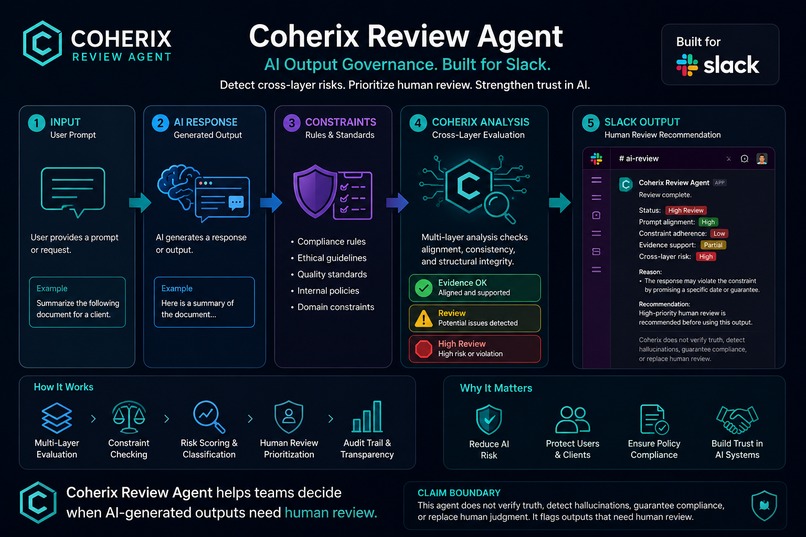
Powered by CMCI — a coherence engine published in Frontiers in AI (2026) and prototyped in hardware. Not a wrapper around another LLM.
-
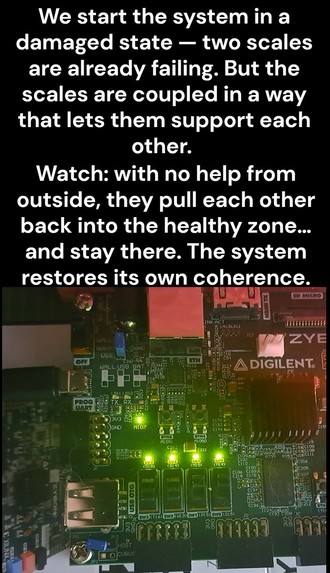
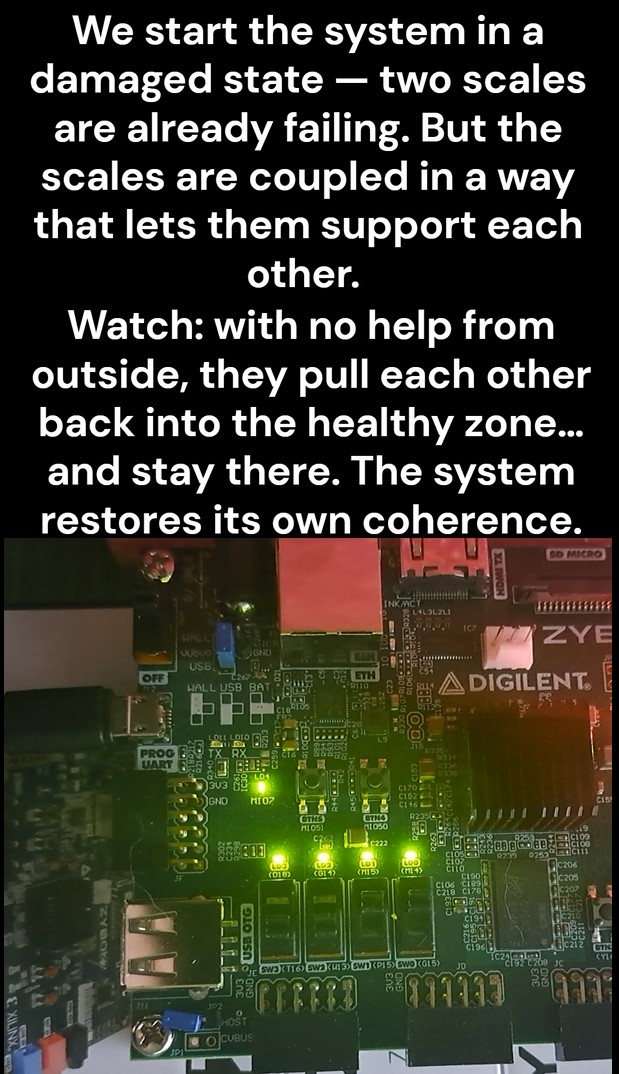
CMCI coherence engine running live on FPGA: a damaged system restores its own coherence, with no help from outside.
Inspiration
AI-generated outputs are increasingly used inside team workflows, but teams often lack a simple way to decide when an output should be reviewed by a human before use.
Coherix Review Agent was inspired by the need for a practical observability layer for AI outputs inside Slack. The goal is not to verify truth, detect hallucinations, or replace human reviewers. Instead, the agent helps teams evaluate whether the different layers of an AI interaction hold together: the original prompt, the AI response, stated constraints, optional evidence, and the intended use.
What it does
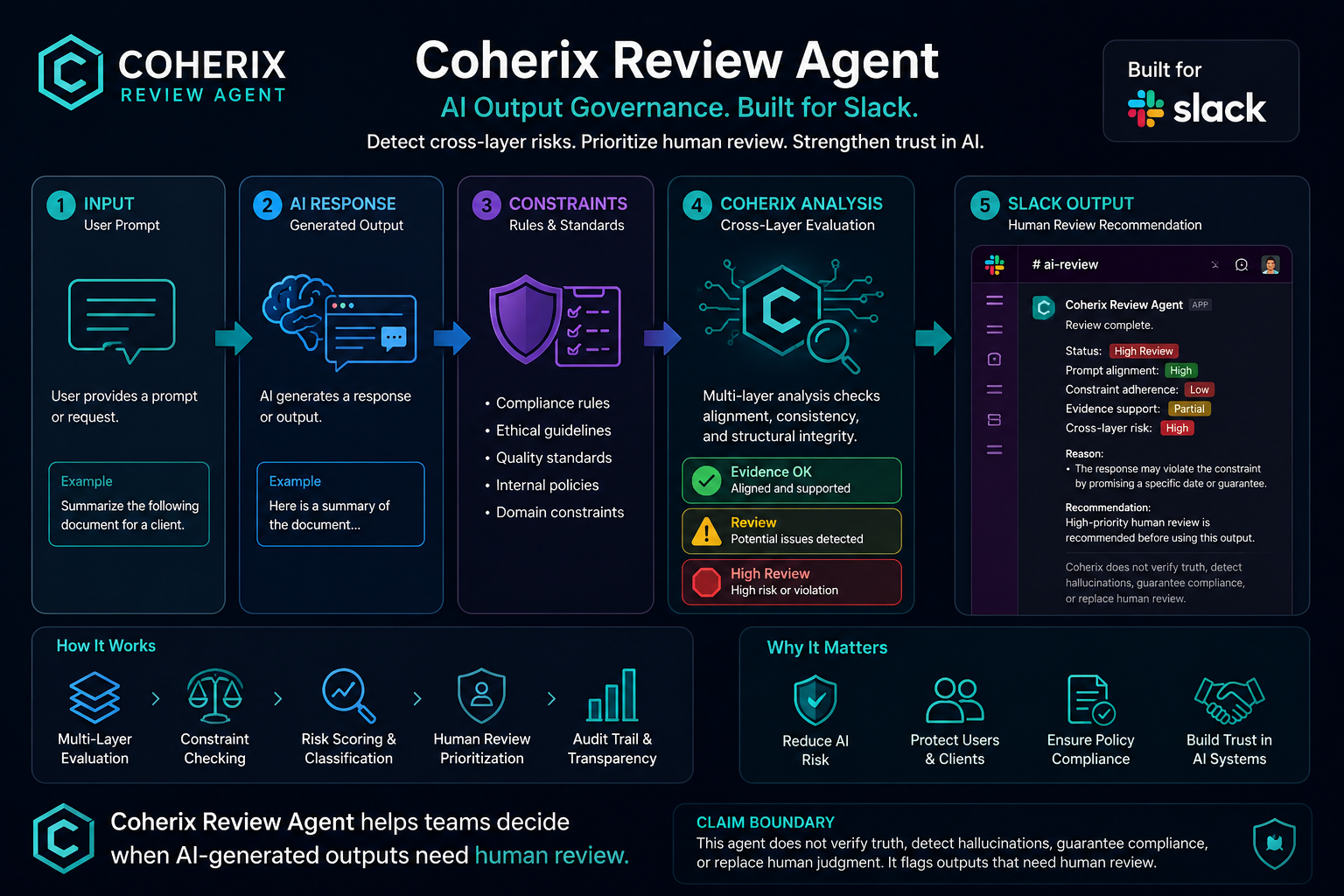
Coherix Review Agent is a Slack agent that helps teams decide when AI-generated outputs need human review.
A user provides the original prompt, the AI-generated response, relevant constraints, and optional evidence or source material.
The agent returns:
- Status: OK, Review, or High Review
- Prompt alignment
- Constraint adherence
- Evidence support
- Cross-layer risk
- A short recommendation
The agent flags possible cross-layer incompatibilities, such as a response that does not fully answer the prompt, violates stated constraints, makes claims not supported by the provided evidence, or gives a recommendation stronger than the evidence allows.
What makes this different
Most AI-review tools ask another LLM to judge the output — one model's opinion checking another. Coherix Review Agent is built on something different: CMCI, a coherence-measurement engine grounded in peer-reviewed research (Frontiers in Artificial Intelligence, 2026) and even prototyped in hardware through a live FPGA demonstration of coherence dynamics.
Instead of asking "is this true?", the agent measures whether the layers of an AI interaction stay coherent with each other — prompt, response, constraints, and evidence. The review signal comes from a structural measurement of cross-layer compatibility, not from another model's guess.
This is the same coherence framework I published and prototyped in silicon, now adapted into a simple, interpretable Slack workflow.
How we built it
The project was designed as a Slack-based review workflow for AI-generated outputs. The core logic is based on cross-layer compatibility analysis: instead of scoring a response as true or false, the agent compares the relationship between the prompt, response, constraints, and evidence.
The coherence logic is derived from CMCI, my published multi-scale coherence framework, not from prompting another model. The MVP focuses on interpretable review signals that a team can understand quickly inside Slack. The output is designed to support human judgment, not replace it.
Challenges we ran into
The main challenge was positioning the system responsibly. Many AI review tools claim to detect hallucinations or verify truth, but those claims are difficult to guarantee in real-world settings.
We deliberately avoided those claims. Instead, we reframed the project around human review support, AI-output governance, and cross-layer incompatibility detection.
Another challenge was keeping the MVP simple enough for a hackathon while preserving the deeper idea behind Coherix: measuring whether different layers of a system remain compatible.
Accomplishments that we're proud of
We created a clear and practical use case for AI-output governance inside Slack.
We also established a careful claim boundary: the agent helps flag outputs that may need human review, supports review workflows, and detects cross-layer incompatibilities. It does not claim to verify truth, guarantee compliance, or replace human review.
Above all, the agent is powered by a real coherence-measurement engine (CMCI) with peer-reviewed and hardware-prototyped foundations — not a wrapper around another model. This makes the project useful, understandable, responsible, and genuinely distinct.
What we learned
We learned that a useful AI governance tool does not need to make extreme claims. A simple, interpretable review agent can provide value by helping teams notice when an AI-generated output should not be used without further review.
We also learned that Slack is a strong environment for this kind of workflow because review decisions often happen in team conversations.
What's next for Coherix Review Agent
The next step is to improve the scoring logic, add empirical thresholds, and test the agent on real examples of AI-generated outputs.
Future versions could include saved review history, team-level review dashboards, configurable risk thresholds, evidence-aware review workflows, and integration with internal documentation or knowledge bases.
The long-term goal is to make Coherix Review Agent a practical observability layer for AI-output governance in team environments, backed by the CMCI coherence engine.
Built With
- aireview
- cmci
- coherix
- espress
- github
- javascript
- node.js
- slack


Log in or sign up for Devpost to join the conversation.