-
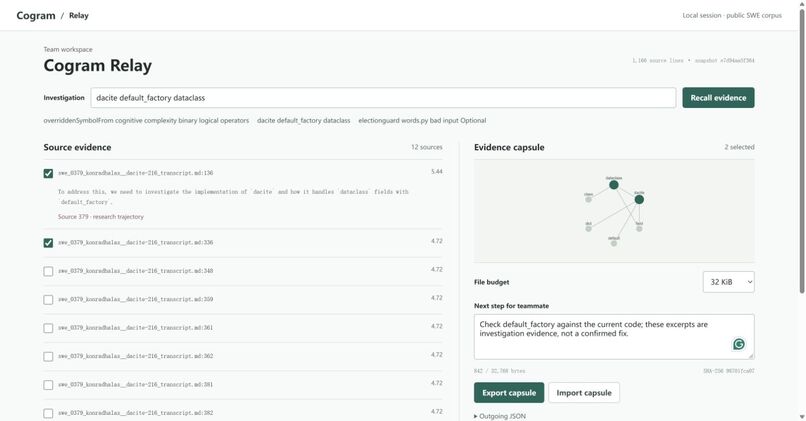
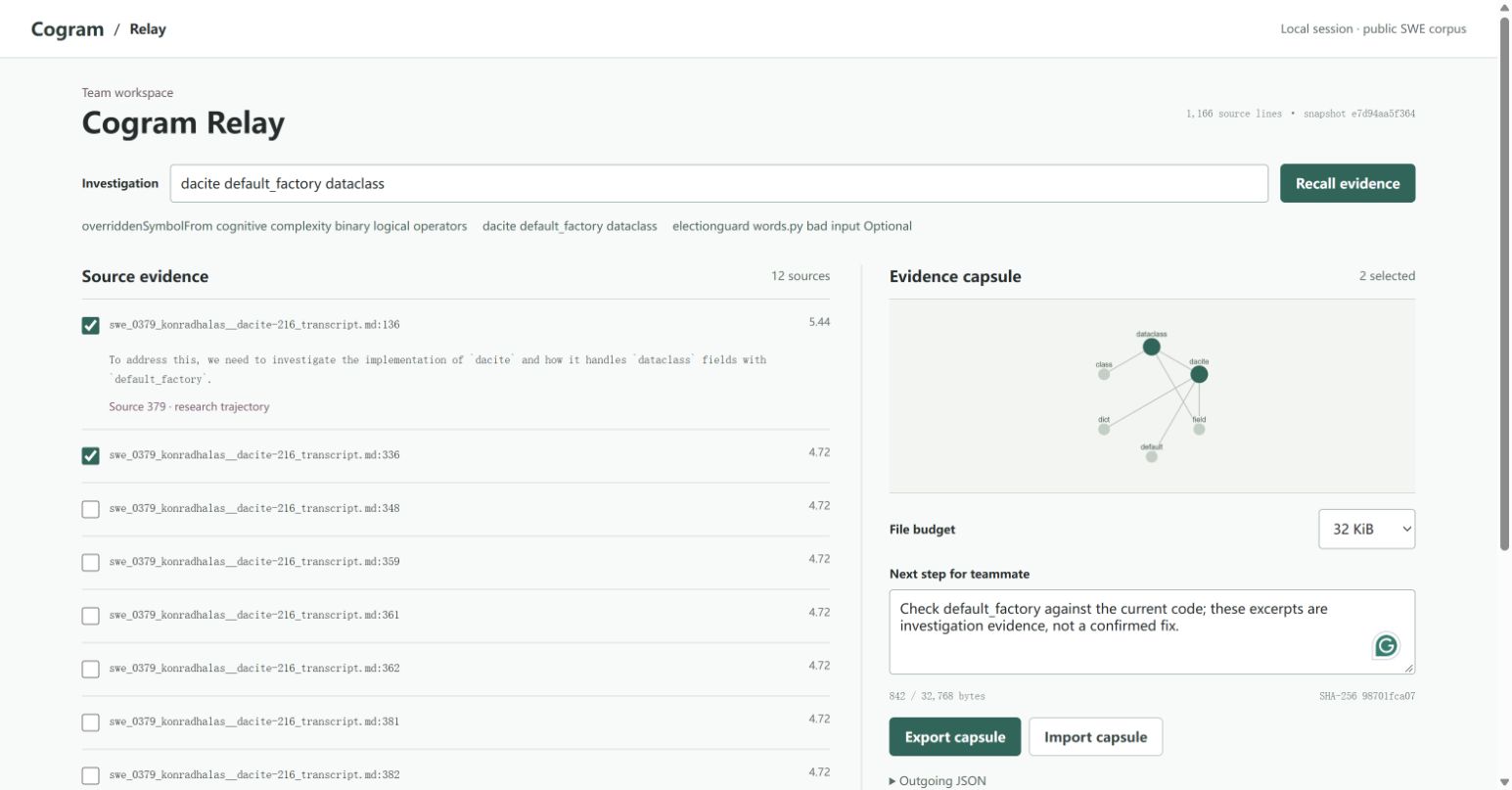
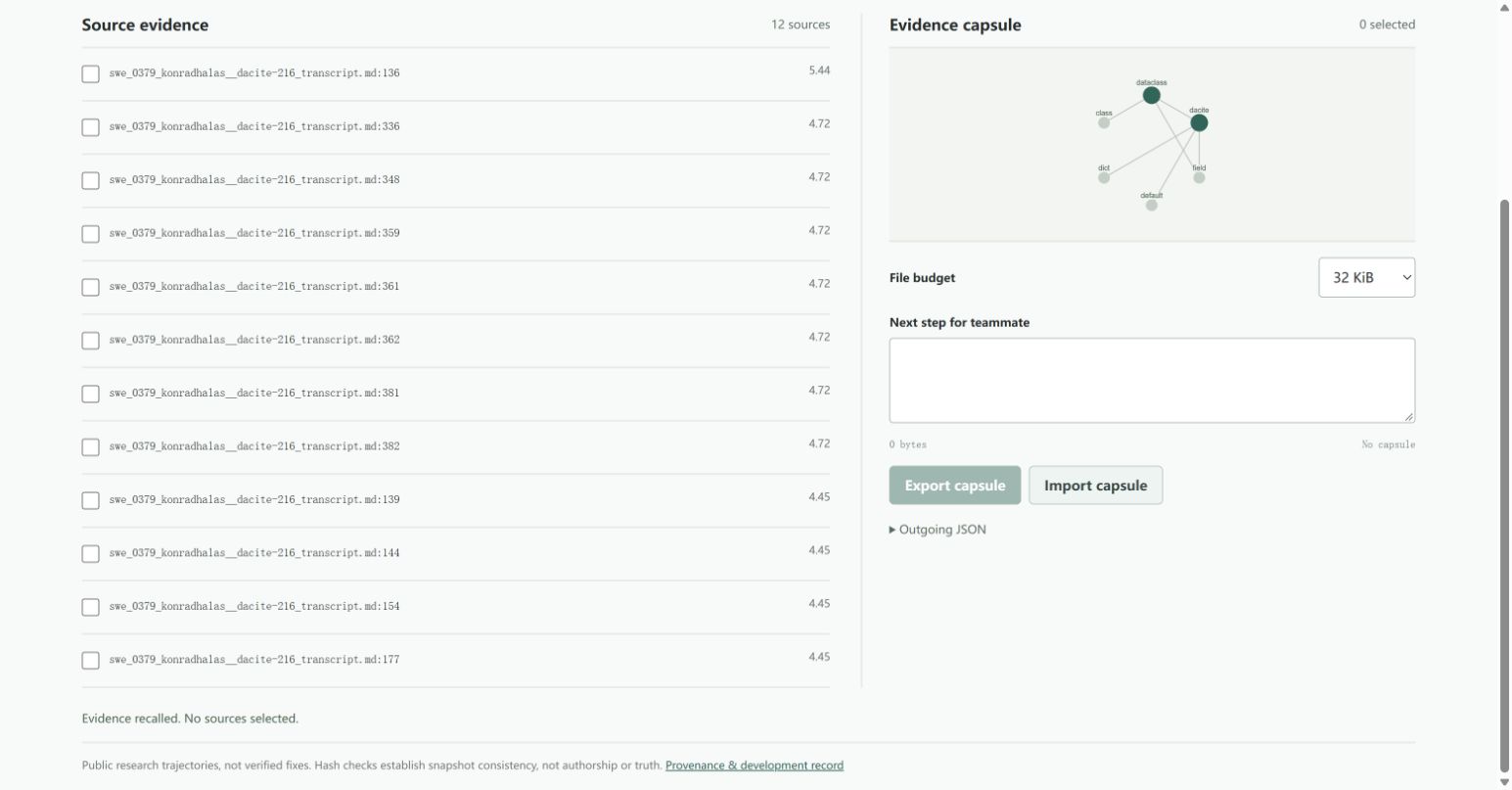
Desktop: select source evidence and prepare a local capsule.
-
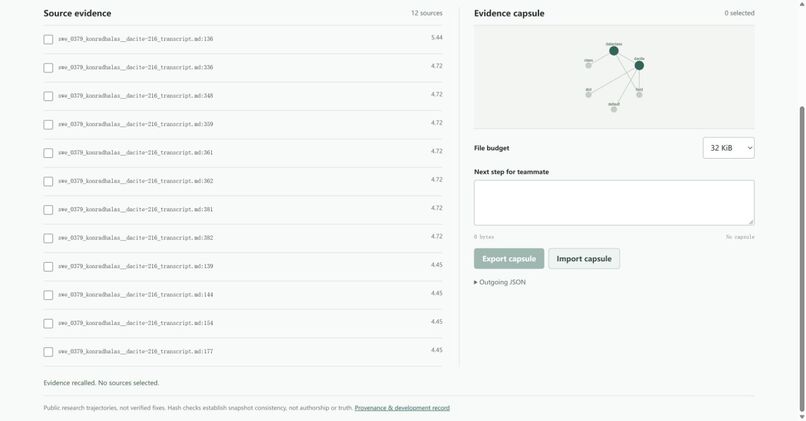
Receiver: inspect incoming sources before explicitly adopting the capsule.
-
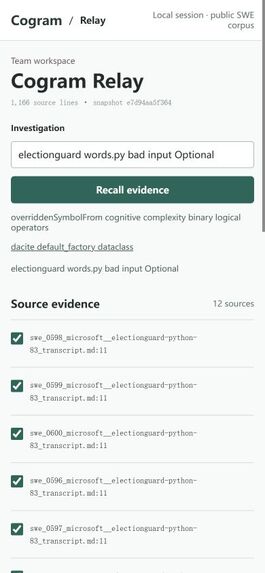
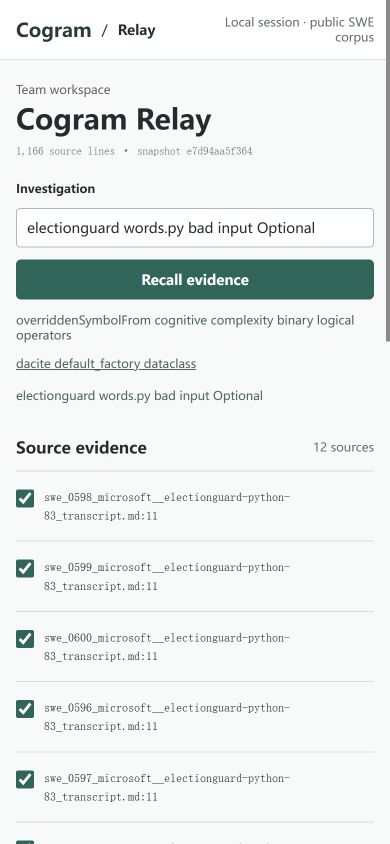
390px mobile view: incoming evidence review.
Inspiration
When a student teammate takes over an investigation, passing a full conversation makes the receiver repeat the filtering work. A short summary can lose the exact evidence or make a tentative suggestion sound like a confirmed solution. We wanted an explicit, inspectable handoff: what evidence is being shared, where it came from, and what still needs checking.
What it does
Cogram Relay recalls source evidence from a concept graph, lets the sender review and select individual full excerpts, and packages only those excerpts with a query and optional next step. A teammate imports the capsule locally, sees what overlaps with their current selection, checks the full quotes, and explicitly adopts it. Import does not silently replace the receiver's current work.
The demonstration uses an existing public SWE-agent trajectory corpus. The excerpts may be investigations, suggestions or failed attempts; Relay does not label them as verified fixes. The current version requires both teammates to load the same corpus snapshot. It is not a general private-chat sharing platform.
Recorded walkthrough (1:46): Watch the Cogram Relay demonstration.
How we built it
The pre-existing Cogram module uses token seeds, two-hop concept activation and relevance/IDF-ranked source pointers without an inference API. The new Relay workflow adds per-source selection, portable JSON, a SHA-256 snapshot identifier, strict schema/version/size validation, exact source-text and pointer checks, a review/adoption state machine and serialized UTF-8 byte budgets. Imported values are rendered as text, not executable HTML. The app adds no server, account, telemetry or automatic upload.
SHA-256 is not an author signature. An exact snapshot match means the shared quotes agree with the loaded corpus, not that the corpus is true or that a proposed fix works. Notes remain sender-authored and can be deliberately edited and rehashed.
What is new for this competition
All new production files are under docs/relay/, developed on October 30. The source quote capsule, integrity/schema validation, file-budget behavior, incoming source-set comparison and explicit adoption workflow are new. Cogram's core retrieval engine, public graph export, Cytoscape asset and historical benchmarks predate the event and are disclosed, not counted as fresh invention.
The existing Arbiter Cogram entry and its main demonstration are not altered by this adaptation. Relay is a collaboration workflow, not a renamed claim to have invented the same memory algorithm twice.
Challenges
A valid hash alone would accept a sender's fabricated quotation after rehashing. The receiver therefore compares every quote and pointer against its loaded corpus as well. Another challenge is avoiding stale context: edits to the investigation clear the previous selection and next step. The byte budget applies to the actual serialized file, including multibyte text, and over-budget selections are rejected rather than silently truncating evidence.
Verification and limitations
The combined Node suite passed 26 checks: 12 existing retrieval regressions and 14 new capsule checks. Browser checks exercised two-page review/adoption, tampered-source rejection, query invalidation, unknown-query behavior and an over-budget UTF-8 selection. Actual 390px mobile layout and import/adoption were exercised without horizontal overflow. These are functional tests, not a study demonstrating collaboration time savings or improved answer accuracy.
A deployed Chrome export was independently found on disk and matched the visible serialized preview. Browser download-event observation timed out; the interface therefore conservatively says Download requested. Export is plaintext, not encryption. Browser extensions are outside this app's privacy guarantee.
What we learned
The useful unit of collaboration can be an inspectable evidence set rather than a second generated summary. Consistency checks should distinguish quote integrity, corpus agreement, authorship and factual correctness. These are different claims, and none should stand in for the others.
What's next
The next evidence should come from student pairs doing real handoffs: compare full transcript sharing with reviewed capsules, measure omitted-relevant-source rate and receiver verification effort, and collect failures. Private corpus support would require permission, access control and redaction review; it is not claimed as implemented.
AI and resource disclosure
AI coding assistance was used for design, implementation drafting, tests and debugging. Cora Zeng's existing Cogram project supplies the retrieval foundation; public SWE-agent trajectories and Cytoscape are pre-existing resources. No private conversations, email or student health data are included. Owner review and explanation are still required before making claims about personal understanding; no completed review is fabricated here.
