Inspiration
We started with a question: after someone receives an Alzheimer’s diagnosis, how can changes in their cognitive performance become easier to follow between appointments?
A single assessment captures one moment. Repeated assessments can provide a clearer picture, but those results need to be organized, compared, and presented in a way a clinician can investigate.
That became the idea behind COGNUANCE: connect patient assessments with personalized forecasts and an evidence-based review workflow.
What it does
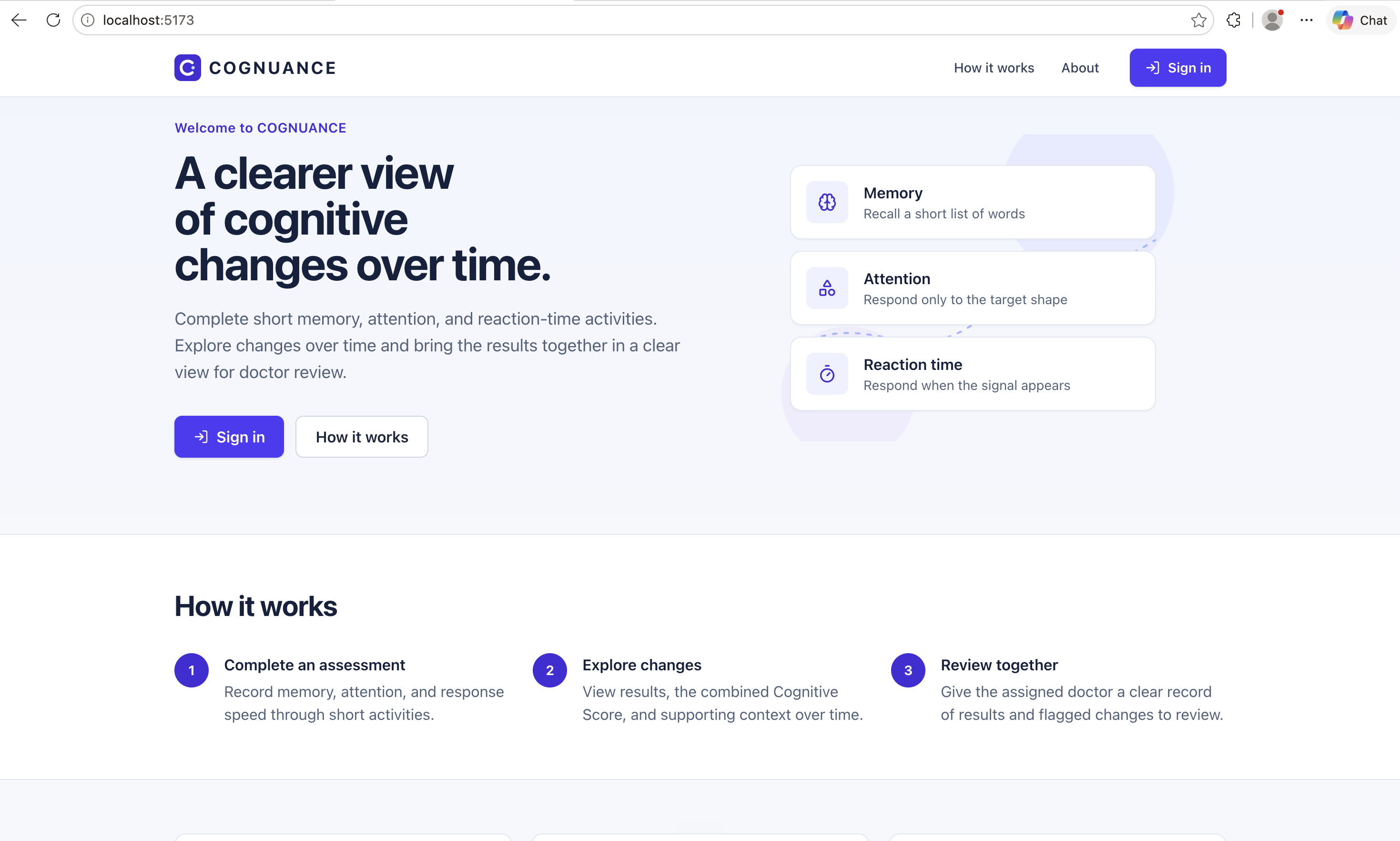
COGNUANCE is an AI-powered prototype designed to monitor cognitive task performance in people living with Alzheimer’s or other forms of dementia.
Patients complete short activities measuring memory, attention, and reaction time, with optional reports about sleep, mood, and medication changes.
The system uses six previous eligible weekly assessments to forecast the next task results. After a new assessment is submitted, it compares actual performance with the stored forecast and evaluates unexpected worsening.
Qualifying changes generate an in-app alert for the assigned doctor. The review screen shows the affected measurements, predicted versus actual results, and relevant history. A dedicated prompt asks the clinician to assess whether further evaluation or testing is appropriate.
Doctors can also explore:
A combined Cognitive Score, displayed above the individual task charts.
A separate Visual Insights tab with heatmaps, change bars, distributions, and context plots.
Comparisons between assessments.
Alert acknowledgment, notes, and resolution history.
How we built it
We built the frontend with React, TypeScript, Vite, and Tailwind CSS. Recharts powers the visualizations, while TanStack Query handles server data and dashboard refreshes.
The backend uses Python and FastAPI, with PostgreSQL for persistent storage, SQLAlchemy for database access, and Alembic for schema migrations. The server validates submissions and calculates scores rather than trusting client-provided results.
Our forecasting model is a custom Gated Recurrent Unit (GRU) network built in PyTorch. It processes six assessments with nine features each: three performance measurements, three context values, and three missing-context indicators.
A GRU layer with 32 hidden units feeds a prediction head that produces the next memory, attention, and reaction-time estimates. We train offline using AdamW and mean squared error, with early stopping, and compare the model against last-value and linear-trend baselines.
Forecasts are stored before new answers arrive. A separate anomaly policy evaluates worsening prediction errors relative to calibrated error scales and checks for repeated deviations.
The Cognitive Score is a versioned arithmetic summary of memory, attention, and normalized response speed. Individual task deviations drive alerts, so an overall score cannot hide a concerning change in one domain.
Challenges we ran into
One challenge was defining exactly what an alert should mean. We focused on unexpected task-performance worsening that warrants review, while leaving interpretation and follow-up decisions to the clinician.
Another was preserving the integrity of the comparison. Forecasts must use only earlier information, missing results must remain unavailable, and interrupted assessments must not be mistaken for cognitive decline.
We also had to make complex information understandable. The dashboard combines a simple overview with access to individual measurements, forecast evidence, context, and review history.
Accomplishments that we're proud of
We brought assessments, forecasting, anomaly analysis, visualization, and clinician review into one application.
We’re especially proud of the traceability: an alert connects back to the assessment, its original forecast, and the evidence that triggered review. The interface lets a doctor move from an overall trend to the specific measurements behind it.
What we learned
We learned that building an AI application requires more than selecting a model. Data quality, comparison rules, reliable storage, and clear explanations determine whether its output is useful.
We also learned to distinguish three separate concepts: predicting performance, summarizing performance, and requesting review. Keeping those responsibilities separate made the system easier to understand and explain.
What's next for Cognuance
We want to explore integrations with wearables such as Apple Watch and WHOOP to bring additional context—such as heart rate, sleep, and activity—alongside cognitive assessments.
With user consent and supported device APIs, these integrations could help us investigate how everyday physiological patterns relate to changes in task performance.
We also plan to improve accessibility and caregiver-assisted use, and work toward clinical validation of the Cognitive Score and alert system
Built With
- alembic
- caddy
- css
- docker
- fastapi
- numpy
- pandas
- postgresql
- python
- pytorch
- query
- react
- recharts
- scikit-learn
- sqlalchemy
- tailwind
- tanstack
- typescript
- vite

Log in or sign up for Devpost to join the conversation.