-
-
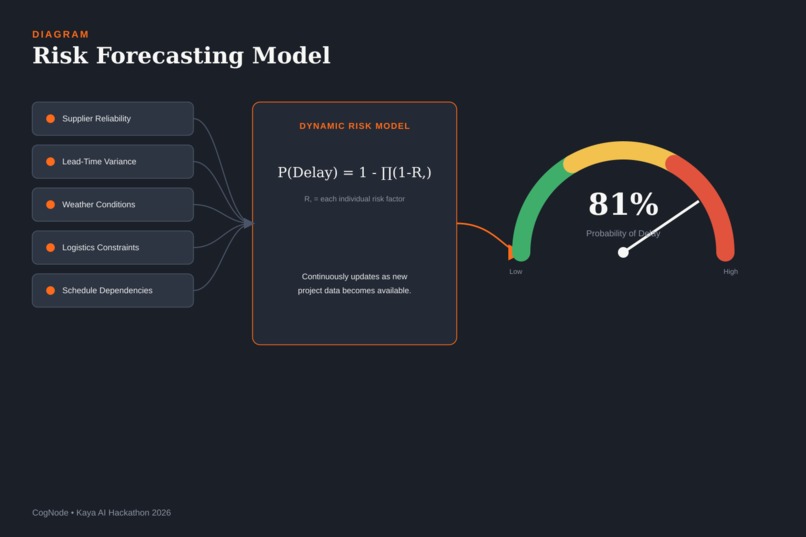
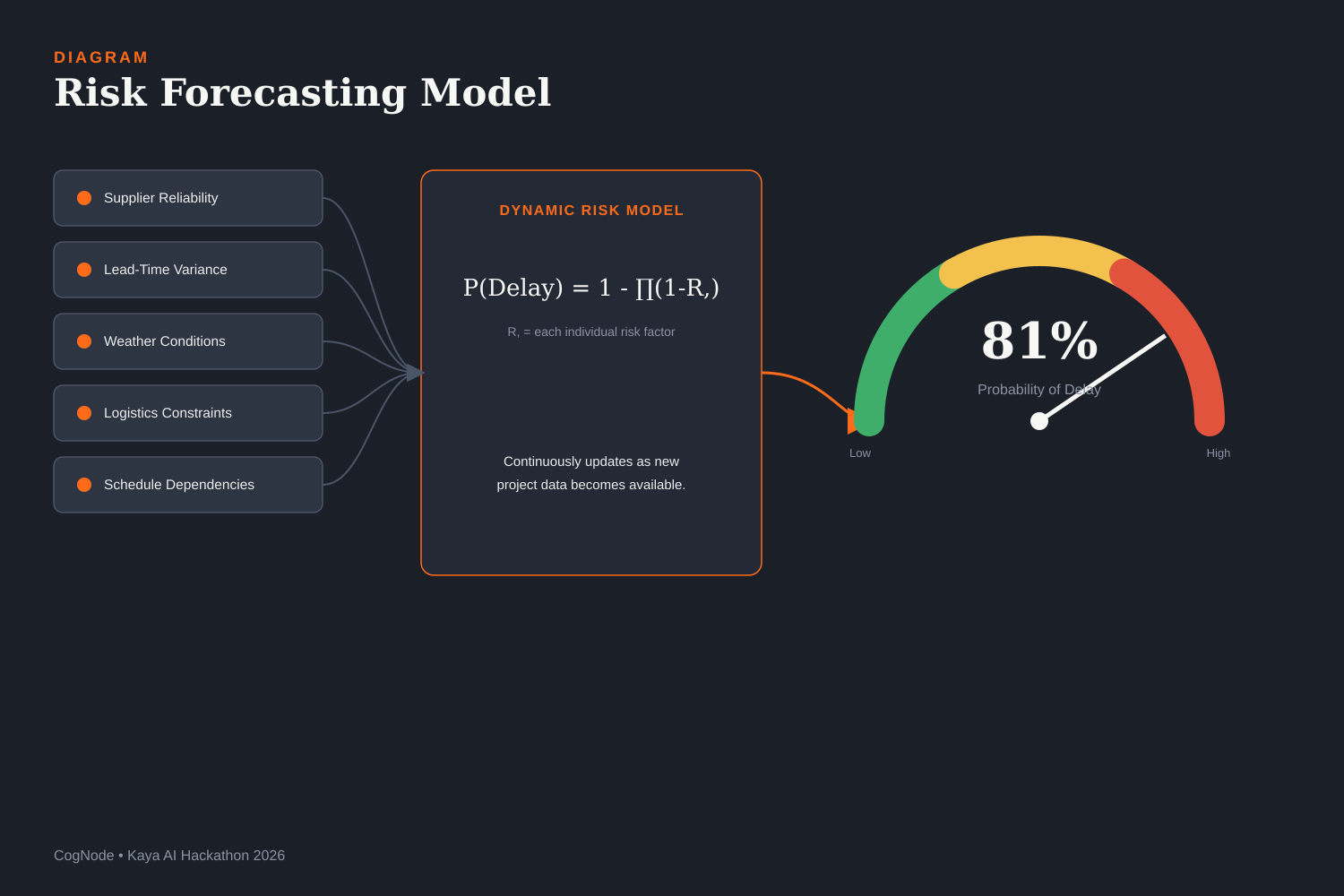
Risk Forecasting Model
-
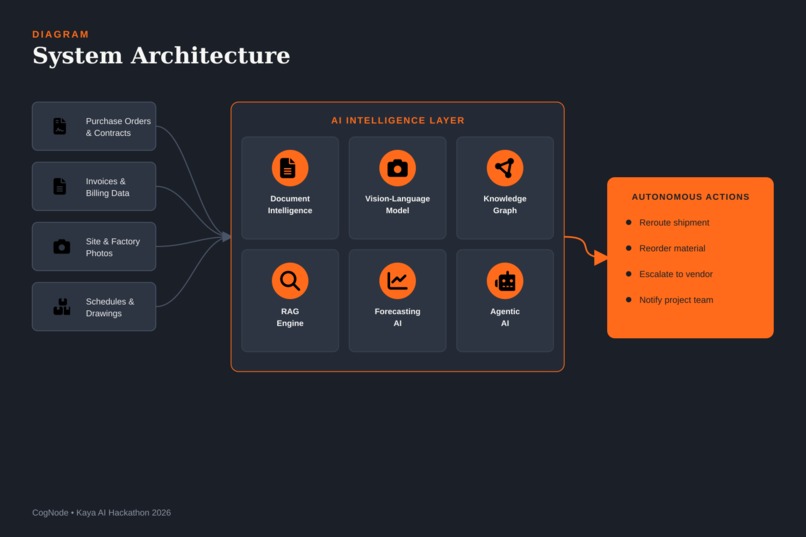
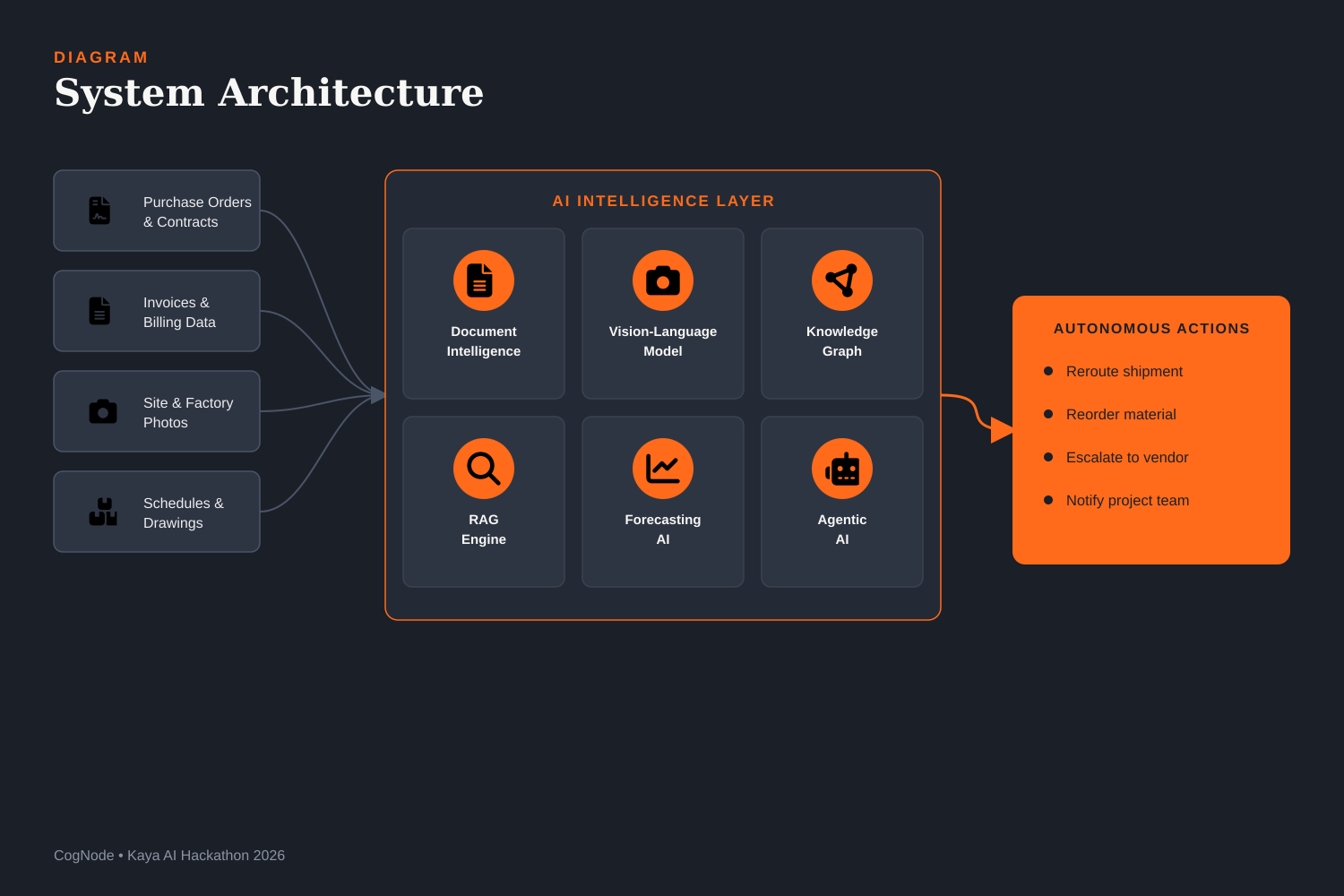
System Architecture
-
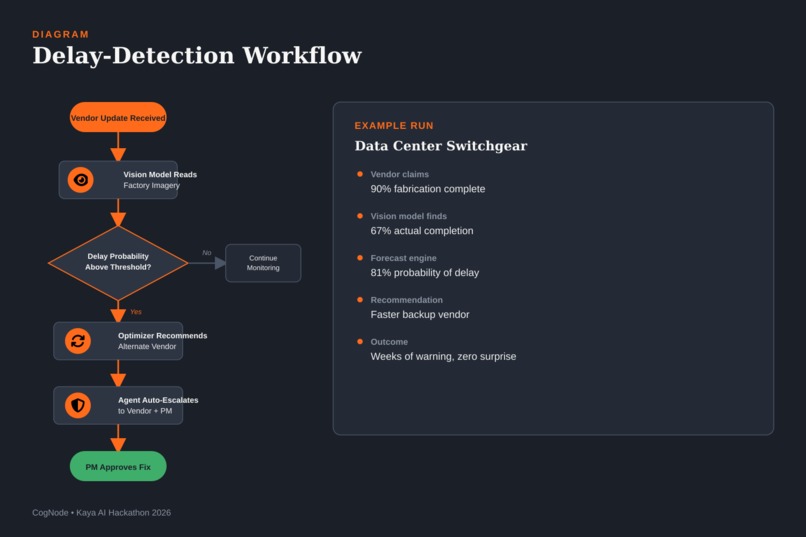
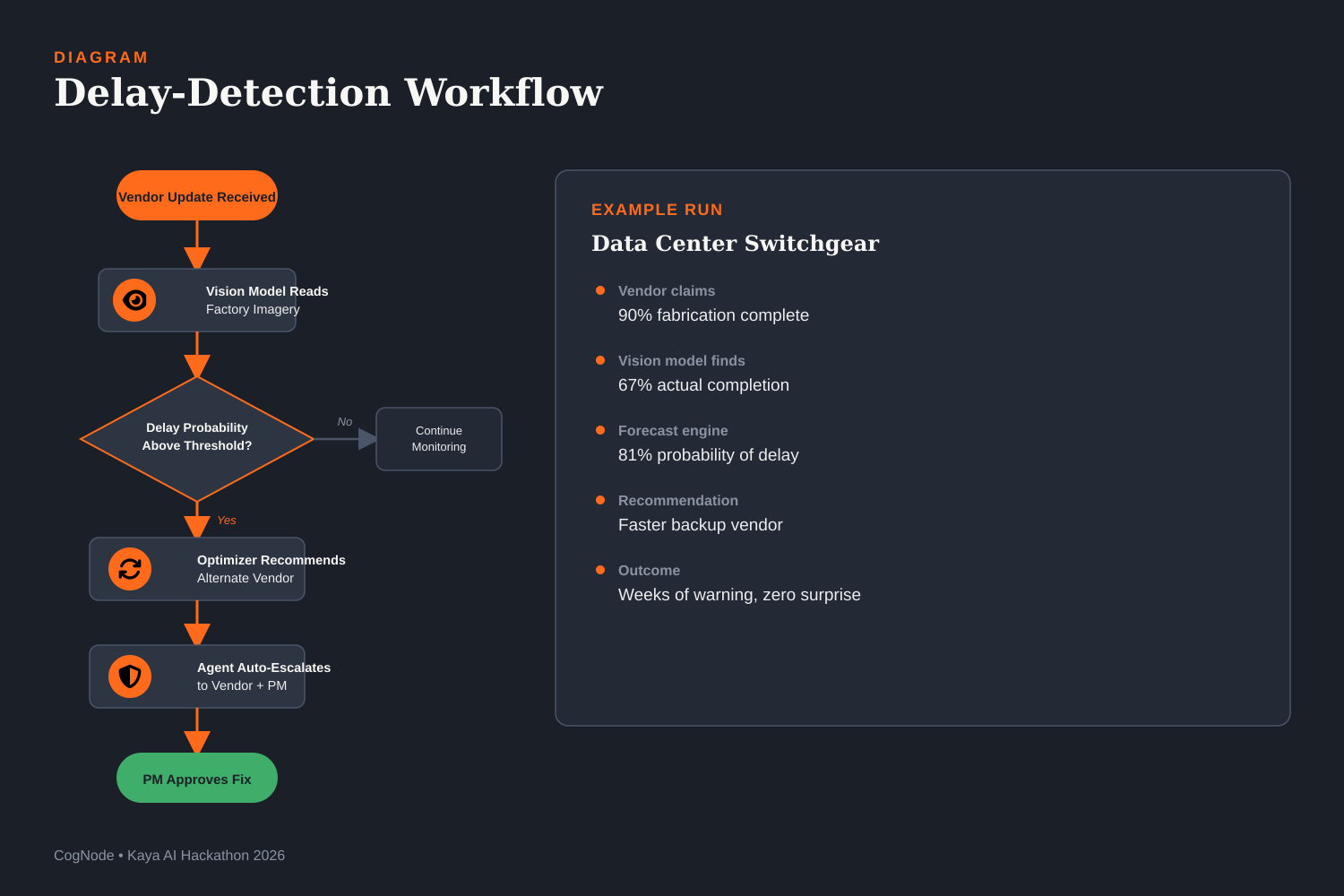
Delay-Detection Workflow
-
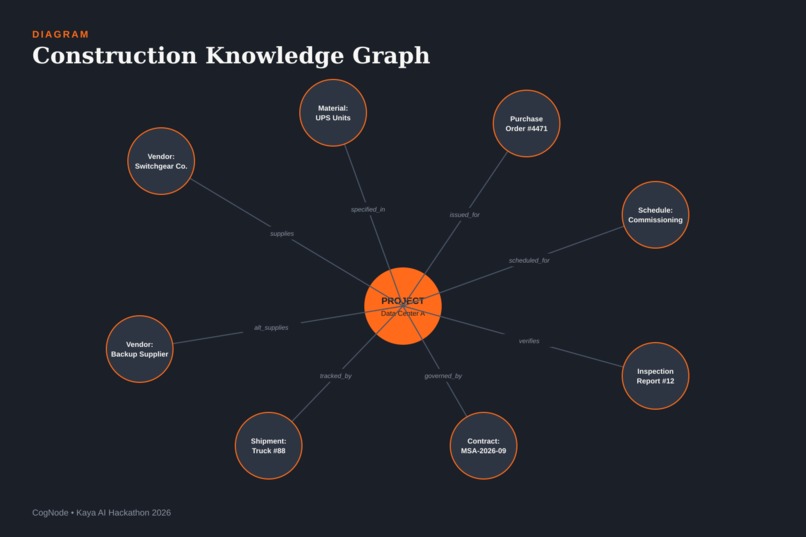
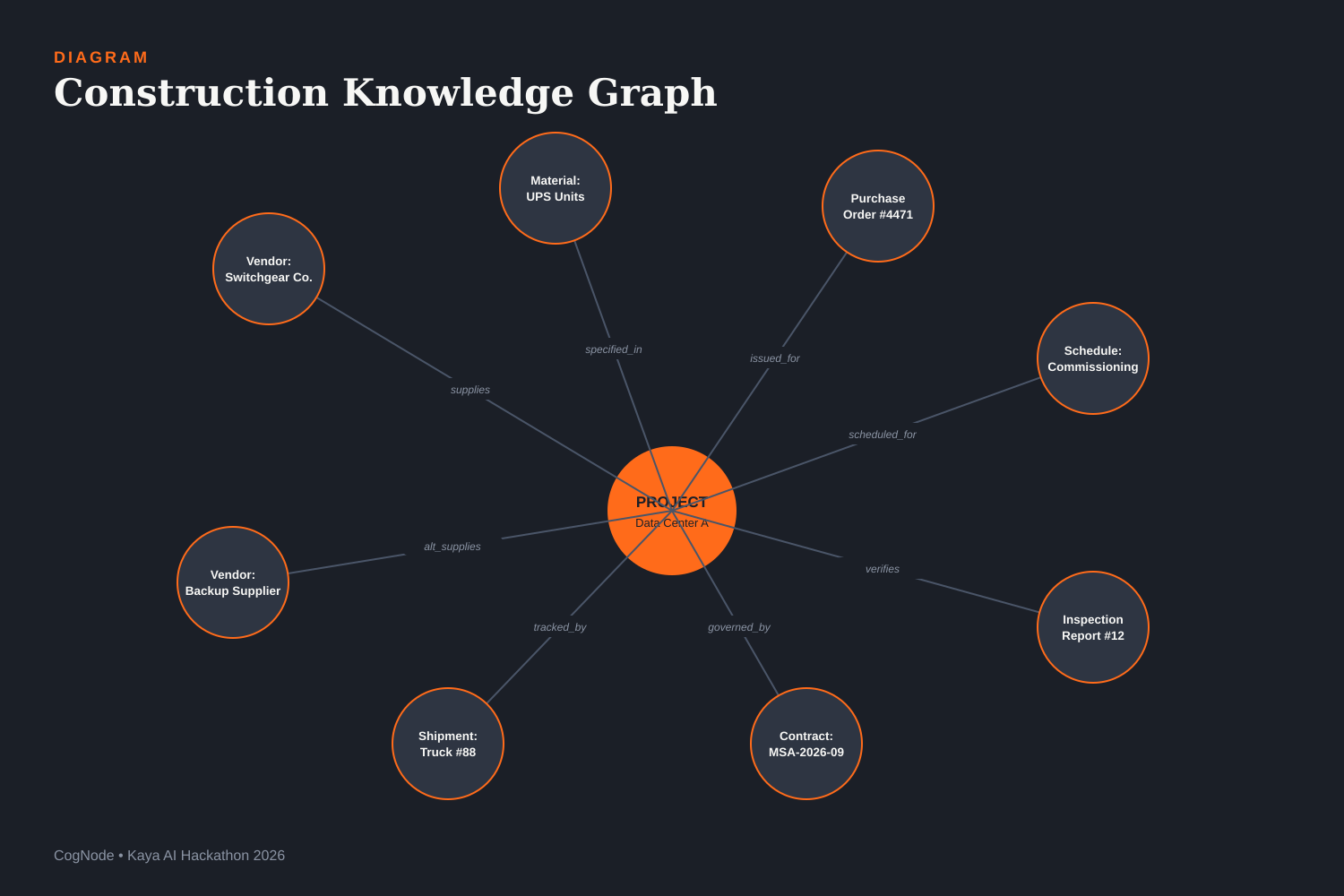
Construction Knowledge Graph
CogNode
The Intelligence Layer for Construction Supply Chains
Cognition + Node — every material, vendor, and milestone becomes an intelligent, connected node in a construction supply-chain brain.
Inspiration
Construction projects worth millions of dollars are often delayed not because materials are unavailable, but because stakeholders lack visibility into where materials are, whether they have been approved, when they will arrive, or what risks may impact delivery. While industries such as manufacturing and e-commerce have embraced intelligent supply-chain systems, construction still depends heavily on spreadsheets, emails, PDFs, phone calls, and fragmented workflows.
Our inspiration came from the realization that every construction project generates enormous amounts of data—purchase orders, drawings, invoices, schedules, logistics updates, inspection photos, fabrication reports, and vendor communications. Yet project teams struggle to convert this information into actionable intelligence. We wanted to build a system that acts as the cognitive nerve center of the construction supply chain, continuously understanding, predicting, and coordinating material movement from procurement to site delivery.
This vision led to CogNode—an AI-powered platform where every document, shipment, vendor, and project milestone becomes a connected intelligence node, enabling smarter decisions across the supply chain.
What It Does
CogNode is an AI-powered construction supply chain intelligence platform that delivers end-to-end material visibility, predictive risk management, and autonomous workflow execution.
The platform combines:
Document Intelligence for procurement and logistics documents Vision-Language Models (VLMs) for site and fabrication image analysis Predictive Analytics for delay forecasting Agentic AI for workflow automation Construction-Specific Knowledge Graph and RAG Architecture
Using natural language, project managers can ask:
What materials are delayed this week? Which deliveries will impact the critical project schedule? What fabrication items are behind plan? Which vendors are high-risk suppliers? What actions should be taken immediately?
Instead of reacting to delays after they happen, CogNode predicts issues before they impact project delivery.
Bringing It to Life: A Representative Scenario
To illustrate how these capabilities work together, consider a representative scenario drawn from a hyperscale data center project—one of the largest and most schedule-sensitive categories of construction today.
A switchgear vendor reports the equipment as ninety percent fabrication complete. CogNode's vision-language model analyzes recent factory imagery against that claim and estimates actual completion closer to sixty-seven percent. Combined with historical vendor performance and lead-time data, the forecasting engine calculates an eighty-one percent probability that this discrepancy will delay a critical commissioning milestone. The optimization layer evaluates alternative suppliers and recommends a faster, marginally higher-cost option that avoids a significantly larger schedule penalty. Autonomous agents then draft the vendor escalation and notify the project team—surfacing in minutes what traditional tracking would take weeks to uncover, if it surfaced at all.
How We are planning to Built It
1. Construction Knowledge Graph
CogNode is designed around a connected intelligence network linking: Purchase Orders Material Specifications Vendors Delivery Schedules Drawings Contracts Inspection Reports Logistics Updates
This construction-specific knowledge graph powers Retrieval-Augmented Generation (RAG), allowing the platform to understand project terminology, material SKUs, vendor references, and engineering specifications.
2. Document Intelligence Engine
Critical supply-chain data is usually buried inside: PDFs Contracts Procurement Records Material Submittals Shipping Documents Fabrication Reports
CogNode is designed to extract and structure information such as: Delivery Commitments Material Quantities Vendor Obligations Lead Times Shipment Milestones Schedule Dependencies
Moving beyond OCR, the system is architected to understand the meaning and relationships behind the data, not just its text.
3. Vision-Language Analysis
Job-site photos and fabrication images provide valuable supply-chain insights that documents alone cannot.
CogNode's vision-language layer is designed to: Verify material availability Assess fabrication progress Detect missing components Compare planned versus actual progress Generate automated progress summaries
This enables visual validation without requiring constant manual inspection.
4. Predictive Risk Intelligence
A forecasting engine continuously evaluates: Supplier Reliability Procurement Performance Lead-Time Variations Weather Conditions Logistics Constraints Project Schedule Dependencies
Risk probabilities are calculated through a dynamic risk model:
P(Delay)=1−∏i=1n(1−Ri)P(Delay) = 1 - \prod_{i=1}^{n}(1-R_i)P(Delay)=1−i=1∏n(1−Ri) Where:
(R_i) represents individual supply-chain risk factors. (n) represents the total number of risk contributors.
The model is designed to continuously learn and update predictions as new project information becomes available.
5. Autonomous AI Agents
CogNode is built to do more than surface insights—it takes action.
AI agents are designed to: Request shipment updates from suppliers Follow up on pending approvals Notify stakeholders of critical risks Generate procurement status reports Escalate delivery exceptions Coordinate follow-up actions
This transforms supply-chain management from reactive monitoring into proactive execution.
Challenges We Faced
Data Silos
Construction data exists across multiple systems, emails, spreadsheets, and documents. Designing a way to connect these disconnected sources into one intelligence platform presented a significant challenge.
Industry-Specific Context
Material codes, engineering specifications, vendor references, and procurement terminology are unique to construction. Generic AI models often struggle with this complexity, requiring us to design domain-aware intelligence from the ground up.
Predicting Uncertainty
Delays result from a combination of factors instead of a single event. Designing a reliable forecasting approach required combining multiple risk indicators into a single, continuously updating model rather than relying on any one signal.
Building Trust
Project teams need to understand why a risk has been identified. Therefore, every recommendation CogNode generates is designed to include supporting evidence, confidence levels, and explainable reasoning—not a black-box score.
What We Learned
Through designing CogNode, we discovered that construction already possesses massive amounts of operational data. The true challenge lies in transforming that data into meaningful decisions.
Key lessons include:
Domain expertise significantly improves AI performance. Intelligent workflows create more value than standalone chatbots. Combining multiple AI techniques delivers stronger results than relying on a single model. Explainability and transparency are essential for enterprise adoption.
Most importantly, we learned that predictive intelligence can dramatically reduce uncertainty and improve project execution across the construction supply chain.
Future Roadmap — What Is Next for CogNode
Future enhancements for CogNode include: ERP and Procurement System Integration Real-Time GPS Shipment Tracking Reinforcement Learning-Based Procurement Optimization Multi-Project Portfolio Risk Analytics Digital Twin Integration Autonomous Vendor Negotiation Agents
Our vision is to make CogNode the operating intelligence layer for construction supply chains worldwide.
Impact
CogNode is designed to transform fragmented construction supply chains into connected, intelligent ecosystems.
Based on early modeling against pilot scenarios and industry benchmarks, CogNode is projected to deliver: 40% earlier risk detection — catching supply disruptions weeks before they reach the site 60% reduction in manual coordination — automating the phone calls, emails, and spreadsheet tracking that dominate procurement today 3x improvement in vendor visibility — real-time status across every supplier and shipment 25% smarter procurement decisions — AI-recommended alternatives that reduce cost and delay exposure
These figures are directional estimates grounded in modeling and comparable industry data, not measured production results—they represent the impact we are building toward as CogNode matures from proposal to prototype.
By combining visibility, prediction, and automation, the platform is designed to help organizations reduce material delays, improve schedule predictability, lower procurement risk, increase project transparency, and enable proactive decision-making.
In an industry where delays can cost millions of dollars, CogNode is built to provide the real-time intelligence needed to keep projects moving forward.
Built With
- ai
- apis
- azure
- blob
- css
- docker
- document
- fastapi
- github
- gpt-4o
- intelligence
- javascript
- langchain
- next.js
- openai
- pandas
- postgresql
- python
- rag
- react
- rest
- scikit-learn
- storage
- tailwind
- typescript


Log in or sign up for Devpost to join the conversation.