-
-
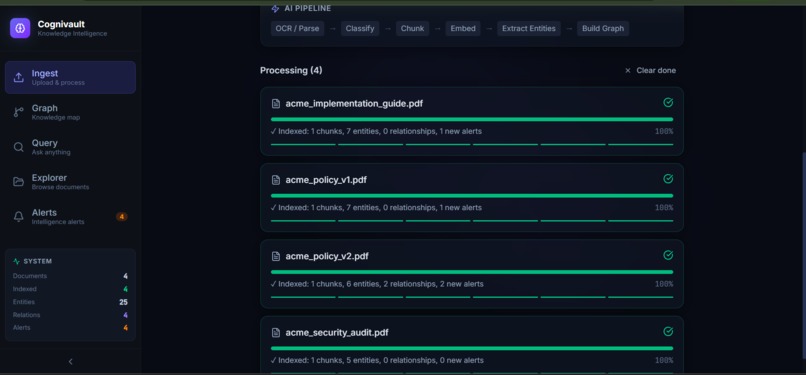
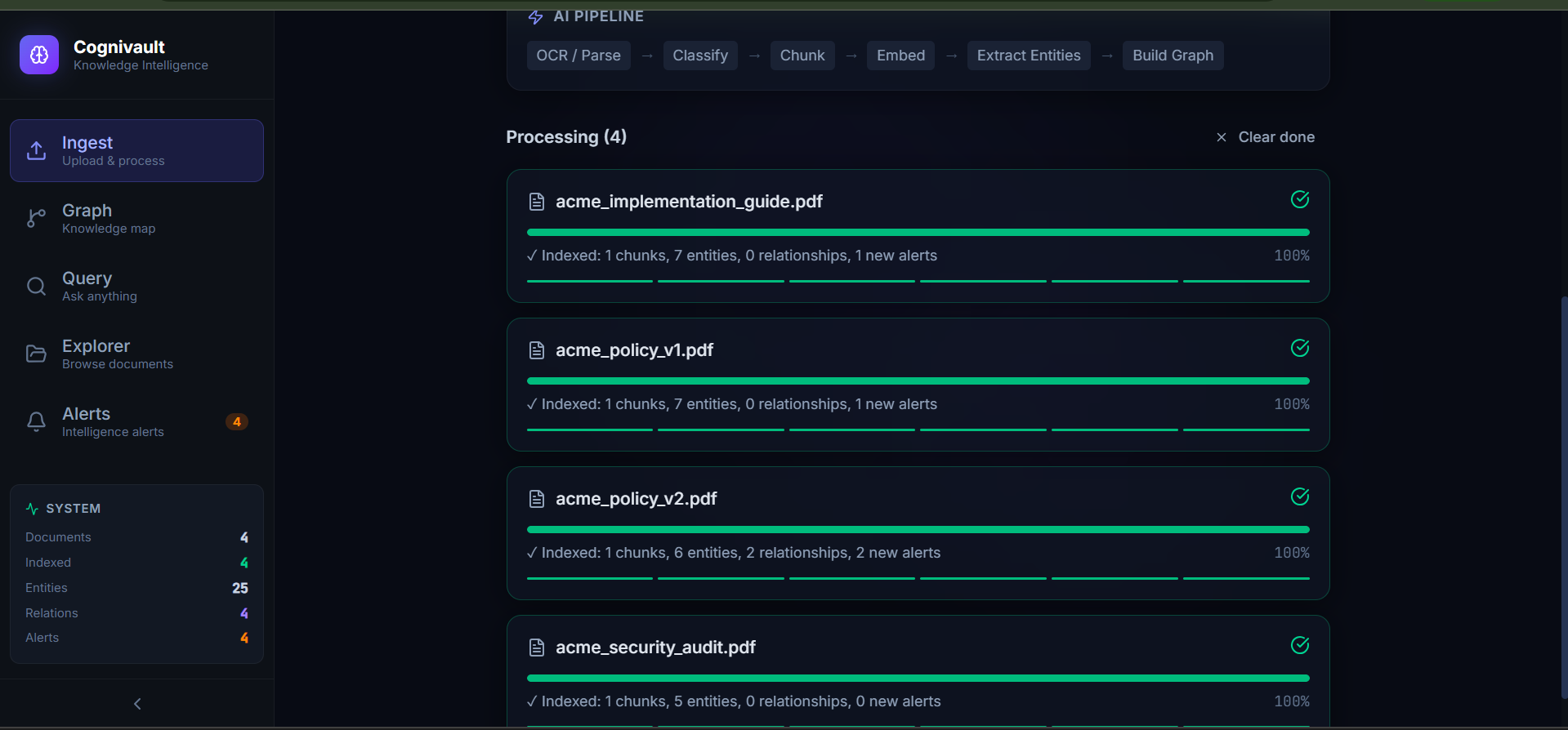
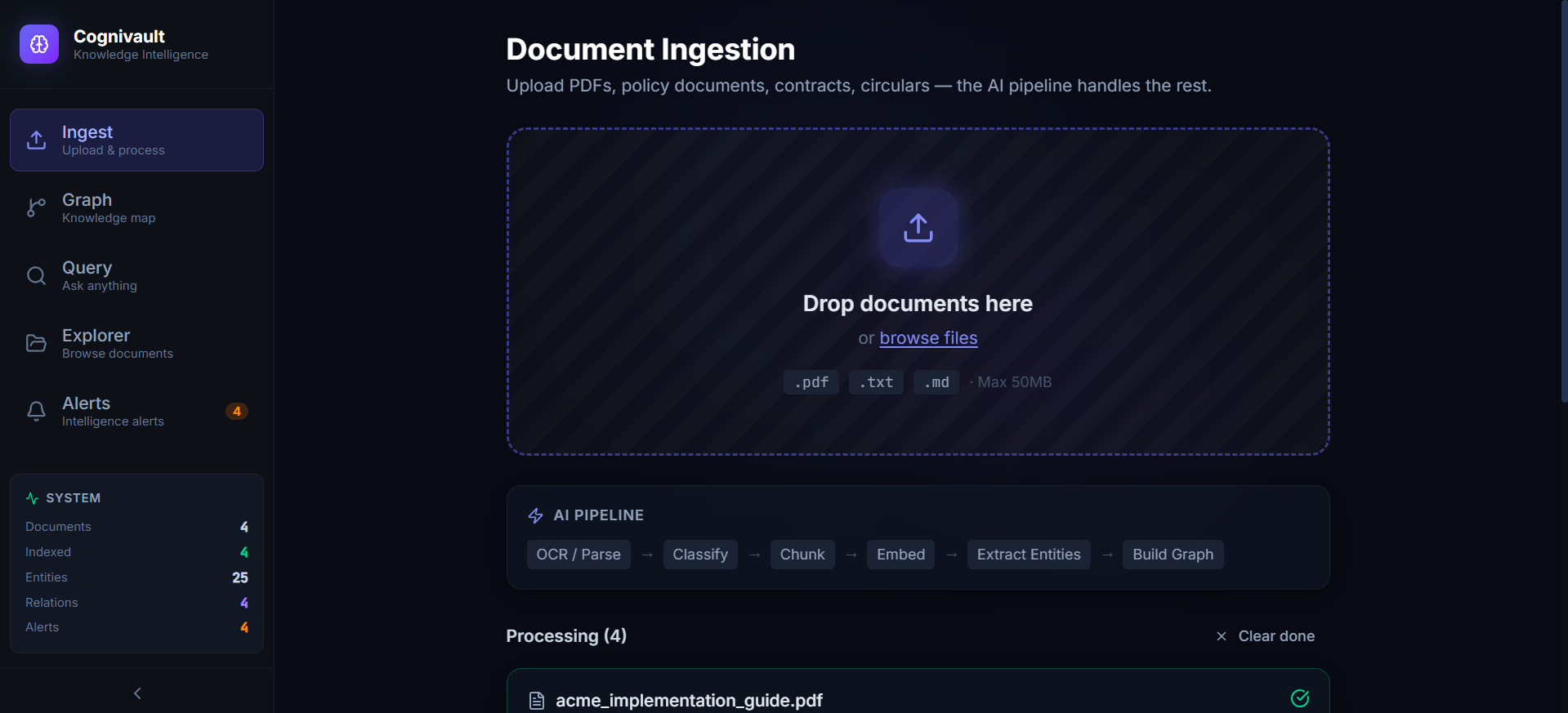
Watch the AI pipeline process documents in real time.
-
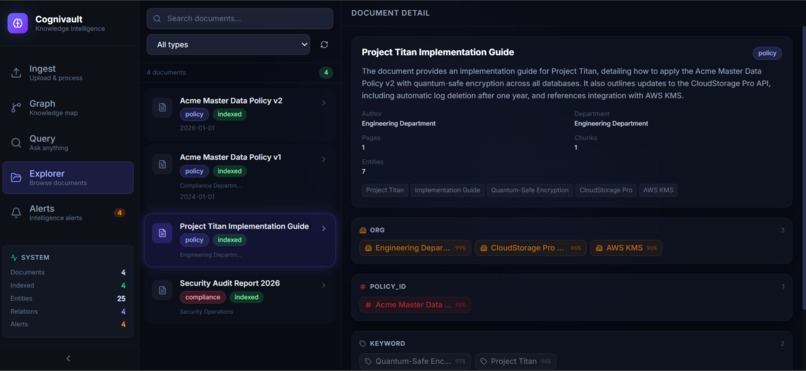
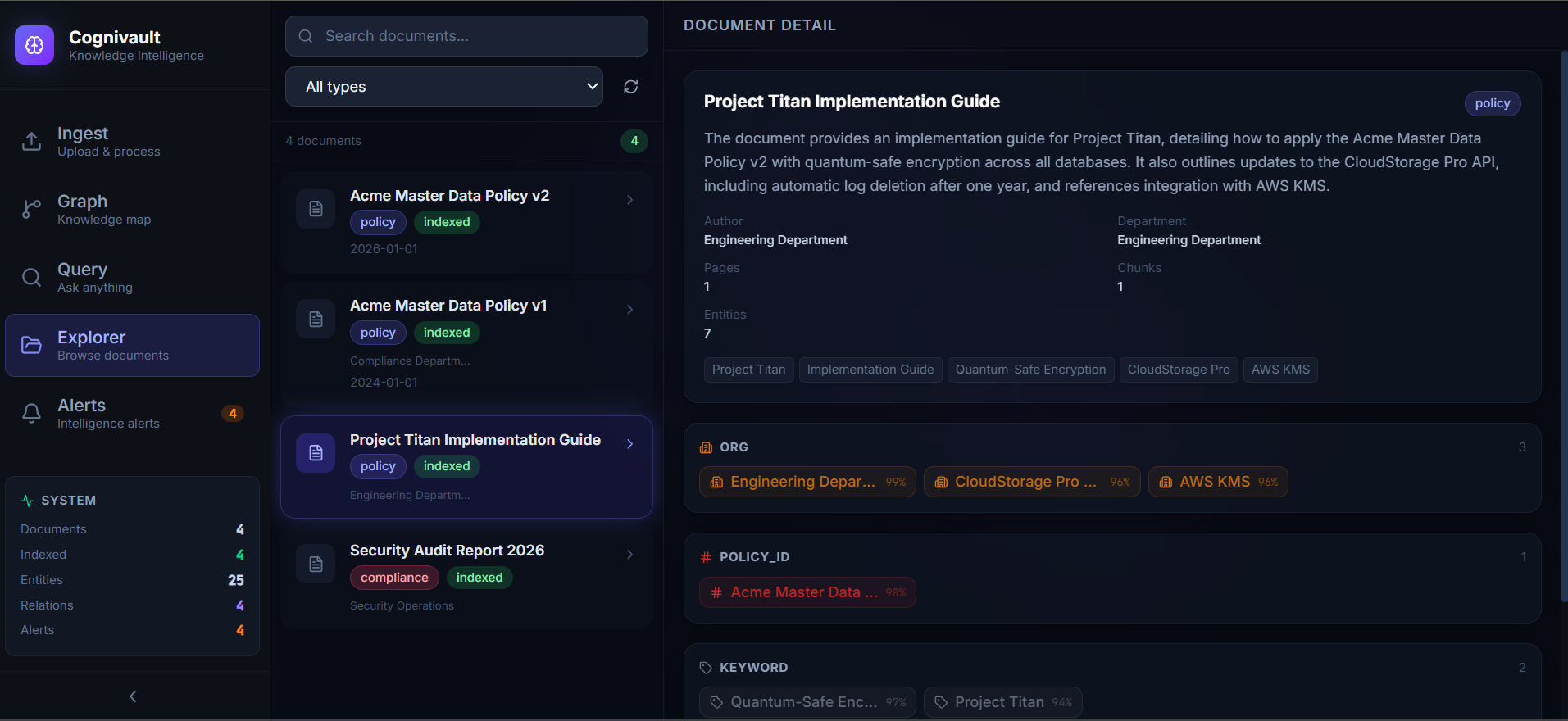
Browse documents with AI-generated metadata and extracted entities.
-
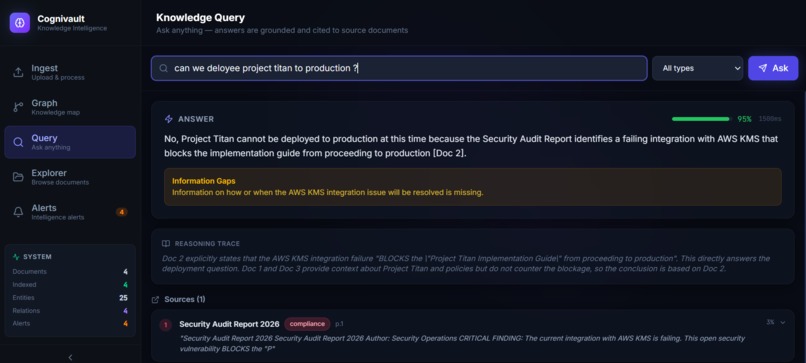
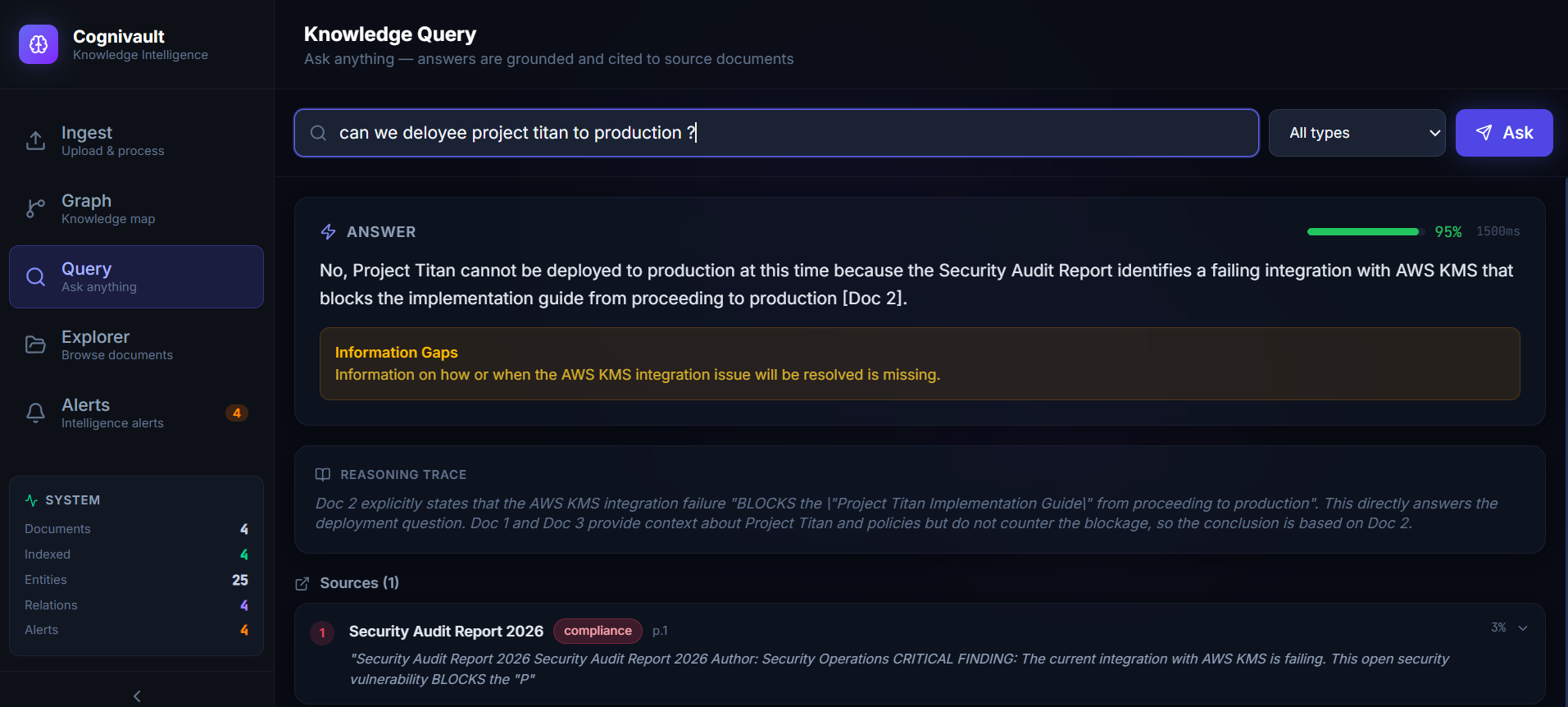
Ask complex operational questions and receive citation-backed answers.
-
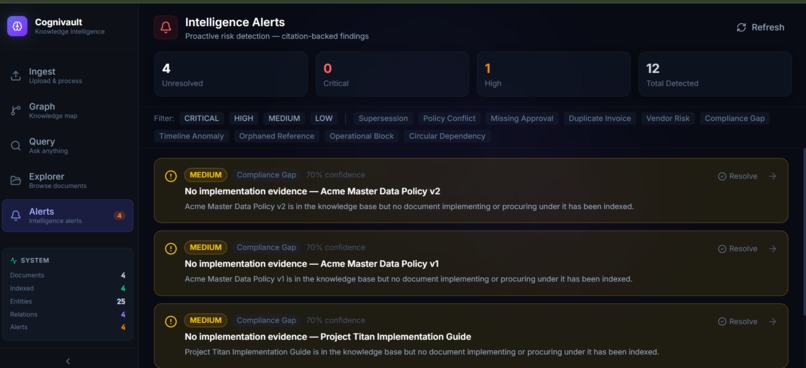
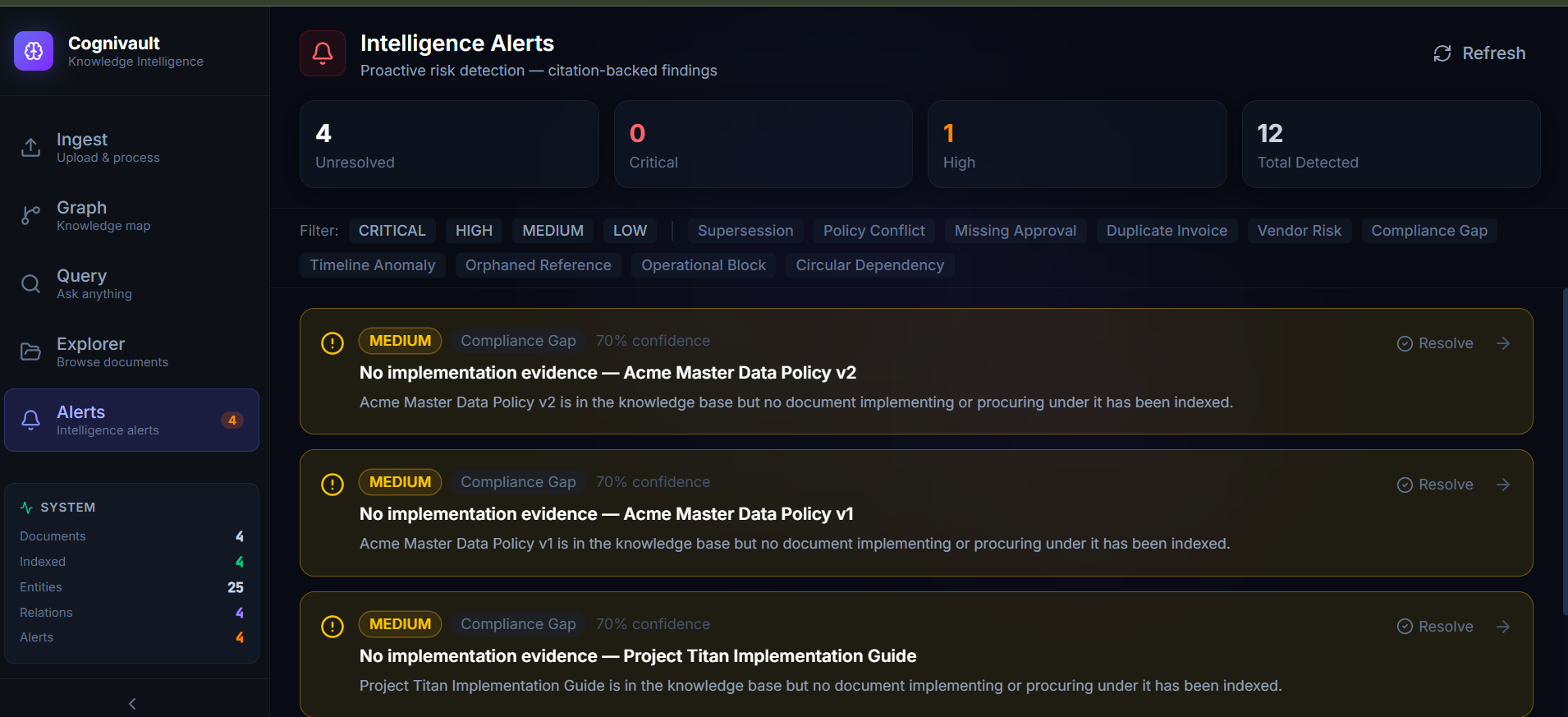
Proactively detect operational risks, compliance gaps, and policy conflicts.
-
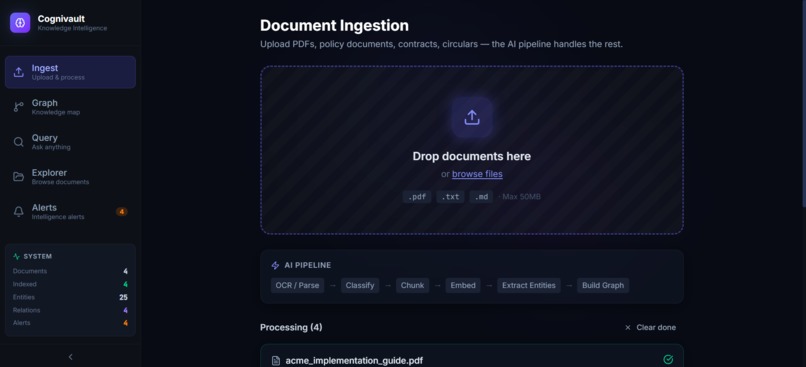
Landing page : Upload documents and let Cognivault automatically process, understand, and organize them into connected intelligence.
-
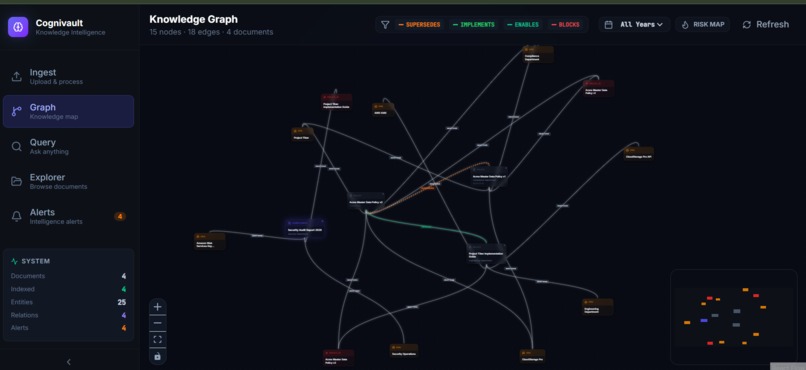
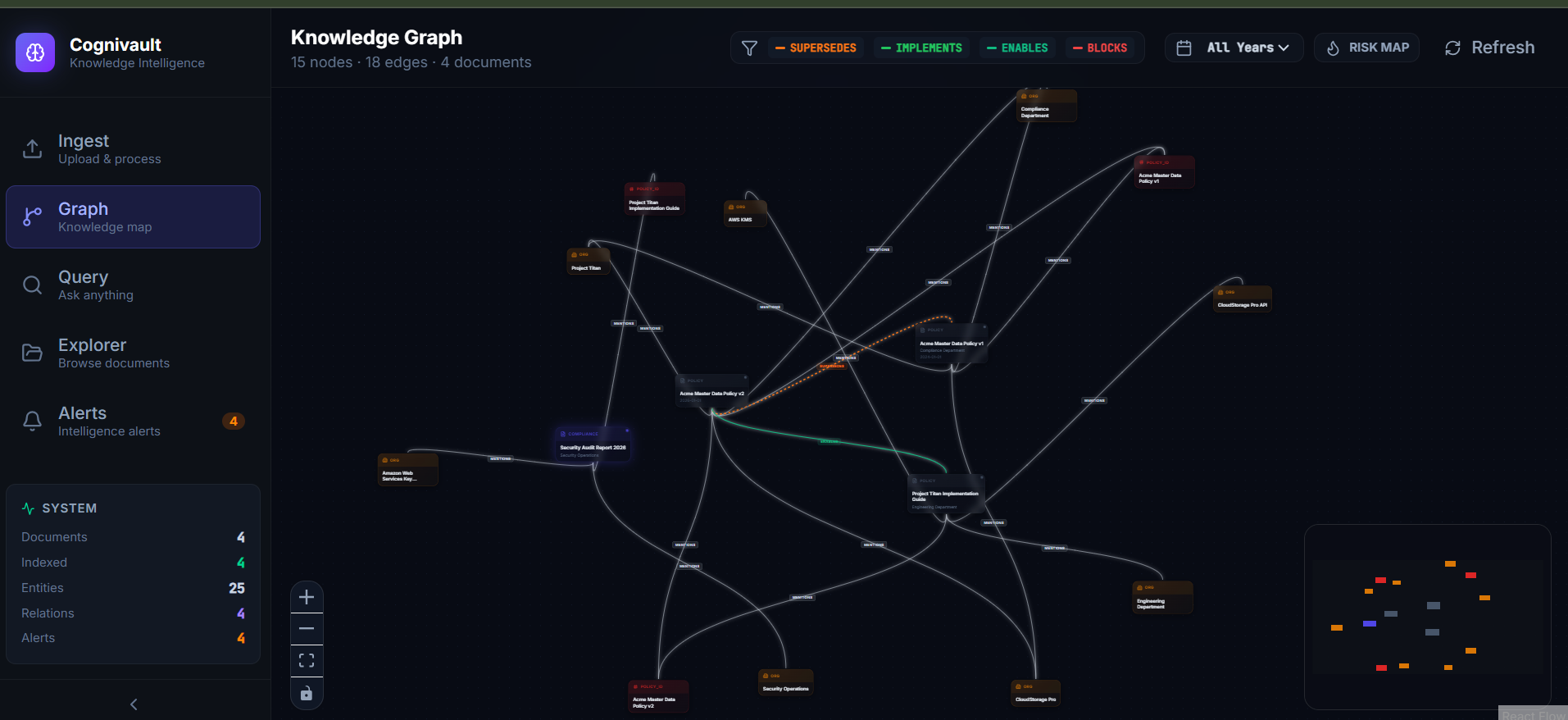
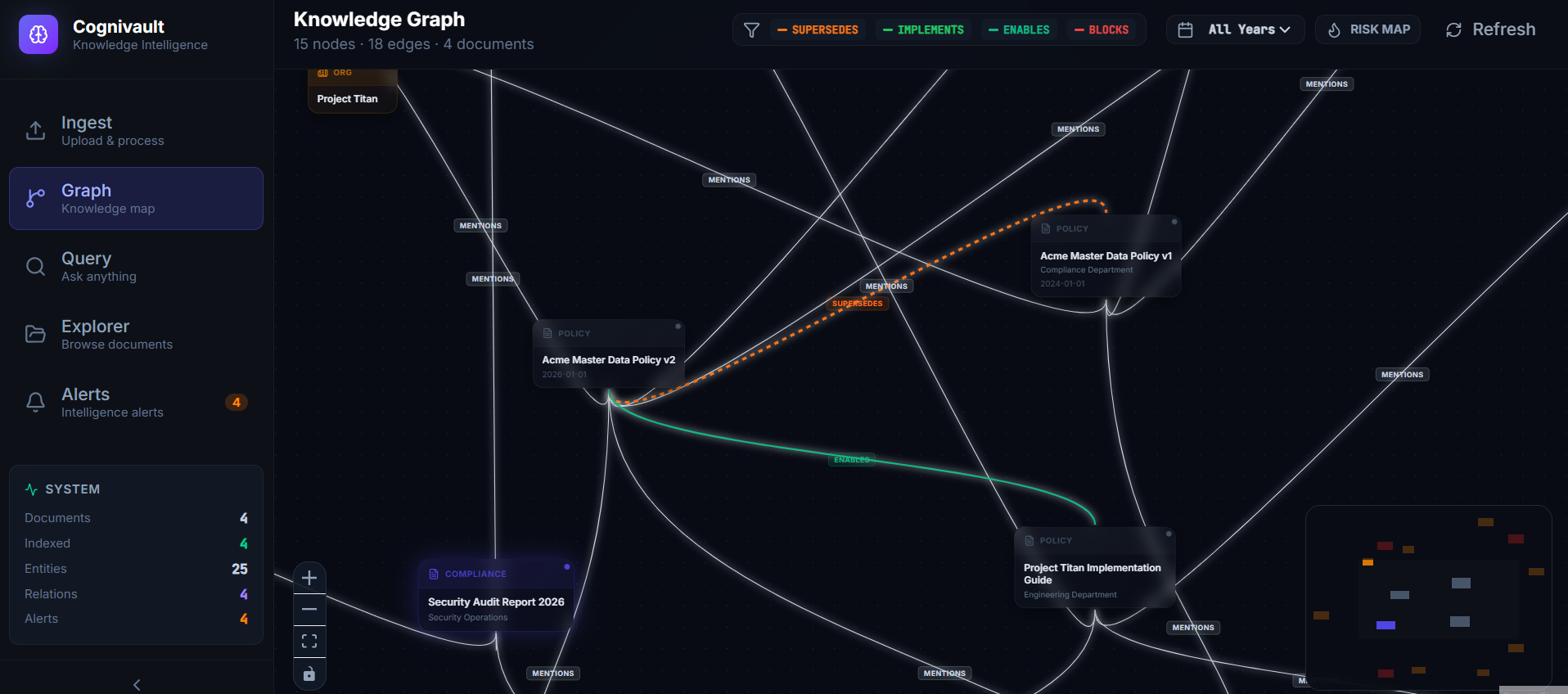
Visualize how documents, departments, policies, and systems are connected.
-
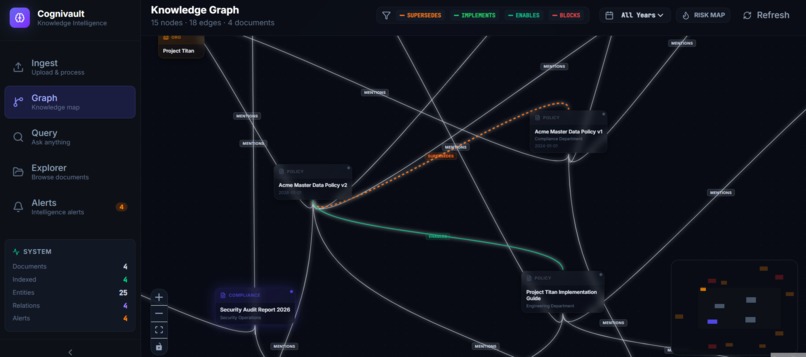
Track policy dependencies and operational relationships visually.
🧠 Cognivault — Autonomous Knowledge Intelligence Platform
Inspiration
Organizations today are drowning in unstructured documents — policies, invoices, contracts, circulars, reports, compliance records, and operational notes. While storage systems have improved, knowledge retrieval and operational understanding remain fragmented.
Most existing “AI document tools” stop at basic summarization or chatbot-style PDF querying. We wanted to go beyond retrieval and build a system that could autonomously structure organizational knowledge, detect operational risks, and surface meaningful relationships across disconnected documents.
Cognivault was inspired by a simple question:
What if organizational documents could become an intelligent, connected knowledge network instead of static files?
Our goal was to build an enterprise-grade AI platform capable of:
- understanding documents semantically
- building relationship-aware knowledge graphs
- detecting operational and compliance risks
- enabling grounded, citation-backed reasoning
- transforming document chaos into actionable intelligence
🚀 What It Does
Cognivault is an AI-powered autonomous knowledge intelligence platform.
Users can upload:
- government policies
- invoices
- procurement records
- contracts
- circulars
- reports
- compliance documents
The platform then autonomously:
- extracts text using OCR pipelines
- classifies documents
- semantically chunks content
- extracts entities and metadata
- detects cross-document relationships
- builds an interactive knowledge graph
- performs hybrid semantic retrieval
- generates grounded answers with citations
- proactively surfaces operational alerts and risks
Unlike traditional RAG chatbots, Cognivault focuses on:
operational intelligence and autonomous knowledge structuring.
🏗️ How We Built It
Frontend
- React
- TypeScript
- TailwindCSS
- React Flow
We built an enterprise-style dashboard with:
- graph visualization
- query-aware highlighting
- temporal filtering
- alert dashboards
- subgraph focus mode
- risk heatmaps
Backend
- FastAPI
- Python
- SQLite + FTS5
- ChromaDB
- NetworkX
The backend orchestrates:
- ingestion pipelines
- semantic retrieval
- graph generation
- anomaly detection
- alert intelligence
- trust validation
AI & Retrieval
We implemented:
- OCR ingestion pipelines
- semantic chunking
- local embedding generation
- hybrid retrieval (vector + BM25)
- reciprocal rank fusion (RRF)
- grounded RAG generation
- hallucination resistance layers
- retrieval quality validation
We also designed a custom operational ontology with relationships such as:
- SUPERSEDES
- IMPLEMENTS
- DEPENDS_ON
- REFERENCES
- ENABLES
- CONTRADICTS
This allowed the system to reason over organizational workflows instead of acting like a generic chatbot.
🧠 Intelligence Engine
One of the most challenging and rewarding parts of the project was building the autonomous alert and reasoning engine.
Cognivault proactively detects:
- superseded policies
- compliance gaps
- broken approval chains
- circular dependencies
- vendor risks
- duplicate invoices
- operational conflicts
The system combines:
- deterministic graph rules
- semantic retrieval
- graph traversal algorithms
- LLM-assisted reasoning
This hybrid approach improved explainability, reliability, and trustworthiness.
⚡ Challenges We Faced
1. Avoiding “Generic RAG App” Syndrome
One of the biggest challenges was avoiding the common trap of building:
“just another chat-with-PDF app.”
We redesigned the architecture around:
- operational reasoning
- graph intelligence
- autonomous alerts
- explainable retrieval
instead of simple conversational AI.
2. Graph Stability & Visualization
Large dynamic graphs became difficult to navigate and visually unstable during ingestion updates.
We solved this by:
- implementing cached graph layouts
- freezing existing node positions
- incrementally introducing new nodes
- enabling focused subgraph exploration
This dramatically improved graph usability and continuity.
3. Hallucination Resistance
Grounded enterprise reasoning required strong trust guarantees.
We implemented:
- similarity gating
- retrieval validation
- evidence scoring
- citation tracing
- insufficient-evidence refusal handling
The system prioritizes correctness over confident hallucinations.
4. Relationship Extraction Complexity
Cross-document relationship extraction introduced scalability and precision challenges.
To reduce unnecessary LLM calls, we implemented:
- entity-overlap gated inference
- deterministic heuristics
- confidence scoring
- ontology-based filtering
This improved both performance and relationship quality.
📚 What We Learned
Through Cognivault, we learned:
- graph-native AI system design
- operational ontology engineering
- hybrid retrieval architecture
- explainable AI pipelines
- graph traversal algorithms
- enterprise UX principles
- hallucination mitigation strategies
- scalable document intelligence workflows
Most importantly, we learned that:
retrieval alone is not intelligence.
True intelligence emerges when systems can:
- connect information
- reason over dependencies
- detect risks
- and surface actionable insights proactively.
🌟 Future Scope
We plan to expand Cognivault with:
- real-time collaboration
- temporal knowledge graphs
- multilingual ingestion
- voice-based querying
- predictive operational intelligence
- workflow automation agents
- advanced graph analytics
- enterprise access control systems
🏁 Final Thoughts
Cognivault evolved from a simple document intelligence idea into a full autonomous knowledge operating system.
By combining:
- semantic retrieval
- graph reasoning
- operational intelligence
- explainable AI
- and proactive alerting
we built a platform that transforms disconnected organizational documents into connected, searchable, actionable intelligence.

Log in or sign up for Devpost to join the conversation.