-
-
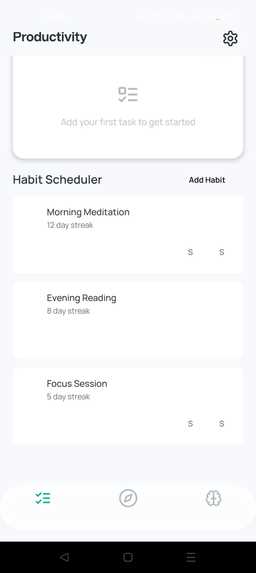
Productivity Tab
-
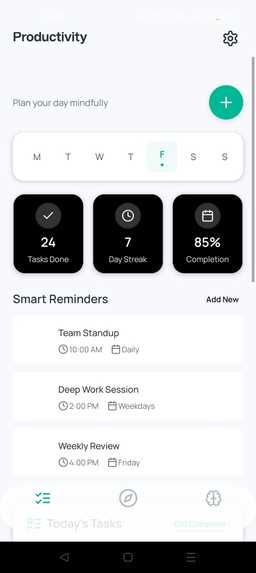
Productivity Tab
Inspiration
In a hyper-connected world, there's a growing struggle with stress, declining focus, and a sense of loneliness, which impairs both productivity and overall well-being. Existing applications offer fragmented solutions, forcing users to switch between separate tools for productivity and mindfulness without intelligent integration. This creates a clear need for a unified platform that addresses these interconnected challenges holistically, moving beyond simple task management to provide truly personalized support for peak performance and mental health.
What it does
Cognito is a dual-platform (Android/iOS) application that merges AI-powered productivity optimization with advanced mindfulness techniques. Its core function is to act as a single, intelligent assistant that enhances both professional output and mental well-being.
Key features include:
Holistic Activity Analysis: The AI engine integrates data from multiple sources with user consent, including in-app behavior, external app usage (screen time), fitness metrics (from trackers like Fitbit, Garmin, Apple Health), and sleep quality data.
Predictive Productivity Modeling: By analyzing this holistic data, the AI forecasts the user's focus capacity and energy levels, dynamically adjusting interventions. For instance, if it predicts fatigue, it might suggest shorter work blocks or a specific mindfulness exercise.
AI-Powered Productivity Tools: The app offers features like time boxing, structured planning, AI-assisted habit formation with deliberate randomization, and an adaptive Pomodoro technique.
Personalized Mindfulness: It provides guided meditations, curated audio environments (including lofi music and binaural beats), and structured journaling prompts based on cognitive behavioral frameworks.
Empathetic AI Coaching: A key differentiator is the AI avatar guide, which develops a psychographic persona of the user to provide personalized coaching. This digital companion offers empathetic support to address emotional barriers to productivity like procrastination and anxiety, and helps combat loneliness.
Gamification of Deep Work: The app includes a novel reward system designed to reinforce sustained focus and the achievement of flow states, going beyond simple streak counters to foster intrinsic motivation.
How we built it
The application is built on a robust and scalable technical architecture designed to support its complex AI and data integration capabilities.
AI Engine & LLM Strategy: A hybrid approach is recommended, combining the strengths of different AI models. Proprietary LLMs (like Google's Gemini or OpenAI's GPT-series) will be used for general-purpose tasks like text summarization and conversational AI. Simultaneously, fine-tuned, self-hosted open-source LLMs (like Llama 3 or Mistral) will be developed for the core, proprietary features such as the predictive productivity engine and the nuanced psychographic persona modeling, ensuring data privacy and customization.
Data Integration Architecture: The system is designed to integrate diverse data streams in real-time. It uses official APIs from platforms like Apple HealthKit, Google Fit, and Android's Digital Wellbeing with explicit user consent. A hybrid processing model is employed, with some data being processed on-device for privacy and low latency, while complex AI model training and holistic analysis occur in the cloud.
Scalable System Design: The backend is built on a microservices architecture, using technologies like Docker and Kubernetes for independent scaling and reliability. It leverages cloud-native services (AWS, Google Cloud, or Azure) and a mix of scalable databases (NoSQL, time-series, relational) to handle large volumes of user data efficiently. Asynchronous processing with message queues (like Kafka) ensures a responsive user experience even while handling intensive background tasks.
Privacy and Compliance: Data privacy is a foundational design principle. The architecture incorporates end-to-end encryption, data minimization, and transparent, granular user consent mechanisms to comply with regulations like GDPR, CCPA, and India's DPDP Act.
Challenges we ran into
The venture anticipates several critical challenges and potential pitfalls that require proactive mitigation strategies.
Technical Underperformance of AI: A core risk is the AI failing to deliver demonstrably superior and tangible benefits compared to simpler apps. If the predictive models are inaccurate or the AI coaching feels generic, the venture's primary value proposition will be undermined.
Data Privacy and Ethical Concerns: The application handles an extensive range of highly sensitive user data, including health metrics, journal entries, and emotional states. Any lapse in security or ethical implementation—such as data breaches, misuse of data, or failure to manage AI bias—could be catastrophic for user trust and brand reputation.
Achieving High User Engagement and Retention: The app market is saturated, and convincing users to consistently engage with a new platform is a major hurdle. Failure to effectively convert free users to the premium tier would render the freemium business model unsustainable.
Effective Monetization and High Costs: The business model's success hinges on maintaining a healthy Lifetime Value to Customer Acquisition Cost (LTV:CAC) ratio. AI development, specialized talent, and cloud computing resources are expensive, potentially leading to initially low gross margins (50-60%) and a significant cash burn rate before profitability is reached.
Accomplishments that we're proud of
Solving the "Integration Gap": The venture's primary conceptual achievement is bridging the gap between productivity and mindfulness applications. It offers a single, synergistic platform, unlike current market solutions that treat these areas in silos.
Pioneering Holistic, Predictive AI: We are proud of the design for a truly holistic AI engine that synthesizes in-app behavior, screen time, fitness data, and sleep quality. This allows the app to move beyond reactive suggestions to a predictive and adaptive model, forecasting a user's cognitive state to dynamically tailor interventions in real-time.
Innovating with Empathetic AI Companionship: A significant accomplishment is the feature of an AI-driven avatar guide designed to address emotional well-being and combat loneliness. This transforms the application from a purely functional tool into a supportive, companionate digital assistant, filling a significant market gap and tapping into a deeper human need for connection.
Meaningful Gamification: The concept moves beyond superficial gamification (like basic streak counters) to a more sophisticated "gamification of deep work". The proposed system aims to foster intrinsic motivation by offering meaningful rewards tied to achieving genuine flow states and sustained focus.
What we learned
The Market Demands Integration: We learned that the most significant market opportunity lies in the "Integration Gap". Users currently juggle multiple single-purpose apps for productivity and wellness. A platform that intelligently synthesizes these functions into a seamless, unified experience addresses a clear and unmet user need.
AI is the Key Growth Driver: The markets for AI-powered productivity tools and habit-tracking apps with AI features are growing at exceptionally high rates (CAGRs of 26.7% and 14.41%, respectively). This validated our "AI-first" strategy and confirmed that emphasizing the unique predictive and personalization capabilities of the AI is critical for market differentiation and success.
A Freemium Model is Essential for Success: We learned that a freemium business model is the most strategic approach. This model is crucial not only for lowering the barrier to entry and facilitating rapid user acquisition but also for gathering the necessary data to train and refine the AI algorithms, thereby creating a virtuous cycle of product improvement.
Privacy is a Competitive Advantage: Given the sensitive nature of the data involved, we learned that robust, transparent, and ethical data privacy is not just a compliance requirement but a critical success factor and a potential source of competitive advantage. Building unwavering user trust is non-negotiable.
What's next for Cognito
Securing Seed Funding: The immediate next step is to secure a seed funding round of approximately $1.5–2.5 million. This capital will be used to finalize product development, scale the AI engine and backend infrastructure, execute the go-to-market strategy, and expand the core team.
Go-to-Market Launch: We will execute a multi-channel go-to-market strategy focused on the 14-50 urban demographic. Key channels will include App Store Optimization (ASO), content marketing centered on the "Al Advantage," paid social media advertising, and authentic influencer partnerships to build trust and drive initial adoption.
Achieving Key Milestones: The goal over the next 18-24 months is to achieve critical milestones that demonstrate product-market fit and readiness for Series A funding. These include successfully launching V1.0 of the app, acquiring an initial user base (e.g., 100k-250k downloads), validating the freemium conversion funnel (e.g., reaching 5k-10k premium subscribers), and proving the efficacy of the AI through strong engagement metrics.
B2B Expansion: While initially focused on a B2C model, a key part of the long-term strategy is to pursue B2B expansion pathways. This involves initiating pilot programs with corporate wellness platforms and universities in Year 2-3, offering a scalable revenue stream and a channel for efficient user acquisition.
Long-Term Vision & Exit Strategy: The long-term vision is for Cognito to become the leading platform for AI-driven personal optimization. Potential exit strategies include acquisition by a major technology company (like Google or Microsoft), a leading productivity software player (like Notion or Asana), or a major digital wellness company (like Headspace Health or Calm) within a 5-10 year timeframe.

Log in or sign up for Devpost to join the conversation.