About the project
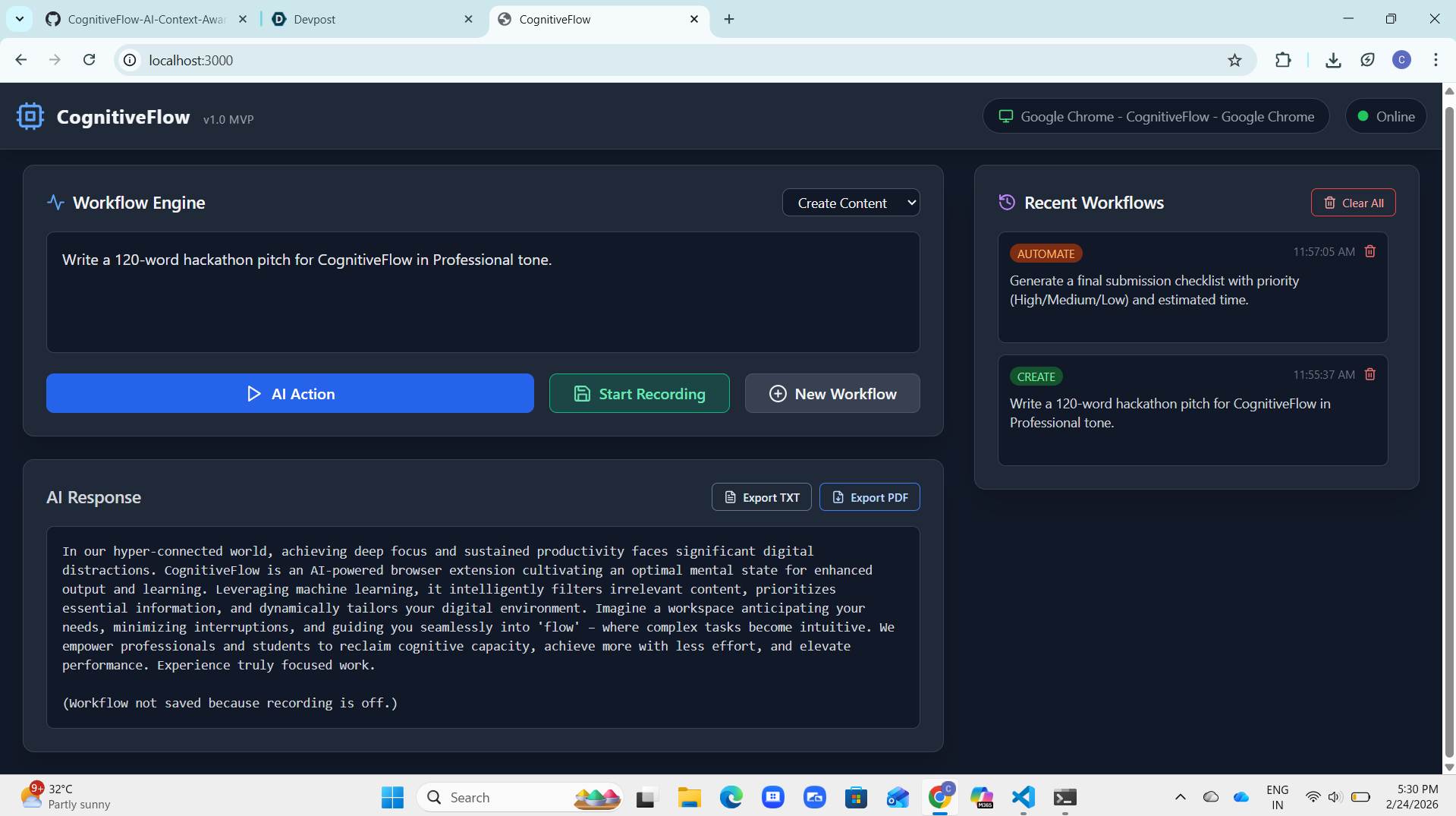
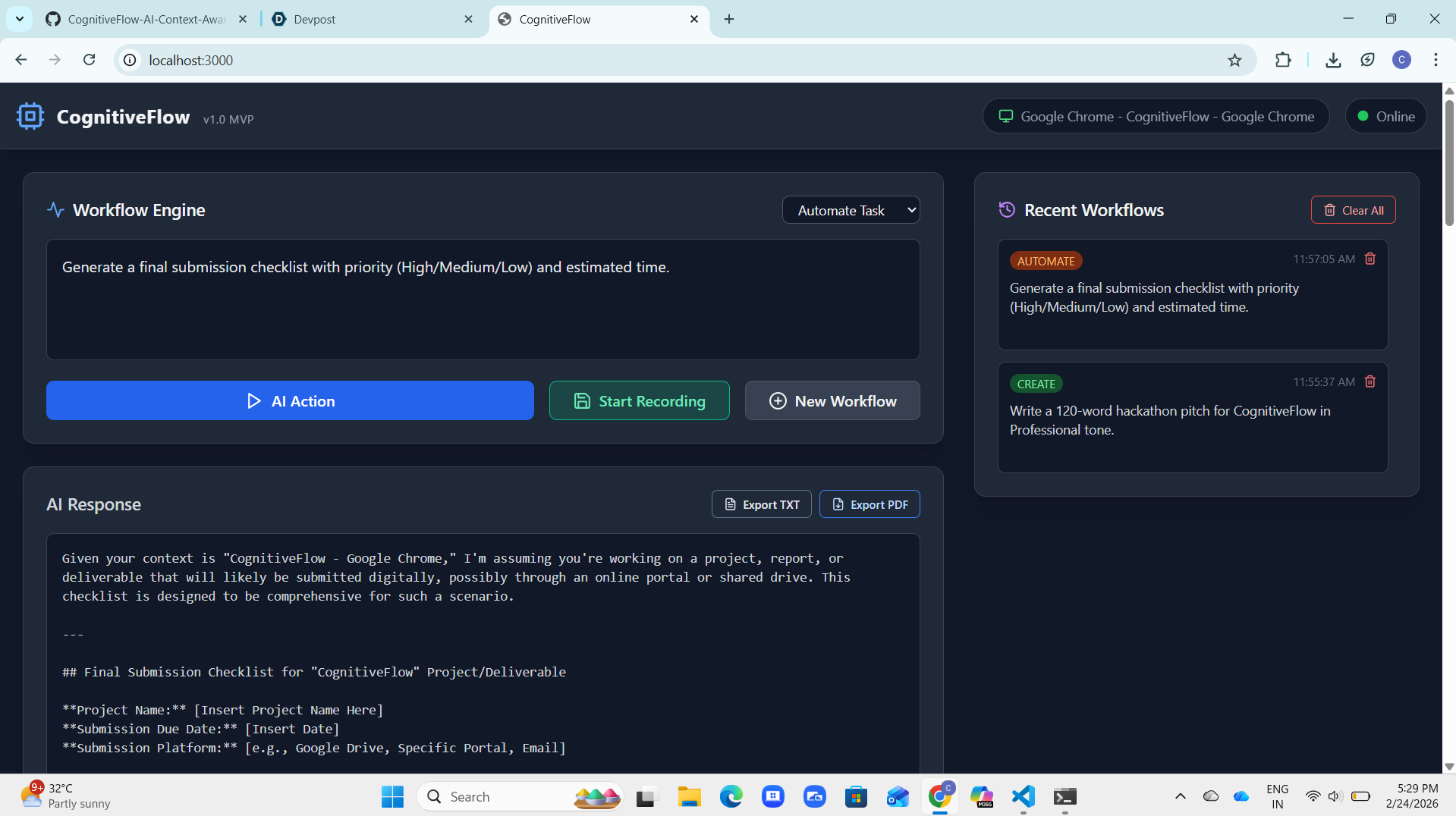
CognitiveFlow is an AI context-aware workflow engine that blends desktop context detection with generative AI to reduce friction between user intent and execution.
The app detects what the user is currently doing (active app + window title), lets the user issue a request in one of three modes (analyze, create, automate), and stores every workflow in a replayable timeline.
Inspiration
Most AI tools are context-blind. Users repeatedly copy-paste context and lose momentum switching between apps.
We wanted to build a desktop-first assistant that understands context automatically and responds with less prompting overhead.
How we built it
- Backend: FastAPI + async endpoints for context detection, AI calls, history, and replay.
- AI layer: Gemini integration with model resolution from configured access tier.
- Storage: SQLite + SQLAlchemy for durable workflow history.
- Frontend: React + Tailwind dashboard with live context indicator and workflow timeline.
- Desktop simulation: Electron wrapper for a native-like experience.
- Export: Download AI response as
.txtor.pdffrom the UI.
Challenges we faced
- API-key and model compatibility across Gemini tiers (1.5 vs 2.5/3.0 access).
- Handling blocking operations (window detection + model calls) inside async API flows.
- Making Electron startup reliable in mixed shell environments.
- Keeping the UX clean while exposing advanced controls (recording, replay, export).
What we learned
- Reliable AI products depend as much on error handling and fallback logic as prompt quality.
- Context-aware UX significantly improves perceived intelligence.
- Even for MVPs, production hygiene (env management, docs, licensing, reproducible startup) matters.
Lightweight scoring intuition
The project uses context and user intent to improve output relevance:
$$ \text{usefulness} \approx f(\text{context quality},\ \text{prompt clarity},\ \text{model capability}) $$

Log in or sign up for Devpost to join the conversation.