-
-
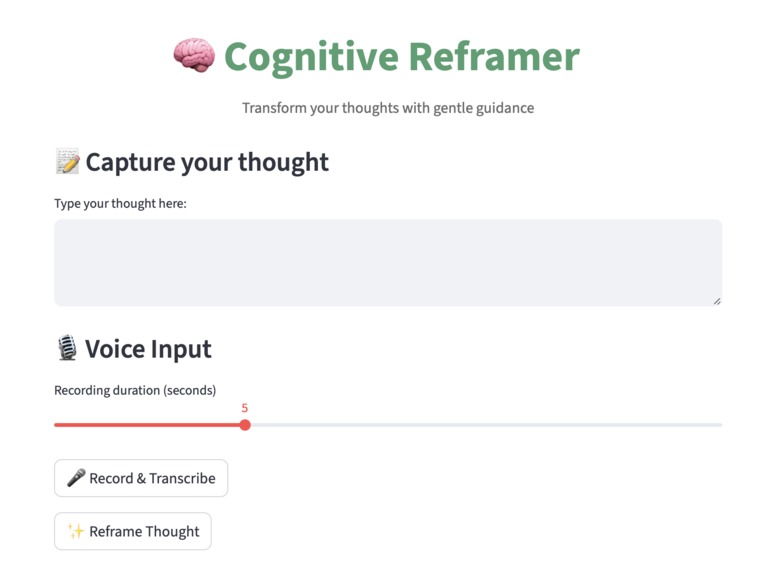
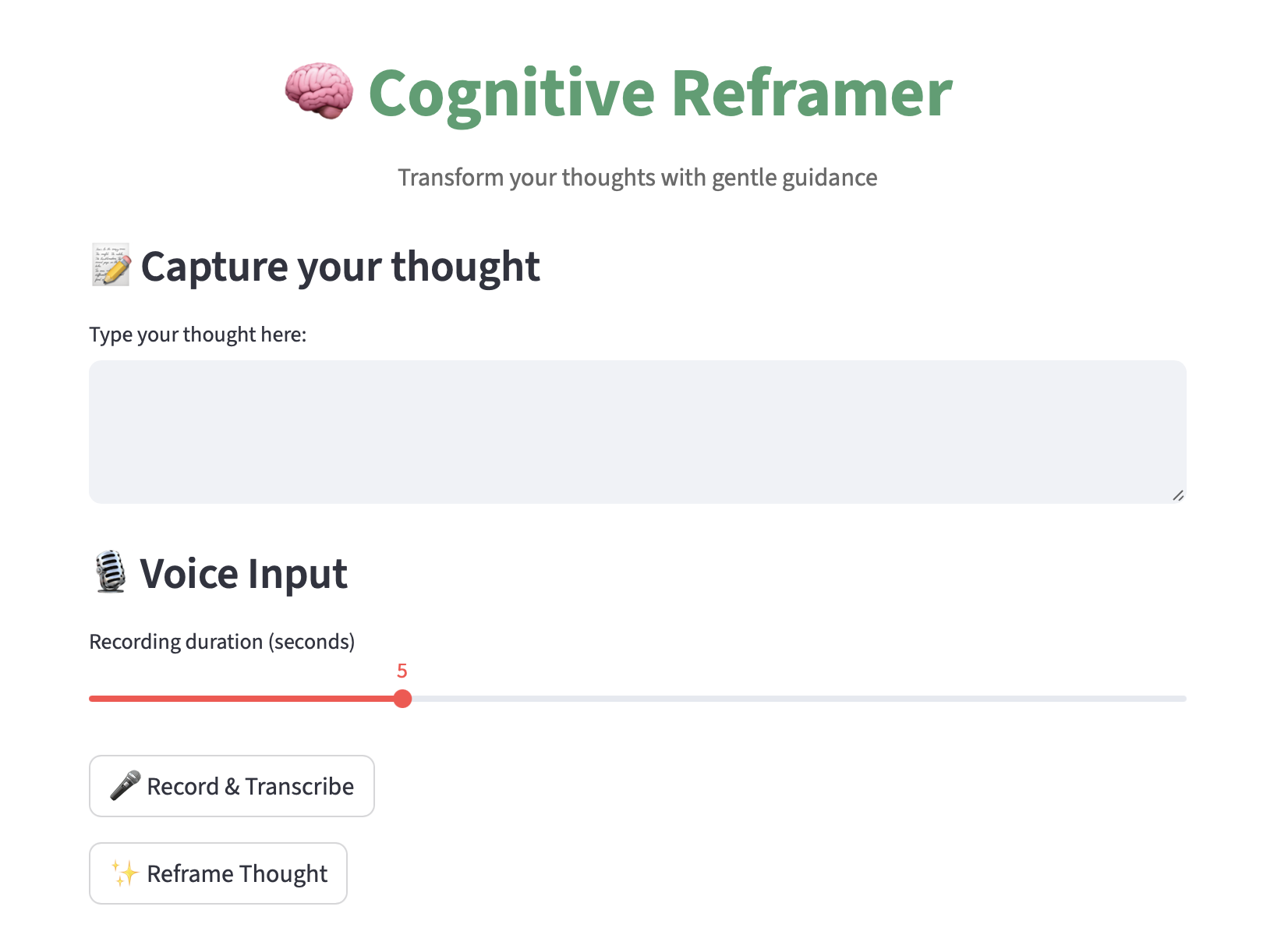
Main UI
Inspiration
The inspiration for this project stemmed from personal experiences and an increasing awareness of the importance of mental well-being. In a world with constant stressors, I recognized a need for practical, easy-to-use tools that empower people to take control of their thoughts. I was particularly inspired by the principles of Cognitive Behavioral Therapy (CBT) and wanted to create a digital artifact that could make these techniques more approachable for everyone. It was about turning abstract psychological concepts into a tangible, interactive experience.
What it does
Cognitive Reframer is a tool designed to help individuals practice cognitive reframing—the psychological technique of identifying and challenging negative or irrational thoughts. The goal is to provide a simple, accessible platform that guides users through the process of changing their perspective on difficult situations, promoting a more balanced and positive mindset. Keep this project accessible offline as well so that people are more comfortable sharing their difficulties.
How we built it
The project was built over a 48-hour period during the hackathon. For this MVP, our priority was user comfort and privacy. We intentionally designed it as a completely private, offline tool with no data storage or cloud-based services. We used a GPT-oss model via Ollama locally and leveraged its reasoning capabilities to generate the reframed thoughts. All processing is done on the user's local machine, ensuring that their stressful and negative thoughts never leave their device.
The development process was highly iterative. We began with wireframes and a minimal viable product (MVP) focused solely on the core functionality.
Challenges we ran into
The biggest challenge was scope management. It's easy to get carried away with ideas during a hackathon, and we had to constantly remind ourselves to focus on the core functionality that provided the most value. Another significant hurdle was ensuring the user experience felt supportive and not like a chore. This involved a lot of design tweaking to perfect the flow and wording of the prompts.
Accomplishments that we're proud of
We successfully built a functional MVP within the 48-hour. We are proud of our ability to implement key features, such as the core reframing engine, and to overcome the technical challenges we faced with the local LLM setup. Our greatest accomplishment, however, is creating a tool that makes psychological concepts more accessible and user-friendly, all while prioritizing user privacy.
What we learned
Building Cognitive Reframer was a journey of learning on multiple fronts. From a technical perspective, I gained a deeper understanding of local-first application design and the complexities of integrating and debugging a local LLM. I also honed my skills in frontend development, focusing on creating a clean, intuitive, and calming user interface. The most significant lesson, however, was in the intersection of technology and psychology. I learned that designing for mental health requires immense care and empathy, and that a lack of storage can be a powerful feature for building trust. The challenges were invaluable learning experiences that reinforced the importance of solid planning and adaptable problem-solving.
What's next for Cognitive Reframer
In the next phase of this project, we plan to evolve from a simple MVP. Our focus will be on allowing users to save the techniques and insights they learn, along with any personal notes they choose to make. This will empower them to build a reference library of their own strategies without storing the initial negative thoughts. We also aim to create a native Mac-specific app to provide an even more seamless and integrated user experience.
Built With
- fastapi
- gpt-oss:20b
- ollama
- python
- whisper

Log in or sign up for Devpost to join the conversation.