-
-
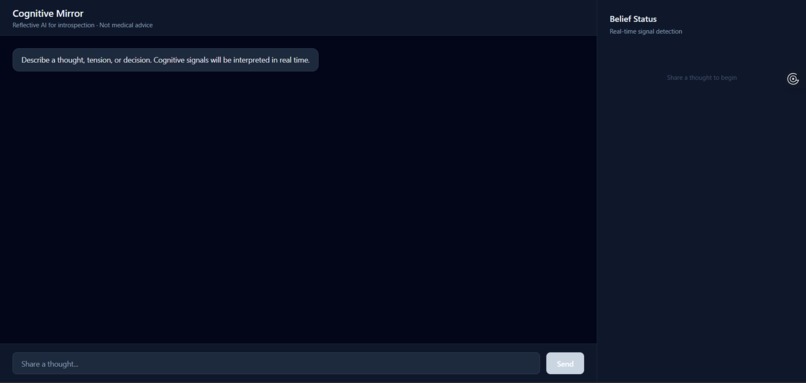
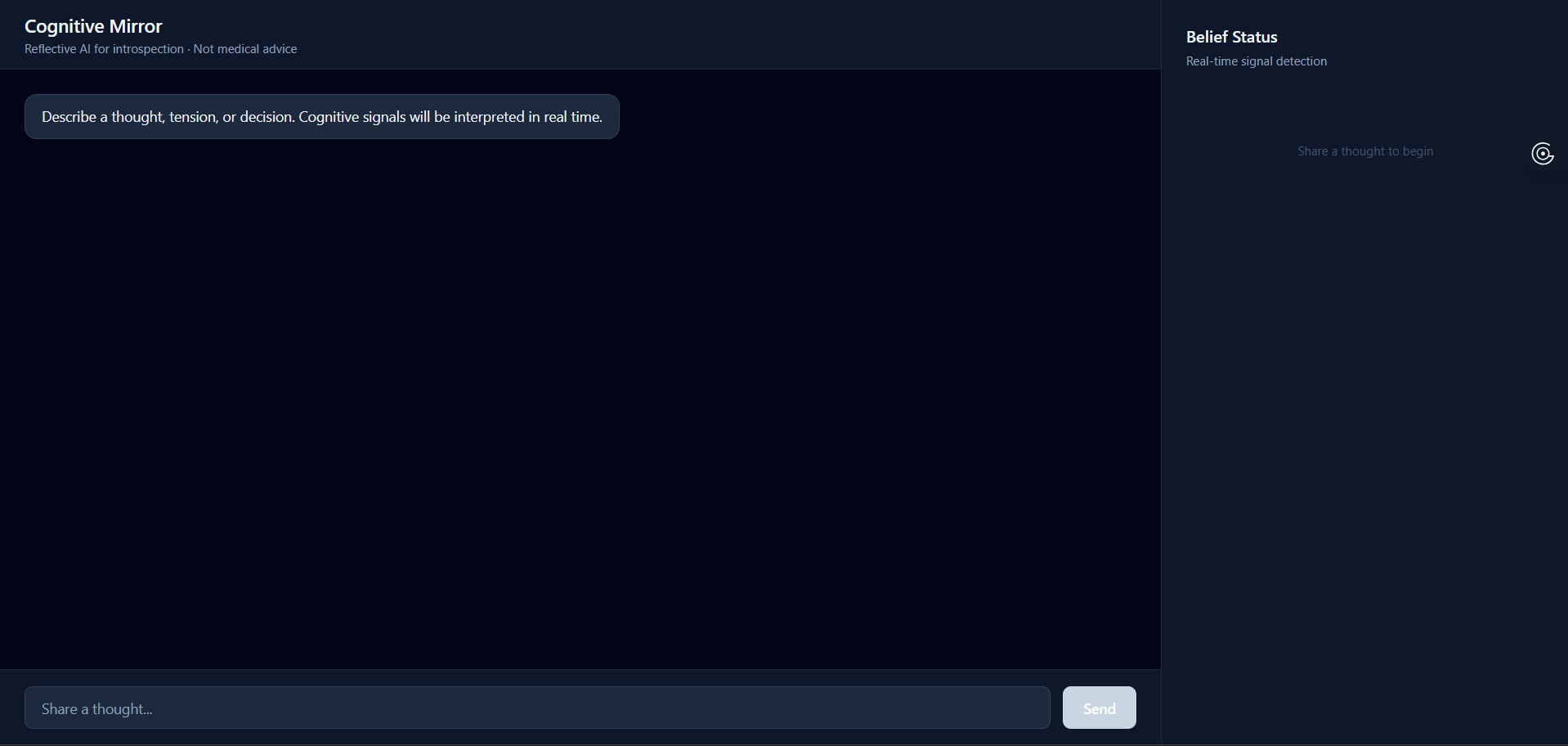
App on Launch (User Entry State)
-
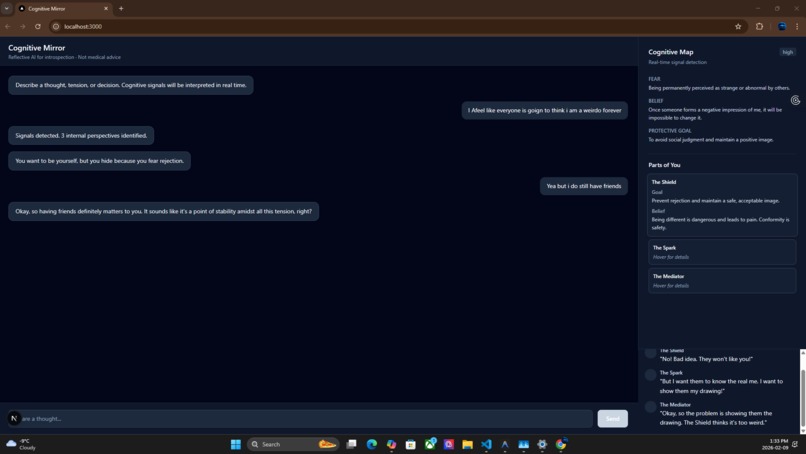
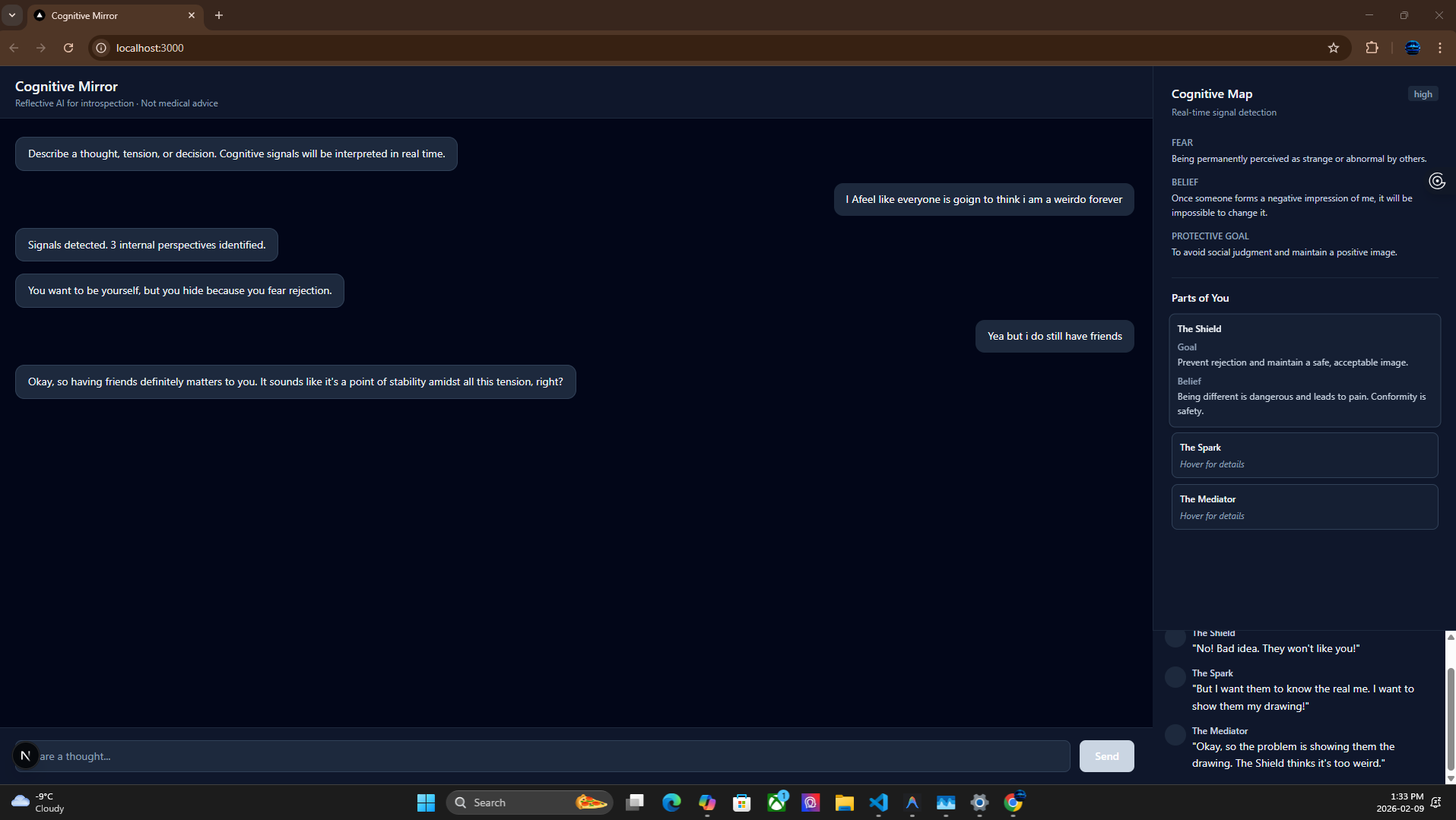
App with Demo Conversation
Cognitive Mirror
Inspiration
Cognitive Mirror was inspired by a simple observation: when people face important decisions, their thinking is rarely linear. Emotions, past experiences, protective instincts, and future ambitions often compete beneath the surface, yet these forces remain difficult to recognize in the moment.
Traditional conversations and even many AI tools respond to what is said without helping users understand the deeper structure behind their thinking. This can leave people trapped in cognitive loops that quietly shape their behavior.
We set out to design a system that creates cognitive distance. Instead of giving advice, Cognitive Mirror reflects internal patterns back to the user, turning introspection into something visible, structured, and easier to navigate.
Our guiding belief was simple:
Awareness often begins not when we are told what to do, but when we can clearly see how we are already thinking.
What it does
Cognitive Mirror is an AI-powered cognitive reflection system that helps users observe the hidden dynamics behind their decisions.
When a user shares a thought, tension, or dilemma, the system:
- Detects underlying goals and fears
- Identifies possible cognitive distortions
- Simulates an internal dialogue between competing psychological perspectives
- Synthesizes these signals into a clear interpretive insight
Rather than acting as an assistant that prescribes solutions, Cognitive Mirror functions as a mirror helping users understand how they are thinking so they can make more intentional decisions.
How we built it
Cognitive Mirror combines a modern web architecture with the advanced reasoning capabilities of Gemini 3, which serves as the cognitive engine of the system.
Gemini 3 Integration
Gemini 3 enabled us to move beyond traditional text generation and design an experience centered on structured reasoning.
Key capabilities we leveraged include:
Advanced Reasoning
Gemini 3 interprets nuanced user input to uncover hidden emotional drivers, competing motivations, and belief patterns.
Structured Generation
We engineered a prompt architecture that guides the model to consistently produce a cognitive map — transforming unstructured thoughts into organized psychological signals.
Contextual Understanding
Gemini 3 maintains conversational context, allowing the system to generate internal dialogues that feel coherent rather than fragmented.
Multi-perspective Simulation
The model enables the representation of multiple internal agents (e.g., protective, aspirational, analytical), mirroring how real human deliberation often unfolds.
Insight Synthesis
Gemini 3 excels at compressing complex emotional and logical signals into concise interpretations, helping resolve internal tension into a forward-looking perspective.
Without Gemini 3’s depth of reasoning, Cognitive Mirror would default to a conventional chatbot. Instead, the model allows the system to function as a reflective cognitive framework.
Technical Architecture
Frontend
- Built with Next.js to deliver a fast, responsive interface
- Structured output design to enhance readability and reduce cognitive overload
Backend
- Secure server-side orchestration for Gemini API interaction
- Enforces consistent analytical formatting
At a conceptual level, the system follows this transformation pipeline:
- User Thought then Pattern Detection then Internal Dialogue then Synthesized Insight
Our goal was not simply to ask Gemini for answers, but to design a framework where its reasoning abilities make human thinking more observable.
Challenges we ran into
Designing Reflection Instead of Advice
Large language models naturally default toward helping and instructing. Constraining the system to reflect patterns without prescribing action required careful prompt engineering.
Balancing Structure with Natural Language
Too much structure made responses feel mechanical, while too little reduced clarity. Achieving the right equilibrium took multiple iterations.
Avoiding the “Chatbot” Experience
We wanted the interaction to feel analytical and illuminating rather than conversational filler. Establishing a consistent cognitive format helped differentiate the experience.
Building Emotional Depth Responsibly
Creating a system capable of engaging with meaningful human concerns while maintaining appropriate boundaries required thoughtful tone design and safety-aware implementation.
Accomplishments that we're proud of
- Designing a system that reframes AI from an advice-giver into a reflection engine
- Successfully leveraging Gemini 3 to model internal reasoning rather than generate generic responses
- Creating a structured cognitive framework that improves interpretability
- Delivering an experience that feels intentional, calm, and insight-driven
Most importantly, we are proud of building something that encourages clarity instead of dependency.
What we learned
This project reshaped our understanding of intelligent system design.
We learned that raw capability is not enough clarity and interpretability create meaningful AI experiences.
Key insights include:
- AI becomes more valuable when it reveals patterns rather than replaces thinking
- Constraints often lead to more trustworthy model behavior
- Structure enhances user confidence
- Great AI design is as much about psychology as it is about engineering
Cognitive Mirror reinforced our belief that the future of human-AI interaction lies in augmentation, not substitution.
What's next for Cognitive Mirror
Cognitive Mirror opens the door to a new category of AI systems focused on meta cognition helping users think about their thinking.
Future directions include:
- Long-term cognitive pattern tracking
- Adaptive belief modeling
- Decision journaling
- Multimodal reflection experiences
- Deeper personalization while maintaining user safety
Our long-term vision is to transform AI from a reactive tool into a system that helps make human reasoning more visible.
We didn’t set out to build a better assistant.
We set out to build a mirror.
Built With
- google-gemini-api-for-multi-agent-reasoning
- next.js-+-typescript-for-the-frontend
- python-powered-backend-services
- restful-apis-for-orchestration
- vercel

Log in or sign up for Devpost to join the conversation.