-
-
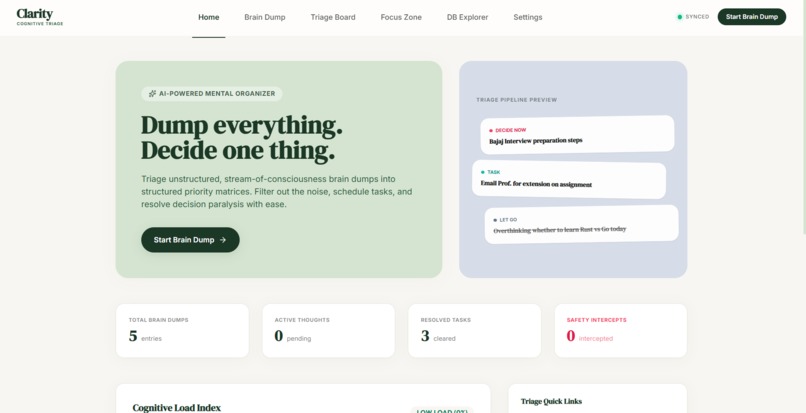
We don't help people do more things—we help them decide the right thing to do next.
In today's digital world, people are constantly overwhelmed by information, notifications, tasks, and decisions. Many productivity tools focus on managing tasks, but very few address the underlying problem of cognitive overload and decision fatigue.
We were inspired by concepts from cognitive psychology, decision science, and personal knowledge management. We wanted to build a system that acts as a mental triage assistant—helping users unload their thoughts, identify what truly requires attention, and reduce the stress caused by keeping everything in their heads.
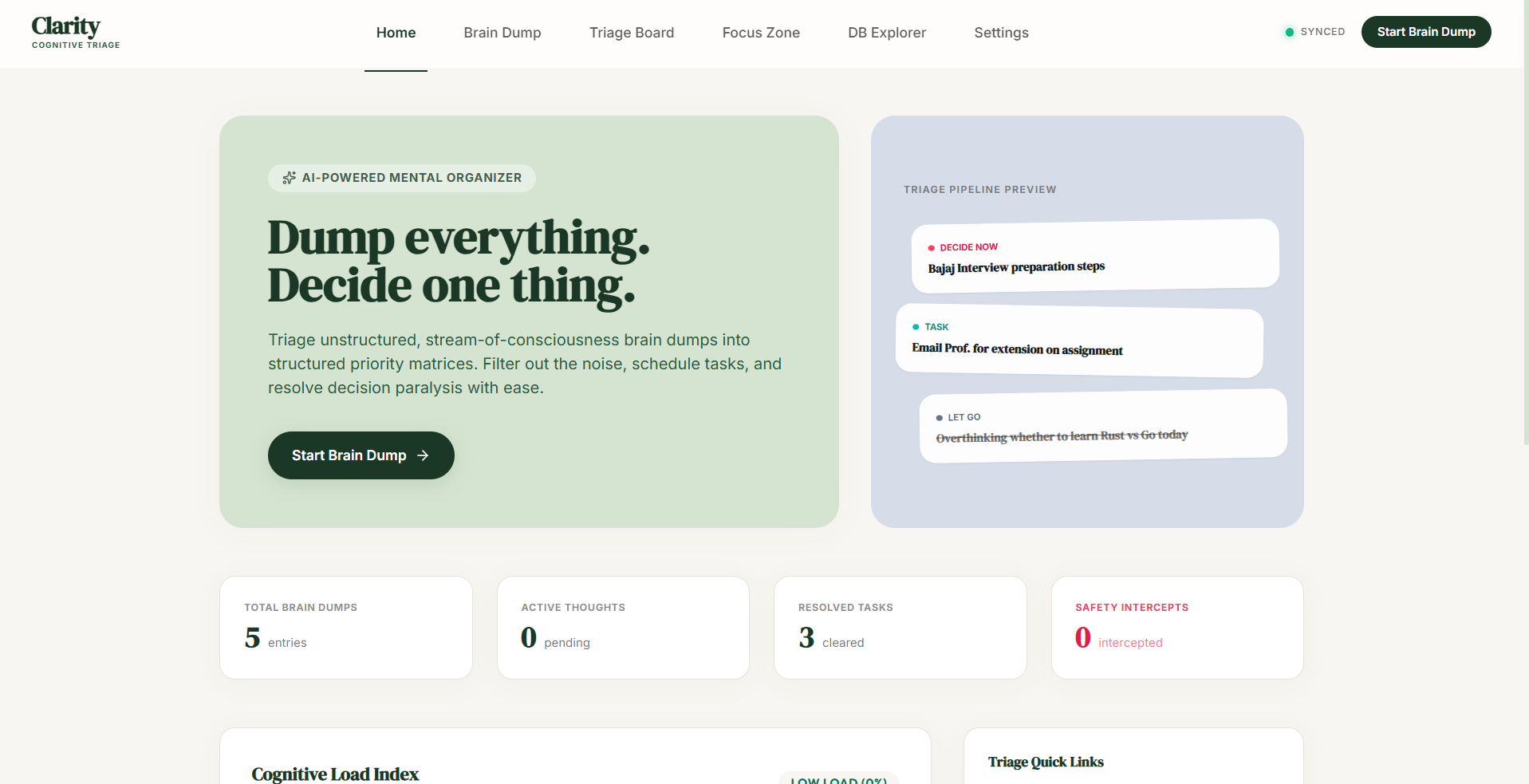
Clarity is an AI-powered cognitive triage platform that transforms an unstructured brain dump into a structured decision-making framework.
Users can enter thoughts through text or voice. The system analyses these thoughts, breaks them into atomic units, and categorises them into four cognitive buckets:
Decide Now – Important decisions requiring immediate attention. Needs Info – Decisions blocked by missing information. Tasks – Actionable items that can be completed directly. Let Go – Worries, concerns, or low-value thoughts that do not require action.
The platform then prioritises thoughts using a Multi-Criteria Decision Analysis (MCDA) model:
$$ \text{Priority Score} = \frac{\text{Urgency} \times \text{Stakes}}{\text{Reversibility}} $$
This approach ensures that high-impact and difficult-to-reverse decisions receive the most attention.
How we built it
Voice & Text Capture Web Speech API for hands-free voice input. Text input for manual thought capture. Local Safety Layer Fast regex-based screening detects distress-related keywords. Critical thoughts are flagged and prevented from being dismissed. AI Processing Pipeline User thoughts are sent to a Cloudflare Worker. Llama 3.3 70B running through Groq processes and classifies thoughts. Atomic segmentation converts large text blocks into individual cognitive units. Decision Intelligence Engine Quadrant classification assigns thoughts to the appropriate category. MCDA scoring ranks priorities based on urgency, stakes, and reversibility. Focus Zone The highest-priority unresolved thought is highlighted. AI generates a clarifying question to help the user move forward. Data Storage The SQLite database stores thoughts, classifications, scores, and safety flags.
Challenges we ran into
One of the biggest challenges was accurately distinguishing between different types of thoughts. Human thinking is often messy, emotional, and ambiguous, making classification difficult.
Another challenge was preventing important concerns from being incorrectly categorised as "Let Go". To solve this, we implemented a local safety layer that identifies distress signals before AI processing begins.
Balancing AI intelligence with speed was also important. We optimised the workflow by combining lightweight local checks with powerful cloud-based language models, ensuring both responsiveness and accuracy. Through this project, we gained practical experience in:
Cognitive psychology and decision science principles. AI-powered text classification and prompting techniques. Cloudflare Workers and serverless architectures. Large language model integration using Groq. Safety-focused AI system design. Prioritisation algorithms and decision-support systems.
Most importantly, we learned that productivity is not just about managing tasks—it is about reducing mental load and helping people focus on the decisions that matter most.
Future Improvements
Future versions of Clarity could include:
Personalised decision-making profiles. Calendar and task management integrations. Long-term cognitive pattern analysis. Multi-language voice support. Mobile applications. Predictive AI recommendations based on user behaviour. Conclusion
Clarity is more than a task manager—it is a cognitive operating system designed to help people think clearly. By combining cognitive psychology, decision science, and modern AI, the platform transforms mental chaos into structured action, helping users reduce stress, prioritise effectively, and make better decisions.
Built With
- api
- axios
- cloudflare
- css
- css3
- express.js
- gemini
- git
- github
- groq
- html5
- llama
- node.js
- react.js
- speech
- sqlite
- tailwind
- typescript
- vite
- web


Log in or sign up for Devpost to join the conversation.