-
-
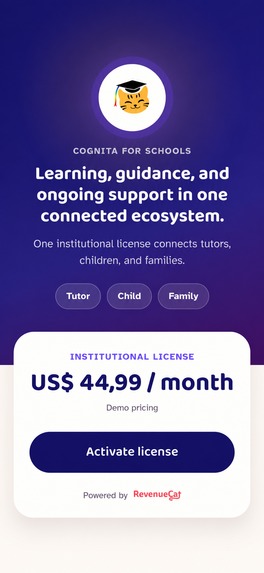
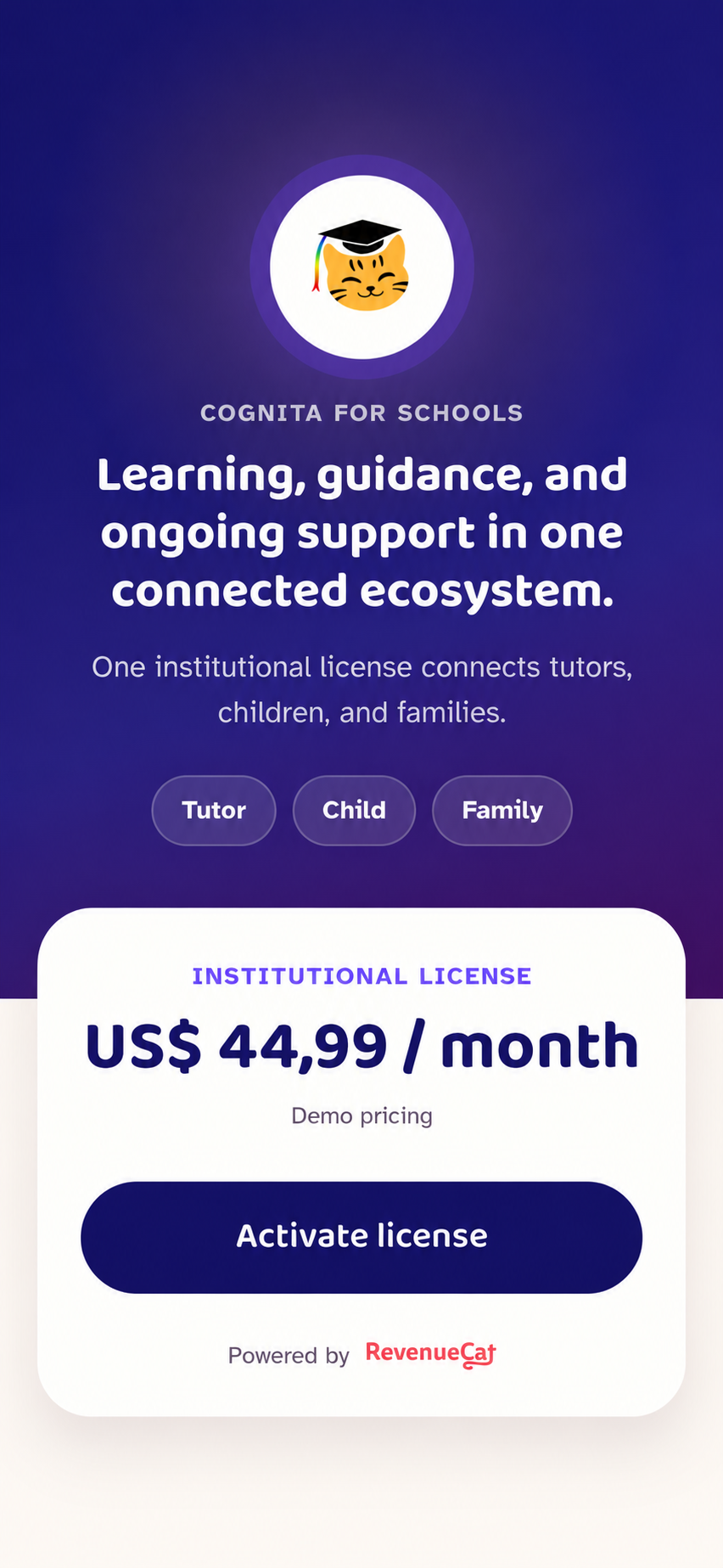
Institutional licensing for schools, powered by RevenueCat
-
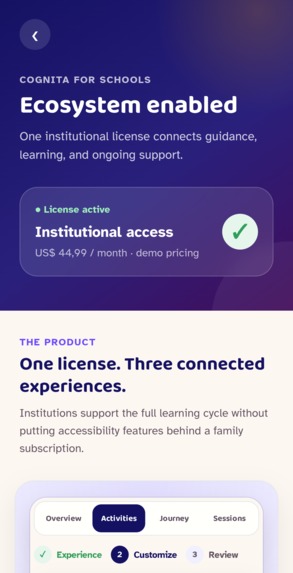
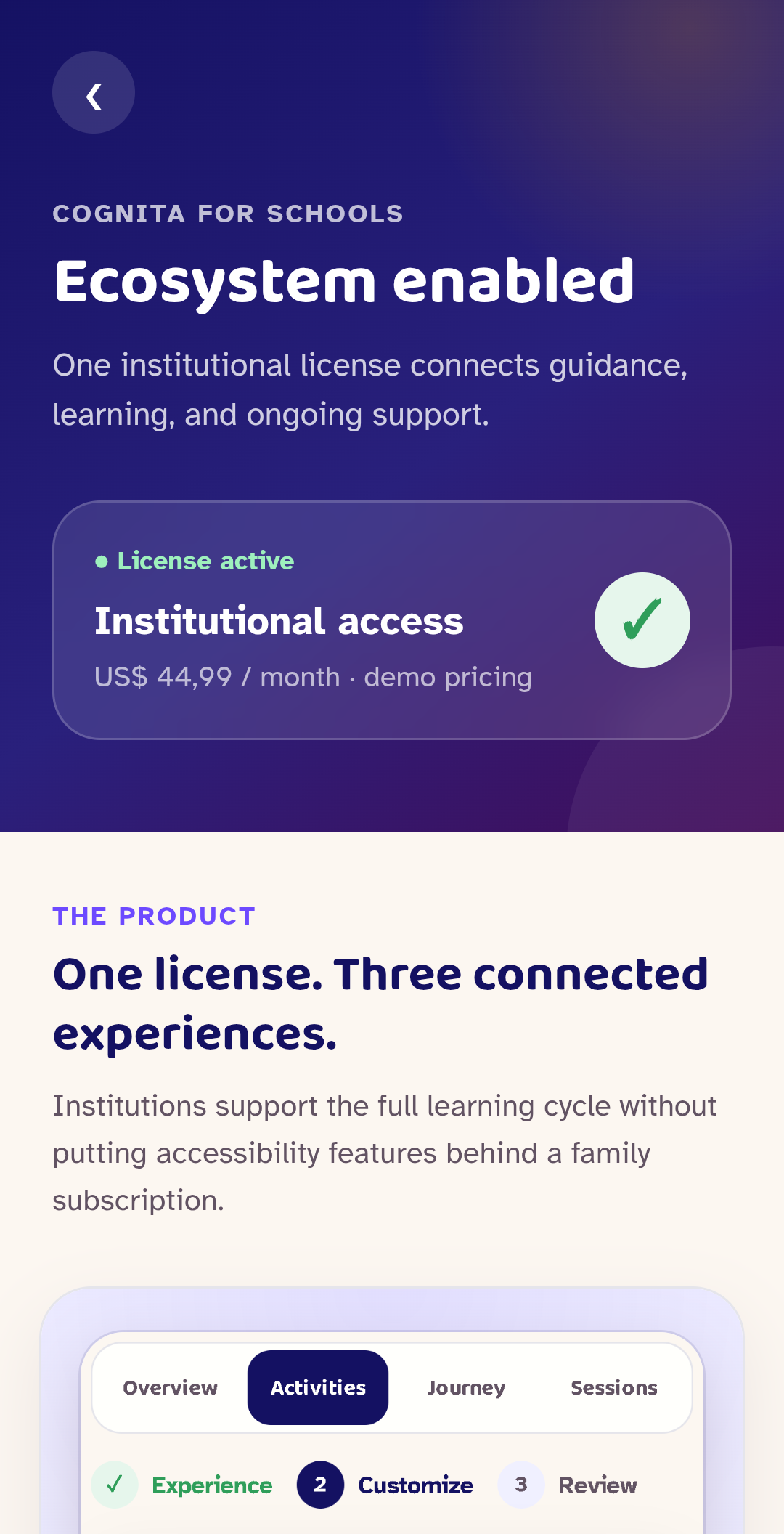
One institutional license unlocks the connected Tutor, Child, and Family ecosystem
-
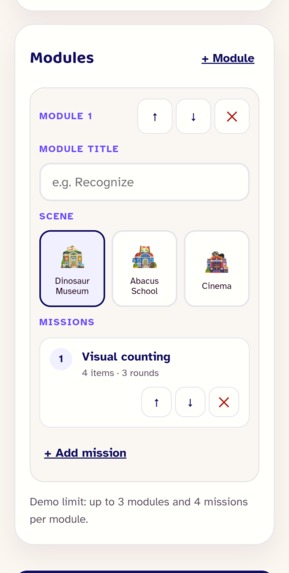
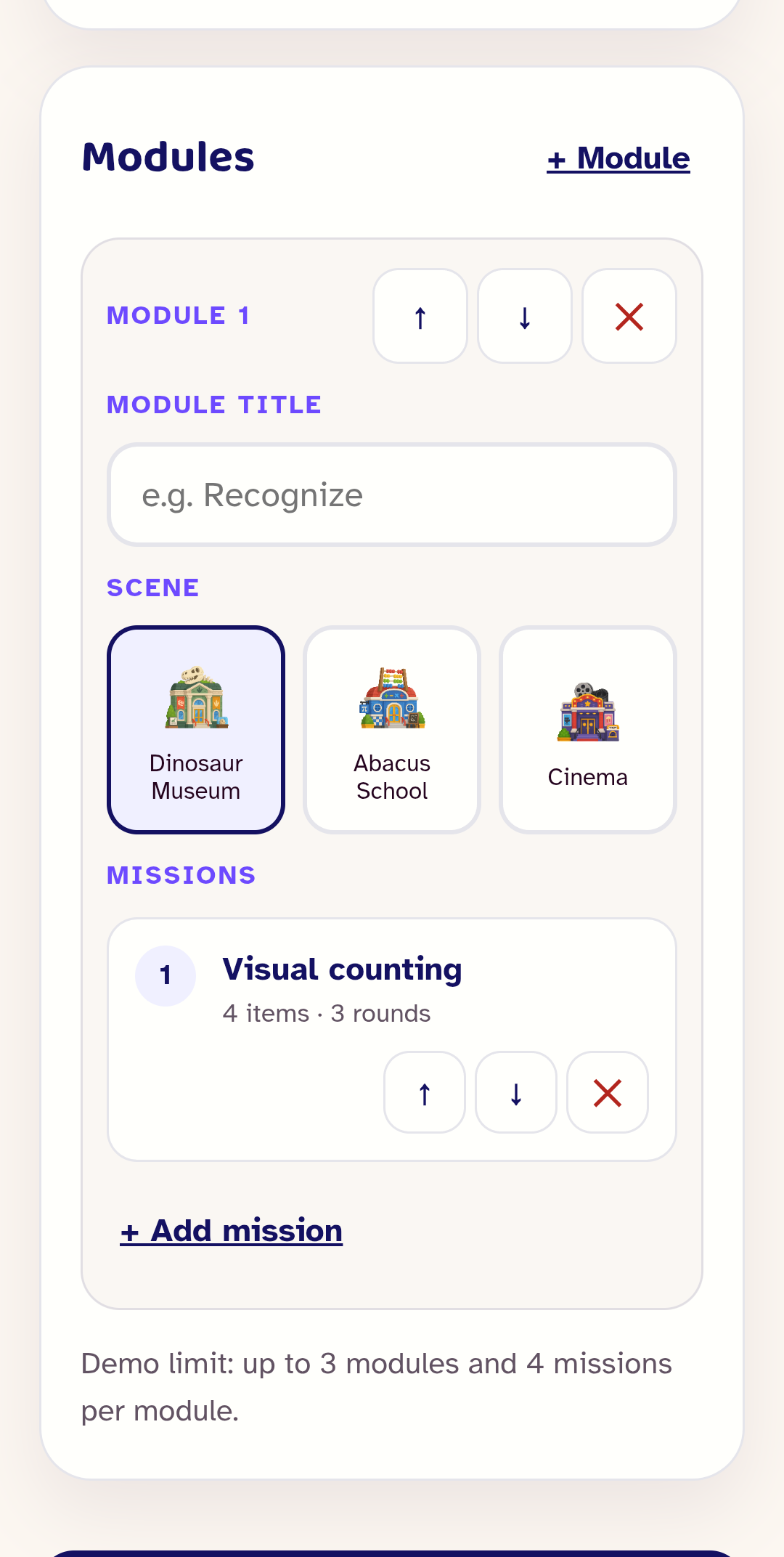
Tutors build personalized journeys using modules, scenes, and prepared activities
-
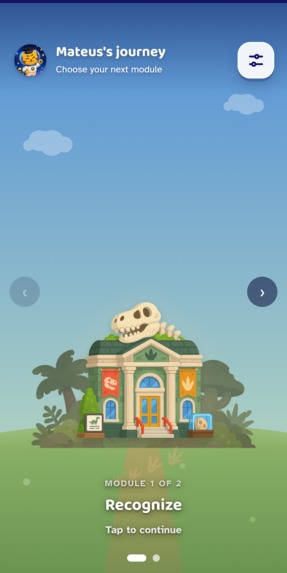
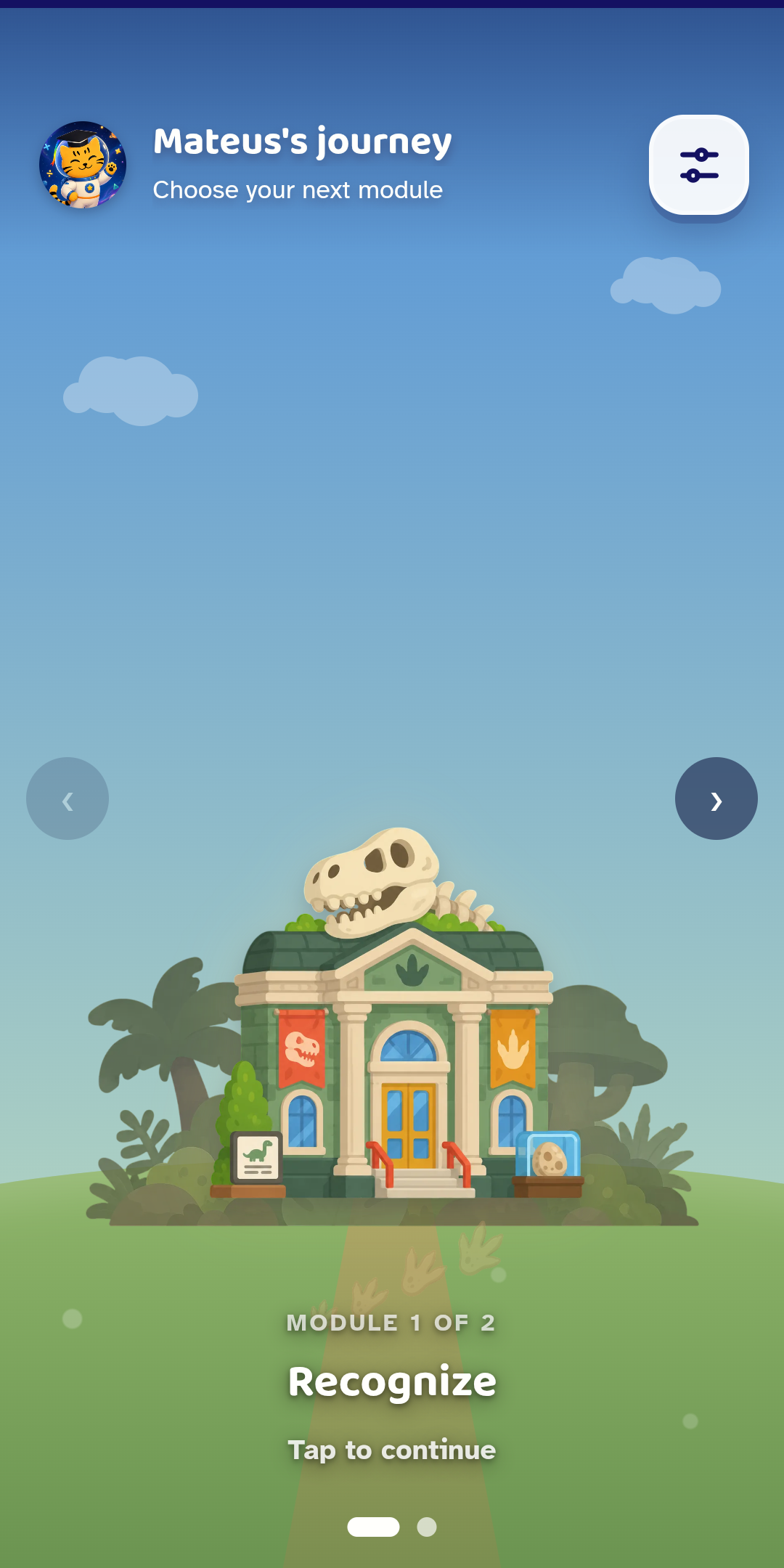
A child-facing Android journey designed around exploration instead of adult-style dashboards
-
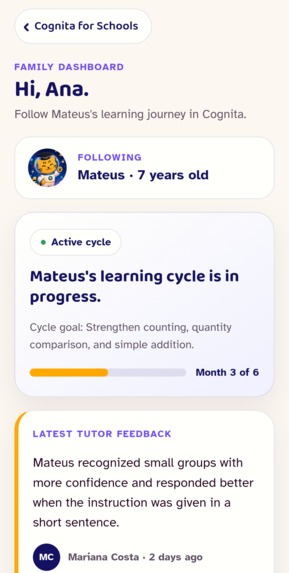
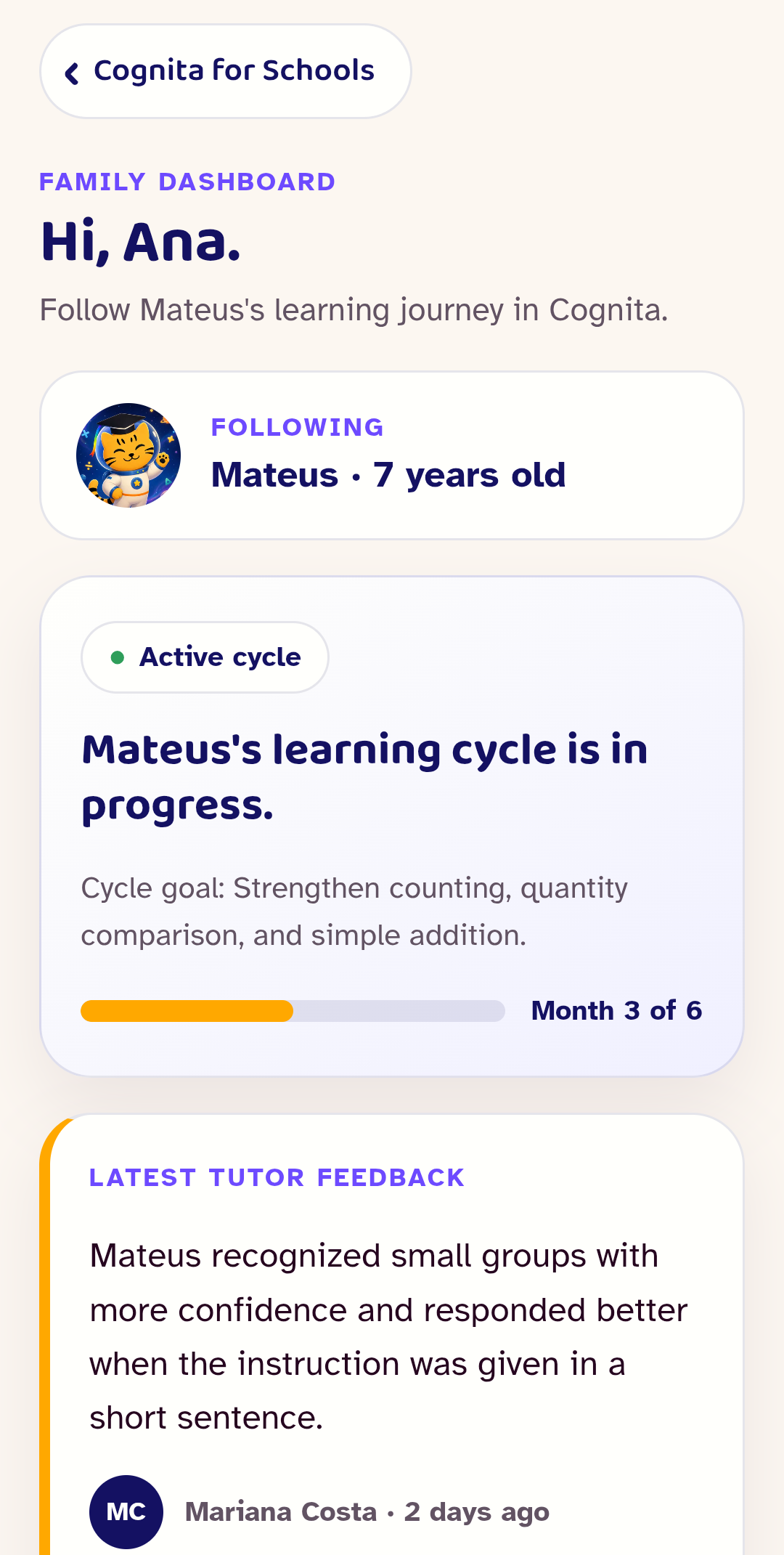
Families follow progress, reviewed tutor feedback, and clear next steps
-


Inspiration
Cognita Hub started with a simple question:
What if educational technology supported the people who know the child instead of trying to replace them?
Cognita was initially created to support mathematics learning for autistic children aged 5–9 and other children who may benefit from more accessible and configurable learning experiences.
As we developed the project, however, we realized that simply creating “accessible exercises” was not enough.
Conversations with educators and researchers at UFPA changed the way we thought about the product. We learned to look at a learning activity as more than content plus a correct answer.
Instructions, support, engagement, context, environment, and human observation can all shape the experience.
That became especially important when thinking about autism.
Children on the autism spectrum do not form a single learning profile. A visual stimulus, animation, instruction style, amount of movement, or support strategy that helps one child may create friction for another.
Because of that, Cognita does not try to translate a diagnosis into a prescribed interface.
Instead, it follows a principle that became central to the project:
Person before diagnosis.
The experience should be adaptable to the child, while important pedagogical decisions remain in human hands.
This pushed Cognita from being “a platform with math exercises” toward becoming a connected learning ecosystem built around preparation, experience, observation, feedback, and adaptation.
What it does
Cognita Hub is a connected educational ecosystem for children, tutors, families, and schools.
It was designed with an initial focus on autistic children, while avoiding the assumption that every autistic child should interact with technology in the same way.
Instead of treating each user as an isolated part of the product, Cognita connects what happens before, during, and after a learning activity.
For children
- Interactive mathematics learning journeys
- Visual and configurable activities
- A dedicated Android experience designed around exploration rather than adult-style dashboards
- Individual settings for text, motion, and interaction
- Learning experiences that can be adjusted without defining the child by a diagnosis
For tutors
- Activity preparation and customization
- Personalized learning journeys
- Session management
- Observation and engagement records
- Context about how the child interacted with each experience
- Reviewed feedback and next-step planning
- Human control over progression between learning modules
For families
- Clear summaries of learning sessions
- Progress through the child's learning journey
- Reviewed tutor feedback
- Suggested next steps
- Access to meaningful context without exposing private tutor notes
Instead of reducing learning to a score, Cognita preserves the context around each session:
What support was needed? How did the child participate? What did the tutor observe? What could be tried next?
This is especially important in our initial autism-focused use case, where the same activity may work very differently depending on the child, the environment, the instructions, and the support provided.
The product follows a continuous cycle:
Prepare → Experience → Observe → Reflect → Adapt
Cognita does not diagnose children, replace educators, or claim to prescribe the “correct” experience for autism.
Its role is to help the people around the child prepare, observe, record, and make better-informed decisions.
For Shipaton, we also developed Cognita for Schools, our institutional licensing concept powered by RevenueCat.
A school can activate institutional access through a RevenueCat purchase flow, unlocking the connected tutor, child, and family ecosystem while keeping the child-facing learning experience free from ads, purchases, and monetization prompts.
How we built it
Cognita combines a web platform for adults with a dedicated Android experience for children.
Web
- Vanilla JavaScript
- HTML5
- CSS
- Vite
- Supabase
Android
- Vanilla JavaScript
- Vite
- Capacitor 8
- Supabase
- RevenueCat Purchases SDK
Supabase powers our PostgreSQL database, authentication, Row Level Security, storage, pairing, and shared learning records.
The web platform provides the tutor and family experiences, while the Android app provides the child-facing experience and the institutional Cognita for Schools demo.
The different interfaces share the same learning context, but they deliberately expose different information.
For example, a tutor can record an internal observation about a session, while the family receives only reviewed feedback and a clear next step.
This separation is important because Cognita is not intended to automate pedagogical interpretation or expose raw observations without context.
For Shipaton, we integrated the RevenueCat Purchases SDK into our Capacitor Android application.
Our institutional prototype uses:
- Offering:
cognita_school - Monthly package:
$rc_monthly - Product:
cognita_school_pilot_monthly - Entitlement:
school_access
We validated the RevenueCat Test Store flow on a physical Android device, including:
- Successful purchase
- Failed purchase
- Purchase cancellation
school_accessentitlement activation
Once the entitlement is active, the app unlocks the Cognita for Schools ecosystem, where the user can explore the tutor, child, and family experiences.
The current purchase flow uses RevenueCat's Test Store and represents a prototype rather than validated commercial pricing.
Challenges we ran into
One of our biggest challenges was designing for three very different perspectives at the same time:
- the child experiencing the activity,
- the adult guiding and observing the process,
- and the family trying to understand what happened.
Each one needs different information, language, and interaction patterns.
Another major challenge came directly from our initial focus on autism.
There is no universal “autism mode” or “accessible mode.”
Autism does not describe one interface preference, one learning strategy, or one support need.
An animation that helps one child stay engaged may distract another.
A highly visual activity may support one child and overwhelm another.
A short instruction may work better in one context, while another child may benefit from additional visual support.
Because of that, Cognita focuses on configurable experiences instead of prescribing one interface based on a diagnosis.
This also influenced how we think about data.
A result such as “8 out of 10 correct” does not explain:
- whether support was needed,
- whether the child stayed engaged,
- whether the instruction had to be changed,
- whether the environment affected the activity,
- or what the tutor observed during the session.
Another challenge was deciding what information should move between users.
Tutors can keep internal observations that should not automatically be exposed to families.
Families instead receive reviewed feedback and a clear next step.
On the technical side, moving from a web-first ecosystem to Android with Capacitor forced us to rethink:
- Navigation
- Native application lifecycle
- Mobile performance
- Initialization
- Touch interactions
- Animations
- Device-specific behavior
Testing on a physical Android device revealed issues that were invisible in the browser and forced us to optimize assets, transitions, layouts, and initialization.
RevenueCat also created an important product challenge:
How do we monetize Cognita without putting accessibility behind a child's paywall?
Our answer was to explore institutional licensing through Cognita for Schools.
Instead of monetizing the child-facing experience directly, the institution licenses the connected ecosystem around it.
Accomplishments that we're proud of
We're proud that Cognita is no longer just an idea.
Today, the prototype includes:
- A working Android child application
- Web experiences for tutors and families
- Device pairing
- Interactive mathematics activities
- Configurable learning experiences
- Personalized learning journeys
- Tutor-created activities
- Journey and module management
- Session and observation records
- Reviewed family feedback
- Shared progress between the different experiences
- RevenueCat integration
- A working institutional licensing prototype
For Shipaton, we built a complete demonstration flow:
Institutional license → Tutor prepares → Child experiences → Tutor observes → Family receives context
The tutor can configure an activity, place it inside a learning journey, assign it to the child, review the resulting session, and transform observations into reviewed family feedback.
The child experience remains intentionally different from the adult interfaces.
Instead of dashboards and management tools, the Android experience uses visual journeys and focused interactions designed around exploration.
We are especially proud of successfully validating the RevenueCat purchase lifecycle on a real Android device.
Cognita Hub also advanced to the national stage of Desafio Liga Jovem, where we presented the working product and ecosystem to external judges.
But our biggest accomplishment was changing the way we thought about the product itself.
Cognita evolved from:
“a platform with math exercises”
into:
a connected learning cycle built around human mediation.
And our understanding of accessibility also evolved.
We stopped asking:
“What interface should an autistic child use?”
and started asking:
“What does this child need in this experience, and how can technology help the adults around them respond?”
What we learned
We learned that educational technology does not need to automate every pedagogical decision to be useful.
A correct answer alone does not describe a learning experience.
Context matters.
Participation, support, engagement, observation, and the way the child experienced an activity can all contribute meaningful information.
Our work around autism reinforced this lesson.
A diagnosis can provide important context, but it should not become a shortcut for assuming what a child can do, what they prefer, or what interface they need.
That is why Cognita is built around configurable experiences rather than diagnosis-based presets.
We also learned that technology becomes more useful when it helps adults make better-informed decisions instead of trying to replace those decisions.
That principle influenced several parts of Cognita:
- the child does not automatically advance to the next learning module;
- the tutor reviews a session before feedback reaches the family;
- internal tutor notes remain private;
- activities and journeys can be adjusted before they reach the child;
- accessibility settings are configurable instead of being automatically assigned based on diagnosis.
We also learned that monetization is not just a technical integration.
RevenueCat pushed us to think about who should actually pay for the product.
For a project centered on accessibility and inclusion, monetizing individual child-facing accommodations felt inconsistent with the direction of the product.
That led us toward an institutional model instead of monetizing the child's experience directly.
And technically, testing on a physical Android device reminded us very quickly that:
“It works in the browser” does not mean “the mobile app is finished.”
What's next for Cognita Hub
Our next step is to expand Cognita with more multimodal learning experiences, including richer visual and auditory interactions.
Today, the activity library is still intentionally small.
We want to explore more ways of presenting mathematics beyond counting and number identification, while preserving the same configurable and human-centered model.
We also want to continue improving:
- Accessibility configuration
- Visual, auditory, and multimodal activities
- Tutor observations
- Connections between one session and the next
- Personalized learning journeys
- Institutional tools for schools
- More mathematics activity formats
- Better support for different learning contexts
- Research-informed product validation
Our initial focus will continue to include autistic children, but we want future decisions to come from real observation and collaboration rather than assumptions about diagnosis.
We want to keep validating Cognita with educators, researchers, families, and children so that new features respond to real needs.
Cognita for Schools can also evolve from our current RevenueCat Test Store prototype into a real licensing model for schools and educational organizations.
Most importantly, we want to preserve the principle that shaped the project:
Person before diagnosis.
Our long-term goal remains simple:
Technology should support the people who know the child, not pretend to replace them.
Built With
- android
- capacitor
- css3
- html5
- javascript
- postgresql
- revenuecat
- supabase
- vite
Log in or sign up for Devpost to join the conversation.