-
-
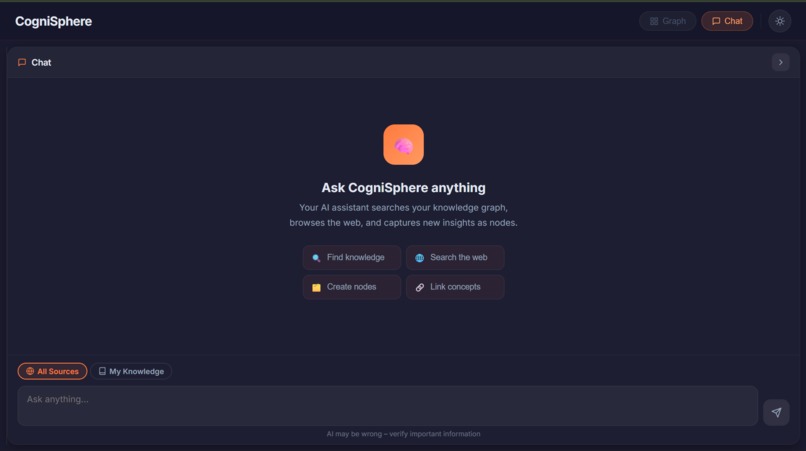
Integrated Chatbot
-
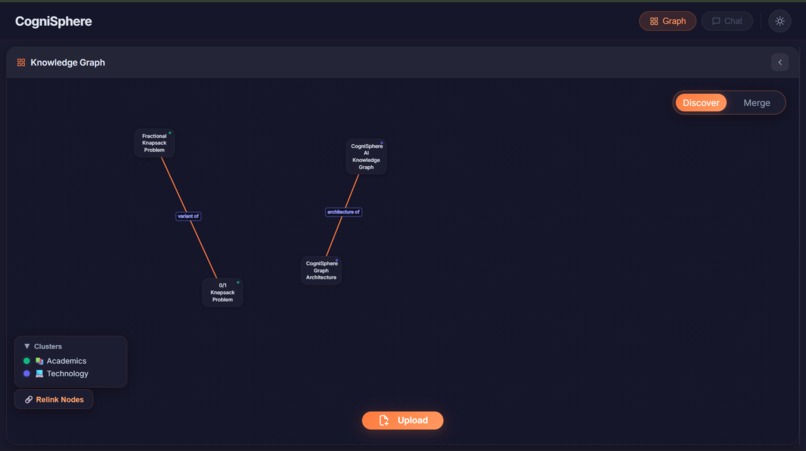
Knowledge Nodes
-
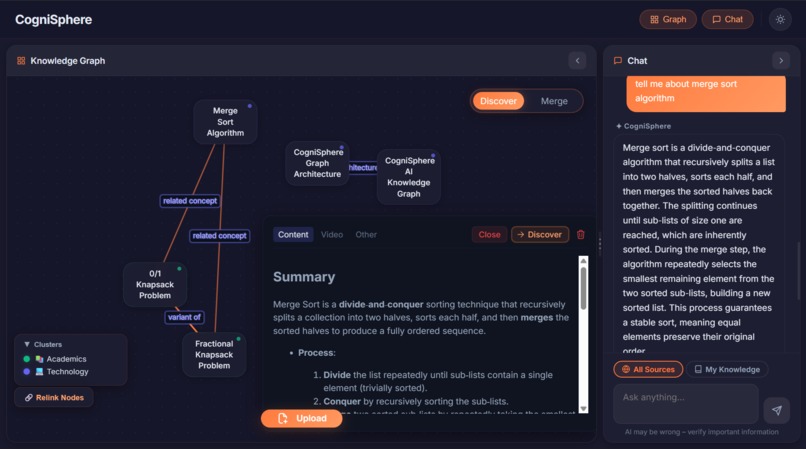
Whole Project Features
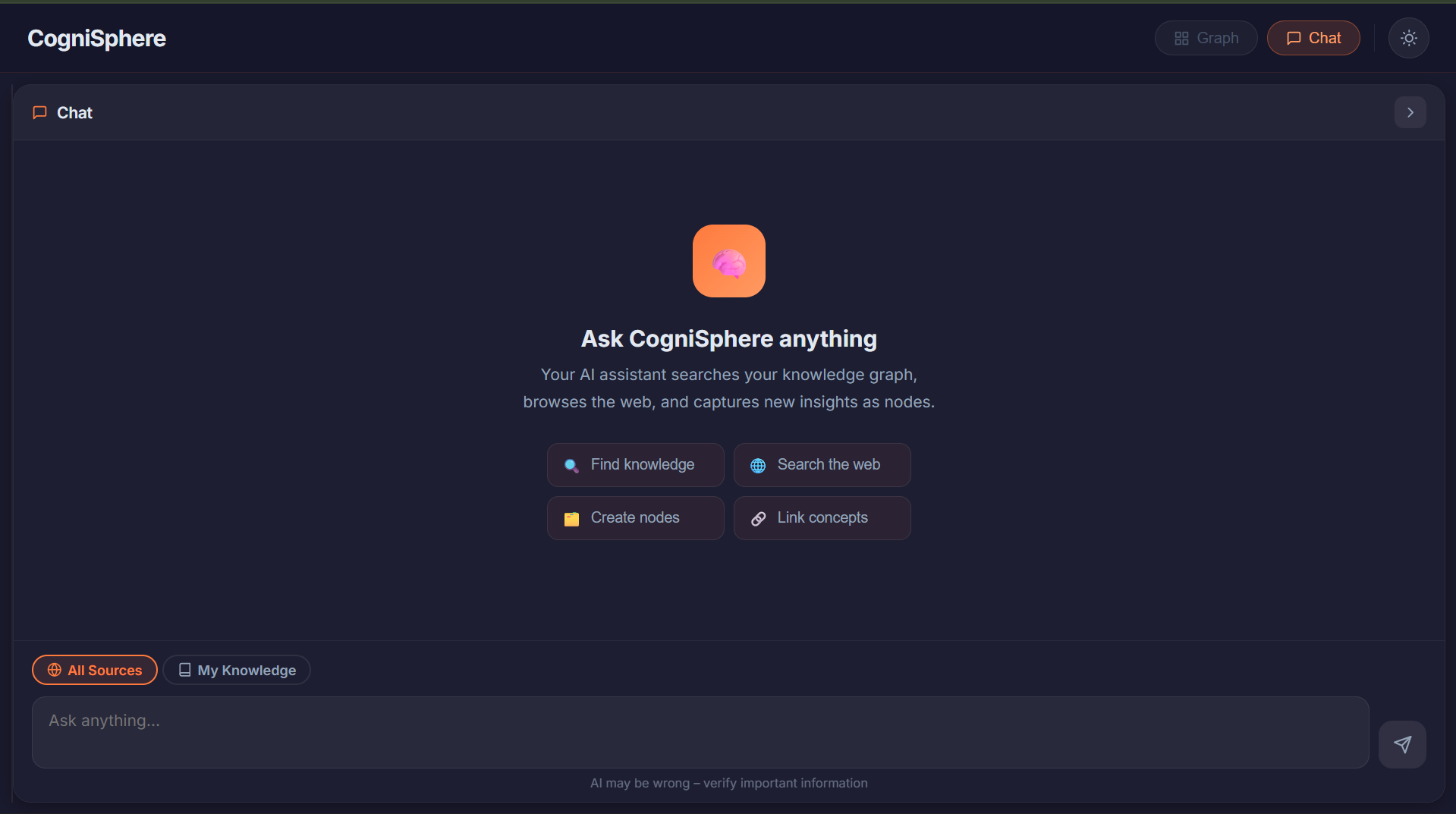
Inspiration
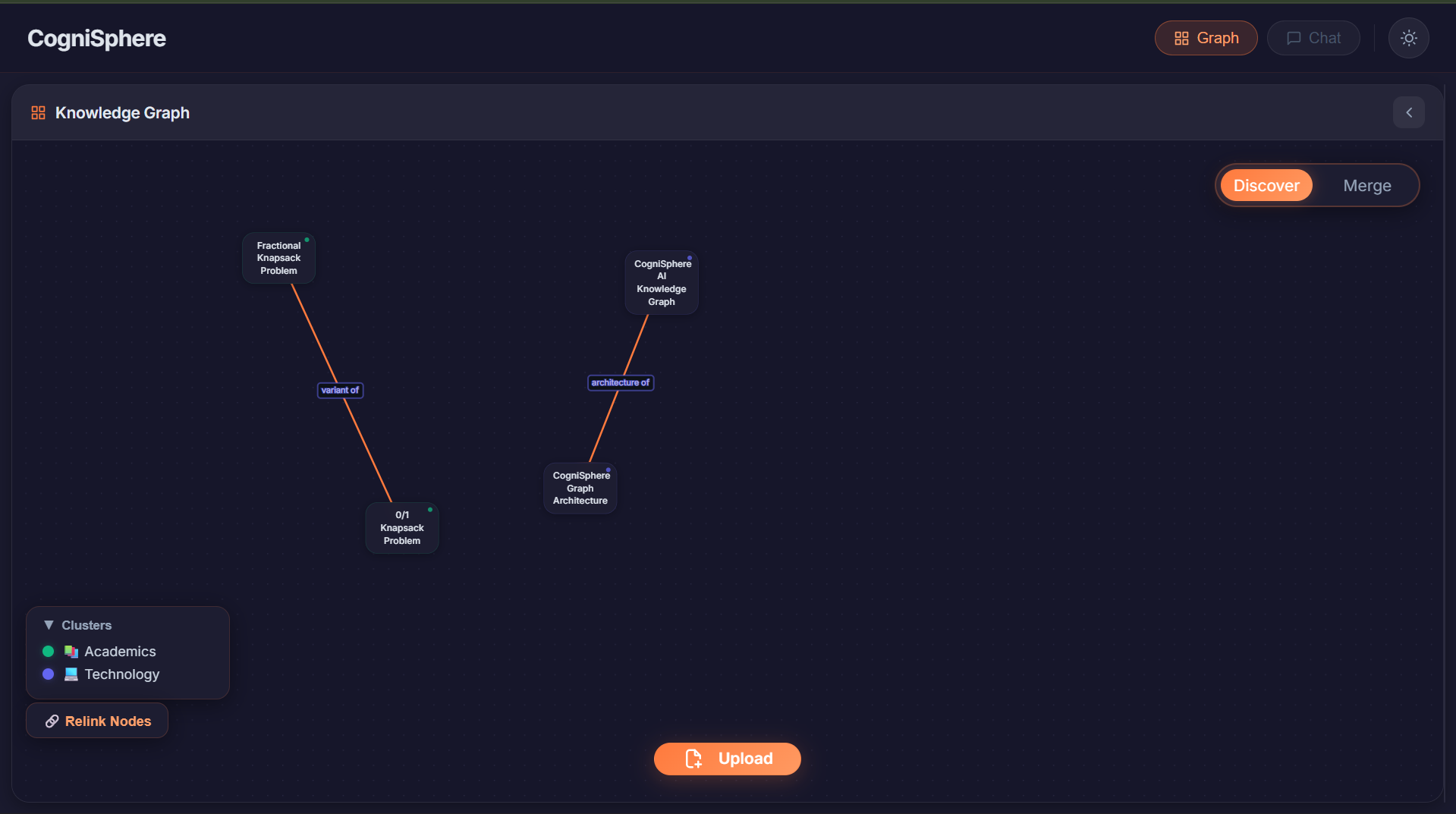
In today’s digital world, information is scattered across many sources such as PDFs, websites, videos, notes, and conversations. While many tools allow users to store information, they rarely help people understand how ideas connect with each other. The inspiration behind CogniSphere came from the way the human brain organizes knowledge. Instead of storing information in isolated documents, the brain connects ideas through relationships. This project aims to replicate that concept digitally by transforming scattered information into an interconnected knowledge graph. The goal of CogniSphere is to create a workspace where users can upload knowledge from multiple sources and instantly see how concepts relate to each other in a visual and interactive way.
What it does
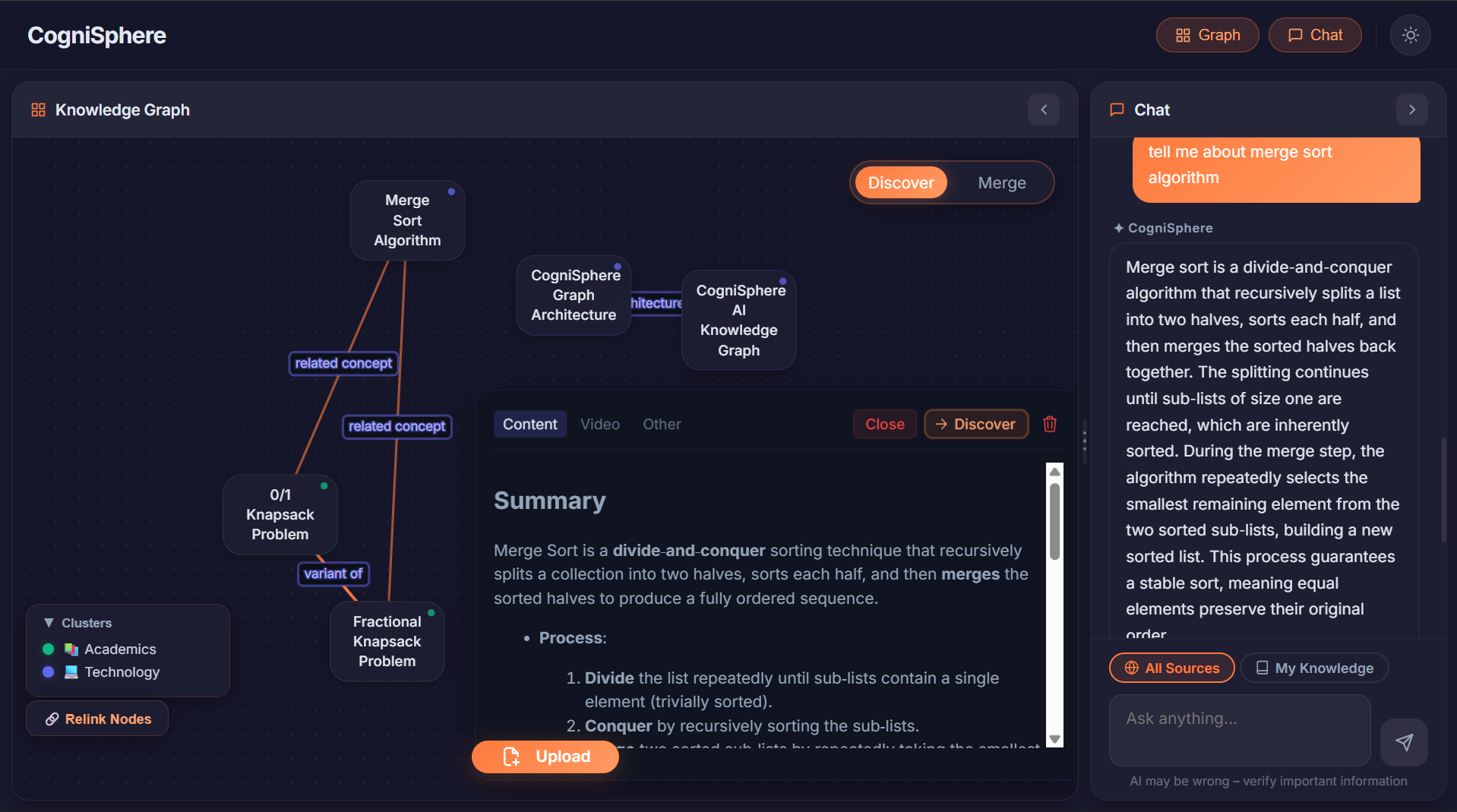
CogniSphere is an AI-powered knowledge graph workspace that converts documents, links, media, and text into a connected network of knowledge. The system extracts key concepts from different sources and organizes them as nodes in a knowledge graph. These nodes are automatically connected using AI-powered semantic analysis, allowing users to explore relationships between ideas visually. Users can also interact with their knowledge using an AI chat assistant that can answer questions based on the knowledge graph and automatically add new insights as nodes. Key features include:
- Visual knowledge graph exploration
- Multi-source content ingestion (PDF, URLs, images, audio, video, text)
- AI-powered semantic linking between concepts
- Conversational knowledge querying using an AI assistant
- Node recommendations to expand the knowledge graph
- Ability to attach videos and additional learning resources to nodes
How we built it
The project uses a full-stack architecture combining modern web technologies, AI services, and a graph database.
Frontend
The frontend is built using React 18 along with ReactFlow to render an interactive node-based knowledge graph. Framer Motion is used for smooth animations and transitions, while Tailwind CSS helps build a responsive and modern user interface. The dashboard allows users to:
- Explore the knowledge graph visually
- Upload files and links
- Chat with the AI assistant
- View and manage individual knowledge nodes
Backend
The backend is built using Spring Boot 3.4 with Java 21, which exposes REST APIs for graph operations, content ingestion, and AI interaction. We used LangChain4j to connect large language models with backend services. This enables the system to extract concepts from data, generate semantic links, and answer questions using knowledge graph context.
AI and Data Processing
CogniSphere uses several AWS AI services to process and analyze data:
- Amazon Bedrock for large language models and embeddings
- Amazon Textract for extracting text from documents using OCR
- Amazon Transcribe for converting audio and video into text
- Amazon Rekognition for analyzing images
The extracted information is then transformed into structured knowledge nodes.
Graph Database
All knowledge relationships are stored in Neo4j AuraDB, a graph database designed for connected data. Each concept becomes a node, and relationships between concepts are stored as edges with AI-generated descriptions and weights. This allows the system to automatically discover meaningful connections between ideas.
Deployment
The application is containerized using Docker and deployed on AWS ECS Fargate. Continuous integration and deployment are handled using GitHub Actions, making the system scalable and production-ready.
Challenges we ran into
Developing CogniSphere involved several technical challenges. One challenge was extracting meaningful concepts from raw content such as documents and transcripts. Designing prompts and parsing logic that produce clean and useful knowledge nodes required multiple iterations. Another challenge was automatically identifying relationships between concepts without creating too many irrelevant connections. Supporting multiple input formats such as PDFs, images, audio, video, and URLs also required integrating several AWS services and designing a unified processing pipeline. Additionally, visualizing large graphs efficiently in the browser required performance optimization and layout improvements.
Accomplishments that we're proud of
Successfully designed and implemented a complete AI-powered knowledge graph system from scratch.
- Built a full-stack architecture integrating React, Spring Boot, AWS services, and Neo4j.
- Implemented multi-source ingestion, allowing the system to process PDFs, URLs, images, audio, video, and plain text.
- Developed an AI assistant that can query the knowledge graph and generate new insights automatically.
- Created an interactive visual graph interface using ReactFlow that allows users to explore relationships between ideas.
- Integrated several AWS AI services (Bedrock, Textract, Transcribe, Rekognition) to process different types of content.
- Implemented semantic linking where AI automatically identifies relationships between concepts.
- Designed a scalable cloud architecture using Docker, AWS ECS Fargate, and CI/CD pipelines.
What we learned
Building CogniSphere provided valuable experience in several areas:
- Designing and working with knowledge graphs
- Integrating AI models into real-world applications
- Using AWS AI services for data processing
- Building scalable full-stack cloud applications
- Managing connected data using Neo4j graph databases The project demonstrated how artificial intelligence can transform unstructured information into structured knowledge, making complex information easier to explore and understand.
What's next for Cognisphere
-Real-time collaborative knowledge graphs so multiple users can build and explore knowledge together.
- Advanced graph analytics to discover hidden patterns and deeper insights within the knowledge network.
- Improved recommendation engine that suggests new topics and connections more intelligently.
- Personalized learning paths generated automatically from the user's knowledge graph.
- Mobile-friendly interface for accessing and exploring knowledge graphs on smartphones and tablets.
- Browser extension to instantly capture information from any webpage into the graph.
- Enhanced search and filtering tools for navigating large knowledge graphs efficiently.
- Integration with note-taking platforms such as Notion, Obsidian, and Google Docs.
Built With
- amazon-web-services
- java
- javascript
- react
- react-flow
- tailwind

Log in or sign up for Devpost to join the conversation.