-
-
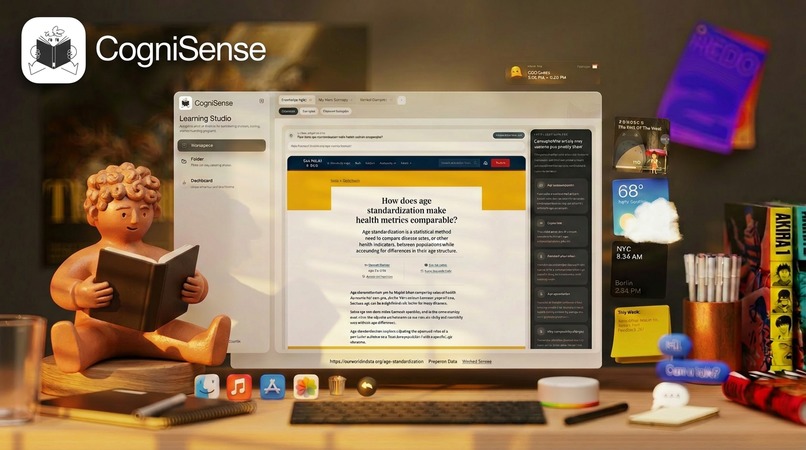
CogniSense: Sensing for Deep Learning
-
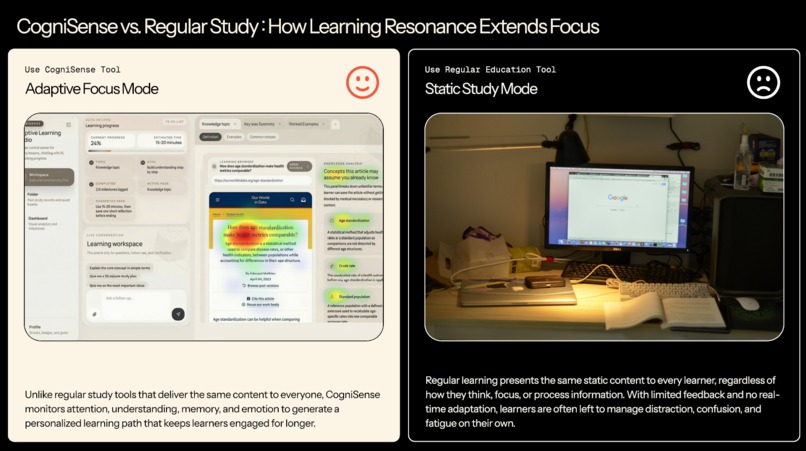
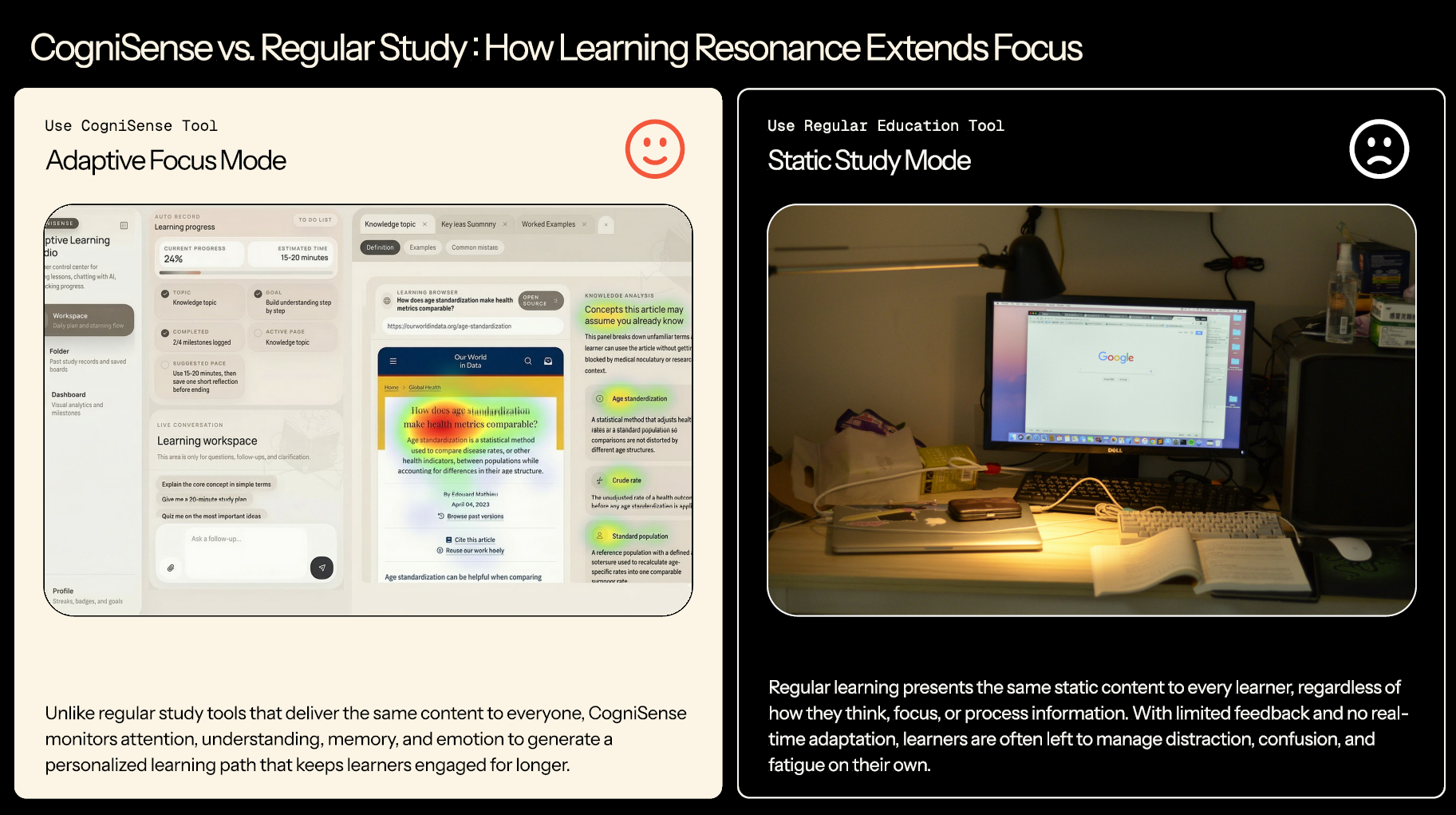
CogniSense vs. Regular Study : How Learning Resonance Extends Focus
-
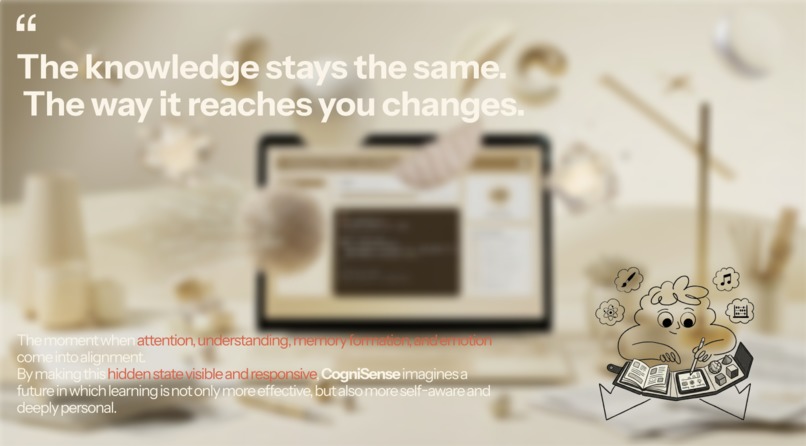
What's CogniSense
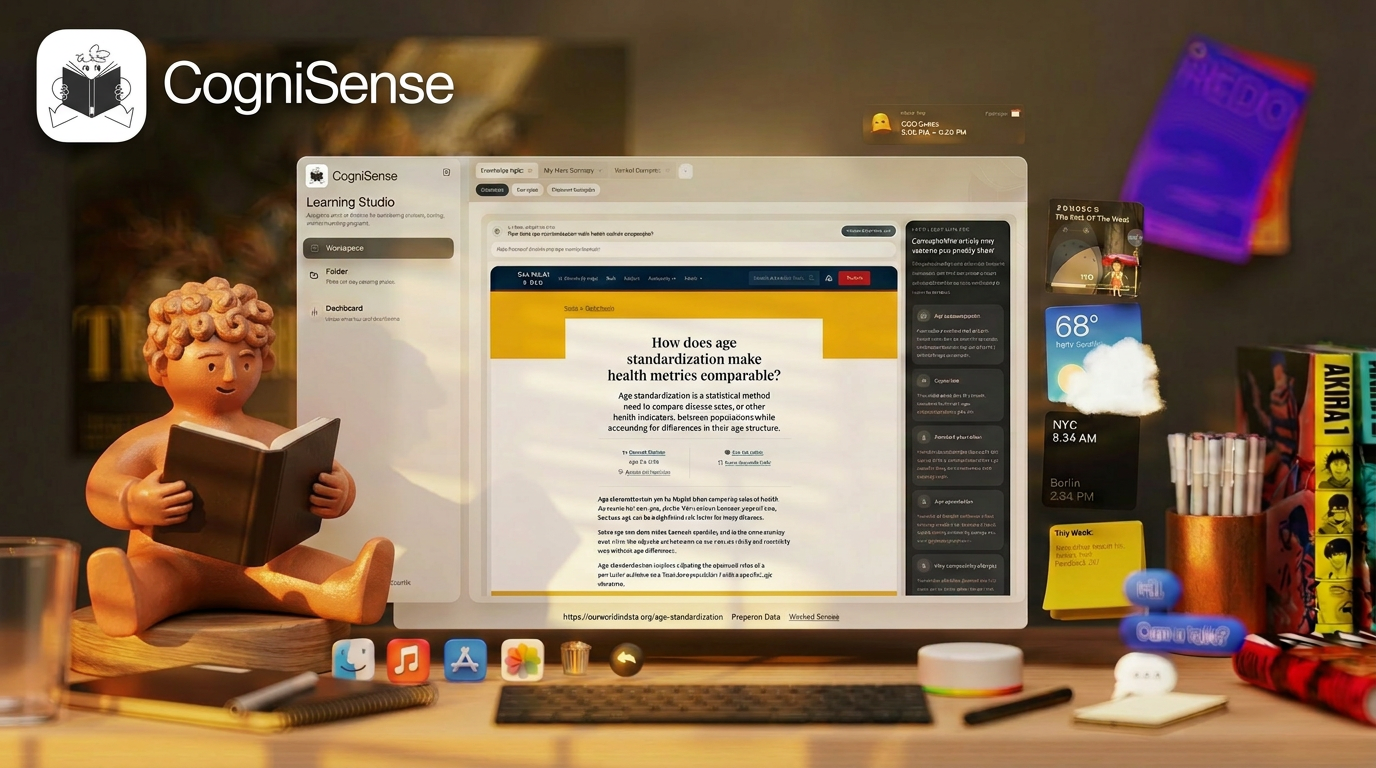
Inspiration
CogniSense was inspired by a simple but urgent question:
What if the problem with learning is not the learner, but the way knowledge is delivered?
As a team, we explored the relationship between AI and education through the lens of cognitive diversity. We noticed that most existing learning systems are still highly standardized: learners are expected to absorb knowledge primarily through reading, static visuals, and memorization, then translate it into their own understanding through repetition, listening, or writing.
This model implicitly assumes that everyone learns effectively in the same way.
However, our research suggests otherwise. Many learners are forced to adapt themselves to rigid formats that do not match their natural cognitive strengths:
- Some learners need structure and systematic frameworks
- Others need narrative and contextual meaning
- Others learn best through interaction and feedback
This observation led us to a deeper hypothesis: during learning, there may exist a hidden internal signal that determines whether real learning is happening.
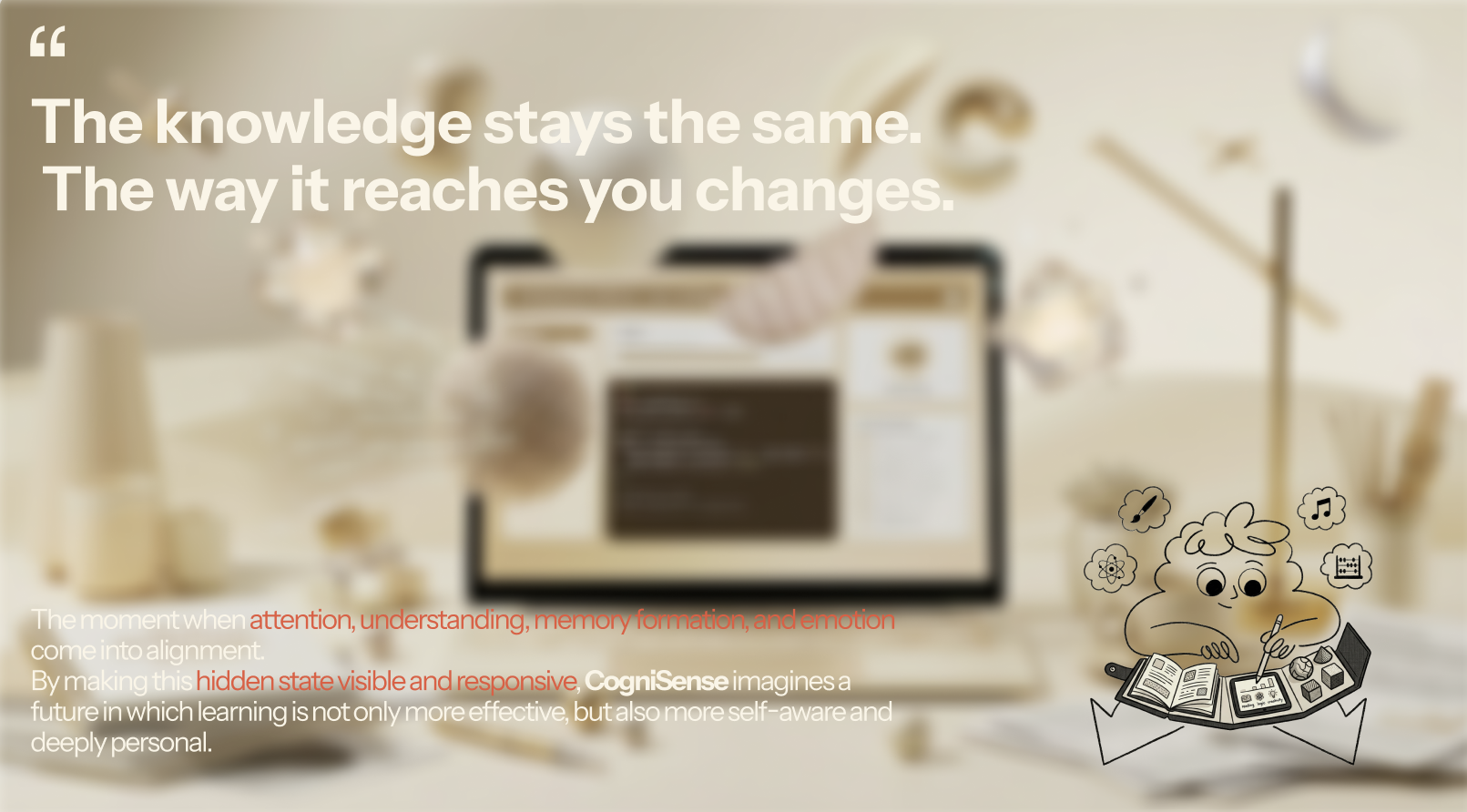
We call this signal Learning Resonance — the alignment of attention, understanding, memory formation, and emotion.
Conceptually, we describe this alignment as:
[ LR = f(A, C, M, E) ]
Where:
- (A) = Attention Stability
- (C) = Comprehension Depth
- (M) = Memory Formation
- (E) = Emotional Alignment
When these four dimensions align, learning becomes deeper, more stable, and more meaningful.
At a time when people worry that AI may weaken human thinking, we believe the opposite is possible:
AI can help us train the mind more deeply, more personally, and more effectively.
What it does
CogniSense is a speculative AI learning tool designed to track and respond to Learning Resonance, a hidden internal learning state where attention, understanding, memory, and emotion come into alignment.
Rather than treating learning as a single fixed pathway, CogniSense personalizes how knowledge enters each learner.
The system monitors four core dimensions:
- Attention Stability — whether focus is sustained or fragmented
- Comprehension Depth — whether real understanding is forming
- Memory Formation — whether knowledge is beginning to stick
- Emotional Alignment — whether emotional state supports or disrupts learning
Using these signals, CogniSense dynamically adapts:
- the learning interface
- the learning pace
- the presentation style
Different cognitive modes are supported through multiple knowledge representations:
- Structured frameworks
- Narrative progression
- Interactive reasoning
The same topic can therefore appear differently depending on the learner.
Our prototype demonstrates this through a biology topic:
How the Immune System Responds to a Virus
The prototype compares how different learners engage more deeply when content is tailored to the way they think.
Ultimately, CogniSense aims to support lifelong learners, from students learning AI to anyone tackling complex knowledge, by helping them discover more effective, self-aware, and personalized ways to learn.
How we built it
We built CogniSense as a speculative product concept and interface prototype.
Our process included:
- researching current education tools and identifying limitations in one-size-fits-all learning systems
- defining the concept of Learning Resonance as a hidden sense behind deep learning
- mapping four measurable dimensions: attention, understanding, memory, and emotion
- creating learner personas with different cognitive styles and pain points
- designing adaptive learning pathways that present the same topic in different ways
- prototyping the product experience and UI flows in Figma
- experimenting with AI-assisted design workflows, including prompt-based generation and iterative visual refinement
Our goal was to build:
- a clear product narrative
- a coherent design system
- a speculative user experience
that demonstrates how AI could support personalized deep learning in the future.
Challenges we ran into
One of our biggest challenges was translating a strong conceptual idea into a clear and polished product interface within a short time.
Although vibe coding and prompt-based design tools helped us move quickly, they were also more complex than expected.
We discovered that generating high-quality interface results still requires:
- strong design judgment
- precise prompting
- and ideally coding knowledge to refine layouts and interactions.
Another challenge was the gap between concept and execution.
Our idea was ambitious: we were not simply building another education app, but proposing a new way to think about learning itself.
This meant balancing:
- speculative thinking
- with practical UX decisions
so that the product remained understandable and usable.
Branding also became an iterative challenge. We spent significant time refining:
- visual direction
- naming
- tone
- UI language
so the concept would feel intelligent, cohesive, and credible.
Accomplishments that we're proud of
We are proud that we developed a concept that goes beyond standard AI-in-education ideas and reframes learning as something deeply personal, adaptive, and measurable.
Key accomplishments include:
- defining Learning Resonance as a new design concept for hidden learning states
- building a product vision that combines speculative design with practical UI thinking
- creating adaptive learning scenarios for different cognitive styles
- developing a coherent prototype that compares regular study vs resonance-based learning
- articulating a hopeful perspective on AI:
> AI is not a force that weakens intelligence, but a tool that can help people learn with more depth and self-awareness - pushing our Figma skills through repeated iteration, refinement, and interface testing
What we learned
We learned that designing adaptive learning systems requires far more than simply changing content.
It requires rethinking:
- how knowledge is structured
- how learning is paced
- how information is emotionally received
We also improved our skills in Figma, especially in:
- interface organization
- visual hierarchy
- prototyping
- translating abstract ideas into concrete product experiences
At the same time, we discovered that AI-assisted design workflows are powerful but not automatic.
Strong results still depend on:
- clear conceptual framing
- careful prompt writing
- critical design editing and refinement
Most importantly, we learned that personalized learning is not merely about preference.
It is about recognizing that different learners may require fundamentally different pathways into the same knowledge.
What's next for CogniSense: Sensing for Deep Learning
Our next step is to evolve CogniSense from a speculative prototype into a more validated product concept.
We plan to:
- refine the UI system to make the experience more coherent, elegant, and interaction-ready
- improve adaptive learning modules so different cognitive modes are more distinct
- develop a lightweight testing framework to evaluate how personalized learning affects:
[ Focus \rightarrow Engagement \rightarrow Understanding ]
- prototype clearer feedback loops around Learning Resonance, including:
- progress tracking
- memory formation
- emotional fit
- explore how CogniSense could support more subjects and complex knowledge domains
- strengthen product strategy, branding, and design language
In the long term, we imagine CogniSense as a lifelong learning tool — one that helps people not only learn more effectively, but also better understand how they learn.
Built With
- css
- frontend
- java
- javascript
- lucide
- motion
- radix
- react
- router
- tailwind
- typescript
- vite


Log in or sign up for Devpost to join the conversation.