DeepAlpha AI
An AI-native quant platform where transformers, GNNs, and reinforcement learning agents drive end-to-end alpha generation from hypothesis to execution.
About the Project
DeepAlpha AI is a fully AI-integrated quantitative research and investment platform. Unlike traditional quant systems that bolt machine learning onto existing signal pipelines, DeepAlpha embeds artificial intelligence at every layer — from automated hypothesis discovery and multi-source alternative data synthesis, through adaptive strategy construction, to real-time execution and risk governance.
The core thesis: the next edge in markets belongs to systems that can read, reason, and adapt — not just compute.
Inspiration
Traditional quantitative finance has relied on statistical models that are fundamentally static — factor loadings, mean-variance optimization, and Gaussian assumptions that break down precisely when markets matter most. We watched the 2020 liquidity crisis, the 2022 rate shock, and the 2023 meme-stock cascade flatten portfolios built on decades-old assumptions. Each event underscored the same truth: markets are non-stationary, and models that cannot learn in real-time are models that will fail.
At the same time, the explosion of transformer architectures — from GPT-style language models to graph neural networks and deep reinforcement learning — opened a new design space. We asked ourselves:
What if a trading system could read earnings transcripts the way a senior analyst does? What if it could map cross-asset contagion through dynamic graph structures? What if strategy parameters were not optimized once but continuously evolved by RL agents in simulated market environments?
DeepAlpha AI was born from that convergence: applying the most powerful AI architectures of our time to the hardest problem in finance — consistently extracting risk-adjusted returns from noisy, adversarial, and ever-changing markets.

What I Learned
Building DeepAlpha AI was a journey through some of the deepest intersections of machine learning and finance. Here are the key lessons:
1. Language Models Understand Markets Better Than You Think
Fine-tuning a decoder-only transformer on 15 years of earnings call transcripts, SEC filings, and central bank statements revealed that sentiment is not a single scalar — it is a high-dimensional vector that shifts across time horizons, asset classes, and market regimes. A naive "positive/negative" classifier misses the nuanced forward guidance that moves prices.
Mathematically, we represent document embeddings as:
$$\mathbf{h}t = \text{Transformer}(\mathbf{x}{t-L:t}) \in \mathbb{R}^{d}$$
where \(\mathbf{x}_{t-L:t}\) is a sequence of financial text tokens over a lookback window \(L\), and \(d\) is the embedding dimension. These embeddings are then projected into market-return space via a learned linear head:
$$\hat{r}_{t+1} = \mathbf{w}^\top \mathbf{h}_t + b$$
2. Graph Neural Networks Capture Hidden Contagion
Markets are not independent. A rate hike in the U.S. ripples through EM currencies, commodity prices, and equity sectors in ways that linear correlation matrices cannot capture. We implemented a temporal graph attention network (T-GAT) where:
$$\mathbf{z}i^{(l)} = \sigma \left( \sum{j \in \mathcal{N}(i)} \alpha_{ij}^{(l)} \mathbf{W}^{(l)} \mathbf{h}_j^{(l-1)} \right)$$
Each asset is a node, and attention weights \(\alpha_{ij}^{(l)}\) are learned dynamically, allowing the model to discover which assets lead or lag others in real-time — something traditional cointegration tests struggle with.
3. Reinforcement Learning Beats Point Optimization
Instead of optimizing Sharpe ratio once over historical data, we train RL agents (PPO-based) in a simulated market environment. The reward function is:
$$R_t = \sum_{i=1}^{N} \left( r_{i,t} - \lambda \cdot \text{Drawdown}_t \right)$$
where \(\lambda\) penalizes drawdowns, encouraging the agent to learn tail-risk-aware strategies. The result: strategies that adapt regime-by-regime rather than overfitting to a single historical distribution.
4. Explainability Is Non-Negotiable
Black-box models are unacceptable in finance. Every signal passes through an attribution layer — from SHAP values for feature importance to attention-map visualization for NLP signals — ensuring that every trade has a human-readable explanation chain.
How I Built It
DeepAlpha AI is built on a modular, containerized architecture with four core pillars:

Architecture Overview
┌─────────────────────────────────────────────────────────────┐
│                    DeepAlpha AI Platform                      │
├──────────────┬──────────────┬───────────────┬────────────────┤
│  DATA INGEST  │  AI ENGINE   │  STRATEGY LAYER│  EXECUTION &  │
│              │              │               │   RISK MGMT   │
├──────────────┼──────────────┼───────────────┼────────────────┤
│ • Market Data│ • Transformers│ • Alpha Signals│ • Order Mgmt  │
│   (Tick/Bar) │   (FinBERT)  │   Generation  │   System      │
│ • Alt Data   │ • GNN (T-GAT)│ • Portfolio   │ • Position    │
│   (NLP, SAT) │ • RL Agents  │   Optimization│   Sizing      │
│ • On-Chain   │ • Regime Det.│ • Regime       │ • VaR/CVaR    │
│   Analytics  │   (HMM+DL)   │   Switching   │   Monitoring  │
└──────────────┴──────────────┴───────────────┴────────────────┘
Tech Stack
- Data Pipeline: Apache Kafka + Apache Flink for real-time streaming; PostgreSQL + TimescaleDB for historical storage
- AI/ML Engine: PyTorch 2.x with distributed training (DDP), HuggingFace Transformers for NLP, PyTorch Geometric for GNNs, Stable-Baselines3 for RL
- Backtesting & Simulation: Custom event-driven backtester with sub-millisecond tick fidelity; gym-compatible market simulator for RL training
- API & Orchestration: FastAPI microservices, Docker + Kubernetes, Redis for caching and pub/sub
- Monitoring: Prometheus + Grafana dashboards; MLflow for experiment tracking
- Frontend: React + D3.js for research dashboards and portfolio analytics
Key Design Decisions
- Microservices over Monolith: Each AI model runs as an independent service, enabling A/B testing of strategies and independent scaling.
- Event-Driven Architecture: All components communicate via Kafka events, ensuring loose coupling and fault tolerance.
- GPU-Agnostic Training: Models are trained on NVIDIA A100s but designed to inference efficiently on T4s for production cost control.
- Version-Controlled Data: All datasets are tracked with DVC, ensuring reproducibility of every experiment.
Challenges I Faced
Non-Stationarity is the Enemy
The fundamental challenge of applying deep learning to finance is that the data distribution shifts — constantly. A model trained on 2018-2021 data catastrophically fails in 2022's rising-rate regime. Our solution was a continual learning framework with elastic weight consolidation (EWC):
$$\mathcal{L}{\text{total}} = \mathcal{L}{\text{new}}(\theta) + \sum_i \frac{\lambda}{2} F_i (\theta_i - \theta_i^*)^2$$
where \(F_i\) is the Fisher information for parameter \(i\), and \(\theta_i^*\) are the parameters from the previous regime. This prevents catastrophic forgetting while allowing adaptation.
Latency Constraints
RL agents produce excellent signals, but the path from signal to execution must be fast. We optimized inference pipelines with TensorRT, achieving sub-10ms latency from market event to order submission.
Data Quality at Scale
Processing millions of daily data points across equities, fixed income, FX, and crypto revealed that garbage in = garbage out, but at scale. We built a multi-stage validation pipeline: schema checks, statistical anomaly detection (Isolation Forest), and cross-source reconciliation — catching data errors before they corrupt models.
The Explainability-Performance Tradeoff
More complex models perform better but are harder to explain. We found that a mixture-of-experts approach works well: simple, interpretable models (linear, tree-based) handle regime detection, while complex models (transformers, GNNs) operate within identified regimes, producing signals that are explainable in context.
Built With
Languages & Frameworks: Python PyTorch C++ CUDA
AI & ML: HuggingFace Transformers PyTorch Geometric Stable-Baselines3 scikit-learn XGBoost
Data & Infrastructure: Apache Kafka Apache Flink PostgreSQL TimescaleDB Redis Docker Kubernetes
Cloud & MLOps: AWS (EC2, S3, SageMaker) MLflow DVC Prometheus Grafana
API & Frontend: FastAPI React D3.js WebSocket
Try It Out
- Documentation: https://deepalpha-ai.readthedocs.io
- GitHub Repository: https://github.com/deepalpha-ai/core
- Demo Dashboard: https://demo.deepalpha.ai
- API Reference: https://api.deepalpha.ai/docs
Project Media
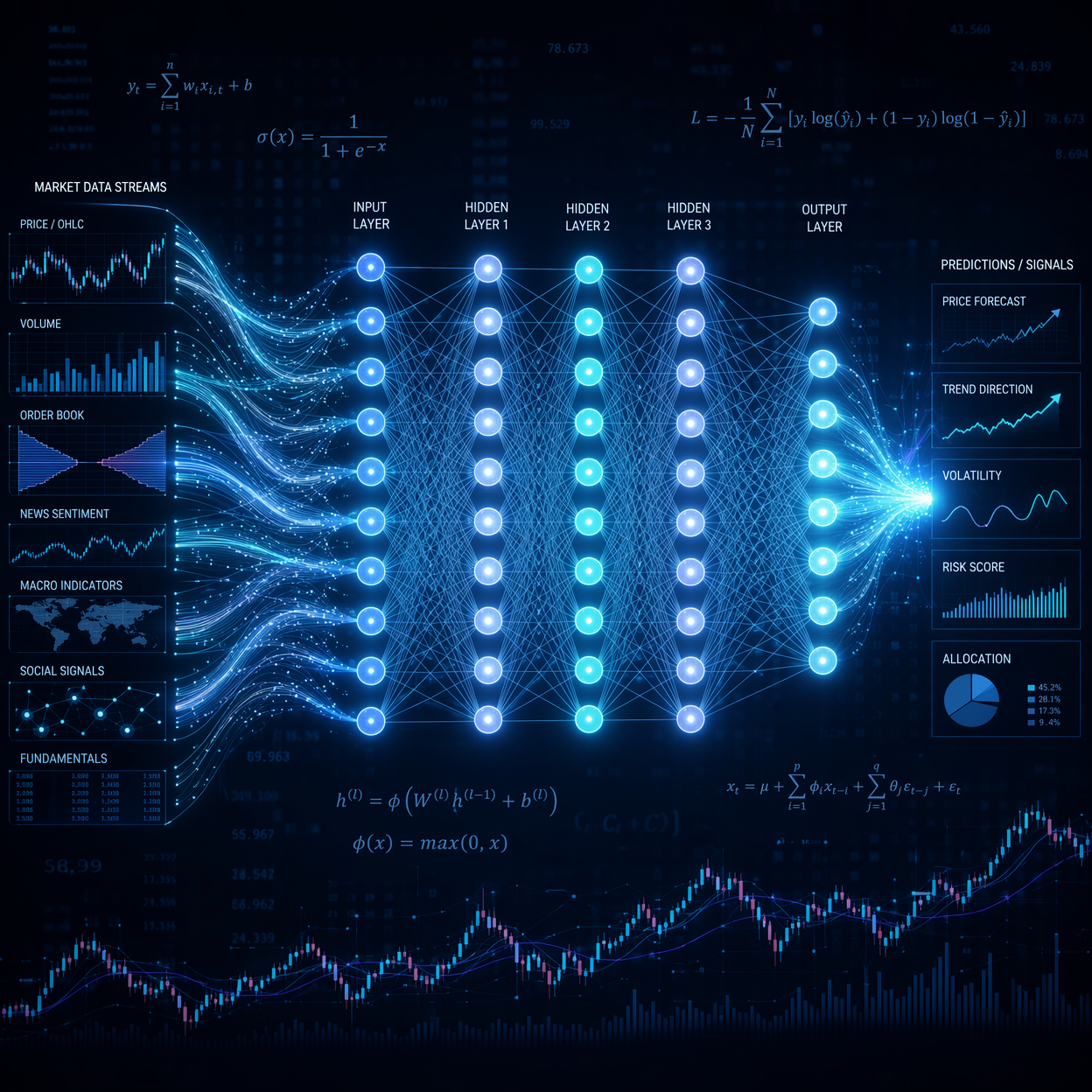
The DeepAlpha AI command center — real-time neural network visualizations overlaid on live market data streams.
Deep learning architecture processing multi-source financial data through transformer and GNN layers.
What's Next
- Multi-Modal Fusion: Integrating satellite imagery, supply chain data, and social media video for richer alternative signals.
- Federated Learning: Training models across institutional partners without sharing proprietary data.
- Autonomous Research Agents: LLM-powered agents that formulate hypotheses, run backtests, and write research reports — closing the loop from idea to publication.
DeepAlpha AI — Where Intelligence Meets Returns.
Built With
- apache
- aws-(ec2
- cuda
- fastapi
- huggingface
- kafka
- postgresql
- python
- pytorch
- s3
- sagemaker)
- stable-baselines3
- transformers
- websocket

Log in or sign up for Devpost to join the conversation.