CogniPath: The Adaptive AI Tutor
Inspiration
As a 3rd-year AI student and GDGoC Chapter Lead, I've seen a recurring struggle: the "One-size-fits-all" educational gap. Standardized curricula often fail to account for the unique cognitive state of each student. We can model Learning Efficiency (E) as a function of the alignment between Material Difficulty (D) and a student’s current Knowledge Base (K):$$E = \int_{t_0}^{t_1} \exp\left( -\frac{(D(t) - K(t))^2}{2\sigma^2} \right) dt$$When the gap between (D) and (K) is too large, efficiency (E) drops, leading to frustration.
I was inspired to build CogniPath to bridge this gap using Gemini 3’s reasoning to create a truly personalized, multimodal learning journey.
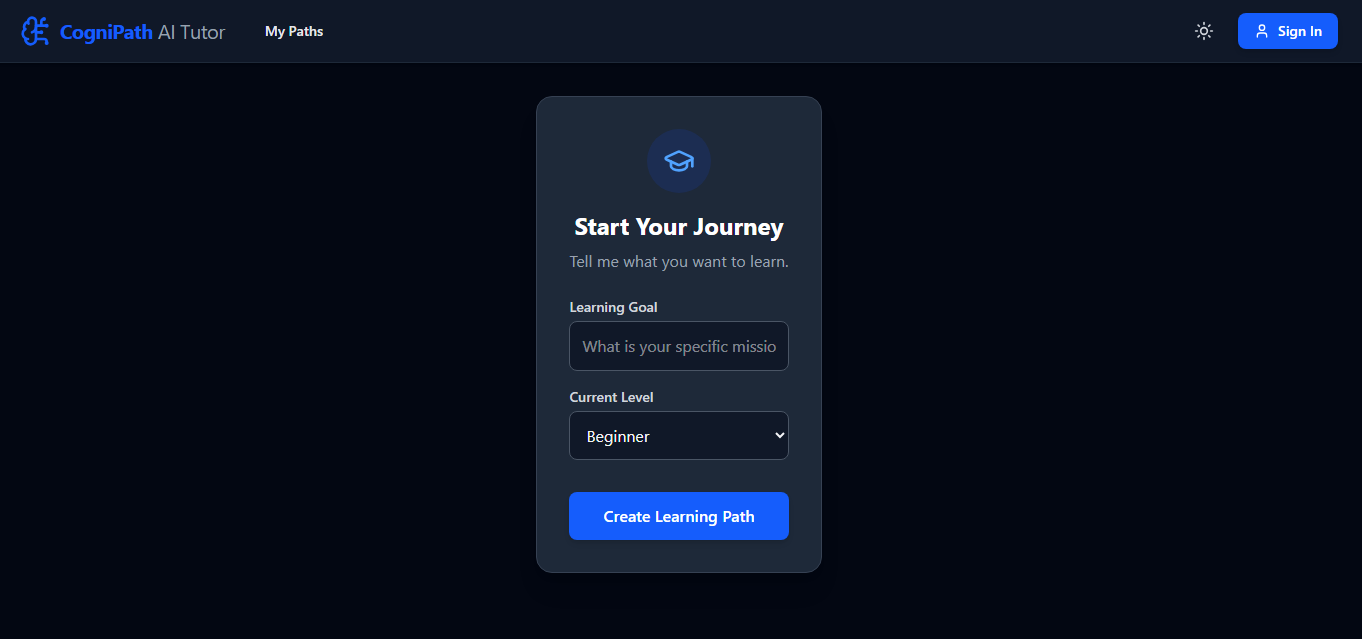
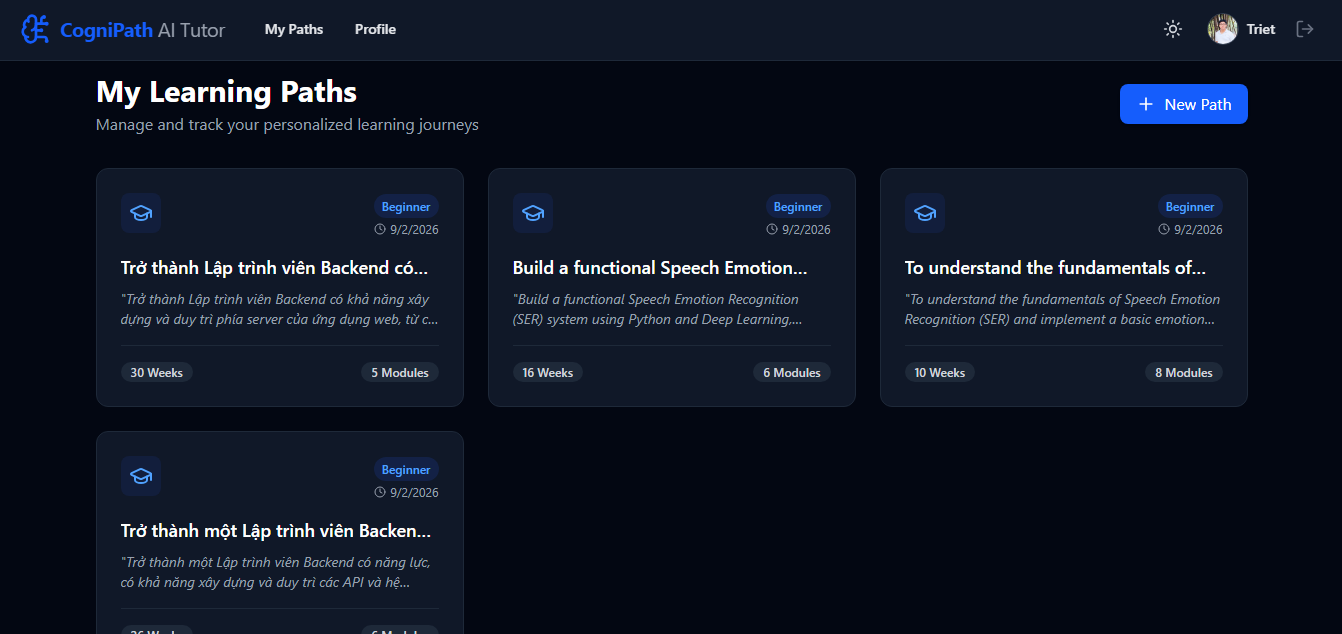
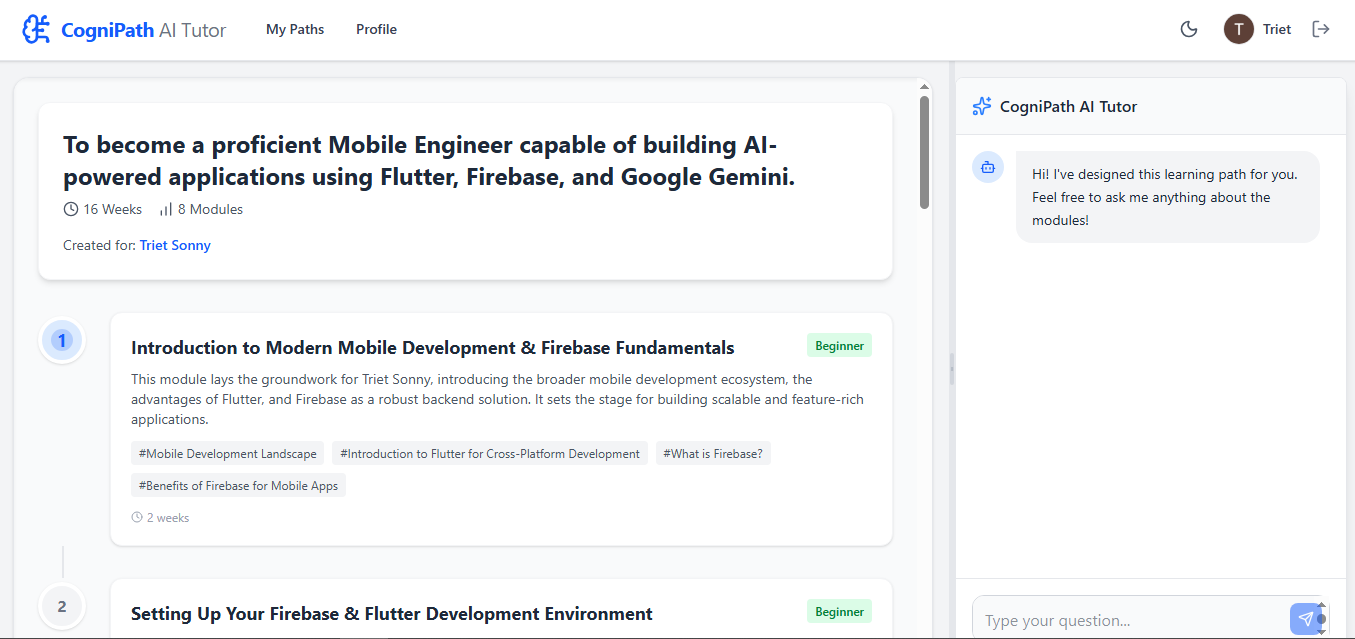
What it does CogniPath is an AI-first learning ecosystem that transforms raw educational data into a dynamic, personalized roadmap.
Knowledge Ingestion: Students upload entire course folders—lecture videos, PDF textbooks, and even handwritten notes.
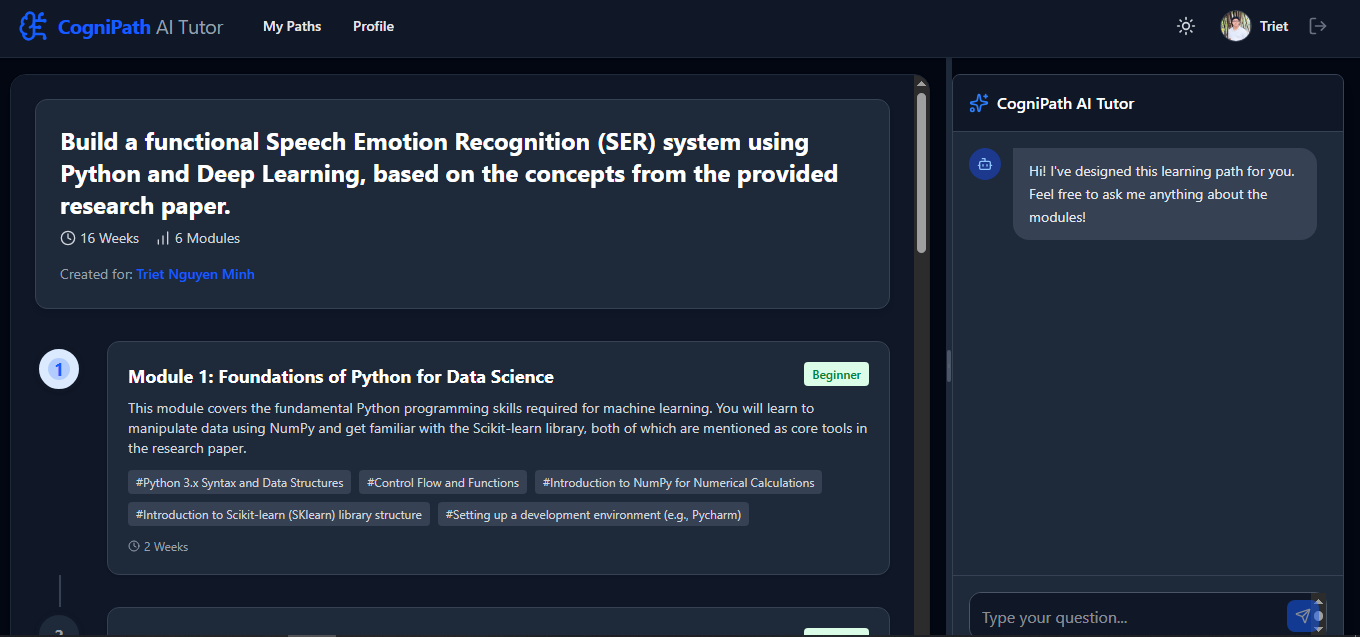
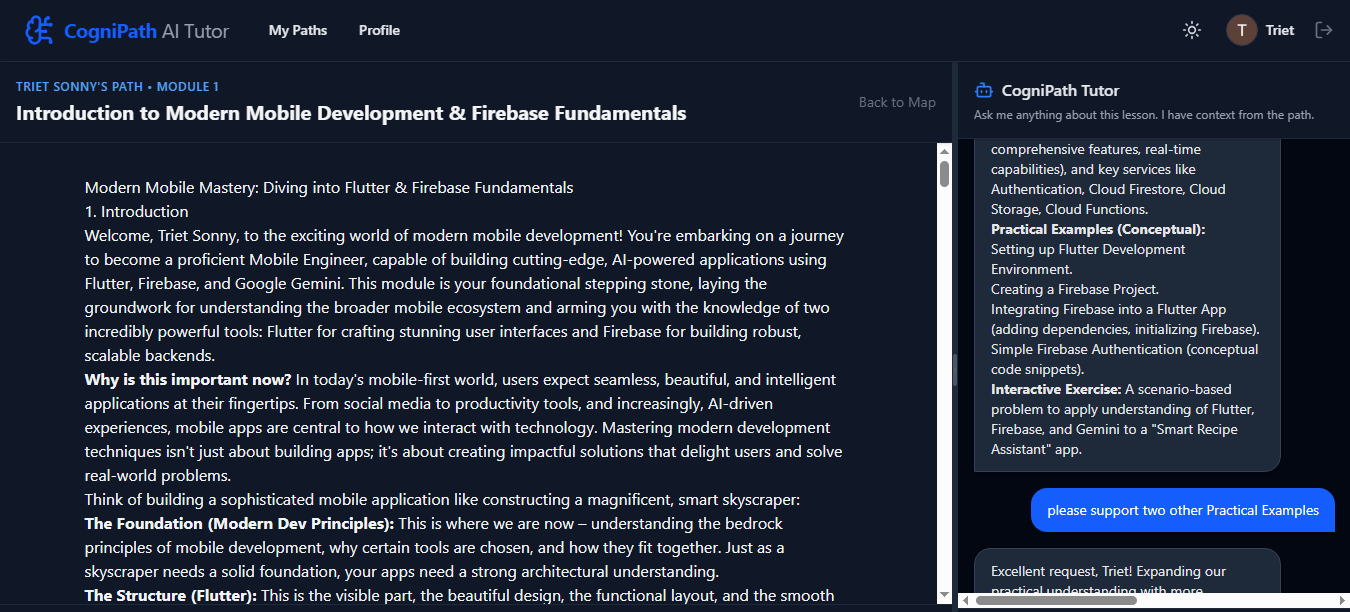
Curriculum Architect: The system analyzes these materials and the student's profile to generate a bespoke, week-by-week learning path.
Socratic Tutoring: Instead of giving direct answers, our AI Agent uses the Socratic method to guide students through critical questioning, ensuring deep understanding rather than rote memorization.
How we built it.
We utilized a modern, scalable tech stack designed for high-performance AI interaction:
Frontend: Built with React, TypeScript and Tailwind CSS, focusing on a "Mobile-First" responsive design that mirrors the Google LMS aesthetic.
Backend: A Python Flask orchestration layer managing the flow between the user and the Gemini API.
Gemini 3 Deep Think: Acts as the "Brain" for generating complex, logical learning paths.
Gemini 2.5 flash: Handles the massive 2M+ context window required to ingest and synthesize multiple textbooks and hours of video simultaneously.
Native Multimodal Integration: We bypassed traditional OCR/Transcription pipelines by using Gemini’s native ability to "see" and "hear" curriculum content directly.
Challenges we ran into:
Orchestrating Agentic Logic: Crafting a Socratic tutor that refuses to provide direct answers required rigorous prompt engineering and fine-tuning of system instructions to maintain its "Teacher" persona.
Structured Output Consistency: Ensuring the AI consistently returned complex JSON schemas for the learning paths was solved by implementing strict TypeScript interfaces and validation layers on the backend.
Latency vs. Depth: Gemini 3's Deep Thinking mode is powerful but requires time. We addressed this by designing an asynchronous UI that provides "Progressive Insights" to the student while the model processes the deeper logic.
Accomplishments that we're proud of: True Multimodality: Successfully building a system that can relate a specific minute in a lecture video to a paragraph in a PDF textbook.
Instruction Following: Achieving a high degree of "Agentic" autonomy where the AI maintains its Socratic pedagogical style even under "pressure" from user queries.
Architecture: Creating a clean, Monorepo structure that is ready for production-level scaling.
What we learned.
This project shifted my focus from "Generative AI" to "Agentic Reasoning." I learned that the true power of Gemini 3 lies not just in its vast knowledge but in its ability to act as a reasoning agent. We discovered that Native Multimodal processing is significantly more context-aware than traditional fragmented pipelines, allowing for a more cohesive understanding of complex educational materials.
What's next for CogniPath:
The Adaptive AI TutorReal-time Visual Assessment: We plan to leverage Gemini 3’s vision capabilities to allow the tutor to "observe" a student's work via camera or screen—providing instant, non-invasive feedback on everything from handwritten math to physical experiments.
Adaptive Testing Modules: Developing a dynamic assessment engine that updates the student's Cognitive Map in real-time, evolving the learning path as they master new concepts.
Collaborative Learning Agents: Enabling multiple AI Agents to simulate "Study Groups," where each agent takes a different perspective to help a student explore a topic from multiple angles.
Built With
- firebase
- flask
- gemini-1.5-pro
- gemini-3-deep-think
- google-cloud
- google-gemini-api
- python
- react
- tailwind-css
- typescript
- vertex-ai


Log in or sign up for Devpost to join the conversation.