-
-
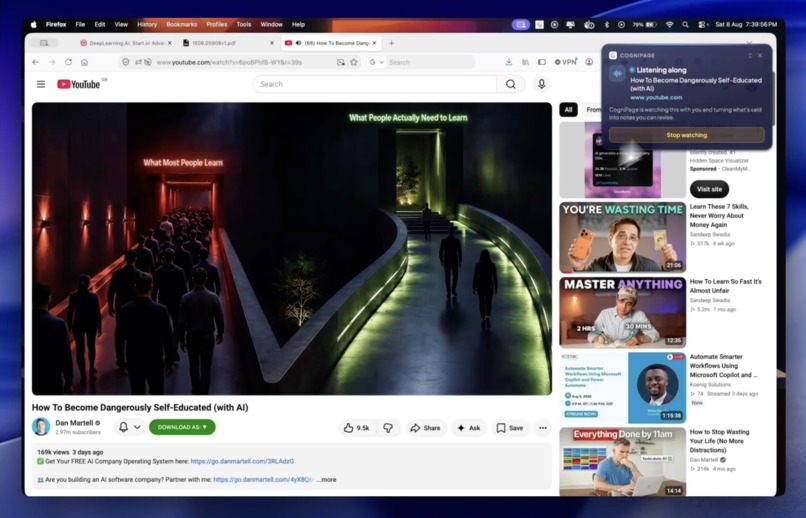
Listening Along
-
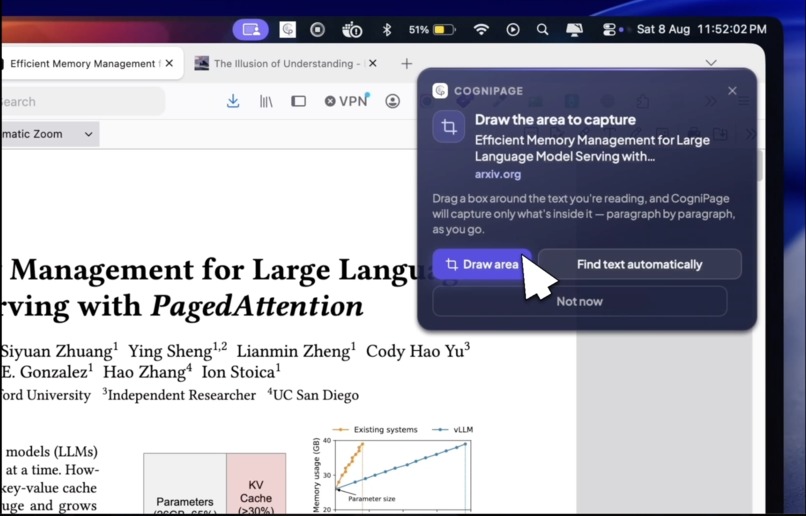
Authored Read Along
-
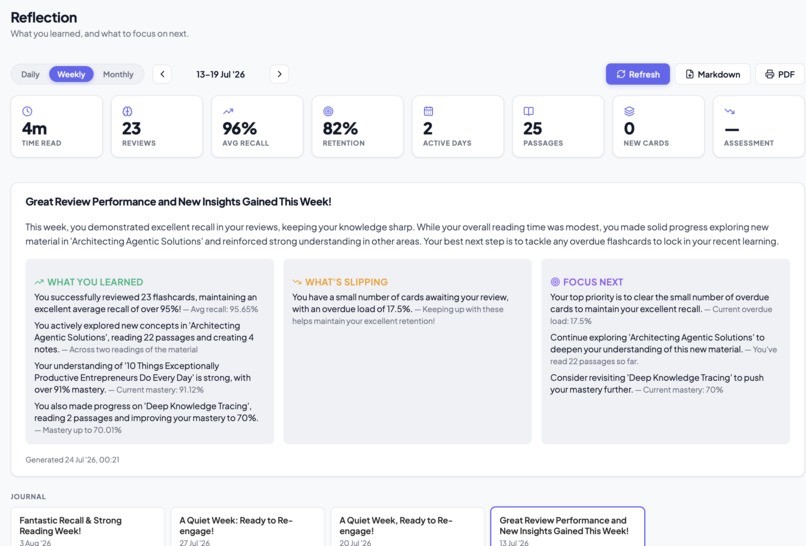
Reflection
-
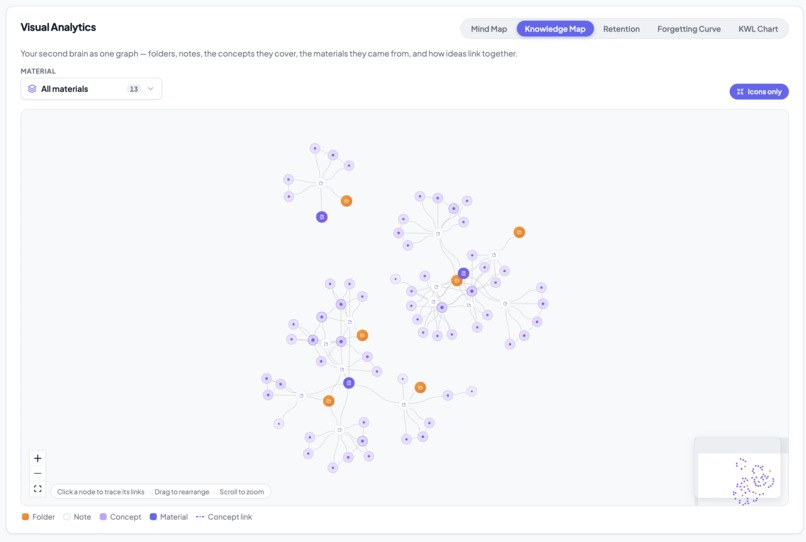
Knowledge Map
-
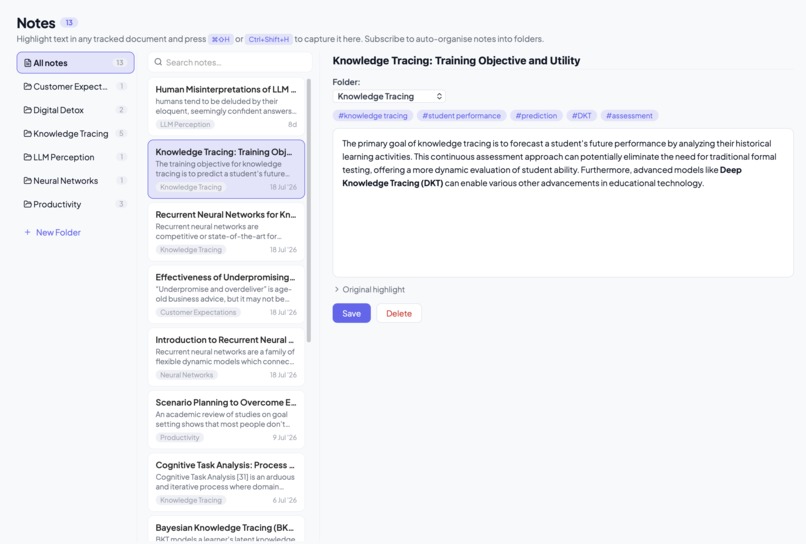
Notes
-
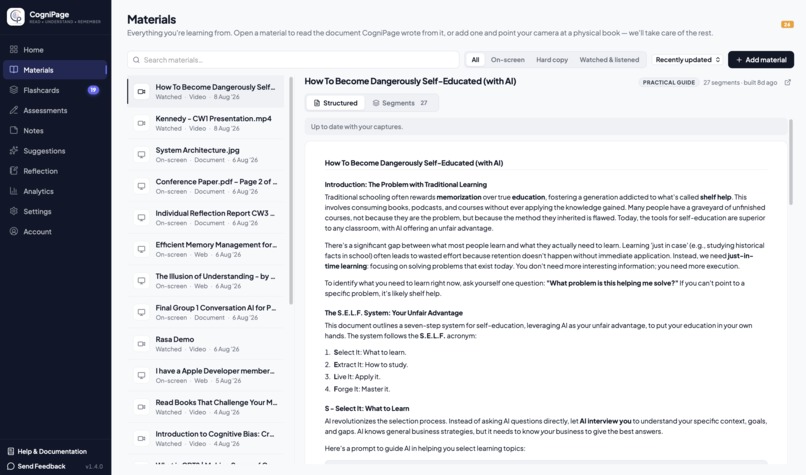
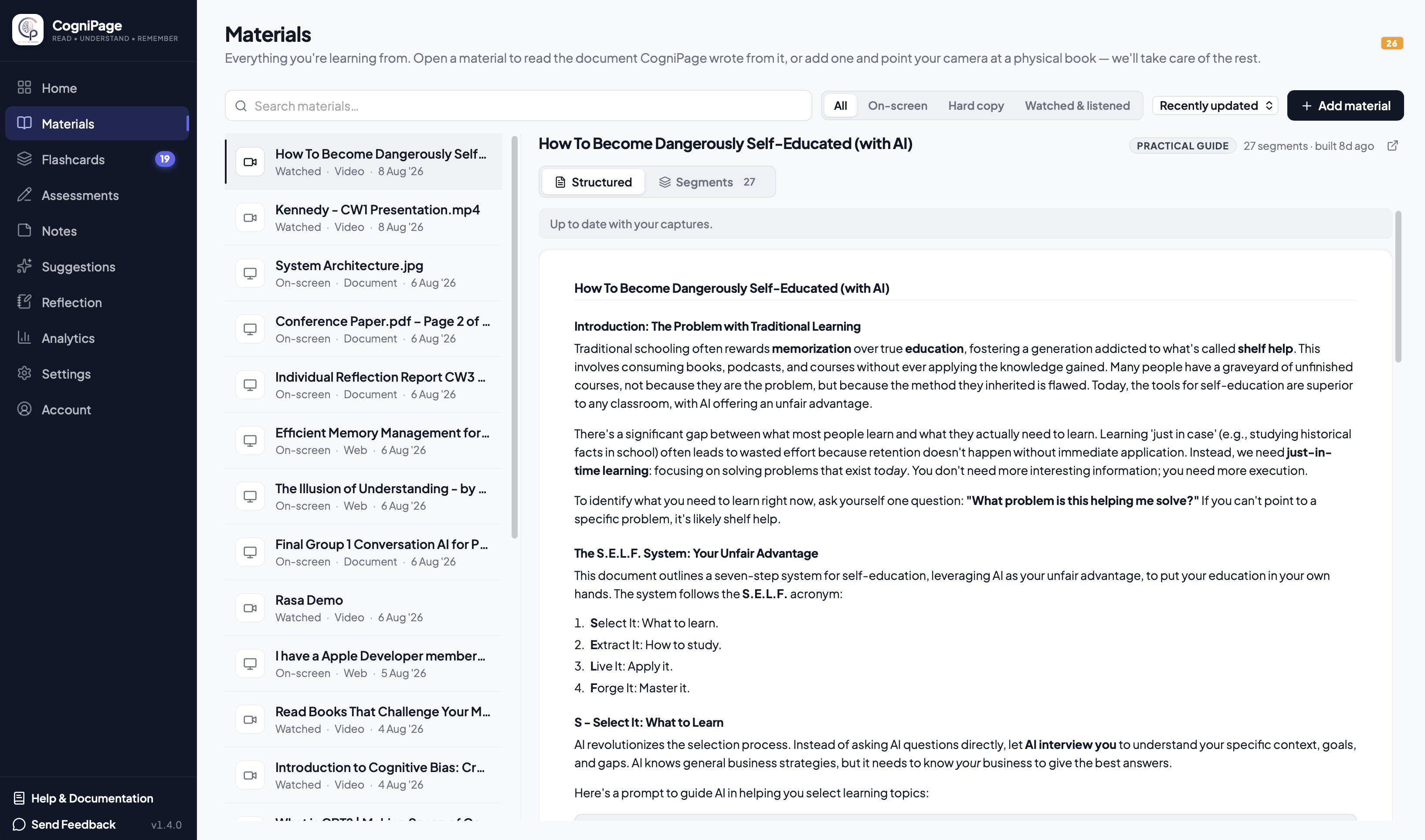
Materials
-
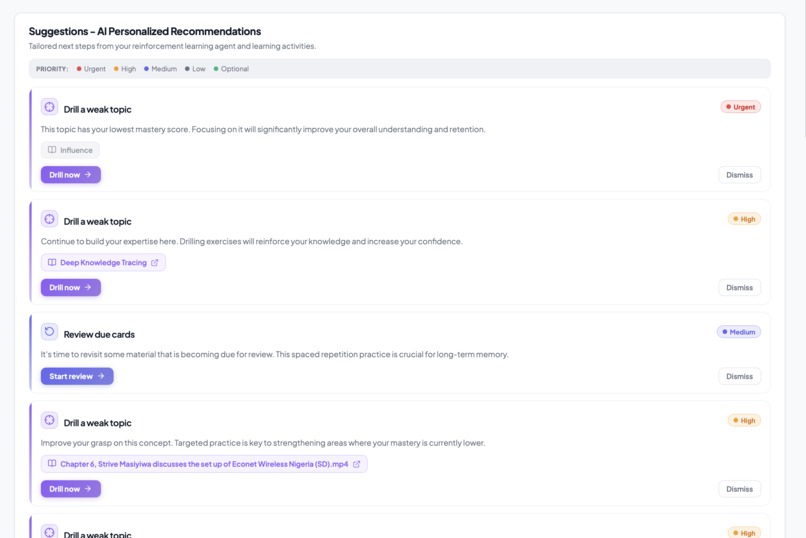
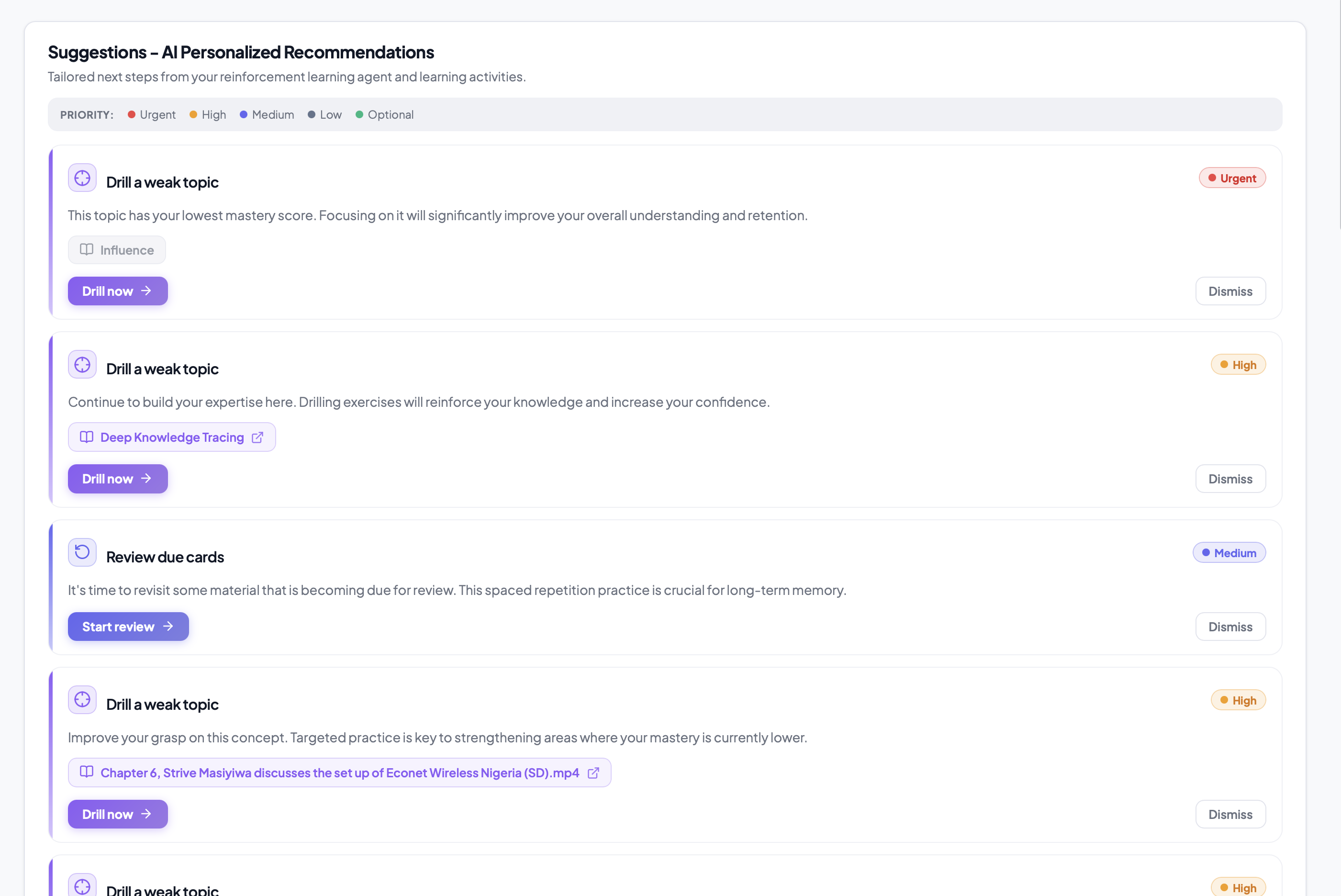
Suggestion / Recommendation
-
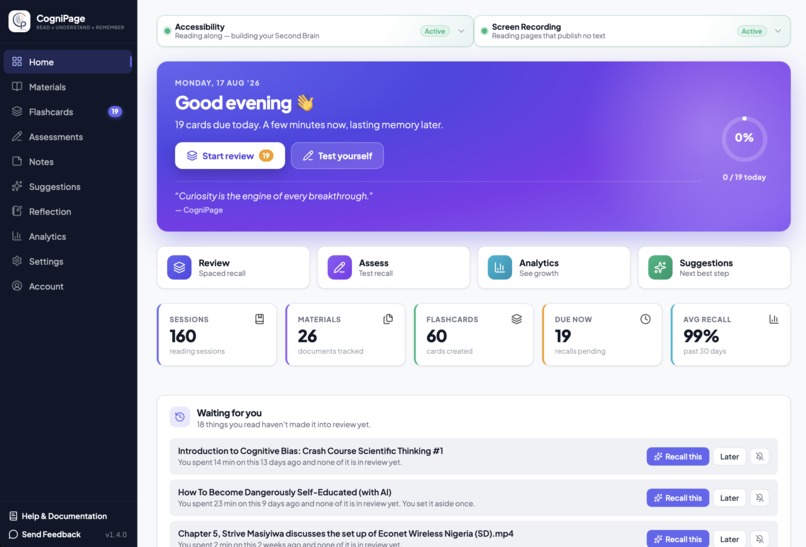
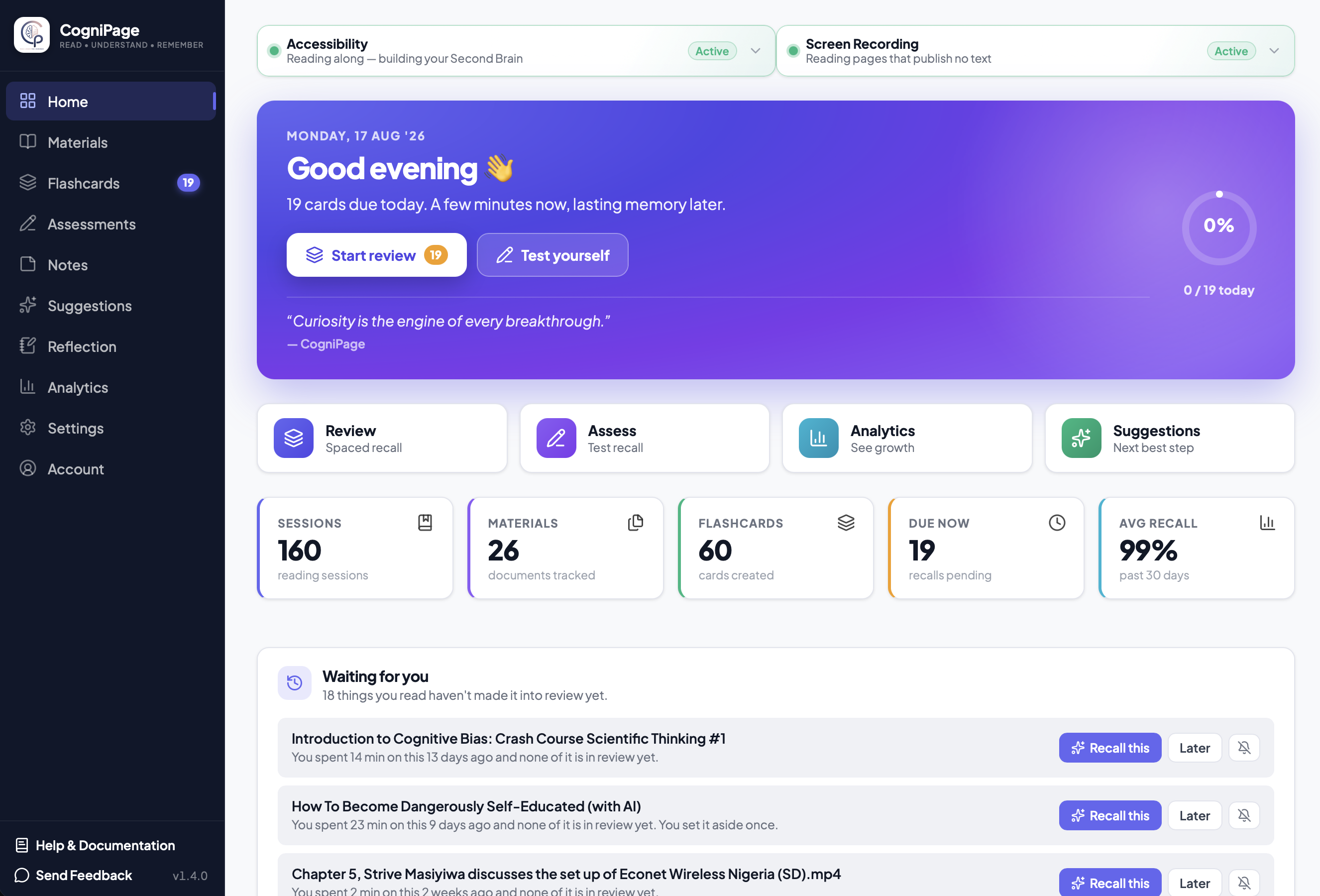
Home
Inspiration
We presently live in the age of information overload, either we are trying to consume information for workforce upskilling, personal growth, or prepare for exams or certifications, we consumes so much information and experience Illusion of Explanatory Depth because we keep dwelling on same information and fells we understand them, but few hours or days down the line, we bearly could remember most of those information.
The present solutions works but they measure our engagements rather than actually retention that survives, and becomes even worst with AI usage. Although, AI helps improves productivity, but impersonating us by offloading our cognitive, which makes our retention even worst.
Not anymore, CogniPage flips all that. We consume information as normal, that Documents or PDF, Browser reading, Video or Audio Lectures on most popular learning websites, AI learning and conversation summary, even Printed books. CogniPage knows exactly what we read, then uses proven memory science to bring them back just before we forget, fitting to our own forgetting curves.
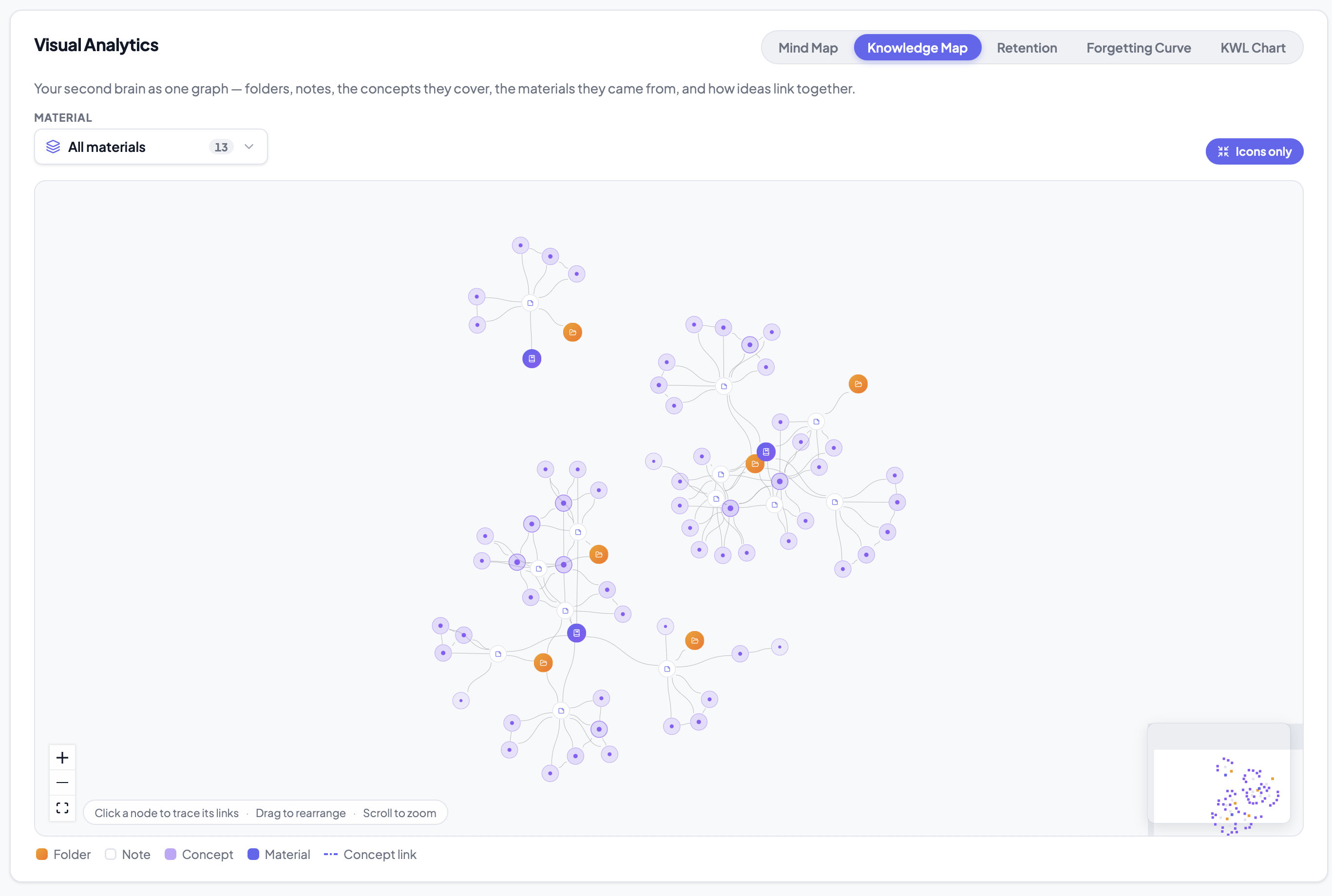
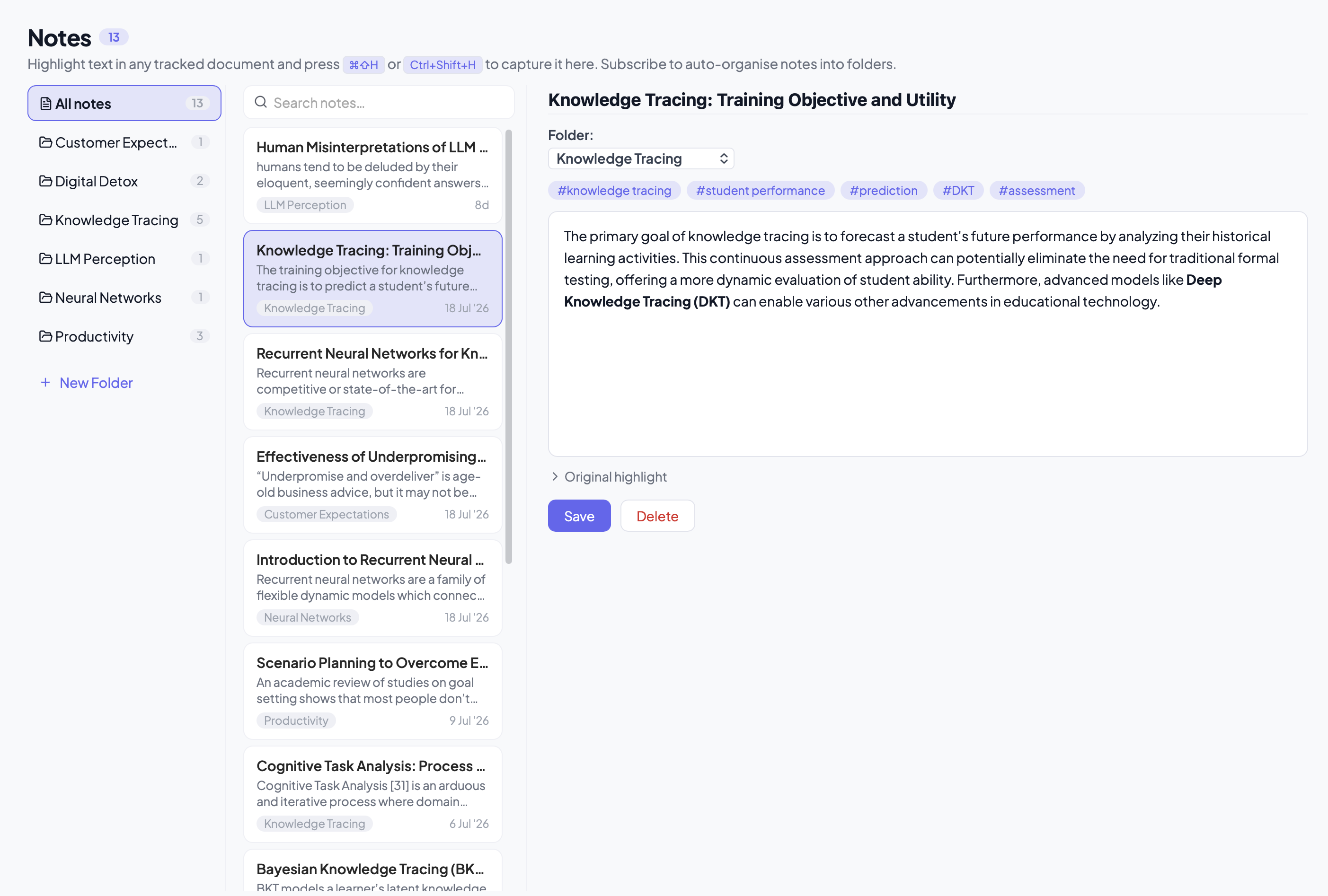
We are reading or chatting with AI, and found something important worth keeping, Hightlight and press Command, Shift, H on Mac or Control, Shift, H on Windows, our Note self-organise itself, effort free, then creates a Knowledge Map that visualises everything in one piece.
The AI Assessment that analyses and identifies concepts or topics we lack and generates multi-type question of our choice, then perform credit-grading based on our responses, and identify where we lac, and points us to the material sections, topics, or concepts we need to forcus attention on.
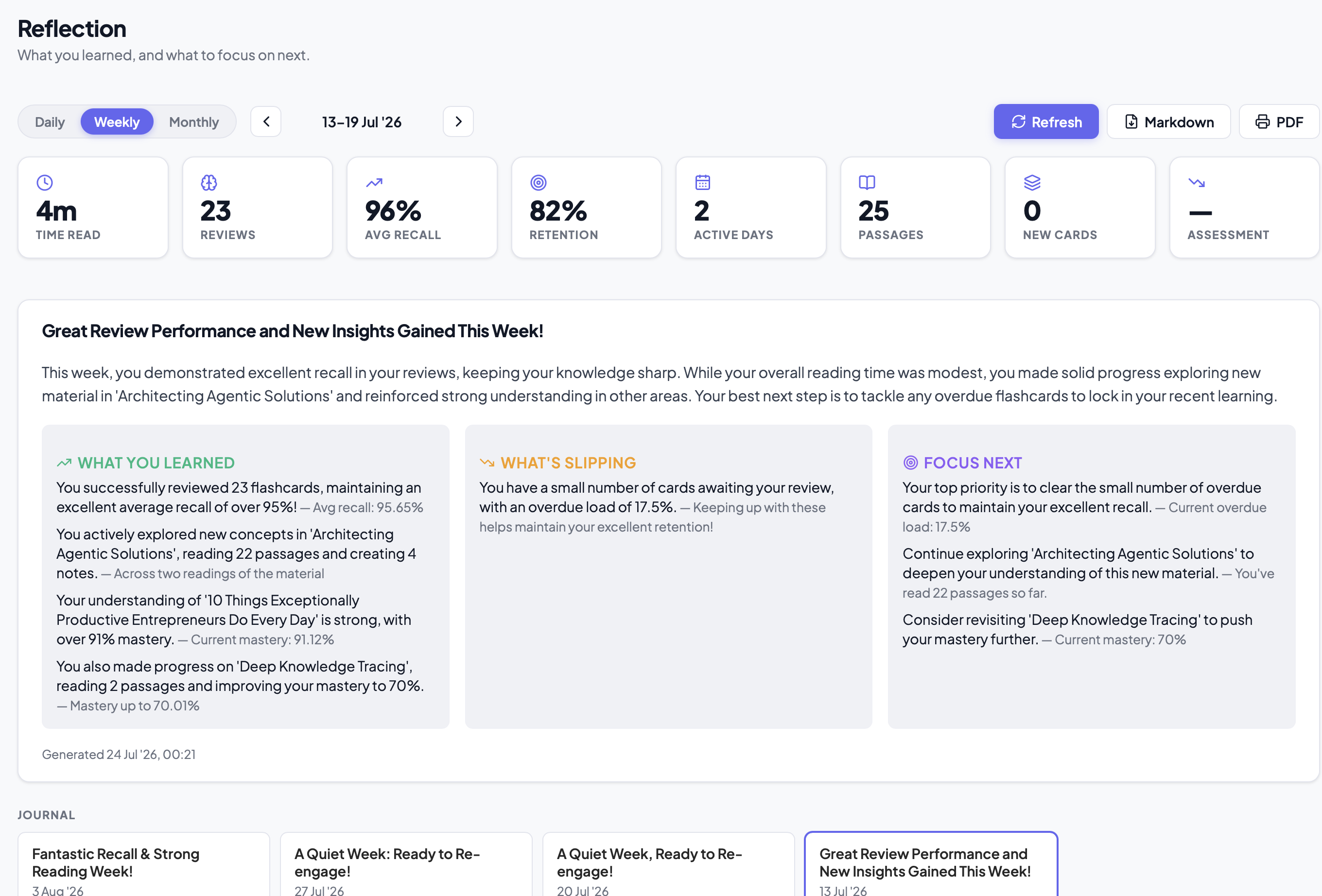
CogniPage provides Daily, Weekly, and Monthly AI reflection that summaries what we read, how long, what we retained, and what we should focus on, all grounded on our retention data using Deep Knowledge Tracing and Reinforcement Learning. In addition, can consult KWL chart, which is, What we already Know, what we Want to know, and what we've Learned, for per material focus.
Other retention visualisation includes Mind Map (the connection of our flashcard's recalls), Retention Heatmap (which days we does retention better, which days it slides), and Forgetting Curve (our personalised forgetting curve, fitted to our retention).
As Privacy is the price we pay for Internet adoptation, so as Cognitive offloading for AI adoptation. Take it back today with CogniPage.
What it does
CogniPage is a privacy-first desktop "second brain" that reads along with you and turns what you read into memory that lasts. Four steps, less effort from you:
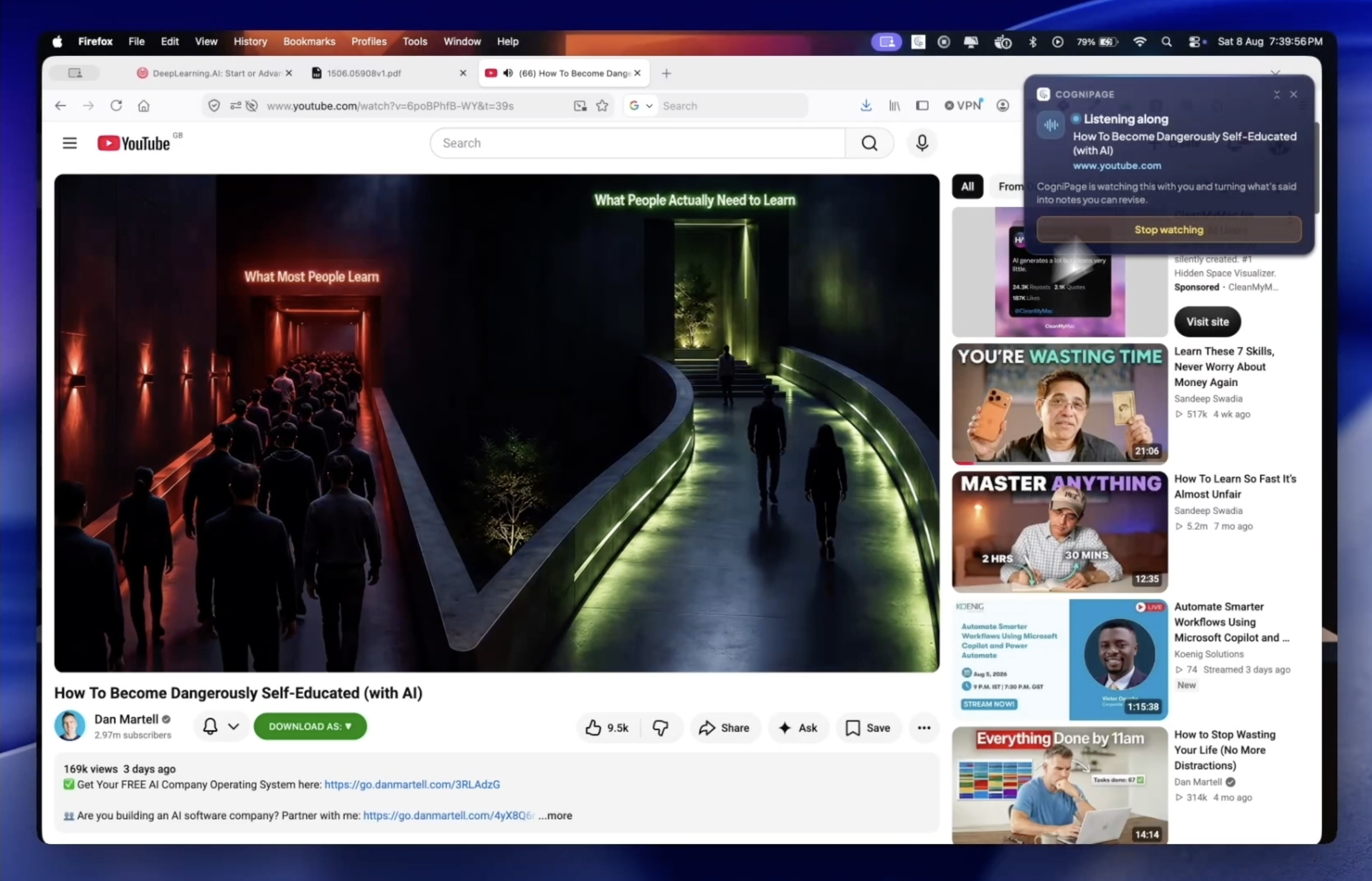
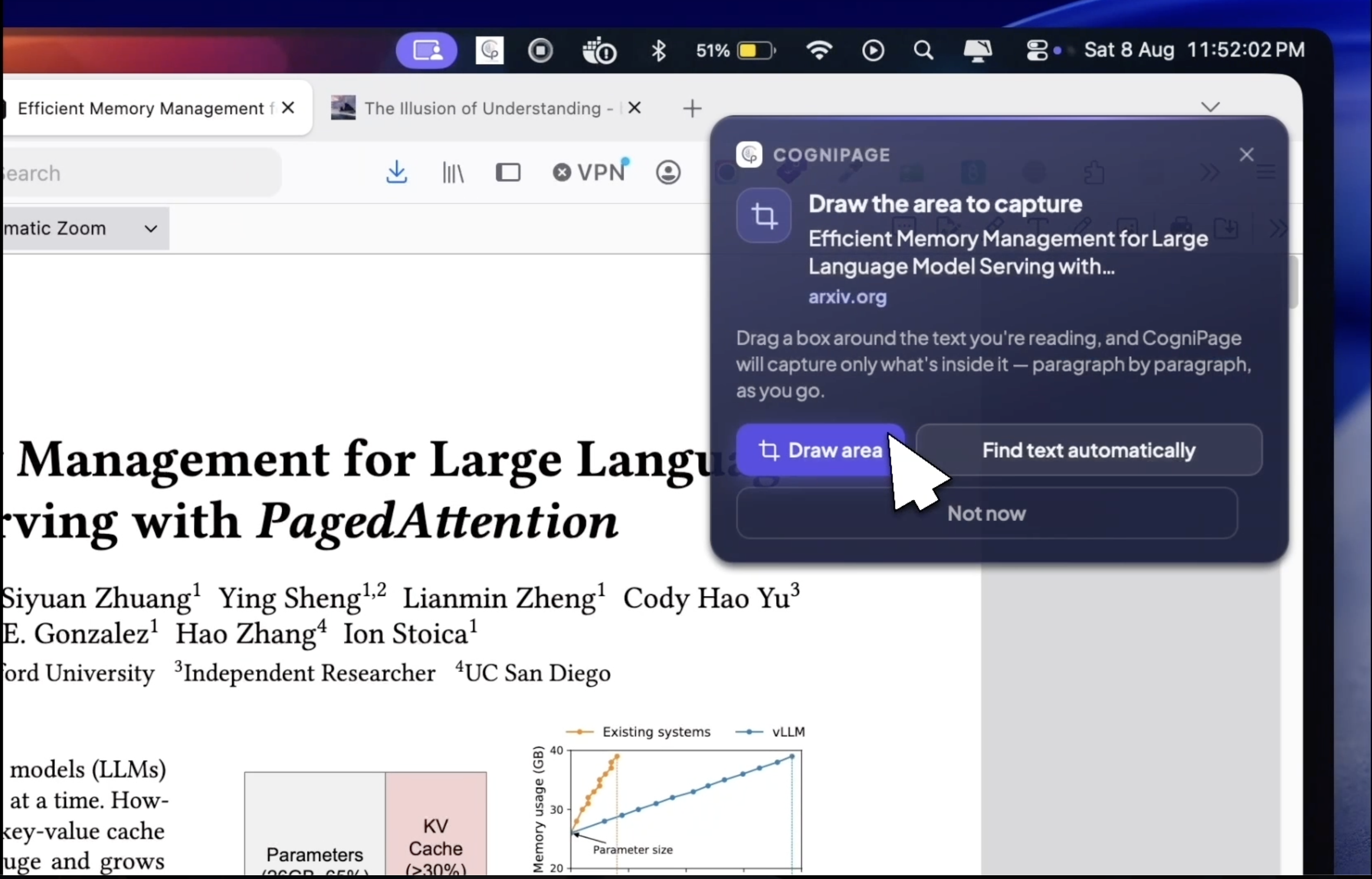
- Read. You keep reading exactly as you do - PDFs, Office documents, the web, lectures on ~50 recognised platforms, even a printed book under a cam. Capture is native (macOS / Windows vision), gated by a three-tier privacy consent model: per video, per website, per document. Lecture audio is transcribed entirely on-device; the microphone is never opened, no audio or screenshot is ever written to disk, and ad breaks (on platform like YouTube) are detected and dropped.
- Capture. A 12-second dwell gate and de-duplication decide what you actually read rather than what merely crossed your screen.
- Recall. AI turn those passages into space repetition, seven types of assessment, self-organising notes, KWL charts, suggestion/recommendation and reflections.
- Retain. An on-device FSRS-6 scheduler — 21 parameters, fitted to your own forgetting curve resurfaces each idea the moment before it fades, with the retention target chosen by a reinforcement-learning policy grounded in deep knowledge tracing.
Four analytics views (Knowledge Map, KWL, Personal Forgetting Curve, Retention Heatmap) turn that history into a picture of what you genuinely know.
How we built it
The product is AI-native, not AI-assisted. Ten (10) focused built on Google's Agent Development Kit, running on Vertex AI (gemini-3.1-flash-lite, global endpoint), execute the decisions that are the product: what is worth remembering, what to ask, how the answer scores and where understanding slipped, what to study next, how a note is titled, filed and linked to prior knowledge, and how a document is structured. The advisor agent doesn't guess, it calls our own models as ADK function tools, so its advice is grounded in real knowledge tracing rather than raw counts.
The stack. A desktop app (offline-first) does capture, scheduling and review locally. A backend does generation, sync, billing and modelling. A modelling layer implements FSRS-6 fitting, a GRU knowledge tracer trained offline across your learning and deployed as exported weights, and an ε-greedy RL policy with logged propensities and SNIPS off-policy evaluation, with a checkpoint registry that promotes a model only if it beats the deployed one on held-out data.
The business runs on AI too. The acquisition funnel is an agent: the public Forget Score quiz adapts question by question to each visitor, scores their reading retention, and hands back a shareable result page, with a deterministic fallback so a growth surface can never 502. A blog agent drafts SEO content under editorial review. Every agent call is traced span-by-span into an admin console showing execution flow, latency percentiles, per-agent and per-tool breakdowns, tokens and cost. Humans set policy and prices and ship code; agents make the per-learner decisions, continuously, in production.
Challenges we ran into
- Capture without surveillance. Reading along means seeing the screen. We answered with architecture, not promises: three-tier consent defaulting to ask, no screenshots or audio retained, on-device transcription and vision, revocable per-item approval, and a full public technical disclosure. A browser is never approved as an "app", every tab is a different document and must be consented separately.
- An honesty audit we chose to fail. An earlier revision claimed deep knowledge tracing while fitting a network per request on a single user's own sequence - reconstruction, not prediction. We documented the gap and rebuilt the lifecycle: offline cross-learner training, held-out evaluation, torch-free inference identical in dev and production.
- Refusing Goodhart's law. The obvious reward signal is engagement. We deliberately reward retention gained per minute studied, penalised for lapses, scored only after the outcome window closes, so the policy cannot learn to nag. We built a product that wants less of your time.
- Payments where cards decline. Cross-border USD fails for Nigerian learners; we added NGN presentment through a local merchant-of-record path, with USD as the safe default in every ambiguous case.
- Shipping a real, trusted desktop binary Apple Developer ID signing and notarisation, an update channel, and a per-learner credit ledger that keeps AI spend below revenue.
Accomplishments that we're proud of
A shipped, signed, notarised product, from v1.0 to v1.4 across eleven (11) weeks and 177 commits, not a demo. Ten (10) agents live in production with full execution traces. Per-learner FSRS-6 fitting that refuses to ship a personalised schedule that predicts worse than the default. An AI-run acquisition funnel that converts visitors into downloads with no salesperson. Naira pricing that puts identical memory science in front of a Lagos student and a London one. And revenue from learners who pay for outcomes, not features.
What we learned
- Defaults beat discipline, the winning intervention was removing effort, not adding features.
- Measure the outcome, not the proxy: retention, never engagement.
- Honest ML earns more trust than impressive ML, and writing down where our own claims outran our code was the most valuable document we produced.
- And a one-person team can operate a real software business when agents own the per-user decisions and humans own the policy.
What's next for CogniPage.io
- Mobile review mobile apps (the highest-leverage gap - memory work belongs in dead time) in architectural design phase.
- "Teach It" teach-back assessment - retain better when teach what learned.
- Institutional and campus licensing.
- Published benchmarks of the FSRS-6 fitting and RL policy against public datasets.
Beyond that: more presentment currencies for emerging markets, and an economic layer around the product - tutors, course creators and learning coaches earning from CogniPage-native material, and university partnerships where retention, not attendance, is the measured outcome.
If knowledge that stops leaking is the compounding asset behind every skilled career, this is human-potential infrastructure, and we intend to price it so that where you were born does not decide how much you get to keep.
Built With
- docker
- fastapi
- fsrs
- google-adk
- google-vertex-ai
- postgresql
- postgressql
- python
- pytorch
- react
- react-flow
- rust
- sqlite
- stripe
- tauri
- typescript
- whisper.cpp

Log in or sign up for Devpost to join the conversation.