-
-
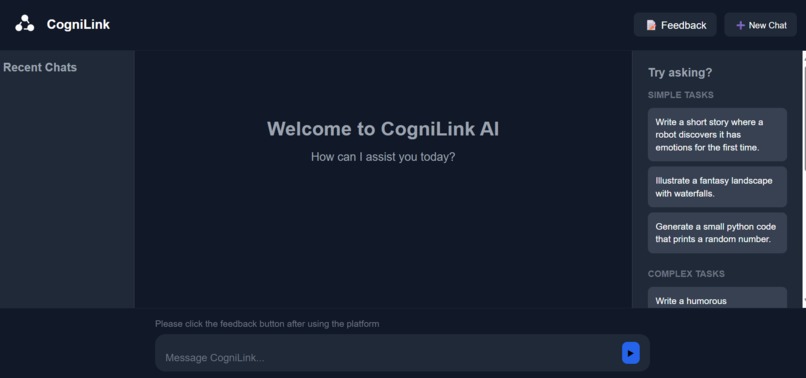
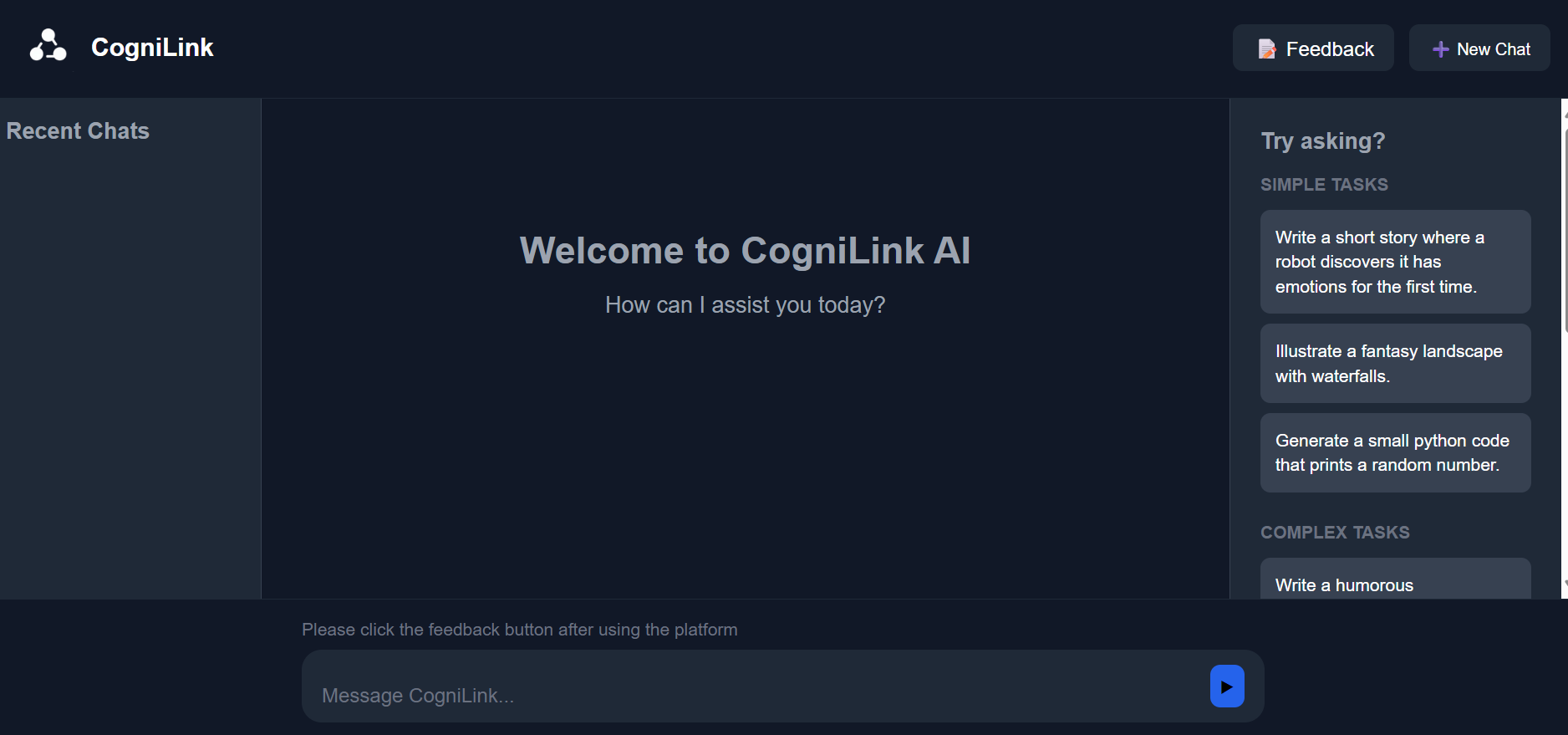
Frontend
-
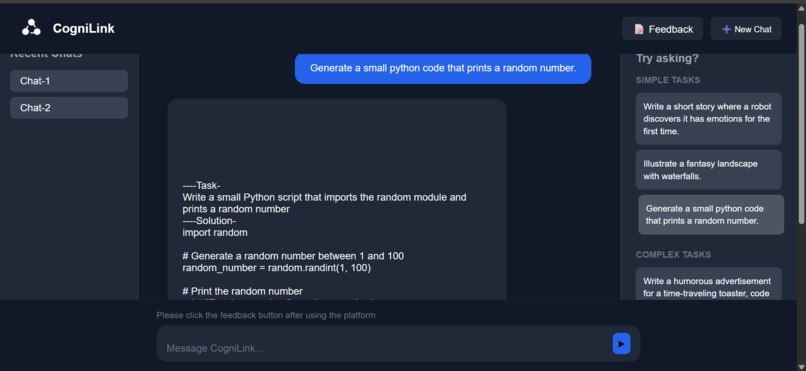
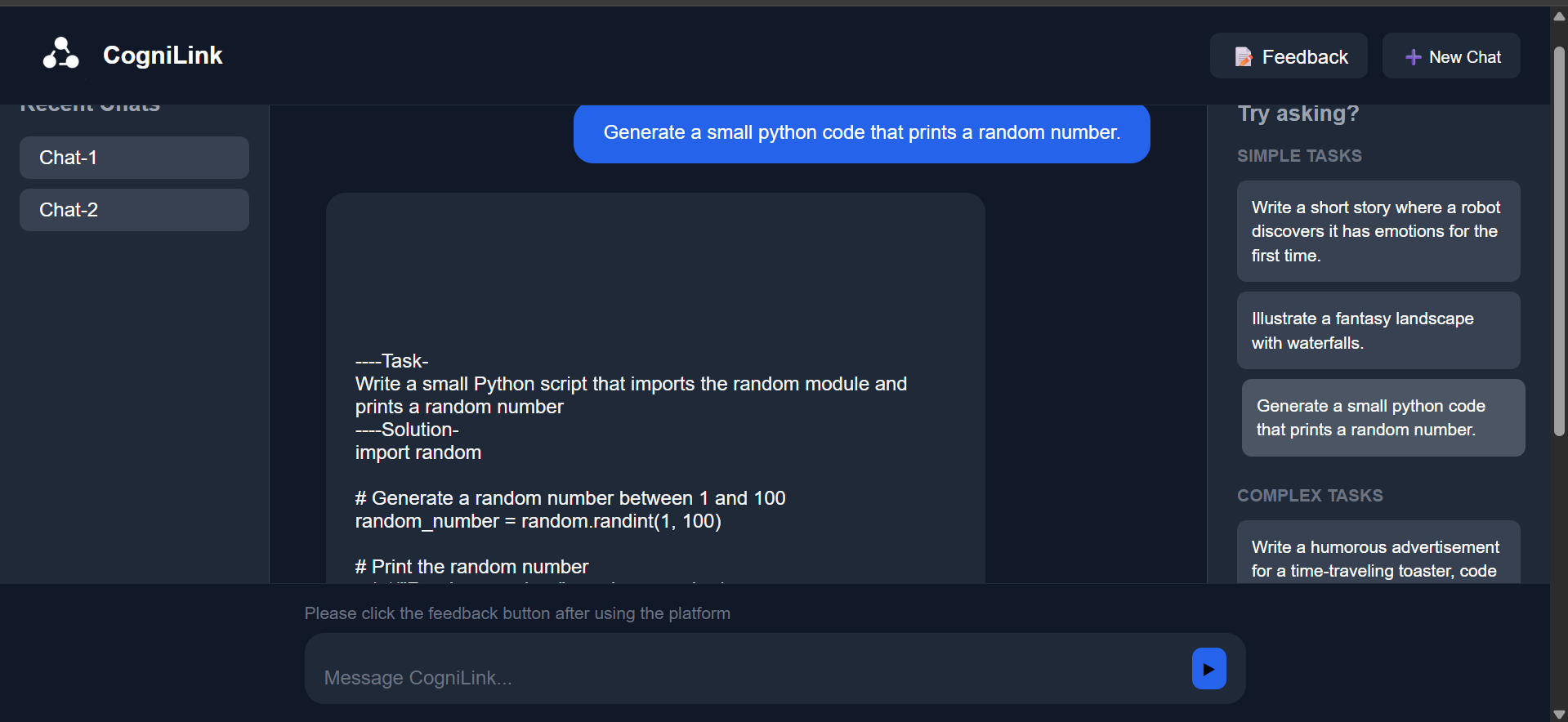
Usage
-
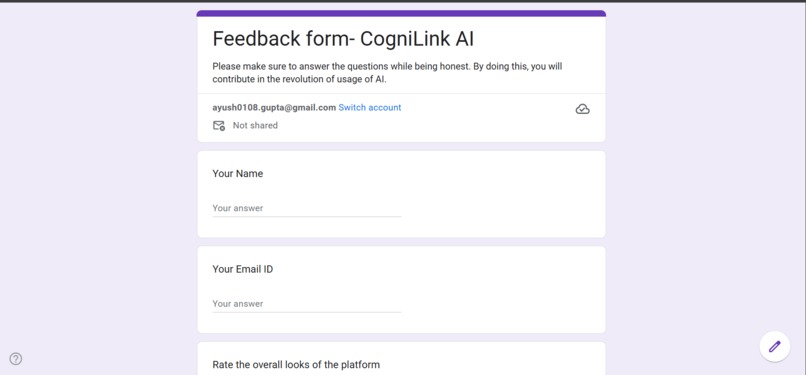
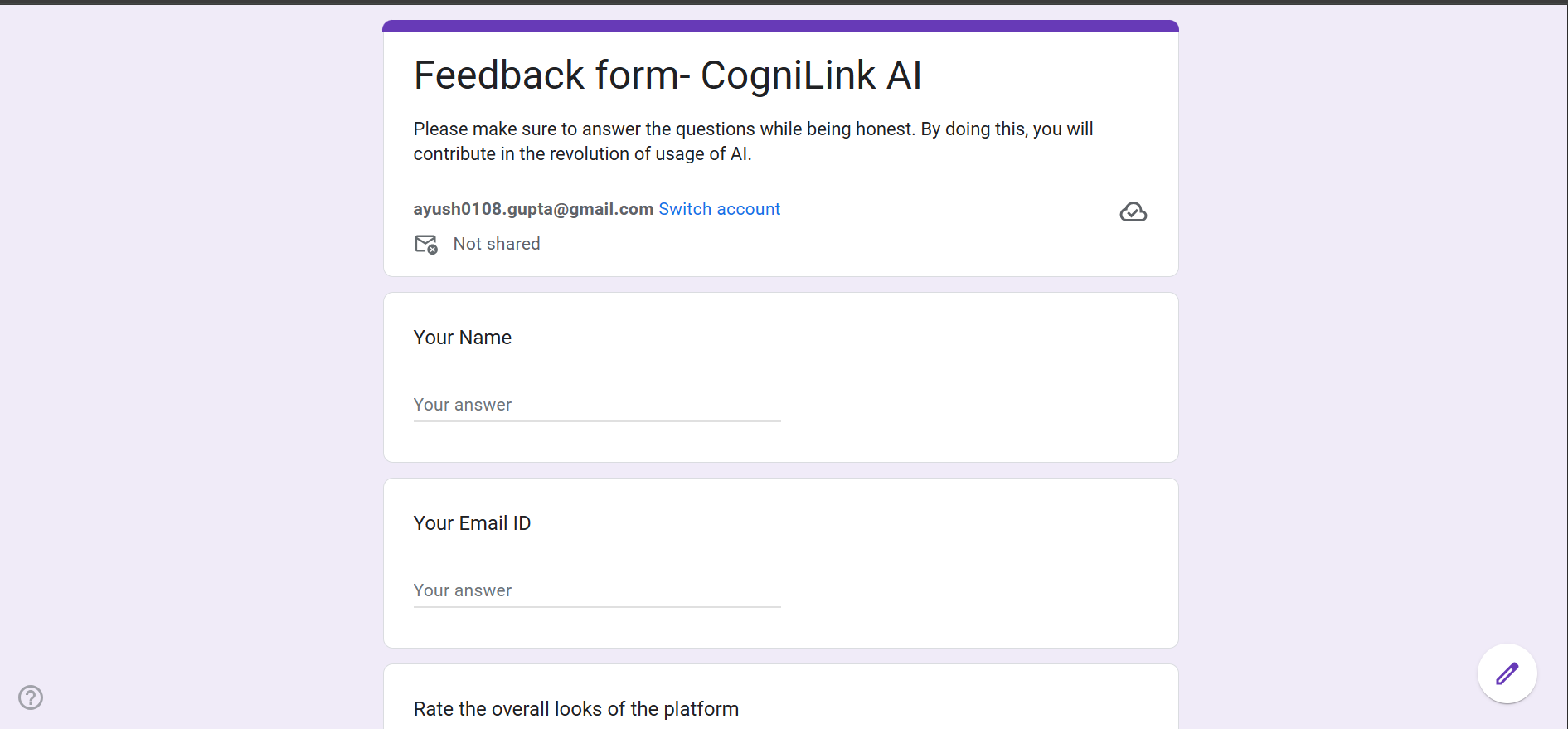
Feedback form automated
-
Logo CogniLink AI
-

Proof
-
Proof
-

Proof
-
Proof
-
Proof
-
Proof
-
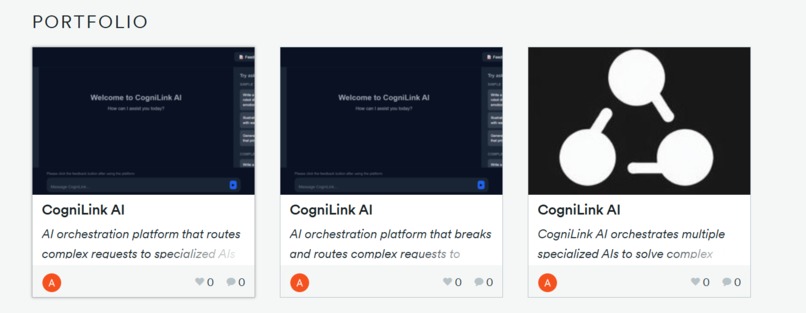
Proof
-
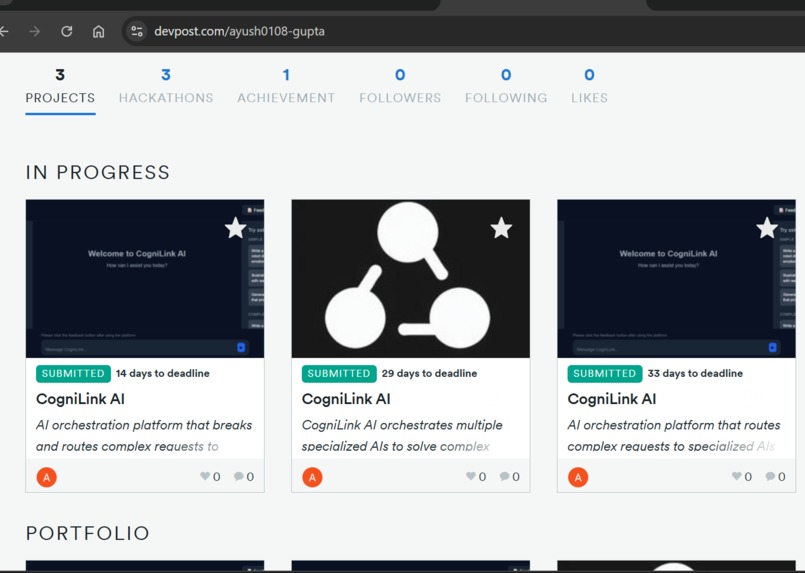
Proof
-
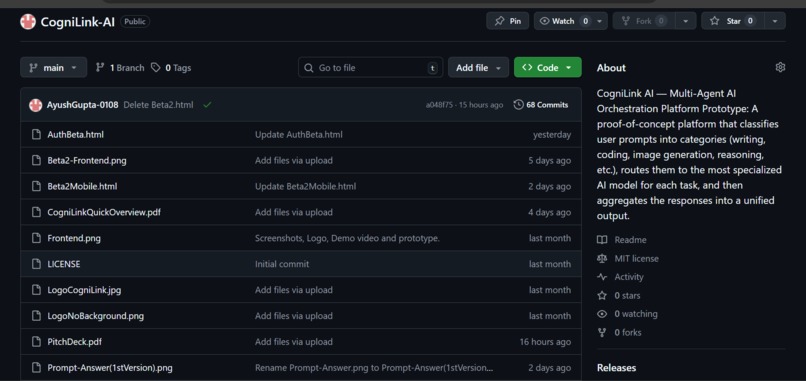
Proof
-
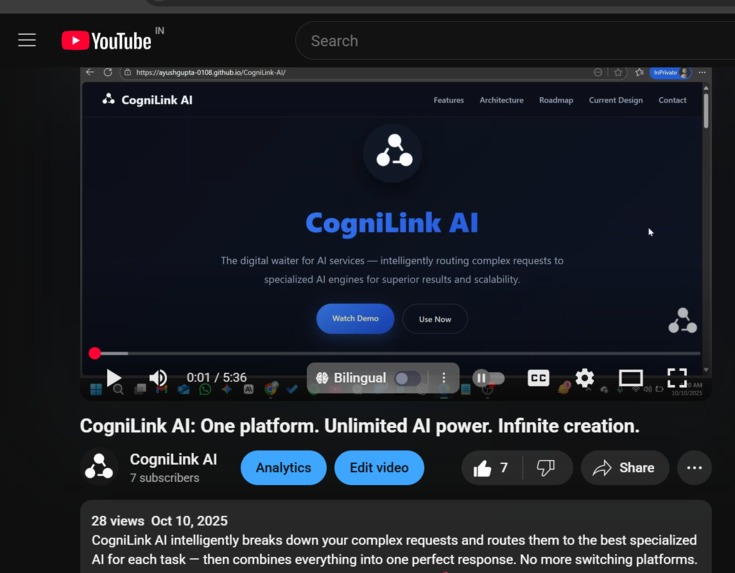
Proof


💡 Inspiration
The inspiration for CogniLink AI came from a deeply personal frustration. While working on my college applications, I found myself constantly juggling between multiple AI platforms — ChatGPT for writing essays, Claude for refining arguments, Gemini for research, and various image generators for visual content. Each time I switched platforms, I had to re-explain context, copy-paste information, and manually piece together results from different tools.
I realized this wasn't just my problem — millions of users worldwide face the same fragmented AI experience daily. Students, creators, developers, and professionals are forced to maintain multiple subscriptions, waste time context-switching, and never get the true power of AI collaboration. That's when the vision crystallized: What if AIs could work together like a well-coordinated team, instead of competing in isolation?
CogniLink AI was born from the belief that users shouldn't need to become AI experts to get expert results. They should simply describe what they want, and the platform should intelligently orchestrate the best combination of AIs to deliver it.
🎯 What it does
CogniLink AI is an intelligent AI orchestration platform that breaks down complex user requests into specialized sub-tasks, routes each to the most capable AI engine, and aggregates all outputs into one coherent, high-quality response.
Think of it as a digital conductor orchestrating a symphony of AI models:
Core Capabilities:
- Smart Request Classification: Automatically analyzes user prompts and identifies different task types (coding, writing, image generation, research)
- Intelligent Routing: Assigns each sub-task to the most suitable specialized AI:
- ChatGPT 4o-mini & 4o for reasoning and creative writing
- Cohere for text processing and analysis
- Dreamlike Photoreal 2.0 for professional image generation
- Parallel Processing: Executes multiple AI tasks simultaneously for maximum efficiency
- Seamless Aggregation: Combines all outputs into a single, polished final response
- Built-in Feedback Loop: Automated feedback collection system with Google Sheets logging and auto-acknowledgment emails
- Token-Based Usage Tracking: Fair, transparent system where users pay only for actual AI work done (prompt + response words)
Example Use Case:
User prompt: "Create a startup pitch with visuals for an eco-friendly water bottle"
CogniLink AI automatically:
- Routes creative writing to ChatGPT for the pitch text
- Sends image generation request to Dreamlike for product mockups
- Uses Cohere for market research insights
- Aggregates everything into one comprehensive pitch deck
Result: What would take 30+ minutes across 3-4 platforms now happens in under 2 minutes, with better quality.
🛠️ How we built it
Building CogniLink AI as an 18-year-old with zero prior coding experience required creative problem-solving and relentless learning:
Technology Stack:
- Frontend: Custom-built HTML/CSS/JavaScript interface (learned and developed with AI assistance)
- Backend Orchestration: Make.com automation platform for workflow management and API routing
- AI APIs Integrated:
- OpenAI ChatGPT 4o-mini & 4o (obtained through AI Grants India program)
- Cohere API (free tier)
- Dreamlike Photoreal 2.0 (free tier)
- Data Management: Google Sheets for feedback logging
- Email Automation: Automated thank-you emails via Make.com workflows
- Hosting: GitHub Pages for prototype deployment
Development Process:
- Architecture Design: Created the "restaurant analogy" mental model — webhook as order receiver, classifier as manager, specialized AI engines as expert kitchens
- Workflow Automation: Built complex Make.com scenarios to handle request classification, parallel API calls, and response aggregation
- API Integration: Learned JSON structure, API authentication, and error handling on the fly
- Frontend Development: Designed user-friendly interface from scratch, iterating based on early tester feedback
- Feedback System: Implemented fully automated loop: user submits feedback → logs to spreadsheet → triggers personalized email
Key Learning Areas:
- Basic HTML/CSS/JavaScript
- API integration and authentication
- JSON data structures
- Automation logic and workflows
- UI/UX principles
- Error handling and debugging
Cost: $0 — Entire platform built using free tools, free API tiers, and grant-provided credits. No external funding used.
🚧 Challenges we ran into
1. Zero Coding Background
Starting with absolutely no programming knowledge meant every line of code was a learning opportunity. Understanding concepts like API calls, JSON parsing, and asynchronous operations required intensive self-study through documentation, AI-assisted learning, and countless trial-and-error iterations.
2. API Access & Limitations
- Funding Constraint: With zero budget, accessing premium AI APIs seemed impossible initially. Solved by applying to AI Grants India (successfully obtained ChatGPT credits) and strategically using free tiers.
- Rate Limits: Free API tiers have strict usage limits. Had to implement smart queuing and error handling to work within constraints.
- API Stability: Free-tier APIs have more frequent errors and downtimes, requiring robust fallback mechanisms.
3. Make.com Automation Limits
Free Make.com plan has operation limits (1,000 operations/month), forcing optimization of every workflow step. Had to design ultra-efficient scenarios that accomplish complex orchestration within minimal operations.
4. Response Aggregation Logic
Combining outputs from different AI models with varying formats, response times, and quality levels into one coherent answer proved technically complex. Required developing custom aggregation rules and formatting logic.
5. Classification Accuracy
Initial prompt classification was rule-based and often misrouted requests. Currently working on improving the classifier using better prompt engineering and potentially implementing a lightweight ML model.
6. Time Management
Building CogniLink while preparing for SAT exams meant working at ultra-high efficiency — learning, building, and testing in compressed time windows, often late nights and early mornings.
7. Testing Without Resources
Conducting beta testing without a marketing budget meant relying on organic outreach, personal networks, and community forums to find early testers willing to provide feedback.
🏆 Accomplishments that we're proud of
Technical Achievements:
- Fully Functional Prototype: Built and deployed a working AI orchestration platform from absolute scratch with zero prior experience
- 80% Efficiency Improvement: Internal testing shows users complete multi-AI workflows 80% faster compared to manual platform-switching
- Zero-Cost Infrastructure: Architected entire system using free tools and grant credits — proving innovation doesn't require massive funding
- Automated Feedback System: Built end-to-end automation (collection → logging → email response) without any backend programming
Learning Milestones:
- Self-Taught Developer: Went from zero coding knowledge to building a functional web application in months
- AI/ML Understanding: Gained deep understanding of LLM capabilities, limitations, and optimal use cases
- System Architecture: Designed scalable multi-AI orchestration architecture with parallel processing
User Impact:
- Live Beta Testing: Real users testing the platform and providing valuable feedback
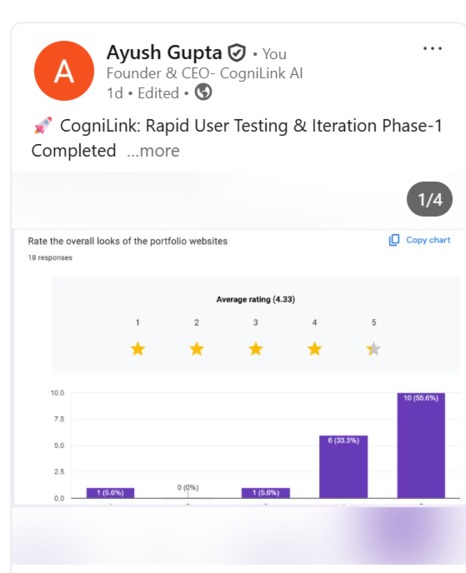
- Positive Early Reception: Beta testers reporting significant time savings and improved workflow quality
- Community Building: Growing network of supporters, mentors, and potential collaborators
Personal Growth:
- Ultra-High Efficiency Learning: Developed ability to learn new technical concepts rapidly through AI-assisted education
- Problem-Solving Mindset: Overcame seemingly impossible challenges through creative thinking and resourcefulness
- Balancing Act: Successfully managed intensive SAT preparation alongside building a complex technical product
Vision Execution:
Every single feature — from the routing algorithm to the feedback system — was built by me despite having no traditional CS education. That transformation from idea to working product is what I'm most proud of.
📚 What we learned
Technical Skills:
- Web Development Fundamentals: HTML structure, CSS styling, JavaScript interactivity
- API Integration: RESTful APIs, authentication, request/response handling, error management
- Automation Engineering: Workflow design, conditional logic, data transformation in Make.com
- Data Structures: JSON parsing, object manipulation, data aggregation techniques
- Debugging: Systematic troubleshooting, reading error logs, testing methodologies
AI/ML Insights:
- Model Specialization: Each AI has distinct strengths — Claude excels at code, ChatGPT at creative writing, specialized models at images
- Prompt Engineering: Crafting effective prompts dramatically impacts output quality
- API Economics: Understanding token costs, rate limits, and optimization strategies
- AI Limitations: When to use AI vs when human intervention is necessary
Product Development:
- User-Centric Design: Early user feedback is invaluable — shaped multiple feature decisions
- MVP Philosophy: Start with core functionality, iterate based on real usage
- Feedback Loops: Automated feedback collection drives continuous improvement
- Problem-First Approach: Solve real pain points, not imaginary ones
Business & Strategy:
- Resourcefulness: Lack of funding isn't a blocker — creativity and hustle can overcome it
- Grant Opportunities: Programs like AI Grants India exist to support student innovators
- Market Validation: 80% efficiency improvement proves real market need
- Token-Based Monetization: Fair usage-based pricing aligns incentives with value delivery
Personal Development:
- Self-Directed Learning: You can learn almost anything through AI tools, documentation, and persistence
- Execution Over Perfection: Shipping imperfect v1 beats endless planning
- Time Management: Balancing multiple high-priority commitments forces efficiency
- Community Value: Sharing your journey attracts supporters, mentors, and collaborators
Key Realization:
The future belongs to orchestrators, not individual tools. As AI models proliferate, the real value lies in intelligent coordination — making diverse AI systems collaborate seamlessly to solve complex problems. This insight will guide CogniLink's evolution from simple routing to autonomous AI-to-AI collaboration.
🚀 What's next for CogniLink AI
Immediate Priorities (Next 3-6 Months):
1. User Authentication & Personalization
- Implement secure user accounts with authentication
- Personal dashboards showing usage history, token balance, and analytics
- Save user preferences and prompt templates
2. Enhanced Classifier AI
- Fix current classification issues with improved prompt engineering
- Potentially implement lightweight ML model for better accuracy
- Add support for more prompt types beyond text, code, and images
3. Expanded AI Integrations
- Audio Processing: Integrate Whisper for transcription, ElevenLabs for voice generation
- Video Creation: Add RunwayML or similar for video generation capabilities
- Data Analysis: Connect to data processing AIs for spreadsheet analysis, visualization
- Research Tools: Integrate Perplexity or similar for web research capabilities
4. 100+ Beta Testers Goal
- Aggressive outreach to student communities, startup groups, and creator networks
- Collect structured feedback to guide feature prioritization
- Build case studies showcasing real-world efficiency gains
Medium-Term Vision (6-12 Months):
5. Dynamic Chain Processing
The game-changing feature: AI-to-AI collaboration without human intervention
Example workflow: "Create a short movie about a forest"
- Chain Step 1: Script-writing AI generates screenplay
- Chain Step 2: Dialogue AI creates character conversations
- Chain Step 3: Image AI generates scene visuals based on script
- Chain Step 4: Video AI compiles images into video sequences
- Chain Step 5: Audio AI adds voiceover and soundtrack
- Chain Step 6: Editing AI assembles everything into final movie
Users just provide the initial prompt — CogniLink orchestrates the entire production chain autonomously.
6. Mobile Application
- Native mobile apps for iOS and Android
- Voice input for prompts on the go
- Push notifications for completed complex workflows
7. Improved UI/UX
- Professional redesign with consistent branding
- Interactive tutorial for new users
- Real-time visualization of AI orchestration process
Long-Term Goals (1-2 Years):
8. Enterprise Features
- Team collaboration workspaces
- API access for developer integration
- Custom AI workflows for specific industries (marketing, education, legal)
- Bulk processing capabilities
9. Funding & Scale
- Apply to startup incubators and accelerator programs
- Secure funding to license premium AI APIs at scale
- Build strategic partnerships with universities and tech communities
- Transition from free APIs to enterprise-grade infrastructure
10. AI Marketplace
- Allow third-party developers to plug in their specialized AI models
- Create ecosystem where best AI for each task gets selected automatically
- Revenue sharing model for AI model providers
11. Memory & Context
- System remembers user style, preferences, and past projects
- Personalized AI recommendations based on usage patterns
- Long-term context retention across sessions
Ultimate Vision:
CogniLink AI becomes the universal interface for all AI interactions — a platform where users describe what they want to create, and multiple AI systems collaborate seamlessly to bring it to life. From simple text generation to complex multi-modal productions (videos, presentations, applications), CogniLink orchestrates it all.
"One platform. Infinite AI power. Unlimited creation."
The future isn't about having the best single AI — it's about intelligently orchestrating all AIs to work together. That's the future we're building.
🔗 Links & Resources
- Live Prototype: Try CogniLink Beta
- Website: CogniLink AI
- Demo Video: Watch Demo
- GitHub Repository: View Code & Roadmap
- Feedback Form: Share Your Experience
- LinkedIn: Connect with Founder
- Contact: [email protected]
Built with passion by an 18-year-old self-taught creator who believes AIs should collaborate, not compete.
CogniLink AI — Orchestrating the future of multi-AI collaboration, one prompt at a time.
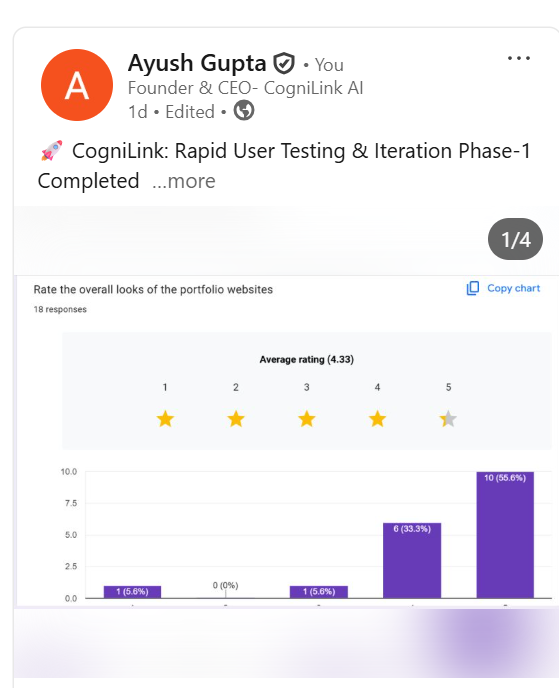
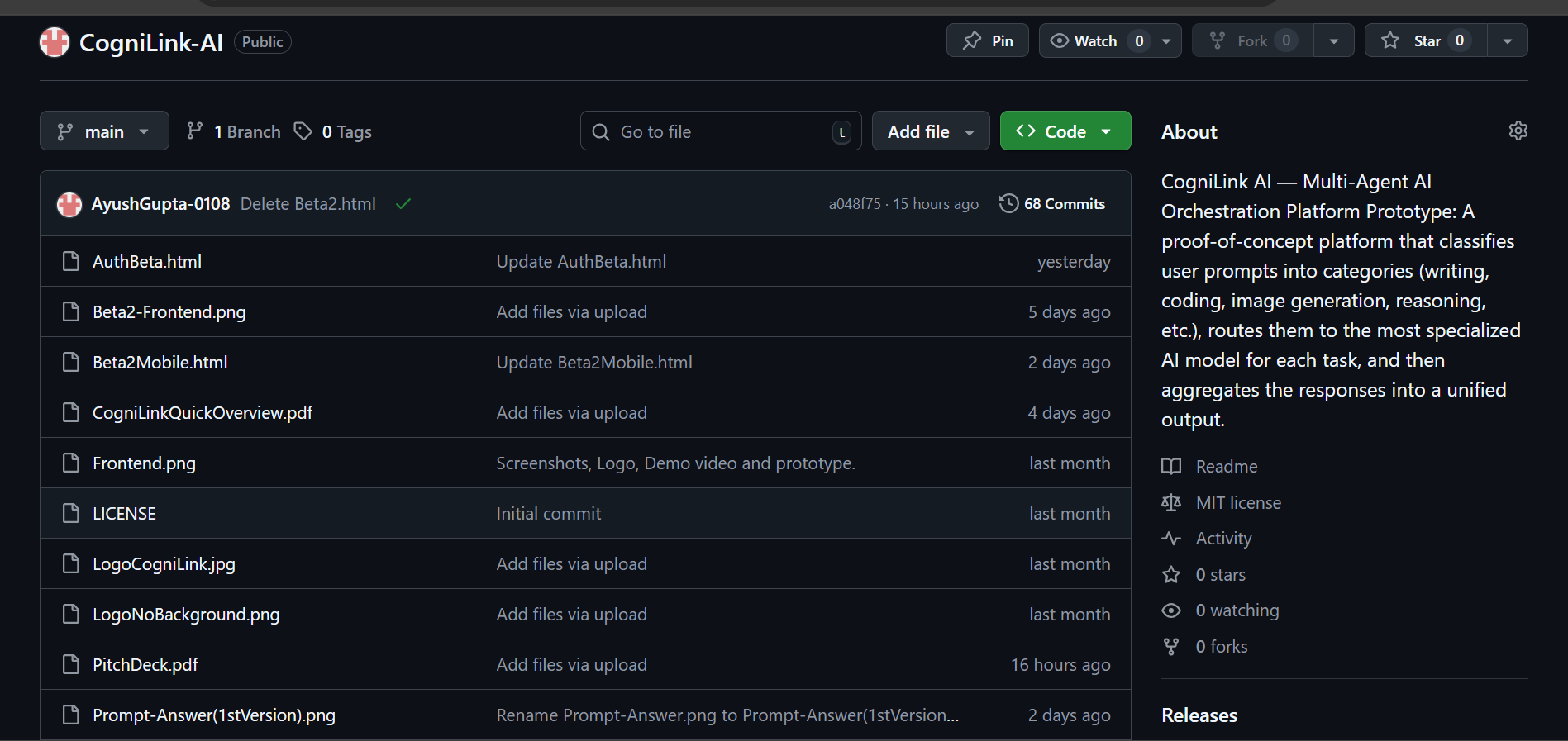
🎯 UPDATE: Market Validation Moment What Happened After Submission Three weeks after launching CogniLink and submitting to hackathons, something extraordinary happened that changed everything. On 12 october 2025, Dhruv Rathee announced "Super Fiesta" - a new feature in AI Fiesta (his funded startup with 30M+ audience) that does intelligent AI routing. Almost exactly what we built. The Timeline That Proves It 📸 Evidence of our independent development:
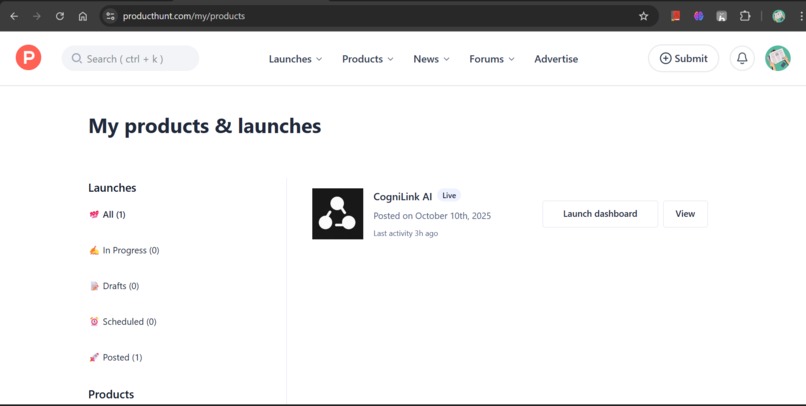
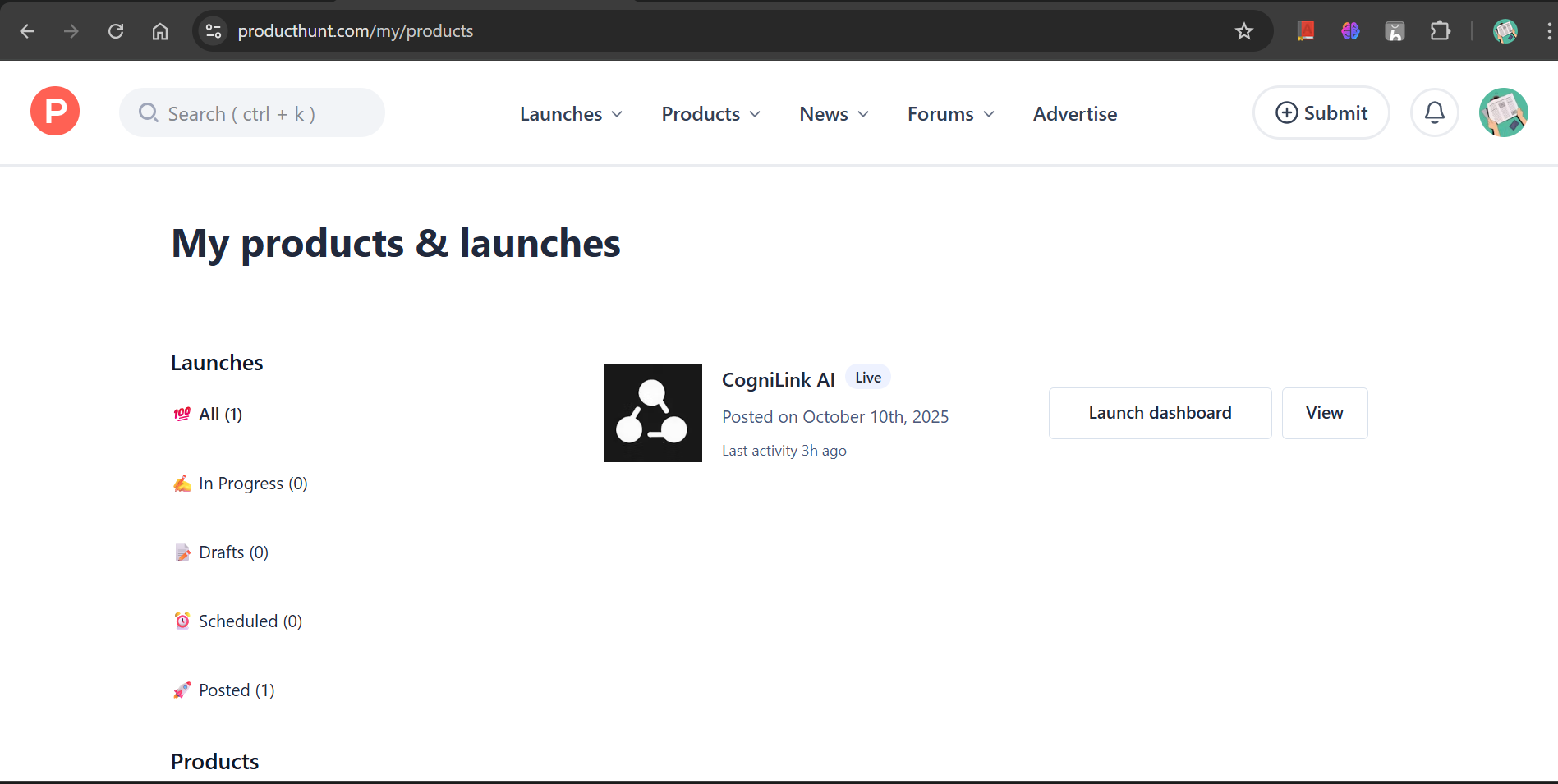
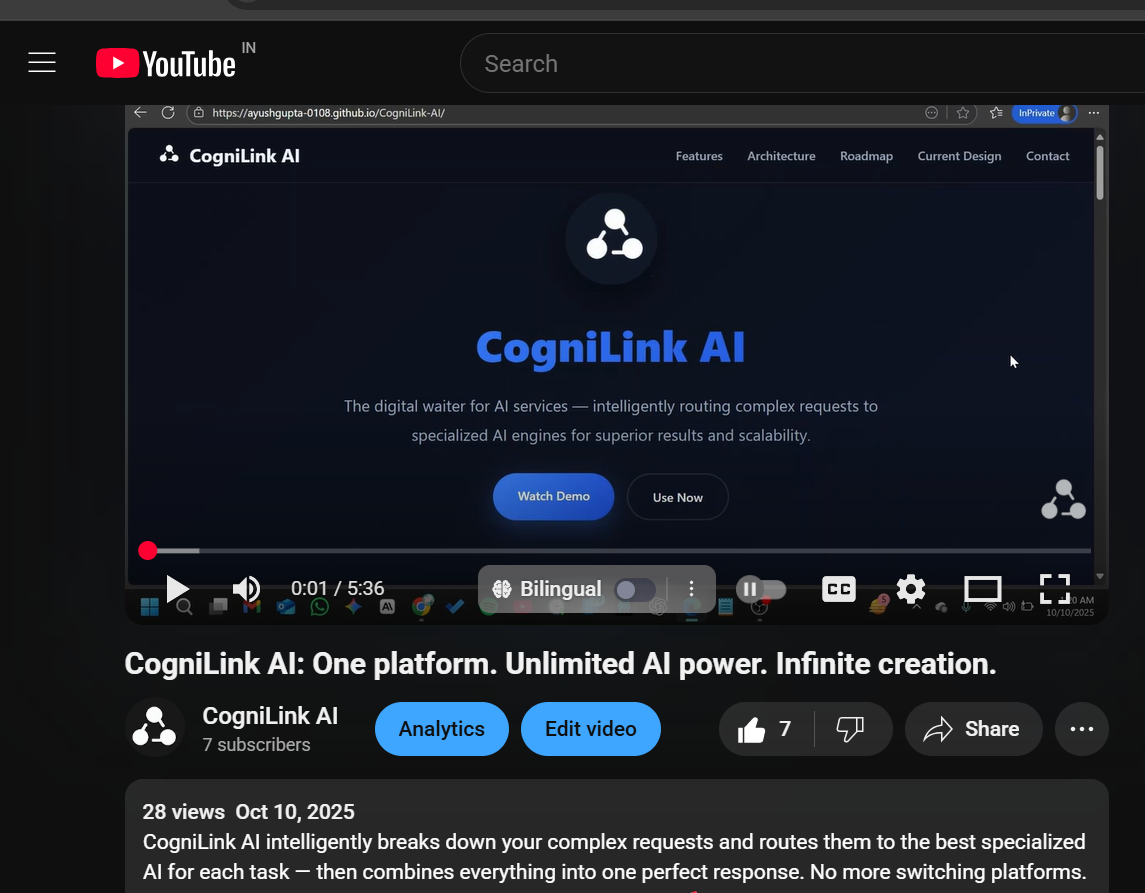
✅ YouTube Demo Upload: October 10, 2024 ✅ Product Hunt Launch: October 10, 2024 ✅ Hackathon Submissions: October 10, 2024 (3 hackathons on Devpost) ✅ LinkedIn Updates: from 23 september (public posts about development) ✅ 30+ Beta Testers: Onboarded before Super Fiesta announcement ✅ Super Fiesta Launch: [12 october] - weeks after our first prototype which was on id september
My first reaction? Panic. "We've been beaten by a celebrity-backed platform with massive resources." My second reaction? Pride. "A funded team independently validated the exact problem we identified."
🔥 Why This Makes CogniLink MORE Important This wasn't a defeat - it was market validation. When a well-funded platform with 30 million users launches features similar to your hackathon project weeks after you ship, you know you identified a real market need. But here's the critical difference: Super Fiesta vs CogniLink: Different Approaches FeatureSuper FiestaCogniLinkCore ConceptSmart routing to ONE best AIMulti-AI orchestrationProcessingSequential switchingParallel + SequentialSub-prompt BreakdownNo - single prompt to single AIYes - breaks into multiple sub-promptsSimultaneous AIs1 AI at a timeUp to 5 AIs per queryOutput AggregationSingle AI responseIntelligent synthesis of multiple outputsUser ControlManual "try another" buttonAutomatic orchestrationChain ProcessingNot announcedComing in Phase 2 The Real Differentiation Super Fiesta approach: User: "Explain blockchain and create an infographic" ↓ Routes to ChatGPT → Gets text explanation ↓ User manually clicks "try another response" ↓ Routes to DALL-E → Gets image ↓ User manually combines both CogniLink approach: User: "Explain blockchain and create an infographic" ↓ Automatic breakdown: ├─ Sub-prompt 1: "Technical explanation" → Claude └─ Sub-prompt 2: "Visual infographic" → DALL-E ↓ Both process simultaneously (up to 5 AIs per query) ↓ Intelligent aggregator combines outputs ↓ User receives: Complete explanation + infographic in ONE response That's the difference: AI switching vs AI orchestration.
🚀 What's Next: Dynamic Chain Processing
Competing with a funded platform taught us we need to think bigger. So we are.
Phase 2 introduces Dynamic Chain Processing - where AIs don't just work in parallel, but collaborate sequentially, each AI using the previous AI's output as context.
Real-World Chain Example:
User prompt: "Find trending tech news and write a LinkedIn post about it"
Automated chain execution:
┌─ Step 1: Scraper AI (Perplexity)
│ └─→ Searches web for trending tech news
│ └─→ Output: "AI-generated movies are going viral..."
│
├─ Step 2: Research AI (ChatGPT)
│ └─→ Takes trending topic from Step 1
│ └─→ Gathers detailed context and data
│ └─→ Output: "Recent statistics show 47% increase..."
│
├─ Step 3: Writing AI (Claude)
│ └─→ Takes research from Step 2
│ └─→ Writes professional LinkedIn post
│ └─→ Output: "🚀 The Future of AI Cinema..."
│
├─ Step 4: Image AI (DALL-E)
│ └─→ Takes post theme from Step 3
│ └─→ Generates eye-catching header image
│ └─→ Output: [professional visual]
│
└─ Step 5: SEO AI (GPT-4)
└─→ Takes complete post from Step 3
└─→ Generates optimized hashtags
└─→ Output: "#AI #FutureOfTech #Innovation"
Final Output: Complete LinkedIn post with image and hashtags Time: ~2 minutes, fully automated Human intervention: Zero Each AI uses the previous AI's output. Full automation. No manual steps.
🎬 The Ultimate Vision: Autonomous Multi-Modal Creation What if you could say: "Create a 2-minute movie about climate change" And watch it happen automatically? The orchestration chain: User: "Create a short movie about climate change" ↓ ┌─ Script AI (Claude) │ └─→ Writes compelling 2-minute screenplay │ └─→ "Scene 1: Melting glacier, wide shot..." │ ↓ ├─ Scene AI (GPT-4) │ └─→ Takes script → Breaks into 6 detailed scenes │ └─→ "Scene 1 visual: Aerial view, blue ice..." │ ↓ ├─ Video AI (Runway ML) [Parallel for 6 scenes] │ └─→ Takes scene descriptions → Generates video clips │ └─→ 6 x 20-second video segments │ ↓ ├─ Voice AI (ElevenLabs) │ └─→ Takes original script → Creates narration │ └─→ Professional voiceover MP3 │ ↓ ├─ Music AI (Suno) │ └─→ Takes movie theme → Composes score │ └─→ 2-minute emotional soundtrack │ ↓ └─ Editing AI (FFmpeg automation) └─→ Takes all assets → Combines everything └─→ Syncs video + voice + music ↓ Final Output: Complete 2-minute movie file Total time: ~5-8 minutes (API processing time) Human involvement: One prompt Is this technically possible? YES. Every API exists today. Is anyone else building this? Not publicly announced. That's our competitive moat.
📊 What We Learned From This Experience Lesson 1: Market validation beats first-mover advantage
We could've stayed secretive Instead, we launched publicly, collected feedback, and iterated When Super Fiesta launched, it proved we were solving a real problem Better to be validated by competition than build in a vacuum
Lesson 2: Vision matters more than resources
AI Fiesta: Funding + Team + 30M distribution CogniLink: One 18-year-old + Zero budget + Self-taught skills Yet we both identified the same problem independently Resources determine speed. Vision determines direction.
Lesson 3: Differentiation is everything
We can't out-market AI Fiesta (they have 30M users) We can't out-spend them (we have $0) But we CAN out-innovate them Multi-AI parallel processing + Chain orchestration = our edge
Lesson 4: Competition validates, doesn't invalidate
Finding out a major platform launched similar features could've been crushing Instead, it became our strongest proof point "A funded team validated our thesis" is now in every pitch Resilience > Perfection
Lesson 5: Independent innovation is powerful
We didn't copy anyone - we identified a problem from personal experience The fact that a professional team reached the same conclusion proves our product sense Great ideas emerge independently - that's validation, not coincidence
💪 Why CogniLink Still Matters "Doesn't Super Fiesta launching kill CogniLink?" No. Here's why:
Different solutions to the same problem
They're building AI switching We're building AI orchestration Both are valuable, but serve different needs
Proof of market demand
A celebrity-backed platform validated the space Market is big enough for multiple approaches Our differentiation (parallel processing + chains) creates unique value
Innovation from unexpected places
I'm 18, self-taught, zero budget, from a small town Yet I identified what a funded team with resources saw too That's not luck - that's product sense
Phase 2 changes the game
Super Fiesta does smart routing CogniLink Phase 2 does autonomous AI collaboration Chain processing is the future they're not building (yet)
Community and learning
Even if CogniLink doesn't "beat" Super Fiesta in users Building it taught invaluable skills Open-sourcing it helps others learn The journey matters as much as the destination
🎯 Updated Roadmap (Post-Validation) Phase 2: Chain Processing (Next 3 months)
Implement AI-to-AI sequential collaboration Context preservation across chain steps Demo: "Find recipe → Create thumbnail" automation Launch to existing beta testers
Phase 3: Advanced Orchestration (6 months)
Multi-modal autonomous creation (text + image + video + audio) "Create a movie" proof of concept Advanced aggregation with conflict resolution Enterprise-ready infrastructure
Phase 4: Ecosystem Play (12 months)
Open API for developers Plugin architecture for custom AI integrations Marketplace for specialized AI workflows Community-driven orchestration templates
🔗 The Big Picture CogniLink started as:
A personal frustration with AI fragmentation A hackathon submission A learning project for an 18-year-old
CogniLink became:
A working prototype with 30+ beta users A Product Hunt launch A vision validated by a funded competitor
CogniLink is becoming:
The future of multi-AI collaboration Proof that innovation can come from anywhere A platform where AIs work together, not compete
Super Fiesta proved the market need exists. CogniLink will prove autonomous AI orchestration is possible.
💬 Final Thoughts When judges evaluate this hackathon project, I want them to know: This isn't just a cool prototype that works. This is a project that was independently validated by real market movement. We didn't build something in a vacuum. We identified a genuine need, built a solution, and watched as a funded platform confirmed our thesis by launching similar features weeks after our prototype. That's not failure. That's proof of product-market fit. And with chain processing coming in Phase 2, we're not just keeping pace with funded competitors - we're building what comes next. Built with curiosity. Validated by competition. Driven by vision.
🔗 Links & Resources Provided above in the text
Built With
- claude
- cohere
- make.com
- opanai

Log in or sign up for Devpost to join the conversation.