-
-
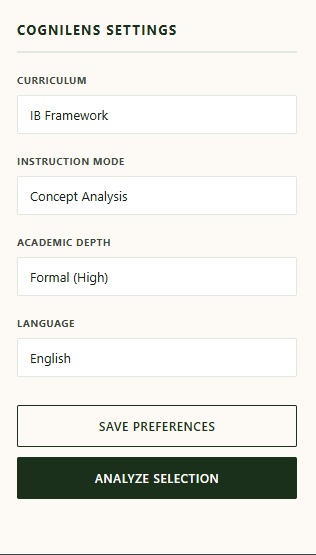
Configuration Settings
-
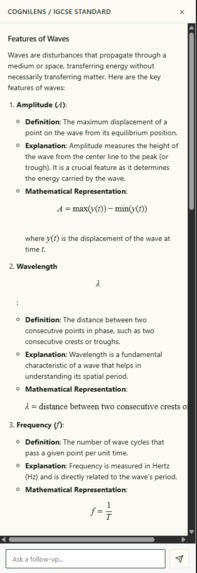
Example Response
-

CogniLens Logo

Inspiration
AI is being increasingly used to support learning; however, most general-purpose models are trained on broad, uncurated datasets and tend to produce inconsistent or syllabus-innacurate explanations. There are existing AI study tools that attempt to solve this, but they are often heavity monetized, cloud-dependant, and cumbersome to use in day-to-day learning.
CogniLens was inspired by the idea that educational AI should local, curriculum-aware, and non-invasive. By running a lightweight open-source language model on the user's device, and using specific contexts from global curricula such as IB and AP to ground responses, CogniLens delivers accurate, relevant explanations directly within the browser. This apporach prioritizes privacy, accesibility, and reliability, while avoiding the need for advanced hardware, constant internet access, or expensive subscriptions.
What it does
CogniLens is a lightweight browser extension that provides currciulum-specific academic assistance without every needing to swtich tabs.
Students can highlight a question, concept or passage on any webpage and instantly recieve concise, syllabus-relevant explanations and reasoning, as well as ask follow up questions. The model runs entirely locally, being adjustable to run on any hardware, and ensuring fast, private responses even with limited or no internet access.
The tools is designed with global outreach in mind: supporting IB, AP, and IGCSE curricula, and featuring support for 5 different languages.
How we built it
CogniLens is build around a small, 7 billion parameter, local language model integrated into a browser extension environment, though users can substitute the exact model based on their hardware. Rather than relying on cloud computing, the model runs on the device using inference techniques to be usable on standard consumer hardware. The backend runs on python, spinning up a local server to handle requests and run the model.
The UI is build in HTML, CSS and JavaScripts, focusing on a minimalist design that offers customizability while remaining intuitive. It can be imported as a standard browser extenstion and easily integrate itself with any device.
Challenges we ran into
The main challenge was balancing the model's size with answer quality. Smaller models are much more efficient, but tend to hallucinate more and give inaccurate responses. I settled on a 7 billion parameter model as it could fit on most consumer hardware, yet remained generally consistent. I circumvented the issue of accuracy by building in json files explaining the core concepts of different subjects directly into the extension. The model can call on this additional context if it believes it is relevant to the query, allowing it to easily fetch informative regarding subject specific knowledge without the need for finetuning or web scraping. This was the best solution and although it is not always accurate in subjects in does not have specific context for, when the knowledge is hardcoded in, the model almost never makes incorrect statements.
Accomplishments that we're proud of
-Making the model highly accurate and consistent while keeping it fast and lightweight -Designing an intuitive, minimal UI that retains all core features -Creating a curriculum-aware system that can draw on specific context as it needs it
What we learned
My biggest takeway was the importance of limiting scope. LLMs are naturally trained to be general purpose; however, for education AI, it is crucial that heavy contraits are put in place and ensuring that the model is pulling information from accurate sources, which is why the subject specific context is so important.
What's next for CogniLens
The next clear step is to expand curriculum and subject coverage, allowing the model to be accurate across a range of topics. This could be achieved by creating a platform for educators to contribute "curriculum packs" that the model could use to base its knowledge off of. Another key feature I'd like to add is to use a VL model that allows the extention to read images as well as text, opening the opportunity for it to understand and comment on diagrams or non-text questions. On a smaller scale though, I hope to continue to add more multilingual support and continue to add support for more subjects within the 3 already established curricula.

Log in or sign up for Devpost to join the conversation.