-
-
-

App QR code
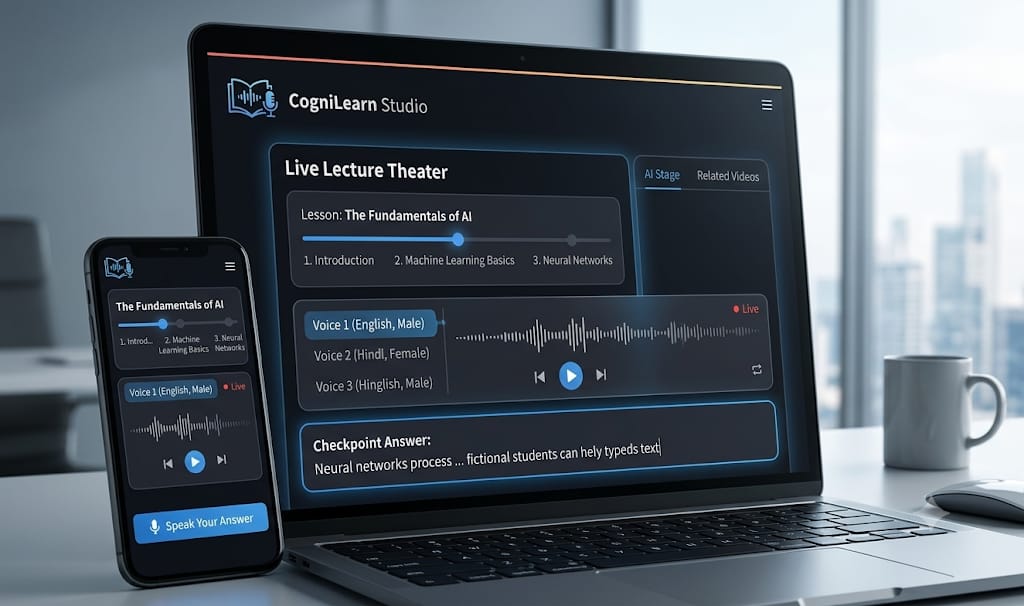

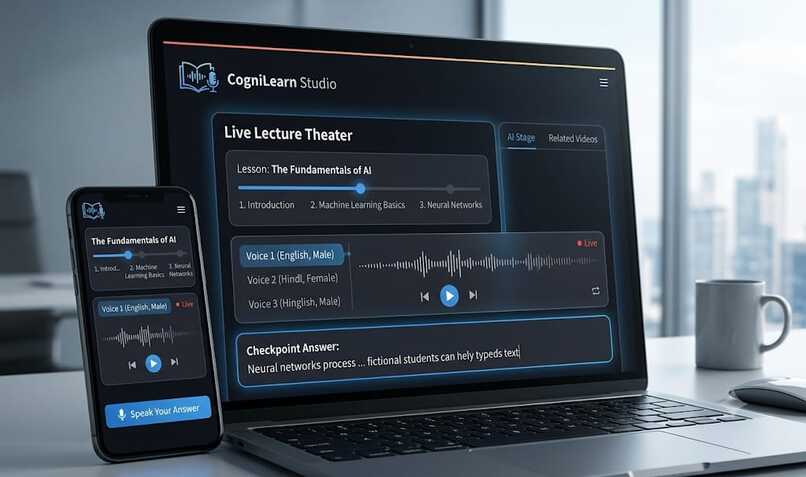
Inspiration Education today heavily relies on static materials—PDFs, slides, and textbooks. We noticed that passive reading leads to low retention and student fatigue, especially when learners struggle with a specific concept and don't have immediate access to a tutor. We were inspired to bridge this gap by creating CogniLearn Studio, an autonomous AI pedagogical engine that transforms any static document into an interactive, voice-guided, and adaptive virtual classroom. We also wanted to break down language barriers by incorporating native multilingual support (Hindi, Hinglish) for complex technical subjects.
What it does CogniLearn Studio acts as an intelligent, round-the-clock tutor. Users can upload a syllabus or provide a topic, select their learning level (Beginner to Advanced), and set a time limit.
Adaptive Lectures: It dynamically generates a customized lecture script using Google Gemini.
Multilingual Voice Synthesis: It delivers the lecture out loud using natural neural voices via edge-tts.
Active Checkpoints: Instead of just talking, the AI pauses to ask a checkpoint question to test comprehension.
Misconception Diagnosis: When the student answers, the AI evaluates the response, identifies specific logic gaps, and re-explains the concept using real-world analogies.
Curated Media: It automatically fetches highly relevant supplemental YouTube videos based on the lesson's context.
How we built it We built the frontend and interactive dashboard using Streamlit, applying a custom glassmorphism CSS theme for an enterprise-grade studio feel.
RAG Pipeline: We utilized pypdf to extract text from user-uploaded documents, feeding it as context to our AI models.
AI Core: We integrated the Google Gemini API (gemini-3.6-flash) for heavy logical reasoning—specifically for structuring the adaptive pedagogical scripts and diagnosing student misconceptions.
Audio Engine: We implemented edge-tts (powered by ffmpeg) to generate high-quality, cloud-rendered MP3 voice tracks on the fly.
Media Integration: We used the youtube-search module to fetch supplemental learning materials dynamically.
Challenges we ran into One of our biggest hurdles was configuring the cloud environment to support our audio pipeline. Getting edge-tts and its underlying ffmpeg dependency to run seamlessly on Streamlit Community Cloud required troubleshooting our requirements.txt and adjusting our subprocess calls. Additionally, managing secure API keys (st.secrets) and ensuring the application didn't crash when files were missing took careful debugging. Finally, prompt-engineering Gemini to act as a supportive tutor—diagnosing why a student was wrong rather than just telling them they were incorrect—required several iterations of context tuning.
What we learned We gained extensive hands-on experience building multimodal GenAI applications. We learned how to seamlessly orchestrate text generation (Gemini), audio synthesis (TTS), document parsing (RAG), and video integration within a reactive Streamlit framework. Most importantly, we learned that AI in education is most powerful when it acts as an active, empathetic evaluator rather than just a search engine.
What's next for CogniLearn Studio In the future, we plan to implement voice-to-text integration so students can verbally answer the AI's checkpoint questions. We also aim to introduce animated AI avatars that sync with the generated audio, and build a teacher dashboard where educators can track class-wide misconception trends over time.


Log in or sign up for Devpost to join the conversation.