Inspiration
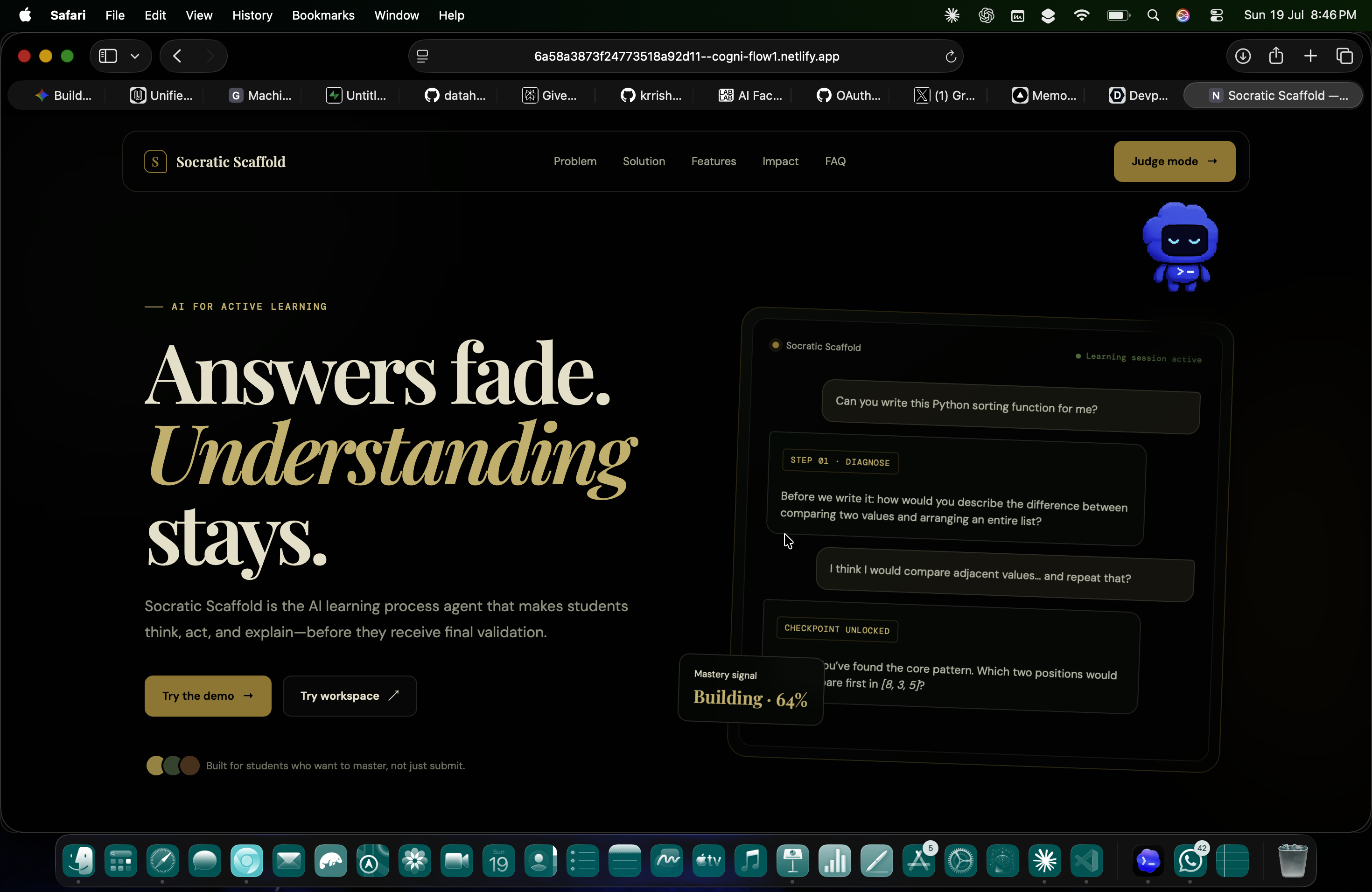
AI can complete assignments instantly, but completion is not understanding. We wanted to build an education product that preserves productive struggle while giving educators clear evidence of how each student learns.
What it does
CogniFlow provides guided AI tutoring rather than immediate answers. It diagnoses misconceptions, gives adaptive Socratic hints, asks checkpoints, generates practice, evaluates explain-back responses, predicts likely mistakes, and tracks mastery. Students see concept progress, prerequisites, next unlocked topics, and personalized interventions. Educators see hints used, misconceptions, explain-back evidence, mastery progression, learner actions, and intervention signals. Admins can monitor platform-wide activity and health.
How we built it
We built a static JavaScript frontend with a Node.js and Express backend, MongoDB/Mongoose persistence, JWT authentication, refresh tokens, bcrypt password hashing, RBAC, Zod validation, Helmet, CORS, and rate limiting. The frontend is deployed on Netlify and proxies /api requests to the Express backend deployed on Render. NVIDIA NIM powers the deployed tutor inference. Codex and GPT-5.6 accelerated product design, architecture, implementation, testing, documentation, and deployment configuration.
Challenges we ran into
Balancing helpful tutoring with preventing answer-first dependency. Designing AI outputs that are structured enough for dashboards and reliable UI updates. Making personalized adaptation visible and understandable to educators. Building secure student, educator, and admin role boundaries. Connecting the Netlify frontend and Render backend with correct CORS and proxy configuration. Reducing tutor-response latency while preserving a useful fallback experience.
Accomplishments that we're proud of
Built a complete learning loop: diagnose → scaffold → action → evaluation → mastery. Added adaptive hint ladders, concept graphs, mistake prediction, practice evaluation, explain-back rubrics, and session evidence. Created separate student, educator, admin, and no-sign-up Judge Mode experiences. Added transparent system_info and reasoning metadata for judge-facing technical evidence. Deployed and tested the frontend-to-backend flow using Netlify, Render, MongoDB Atlas, and GPT 5.6. Implemented secure authentication and role-based permissions.
What we learned
We learned that AI education products need more than a chat interface. The important design question is not only “Can the model answer?” but “What evidence shows that a student learned?” We also learned that transparency matters: educators trust adaptive systems more when they can inspect misconceptions, rubrics, learner actions, and mastery evidence. Finally, we learned that deployment details such as CORS, API proxying, and role security are essential for turning a prototype into a credible product.
What's next for CogniFlow
Add educator-managed classrooms and student assignment flows. Replace manual student-ID lookup with privacy-safe student pickers and roster management. Add real-time notifications for intervention-risk students. Expand syllabus ingestion and subject-specific learning pathways. Add richer analytics for time-to-understanding and misconception resolution. Conduct pilot testing with students and educators to measure learning impact. Add production email delivery for password reset and account onboarding.
Built With
- 3.1
- api
- codex
- css3
- docker
- edtech
- express.js
- gpt-5.6
- helmet
- html5
- javascript
- jest
- jwt
- llama
- mongodb
- mongoose
- netlify
- node.js
- pino
- render
- rest
- zod

Log in or sign up for Devpost to join the conversation.