-
-
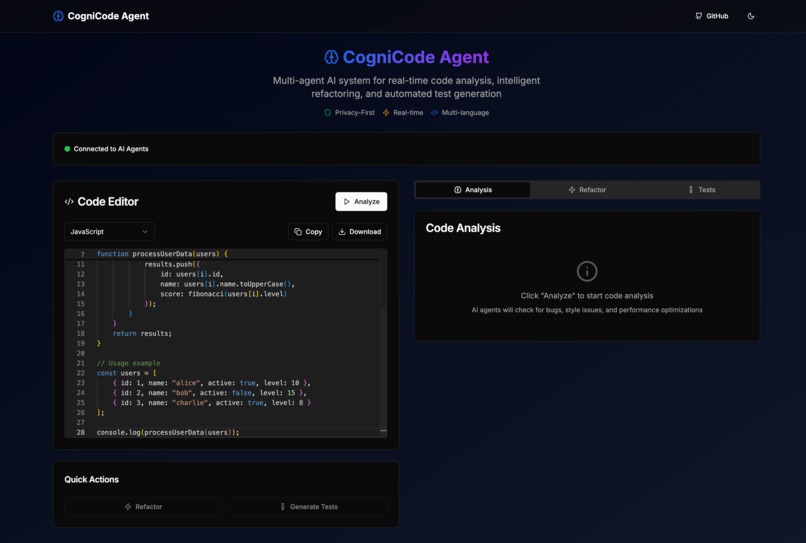
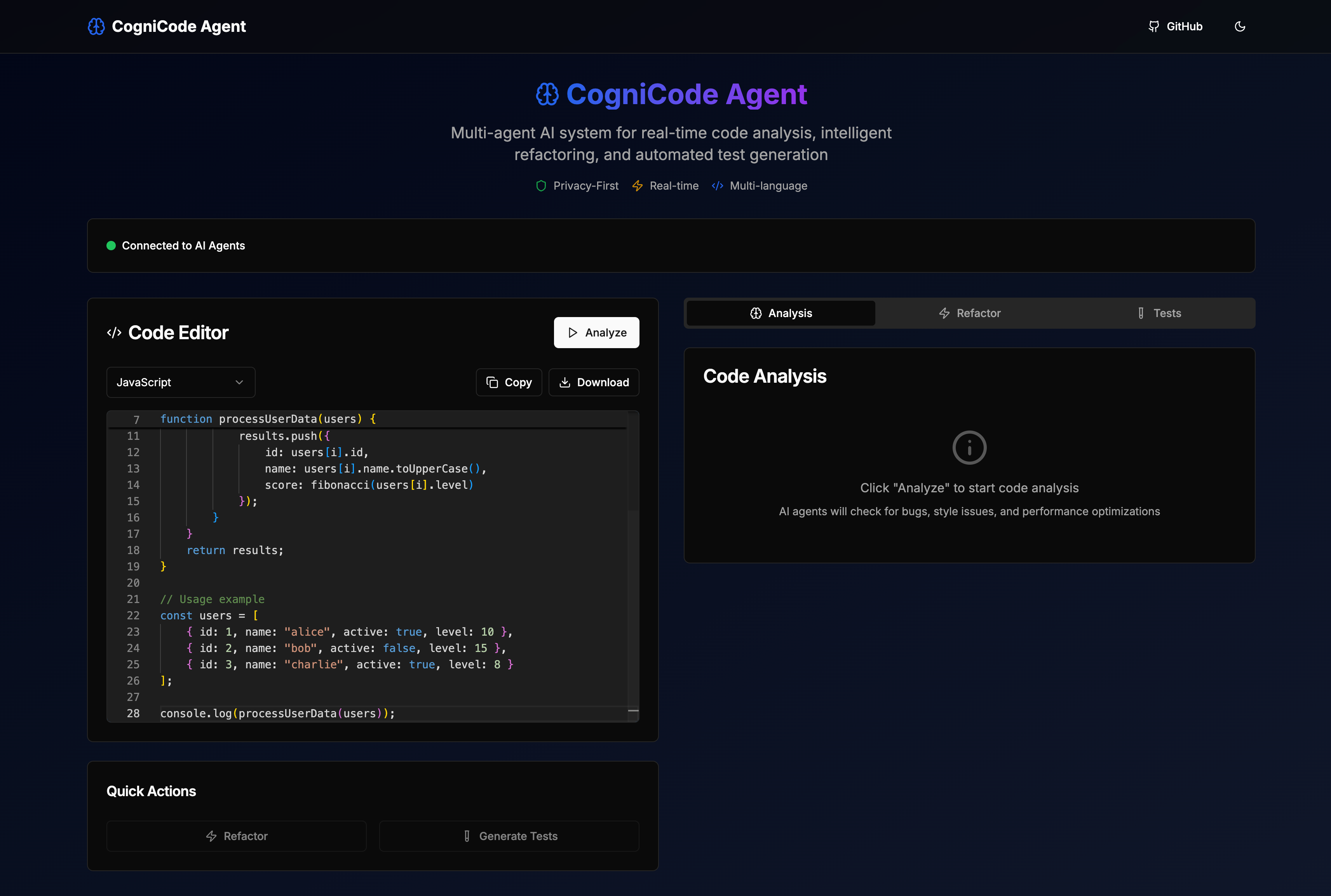
Hero/Landing Screen
-
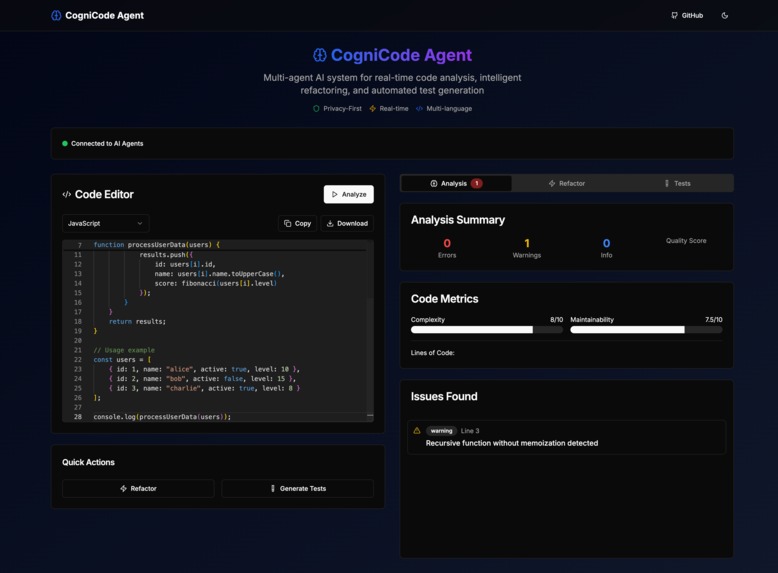
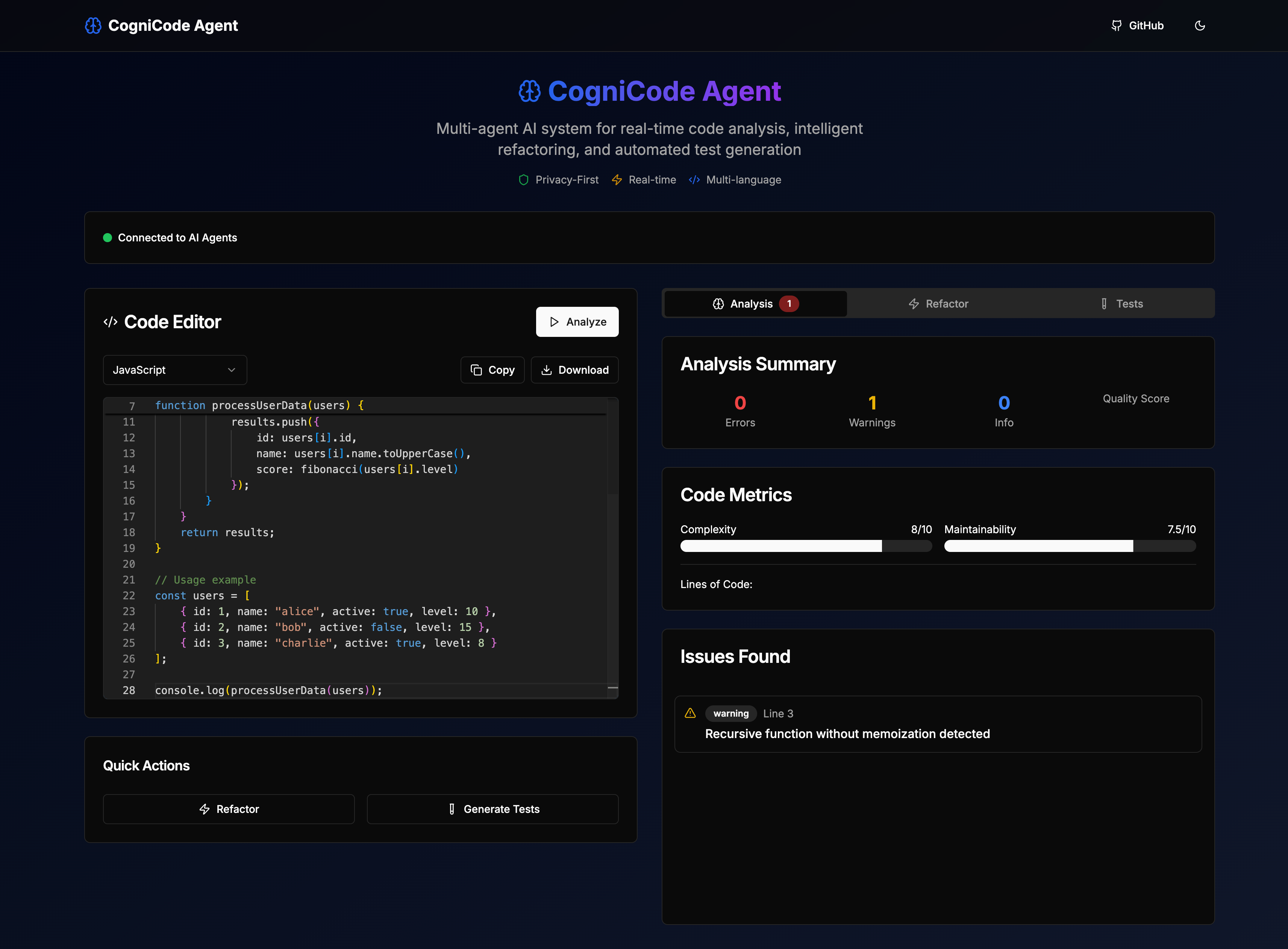
Analysis Results
-
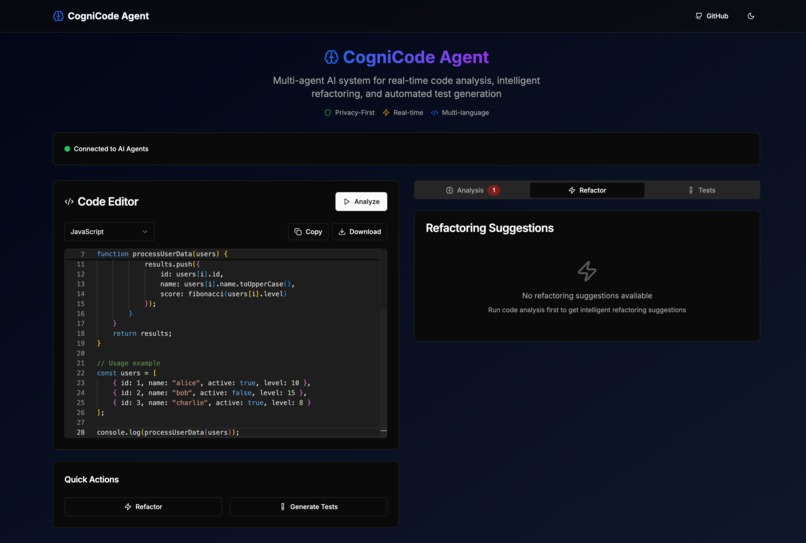
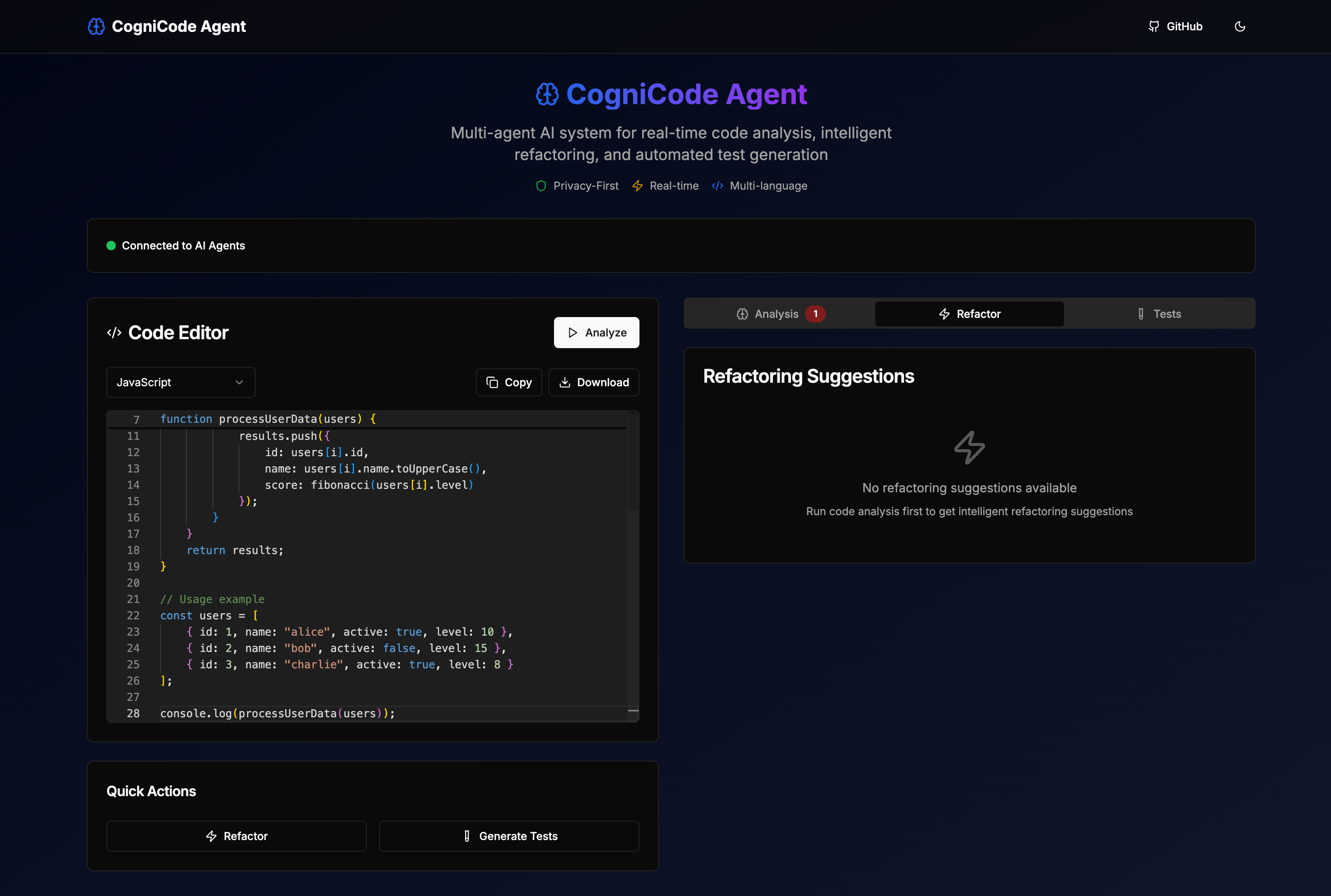
Refactoring Suggestions
-
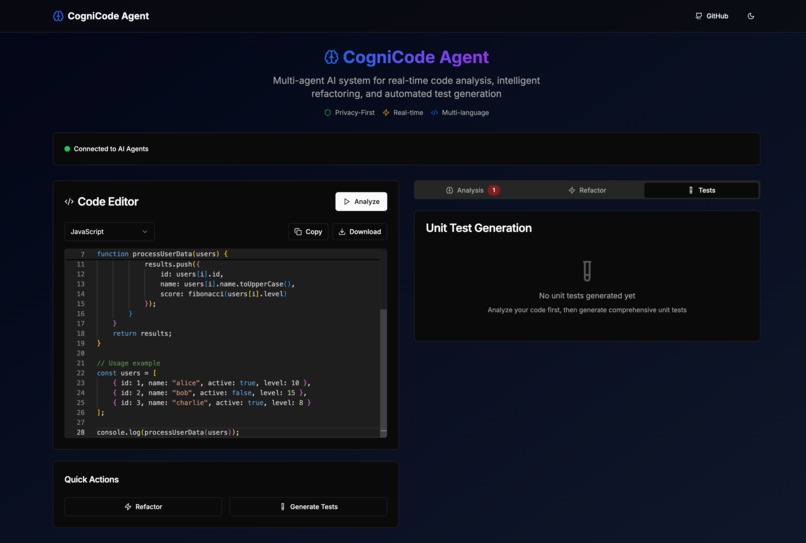
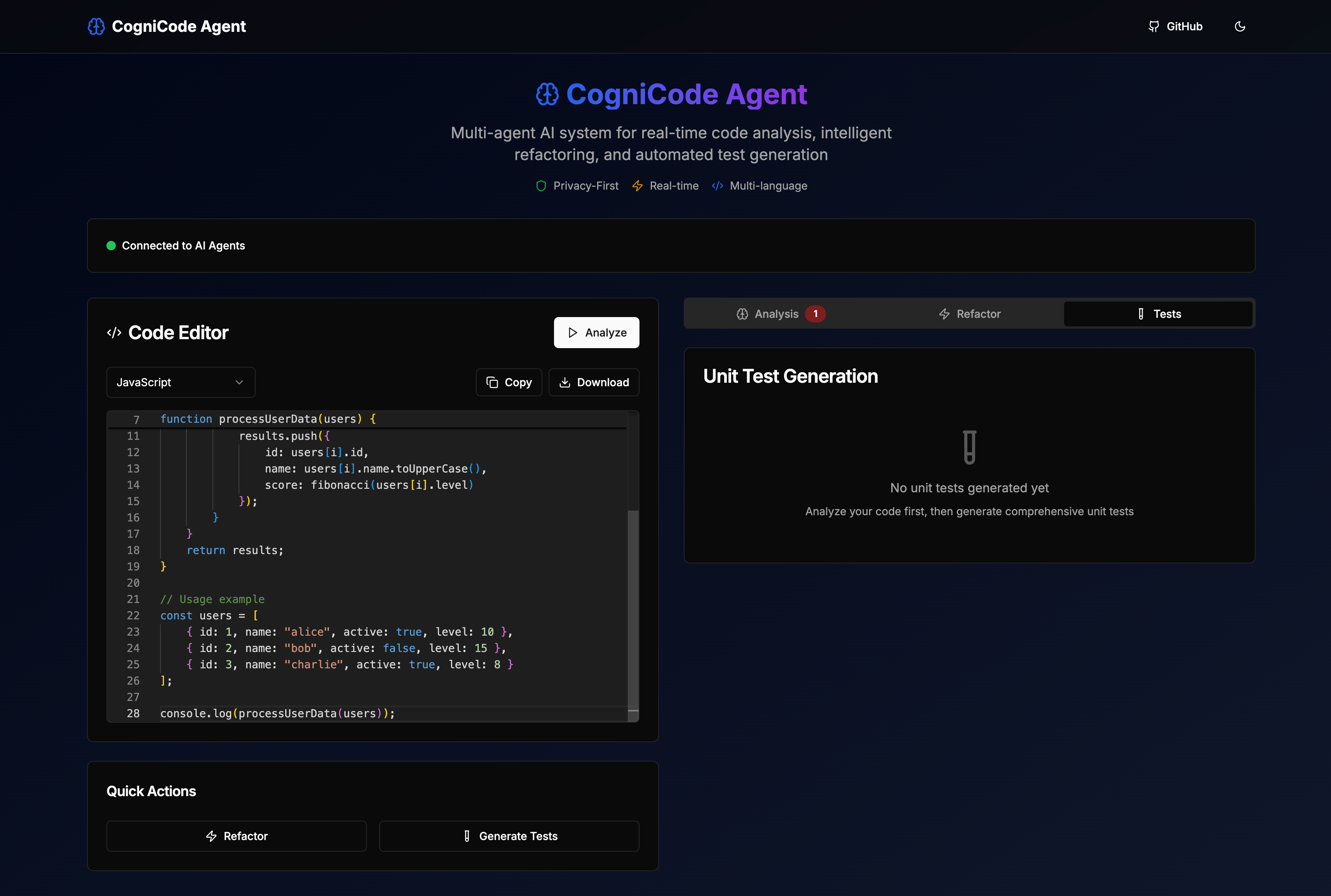
Generated Tests
Inspiration
The contemporary landscape of software development is characterized by an escalating demand for highly efficient and intelligent tools capable of maintaining code quality and accelerating development cycles. Traditional static analysis tools, while foundational, often lack the sophistication required to provide truly context-aware suggestions or to dynamically generate complex content such as comprehensive unit tests. The impetus for this project originated from the observed limitations in existing developer tooling and the increasing complexity inherent in modern codebases, which necessitates a more proactive and intelligent form of coding assistance.
The conceptualization of CogniCode Agent was significantly influenced by prior work on a "narrow AI coding assistant" and an "OpenAI and AI SDK Chatbot". These earlier endeavors underscored the profound potential of artificial intelligence to augment developer workflows, yet simultaneously highlighted the inherent limitations of single-model approaches and the paramount importance of data privacy in sensitive coding environments. Furthermore, the prevailing themes for Hackathon 2025, which prominently feature "AI and Machine Learning themes", coupled with a significant emerging focus on "AI agents" and "real-time applications", provided a clear directional impetus. The developer's ongoing research into "Multi-Agent systems" offered the precise theoretical and practical foundation required to synthesize these interests into a novel and impactful solution. The vision was to create a system where specialized AI agents could collaboratively offer comprehensive code intelligence, crucially ensuring user code privacy by executing all processing locally. This strategic alignment between a cutting-edge hackathon trend and the developer's specialized research area allowed for the pursuit of a "staff+ level" project that remains solo-feasible within the hackathon timeframe. The pre-existing knowledge base in multi-agent systems significantly reduces the initial learning curve for core AI paradigms, enabling a focused effort on implementation, integration, and user experience, thereby enhancing the project's sophistication and competitive edge.
What It Does
CogniCode Agent delivers a robust, interactive web interface designed for developers to input or upload code snippets, receiving immediate and intelligent analysis. The system operates on a sophisticated multi-agent AI architecture, performing several critical functions to enhance developer productivity and code quality. Firstly, it offers Real-time Code Analysis, identifying potential bugs, code smells, and style violations with instant feedback as the user types or uploads code. This capability directly aligns with the "real-time applications" trend prevalent in Hackathon 2025. Secondly, the system provides
Intelligent Refactoring Suggestions, moving beyond basic linting to propose advanced refactoring patterns that demonstrably improve code readability, maintainability, and overall performance. Thirdly, it excels in Automated Unit Test Generation, creating relevant unit tests for specified code functions, which substantially reduces the manual effort typically associated with test-driven development.
A cornerstone of CogniCode Agent's design is its Privacy-First Design. All code analysis and AI processing are meticulously engineered to run locally on the user's machine, leveraging open-source models. This architectural choice ensures that sensitive code never leaves the user's secure environment, directly addressing the "privacy-first solutions" trend and fulfilling the "cost-free" requirement of the hackathon. The web interface presents a visually appealing dashboard, drawing on the developer's experience with CSS in projects like faculty-management-system and UI/UX from open-ai-and-ai-sdk-chatbot. This intuitive dashboard effectively displays analysis results, refactoring options, and generated tests, transforming complex AI interactions into actionable and user-friendly insights. This strategic combination of a sophisticated multi-agent AI backend with a highly interactive and visually appealing frontend creates a compelling demonstration of full-stack development capabilities, making it an exceptional addition to a GitHub portfolio.
How We Built It
The CogniCode Agent was architected with a modern, full-stack approach, leveraging technologies that align with the developer's existing expertise and the project's core requirements. The frontend was developed using Next.js 14+ and React.js with TypeScript. This combination provides a robust, type-safe, and highly performant user interface, essential for a responsive developer tool.
Tailwind CSS and shadcn/ui were utilized for rapid and visually appealing component development, a methodology previously applied in the open-ai-and-ai-sdk-chatbot project. The frontend establishes real-time communication with the backend via WebSockets to deliver instant feedback and streaming results.
The backend comprises a lightweight Flask server, written in Python, which serves as the central orchestrator for the AI agents. This Flask application is responsible for managing the local execution of various AI models and coordinating the intricate interactions within the multi-agent system. The
AI/ML core is powered by PyTorch and integrates several open-source pre-trained models. For code analysis and refactoring, fine-tuned versions of models such as CodeBERT or CodeT5, specifically designed for code understanding and generation, were employed. For automated unit test generation, a specialized model trained on extensive code-test pairs was utilized. To adhere to the "cost-free" and "privacy" mandates, these models are loaded and executed locally using the Hugging Face Transformers library, with options for integration with local LLM inference engines like Ollama for larger models. This architectural choice directly addresses the "cost-free" requirement by avoiding reliance on paid cloud AI APIs and inherently fulfills the "privacy-first" commitment by ensuring sensitive user data remains on their local machine.
A key architectural distinction is the Multi-Agent Architecture. This system implements a fundamental multi-agent paradigm where distinct "agents," such as a LinterAgent, RefactorAgent, and TestGenAgent, specialize in specific code-related tasks. The Flask backend facilitates seamless communication and task delegation among these agents, fostering a modular and extensible AI system. This design directly applies the developer's research interest in "Multi-Agent systems" and aligns precisely with the burgeoning "AI agents" trend of 2025. The emphasis on
Real-time Processing is achieved through WebSockets, chosen as the communication layer to enable immediate feedback and streaming results from the AI agents, building upon the developer's prior experience with "Streaming AI Responses" in their open-ai-and-ai-sdk-chatbot.
Challenges We Ran Into
Developing CogniCode Agent presented several significant challenges, primarily centered around the integration and optimization of complex AI components within a real-time, local-first architecture. A major hurdle was integrating diverse AI models for local execution. This required carefully selecting, and in some cases, quantizing, potentially large open-source AI models to ensure efficient operation on consumer-grade hardware without excessive resource consumption. Optimizing PyTorch inference for both CPU and GPU environments was critical to achieving acceptable performance.
Another complex aspect was designing effective multi-agent communication. Orchestrating specialized AI agents to work collaboratively and seamlessly pass context between them proved intricate. Ensuring that the output from one agent, such as a detailed code analysis, could effectively inform and guide another agent, like the refactoring suggestion engine, necessitated the development of a robust internal API and sophisticated state management mechanisms within the Flask backend.
Optimizing for real-time performance was also a continuous challenge. Delivering near-instantaneous feedback for code analysis and generation, particularly when relying on locally running AI models, demanded meticulous performance tuning across both the Python backend and the frontend's data handling. A delicate balance had to be struck between the complexity of the AI models and their inference speed to maintain a fluid and responsive user experience, crucial for a developer tool.
Finally, ensuring comprehensive privacy without sacrificing utility presented a unique constraint. The commitment to local processing for privacy meant that the project could not rely on the computational power of large, cloud-based language models without requiring users to provide their own API keys. This limitation compelled innovation, pushing the development towards leveraging smaller, specialized open-source models and highly efficient local inference techniques. The goal was to ensure the tool remained highly useful and competitive while strictly adhering to the principle of respecting user data and maintaining a "cost-free" operational model.
Accomplishments That We're Proud Of
The development of CogniCode Agent yielded several key accomplishments that underscore its innovation and technical prowess. A significant achievement is the successful multi-agent orchestration, where a functional multi-agent AI system was implemented, demonstrating collaborative intelligence for complex code-related tasks. This represents a cutting-edge application of AI agents, aligning with the latest trends in artificial intelligence.
Another source of pride is the delivery of real-time, privacy-preserving code intelligence. The web application provides instant, actionable AI-driven insights on code, critically ensuring that all user data remains private through local processing. This effectively combines the "real-time" and "privacy-first" trends, offering a unique value proposition. The project also boasts an
intuitive user experience for complex AI. A clean, responsive, and visually appealing interface was crafted, making interactions with advanced AI models straightforward and highly productive for developers. This showcases the ability to translate sophisticated AI capabilities into practical, user-friendly applications.
Furthermore, the robust local model integration is a testament to the project's technical depth. It demonstrates the feasibility of building powerful AI tools that are "cost-free" and can run entirely offline, thereby making advanced AI accessible to a broader range of developers without the dependencies or recurring costs associated with cloud services. The project has also established a foundation for future AI-powered developer tools. By building a modular and extensible architecture, CogniCode Agent is designed to easily incorporate new AI agents or expand its functionality, setting the stage for even more sophisticated developer assistance in the future.
What We Learned
The development of CogniCode Agent provided invaluable learning experiences, deepening the understanding of advanced AI and full-stack development principles. A primary lesson was the deepened understanding of multi-agent system design. This project offered practical, hands-on experience in designing, implementing, and orchestrating intelligent agents, moving beyond theoretical concepts to a functional prototype. This directly enhanced the understanding of the developer's research area in "Multi-Agent systems".
Furthermore, the project offered practical application of PyTorch for code-specific tasks. This involved learning to fine-tune and deploy PyTorch models specifically for nuanced tasks such as code analysis, refactoring, and generation. This process provided a deeper appreciation for the complexities of working with code as data for AI models. The effort also led to significant learning in optimizing full-stack performance for AI-driven real-time applications. The project provided direct experience in optimizing both frontend and backend components to efficiently handle real-time data streams and computationally intensive AI inferences. This is a critical skill for developing modern, high-performance web applications that integrate AI.
Finally, the hackathon environment taught the importance of balancing innovation with practical constraints. The "cost-free" and "solo-feasible" requirements necessitated a pragmatic approach, prioritizing core functionality and effectively leveraging open-source tools. This experience underscored the ability to innovate within tight limitations, delivering a high-quality prototype under challenging conditions.
What's Next for CogniCode Agent
The future development of CogniCode Agent is envisioned across several key areas to enhance its utility and reach. A primary next step is IDE Integration, which involves developing plugins for popular Integrated Development Environments such as VS Code and IntelliJ. This will seamlessly integrate CogniCode Agent's powerful capabilities directly into the developer's existing workflow, providing immediate, context-aware assistance without requiring them to switch applications.
Another crucial area for expansion is support for more programming languages. The current AI models and parsing capabilities will be extended to accommodate a wider array of programming languages beyond the initial focus, making CogniCode Agent a versatile tool for developers working in diverse tech stacks. This will involve training or fine-tuning additional models specific to new language syntaxes and semantics.
The project also aims to implement advanced refactoring patterns. This involves developing more sophisticated refactoring agents capable of handling complex architectural improvements and applying advanced design patterns. These agents would go beyond simple code improvements to suggest structural enhancements that significantly improve the long-term maintainability and scalability of a codebase.
Furthermore, exploring mechanisms for self-improving agents is a compelling future direction. This would involve enabling agents to learn from user feedback, code changes, and successful refactoring applications, continuously improving their suggestions and accuracy over time through reinforcement learning or active learning techniques.
Finally, the creation of a Community Model Hub is envisioned. This platform would allow users to share and contribute their own fine-tuned open-source models or custom agents. This would foster a collaborative ecosystem around CogniCode Agent, enabling the community to collectively enhance the tool's capabilities and adapt it to specific needs and domains.
Built With
- flask
- git
- hugging-face-transformers
- localstorage-api
- nextjs
- python
- pytorch
- react
- shadcn/ui
- tailwindcss
- typescript
- websockets

Log in or sign up for Devpost to join the conversation.