Inspiration
As someone who has been in cognitive science and psychology labs for 6 years in college, I experienced the pain point of creating and building behavioral experiments. The opportunity is huge — universities spend over $7B a year on IT, and the global UX research software market is growing fast, from $400M in 2023 to a projected $1.7B by 2032. Together, that’s a ~$9B market we can capture by making experimentation as simple as drag-and-drop.
Pain points experienced:
- High learning curve for tools like PsychoPy and jsPsych.
- Experiment creation is time-consuming and tedious.
- Short master’s programs create time pressure, limiting research scalability/efficiency.
- Experimenter bias when conducting experiments.
- Replication crisis - studies are difficult to replicate reliably. (63% of psychology studies not able to be replicated and produce the significant findings of the original studies.)
What it does
AI-powered experiment builder: generates behavioral experiments without coding.
Key features:
- Drag and drop experiment builder, complete with consent, debrief, demographic questions, and tasks.
- Supports complex designs, stimuli, and response logging.
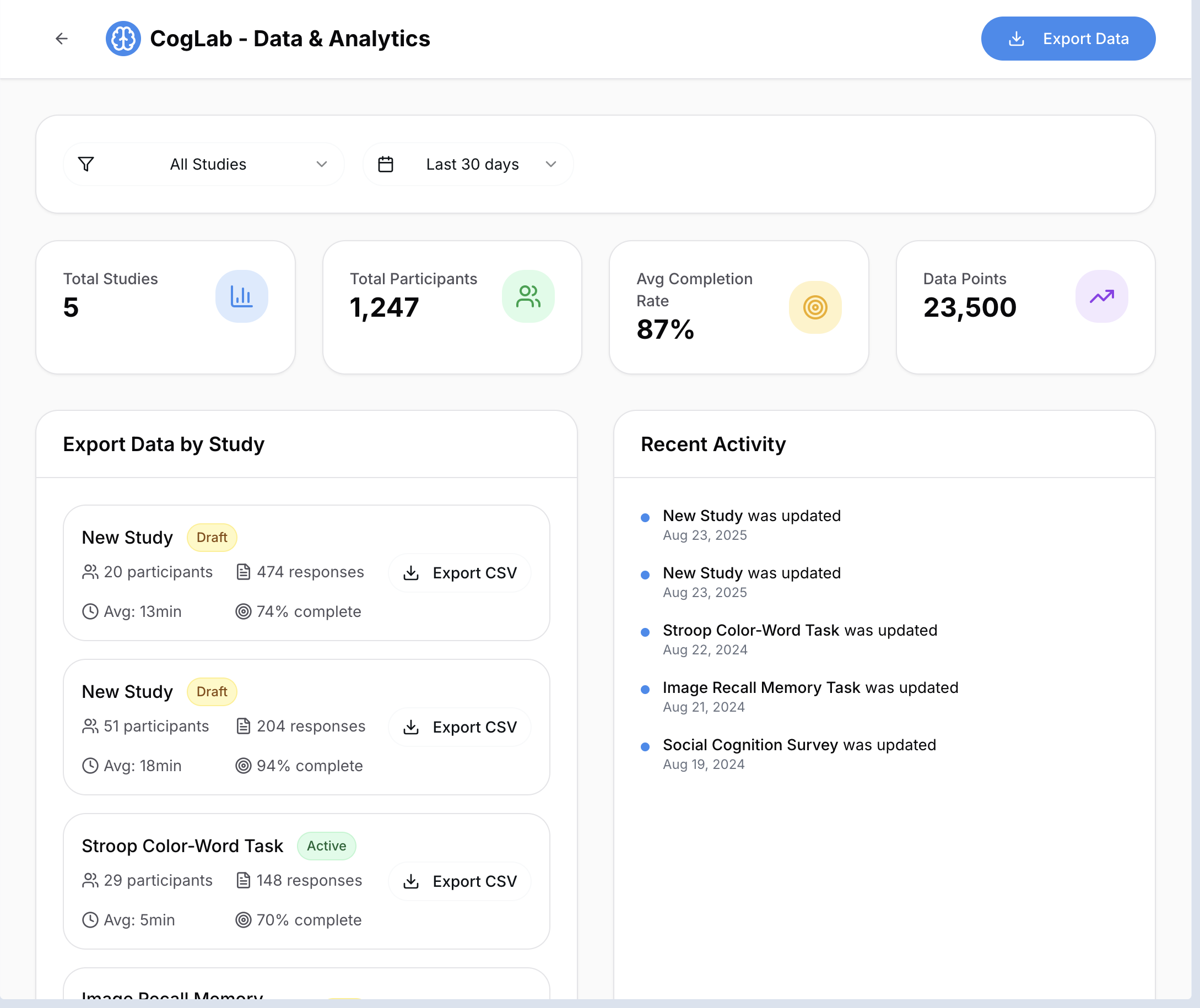
- Optional data analysis: cleans, structures, and visualizes results.
- Easily replicable across participants and labs.
How we built it
- Front-end: React, TypeScript, JavaScript
- Back-end / Scripting: Python, Next.js, Vite
- AI & Voice: OpenAI (image generation), DALL·E (images)
- Workflow: Full-stack web app hosted on AWS EC2
Other tools: APIs integrated for stimuli generation and experiment management
Challenges we ran into
- Handling timing and response recording for memory/recall tasks.
- Ensuring unbiased instructions with voice AI. (future feature)
- Designing a flexible system that supports multiple experiment types.
- Balancing demo simplicity with showing the full experiment workflow.
Accomplishments that we're proud of
- Built a fully functional AI experiment builder in a short hackathon timeframe.
- Implemented consent, stimulus presentation, recall, and logging in a single workflow.
- Added voice instructions to remove experimenter bias.
- Thought through and designed the entire experiment process, from setup to data collection.
- Demonstrated potential to automate data analysis and expand to UX research.
What we learned
- Automating experiment creation reduces barriers for researchers without coding skills.
- Voice AI can standardize instructions and improve reliability.
- Even small design choices (timing, button hierarchy) impact usability and data quality.
- Rapid prototyping highlights how AI can accelerate research pipelines.
What's next for CogLab
- Add automated data analysis and visualization.
- Expand to UX research and usability studies.
- Make experiments even more replicable across labs and participants.
- Consider multi-platform support (web + mobile) for broader access.
Built With
- dali
- elevenlabs
- javascript
- next.js
- openai
- python
- react
- typescript
- vite

Log in or sign up for Devpost to join the conversation.