Inspiration
It started with a phone call to my neighbor a former hospital nurse in Puerto Rico: "Yo no sé cuántos dermatólogos llamé. Ninguno coge plan médico. Ninguno." ("I don't know how many dermatologists I called. None take my plan. None.")
Plan directories say yes, offices say no, and patients pay with lost days and delayed care. About half of Medicare Advantage directory listings contain errors, and in April 2026 the Centro de Periodismo Investigativo found that half of the specialists it called accept no First Medical coverage at all. The root cause is low, late payments from plans, which push doctors out of networks while the directories never catch up.
Why this problem
The memo named three problems: specialists who don't take your plan, nurses tracking 8 to 10 patients by hand, and lab lines where you take a number and lose your day. We scored all three:
| Patient registry (chosen) | Nurse task tool | Lab virtual line | |
|---|---|---|---|
| Who it helps | 3.2M residents, including 1.4M on Plan Vital and 771K aged 65+ | Nurses in one hospital per sale | Patients of one lab network |
| Time to launch | Weeks, on WhatsApp | Procurement plus EHR integration | One operator partnership |
| Who pays | Health plans (federal directory accuracy rules) | Hospital IT budget | The lab operator |
| Patient data needed | None from patients | Full patient records | Scheduling data |
Patient first means the most people and the fastest launch.
What it does
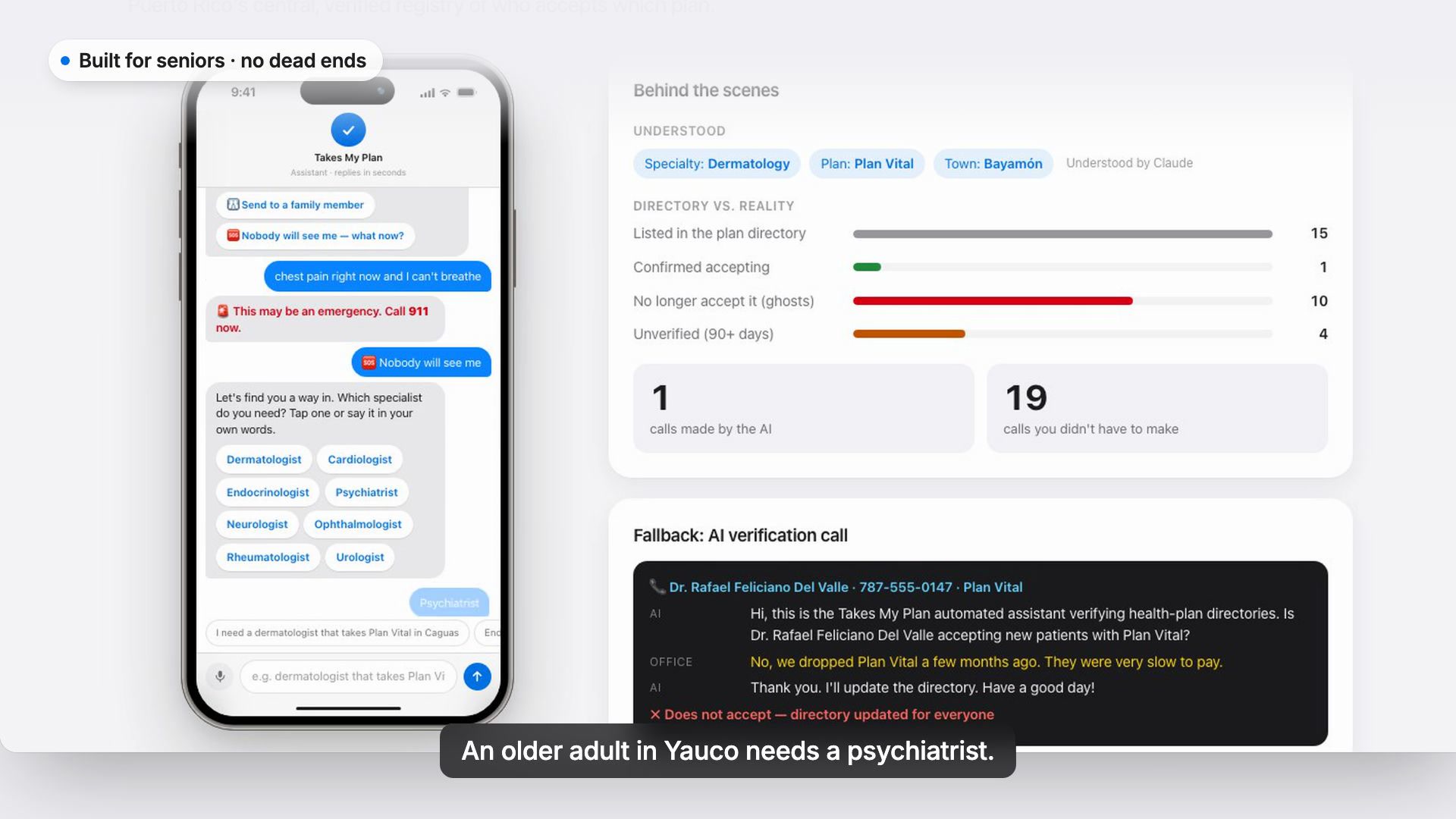
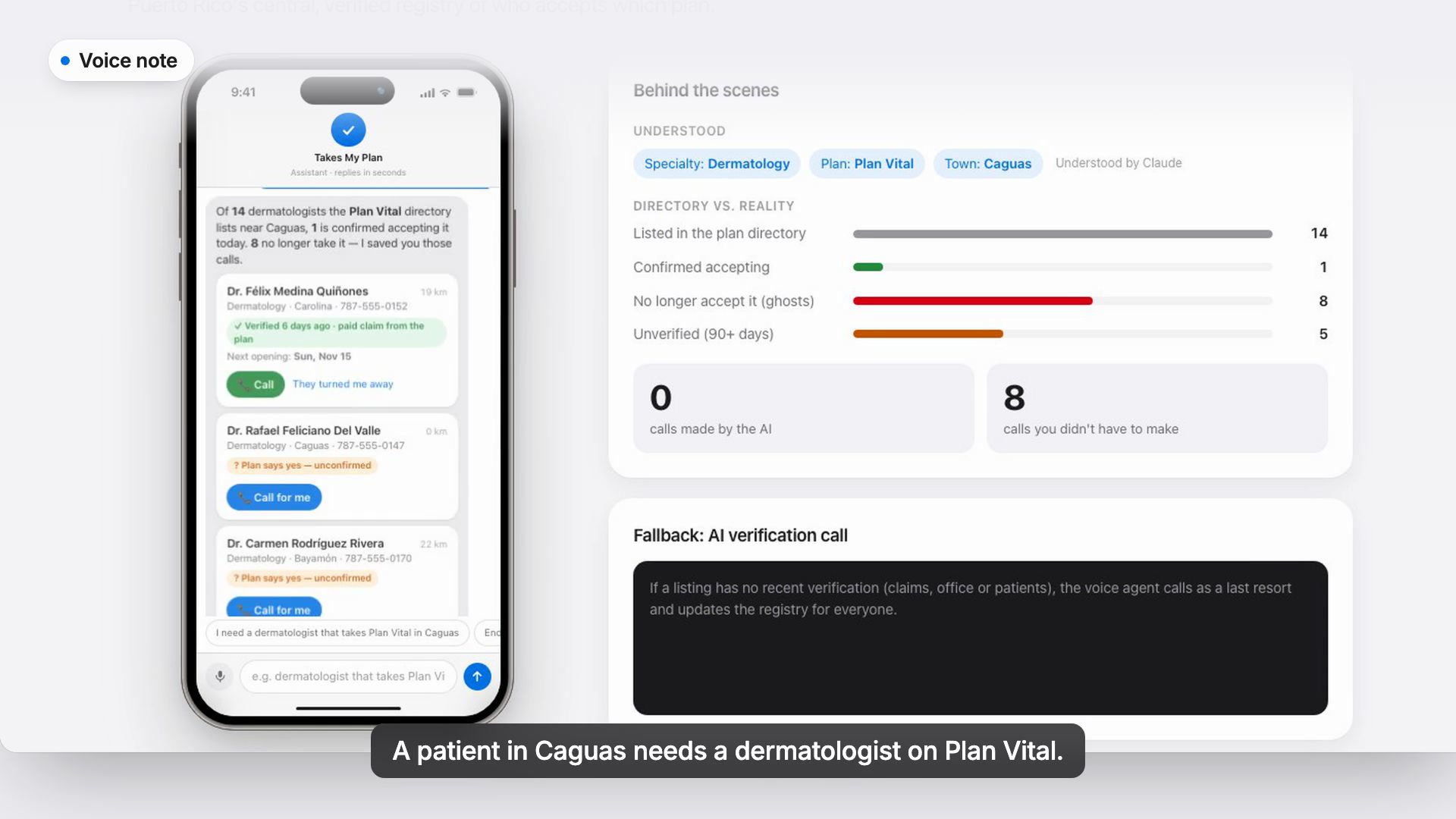
- Ask in your own words. Type or send a voice note in Spanish or English, like "mi mamá tiene la piel irritada, tiene la reforma, vivimos en Toa Baja." Claude turns it into dermatology, Plan Vital, and the nearest listed town (Bayamón).
- See who actually says yes. Results show confirmed specialists with the date and source of each verification (paid claim, office, patient report, AI call), next openings, and how many directory listings are ghosts.
- No dead ends. If nobody accepts the plan, the app offers telehealth options, a ready-made request to the plan, the Oficina del Procurador del Paciente, and the private-pay price.
- Safety first. Emergency language is caught on the device, before any AI call, and shows 911, 988 and Línea PAS.
- Built for seniors. Tap-first choices, voice notes, large text, and "send to a family member."
- Pharmacy mode. Community pharmacists answer "¿quién coge mi plan?" at the counter and report turn-aways with one tap.
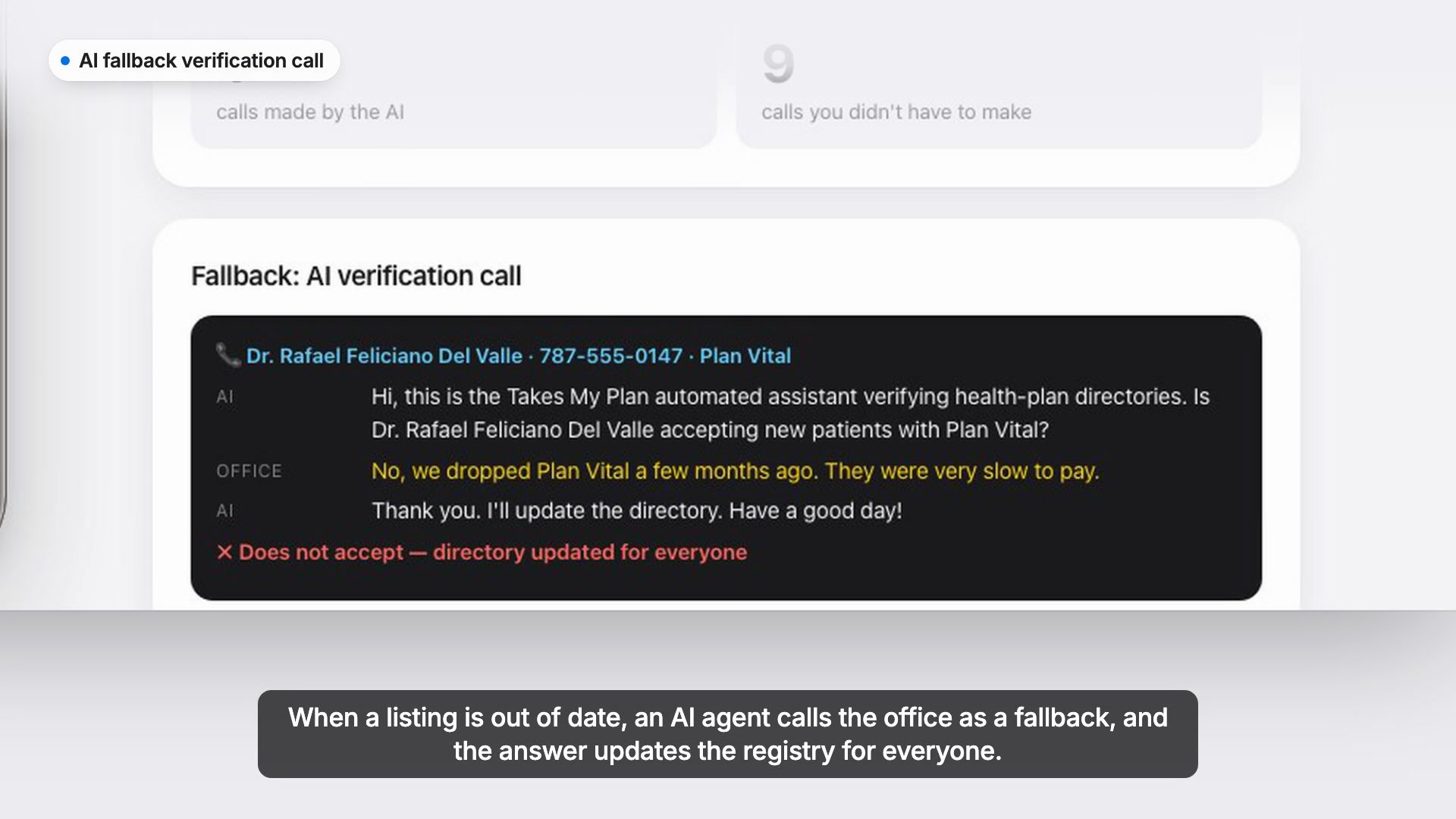
- Verified registry. Listings with no evidence in 90+ days are queued by patient demand, and an AI voice agent calls only as a fallback.
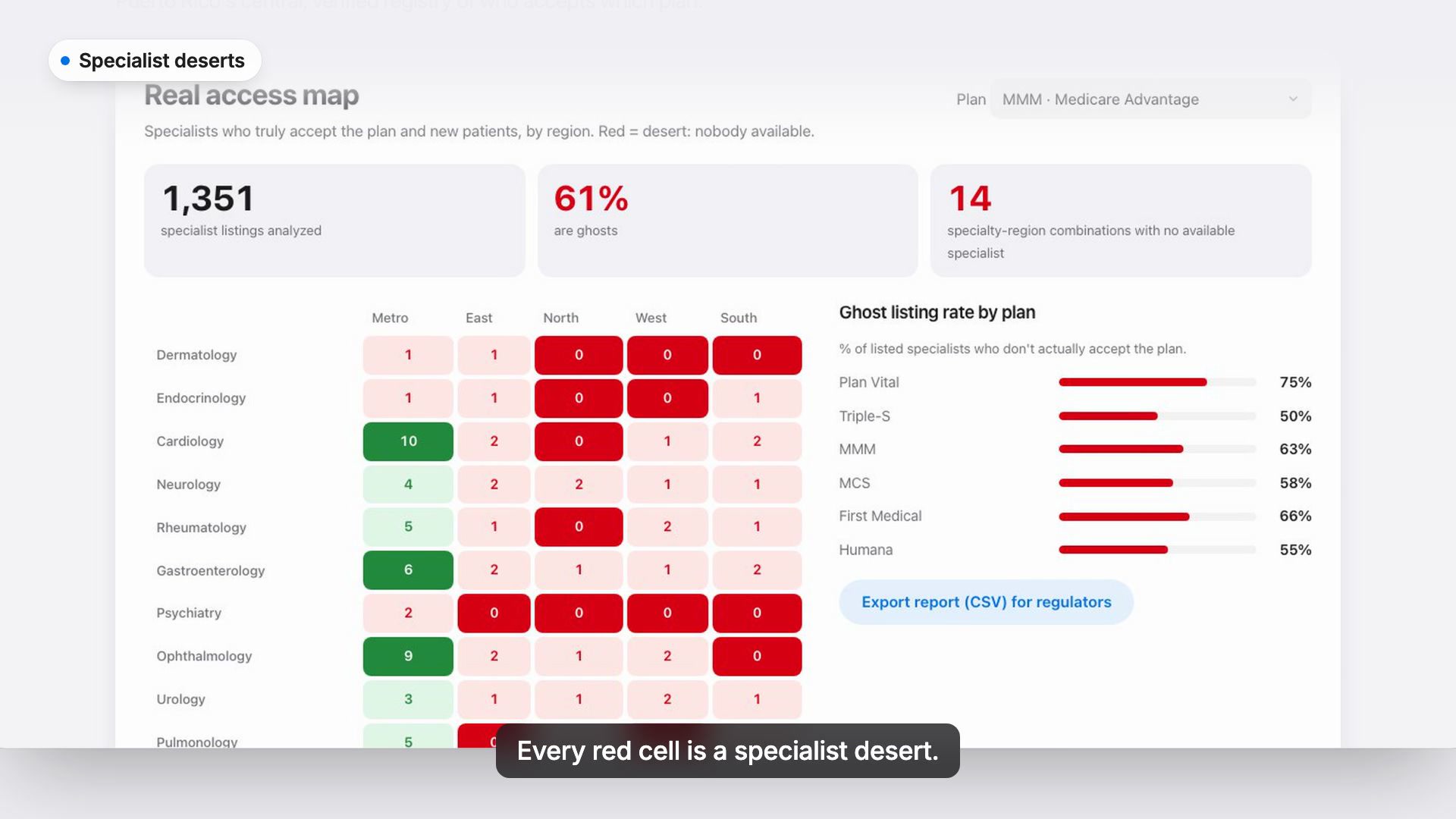
- Impact map. Ghost-listing rates by plan and specialist deserts by region, exportable for regulators (OCS, ASES).
How we built it
- A static web app (HTML, CSS, JavaScript) designed to Apple's Human Interface Guidelines: an iMessage-style chat in an iPhone frame, dark mode, reduced motion, and 44pt touch targets.
- Claude (Opus 5.5) runs in a Netlify Function. It turns free-form messages into structured slots (specialty, plan, town) using JSON-schema structured output, maps symptoms to specialties and unlisted towns to the nearest one, and flags emergencies.
- A deterministic parser takes over whenever the AI is unavailable, so the app never breaks.
- A Twilio-ready WhatsApp webhook uses the same AI layer and keeps only three search slots, under a hashed phone number, for 30 minutes.
- Per-visitor rate limiting, plus a synthetic registry generated with a seeded random number generator.
- The demo video was cut in Remotion, with narration in my own ElevenLabs voice.
Challenges we ran into
- Keeping the AI helpful without ever giving medical advice. It only routes to a type of specialist, and an on-device emergency screen runs first.
- Making a demo that can't fail in front of judges: resilient fallbacks, cold-start handling, and a one-click guided demo.
- Designing for older adults: voice, taps instead of typing, and large text.
- Getting the regulation right. Medicare Advantage and Medicaid plans must update directories within 30 days, and commercial plans must verify every 90 days, so every plan type already has a reason to buy.
Accomplishments that we're proud of
A working, bilingual, AI-powered prototype that real people in Puerto Rico would understand in ten seconds, with privacy built in from the start.
What we learned
The data problem is the patient problem. Verifying who accepts which plan, and showing how old every answer is, matters more than any single feature.
What's next for ¿Coge Mi Plan?
A 90-day pilot in Caguas: three specialties, two plans, and ten CUD community pharmacies. We'll measure ghost-listing rate, days to first appointment, and calls saved. Then come booking, lab virtual lines, and nurse task tools on the same platform.
Data and privacy
The demo uses 100% synthetic data, with fictional providers and the reserved 555 phone range. The verification calls are simulated. No patient records are stored, and searches are anonymous. The claims-based verification feed would require data-sharing agreements with the plans and would use only de-identified provider-plan pairs, never patient identities.
Built With
- anthropic
- claude
- css3
- html5
- javascript
- netlify
- netlify-functions
- remotion
- twilio

Log in or sign up for Devpost to join the conversation.