-
-
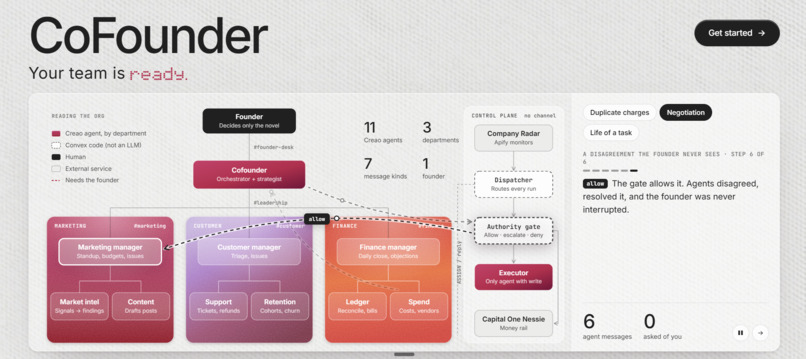
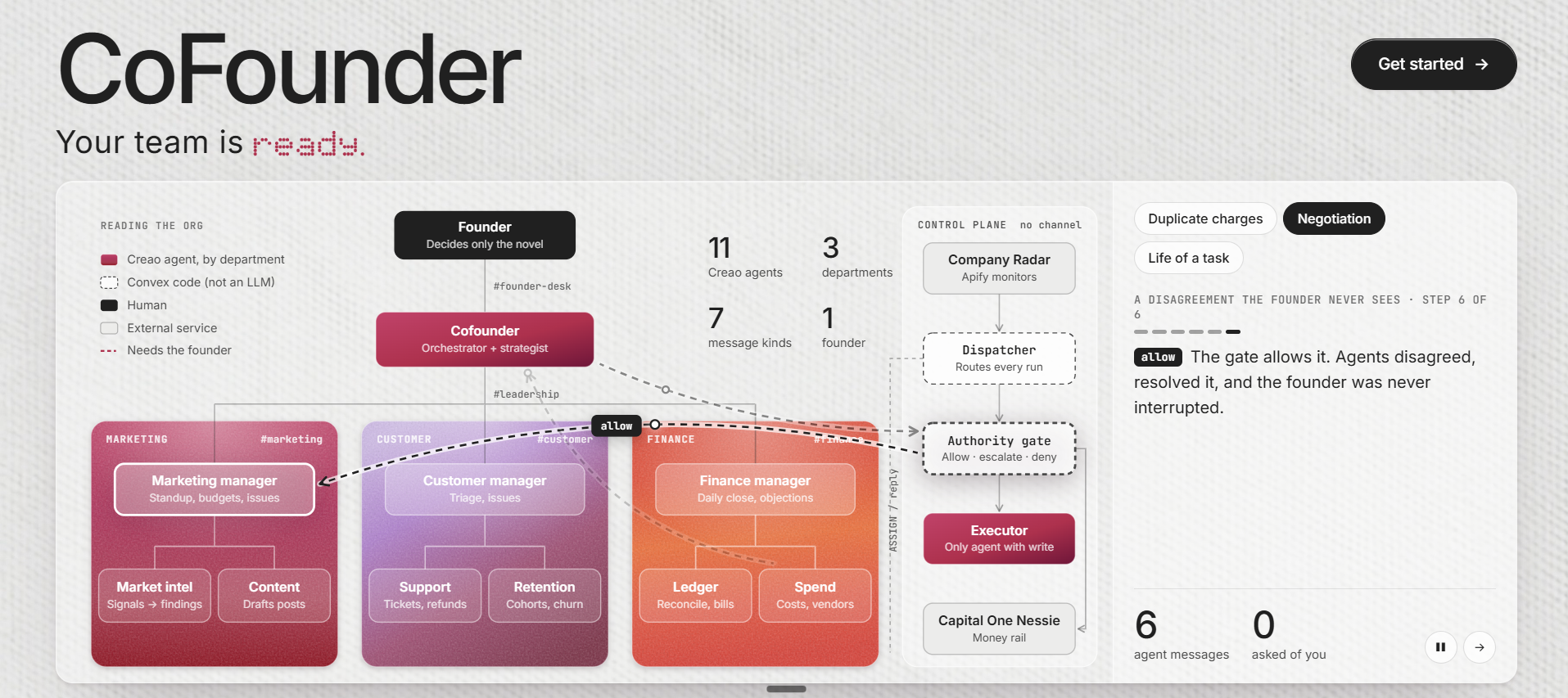
Landing Page
-
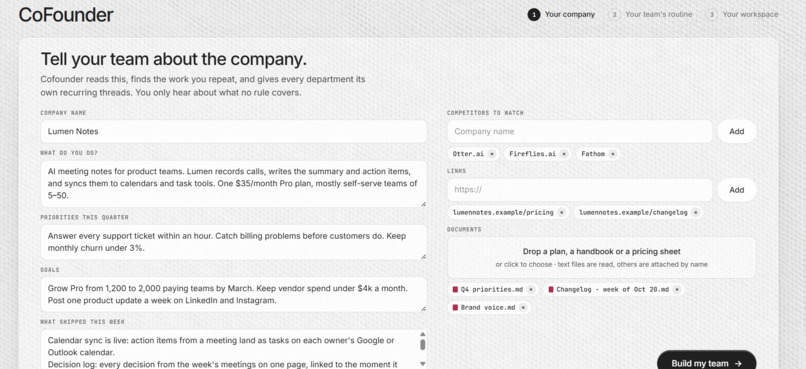
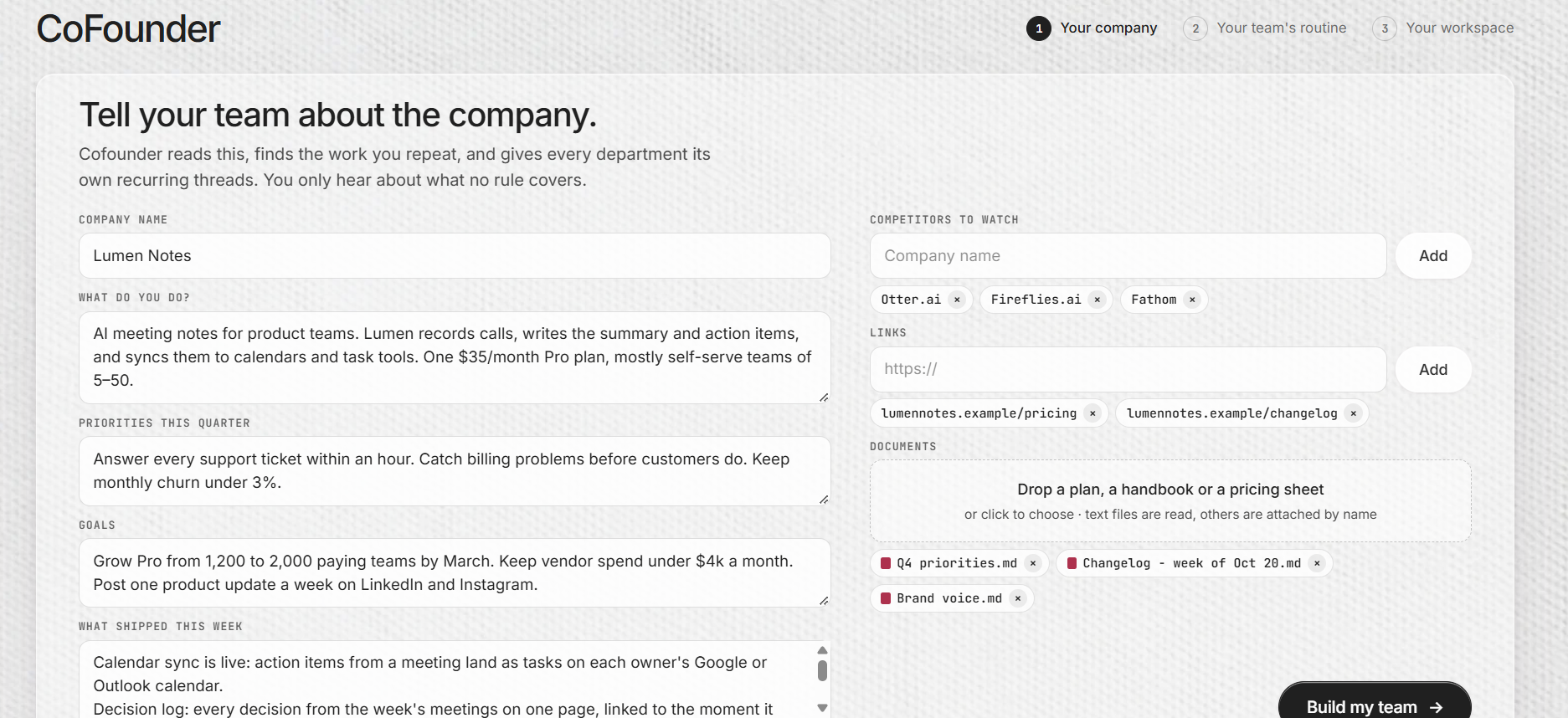
Founder Onboarding Page
-
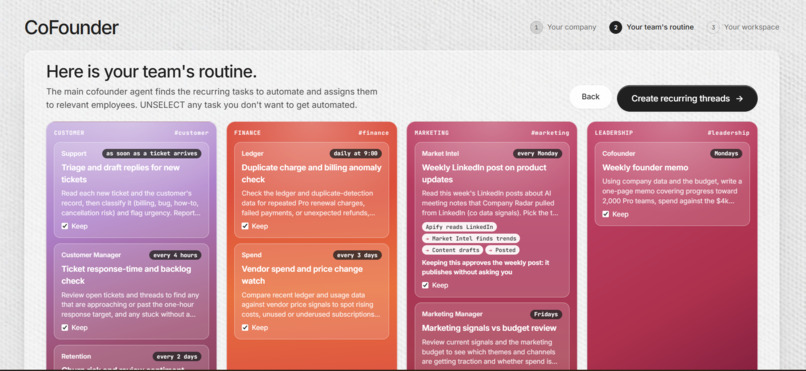
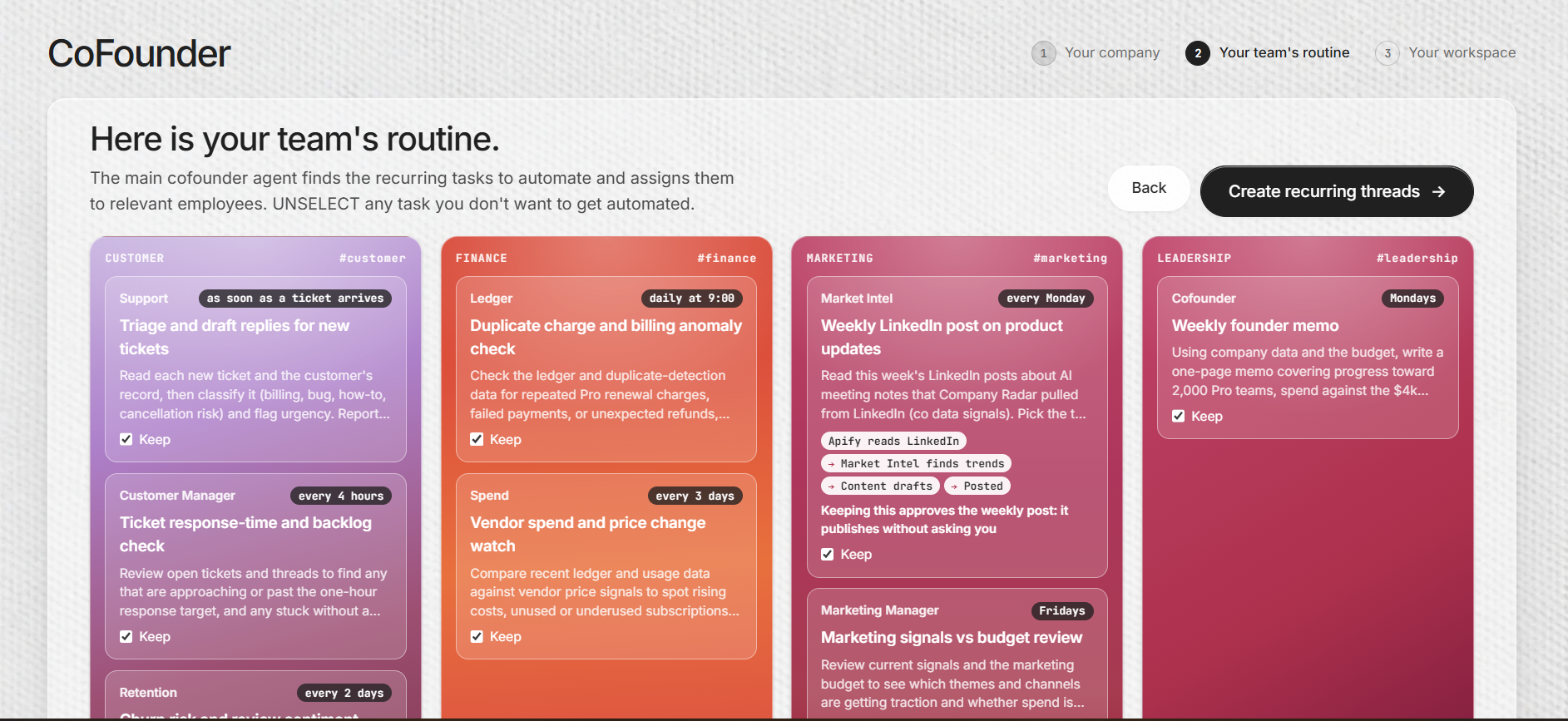
Recurring tasks made and scheduled for each department by cofounder
-
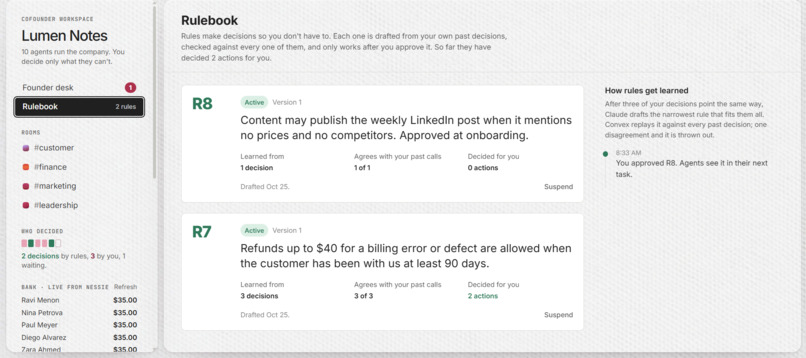
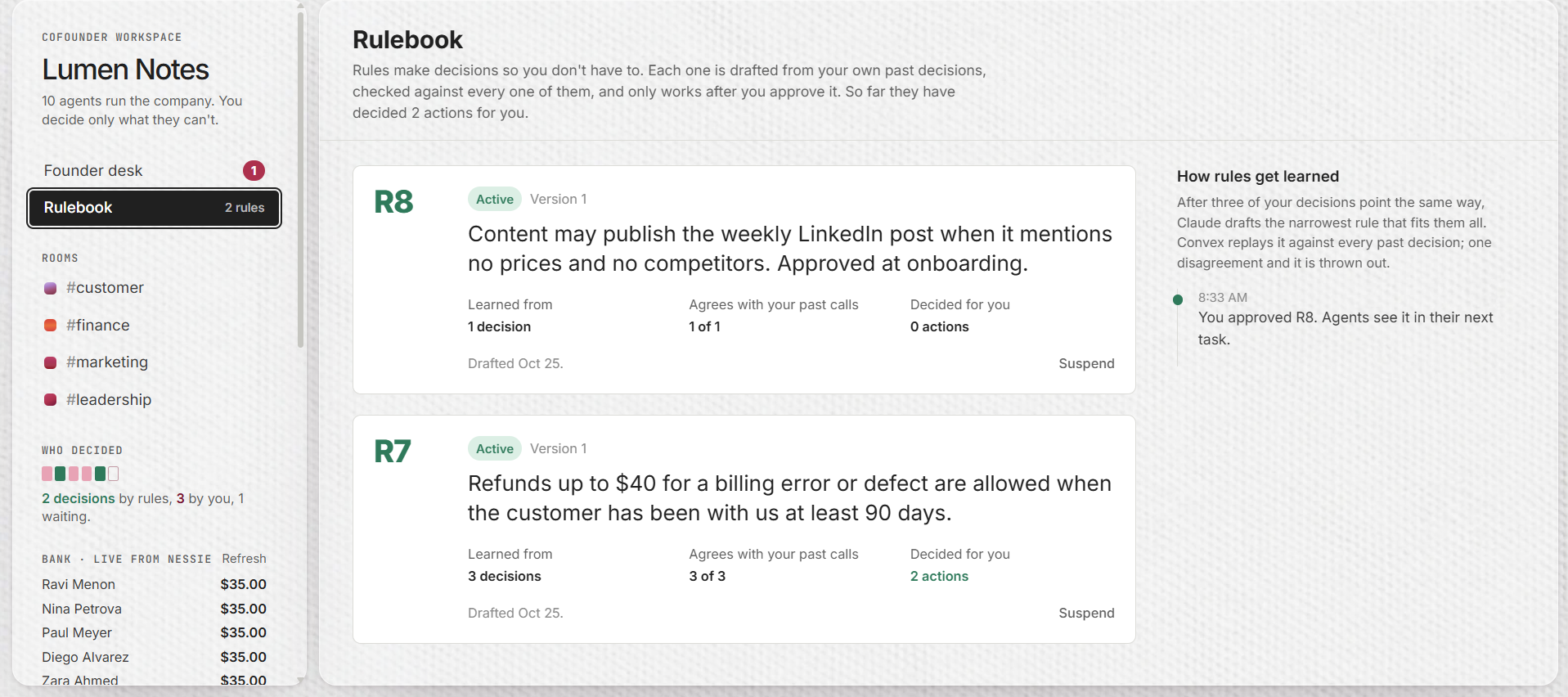
Rulebook to learn your prefernces
-
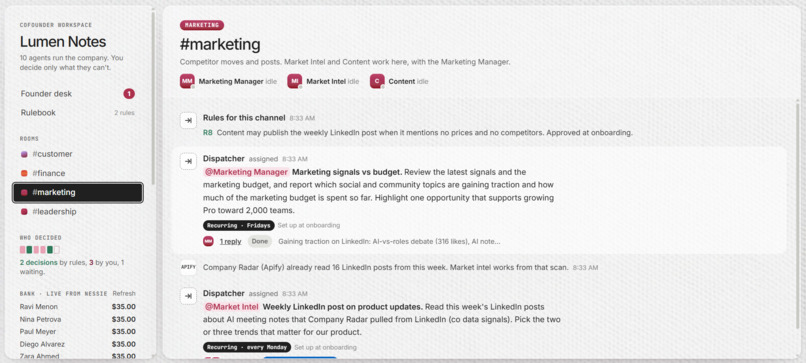
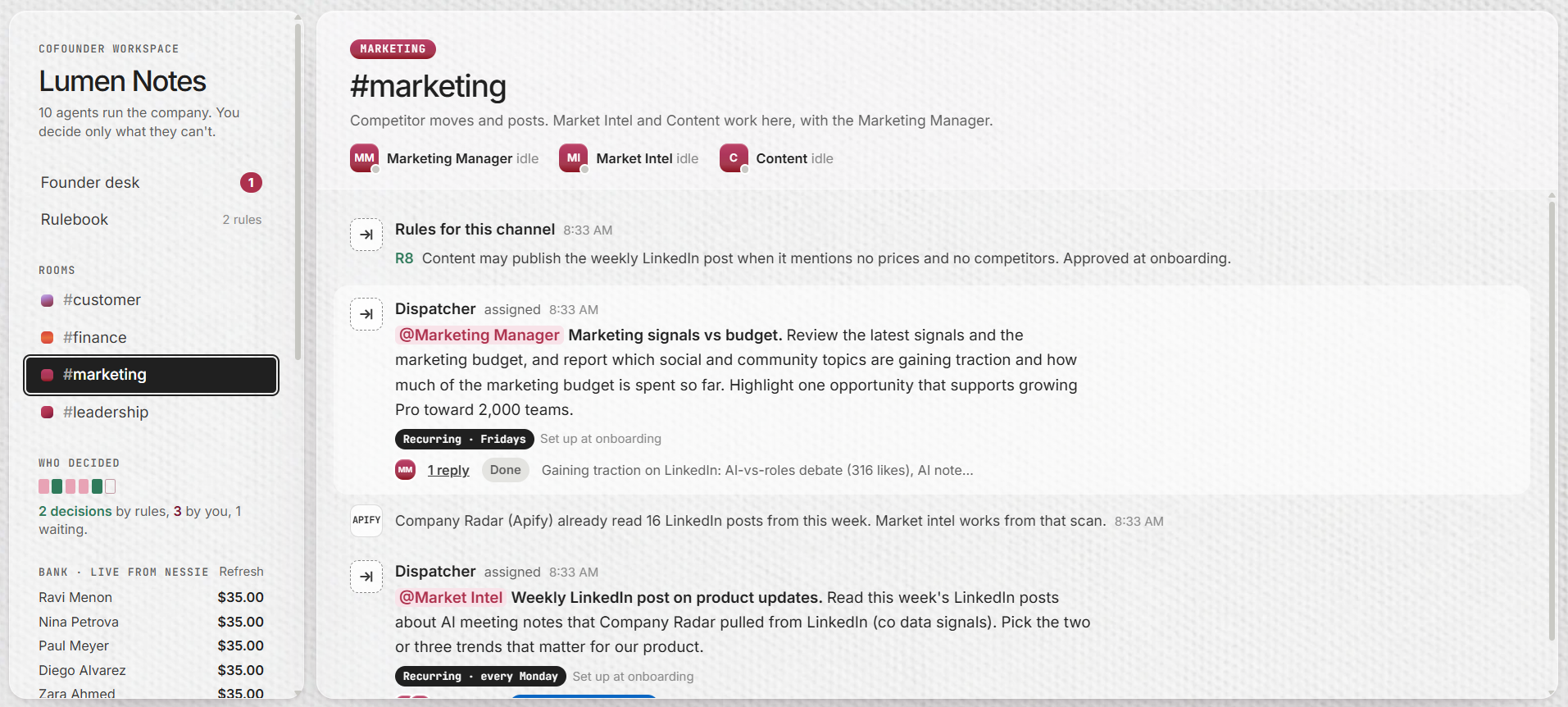
Creao Rooms operating the departments
-
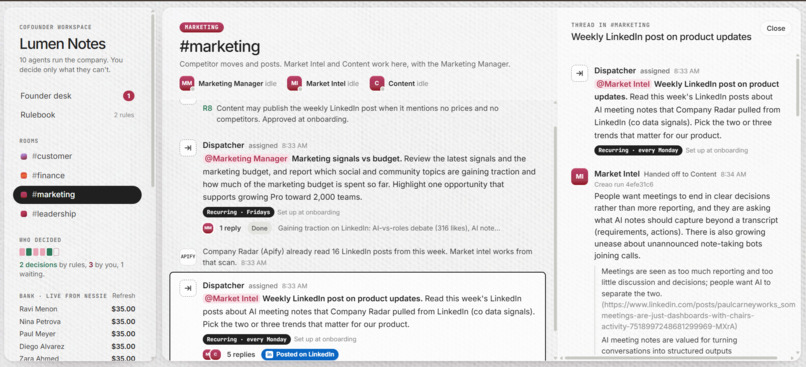
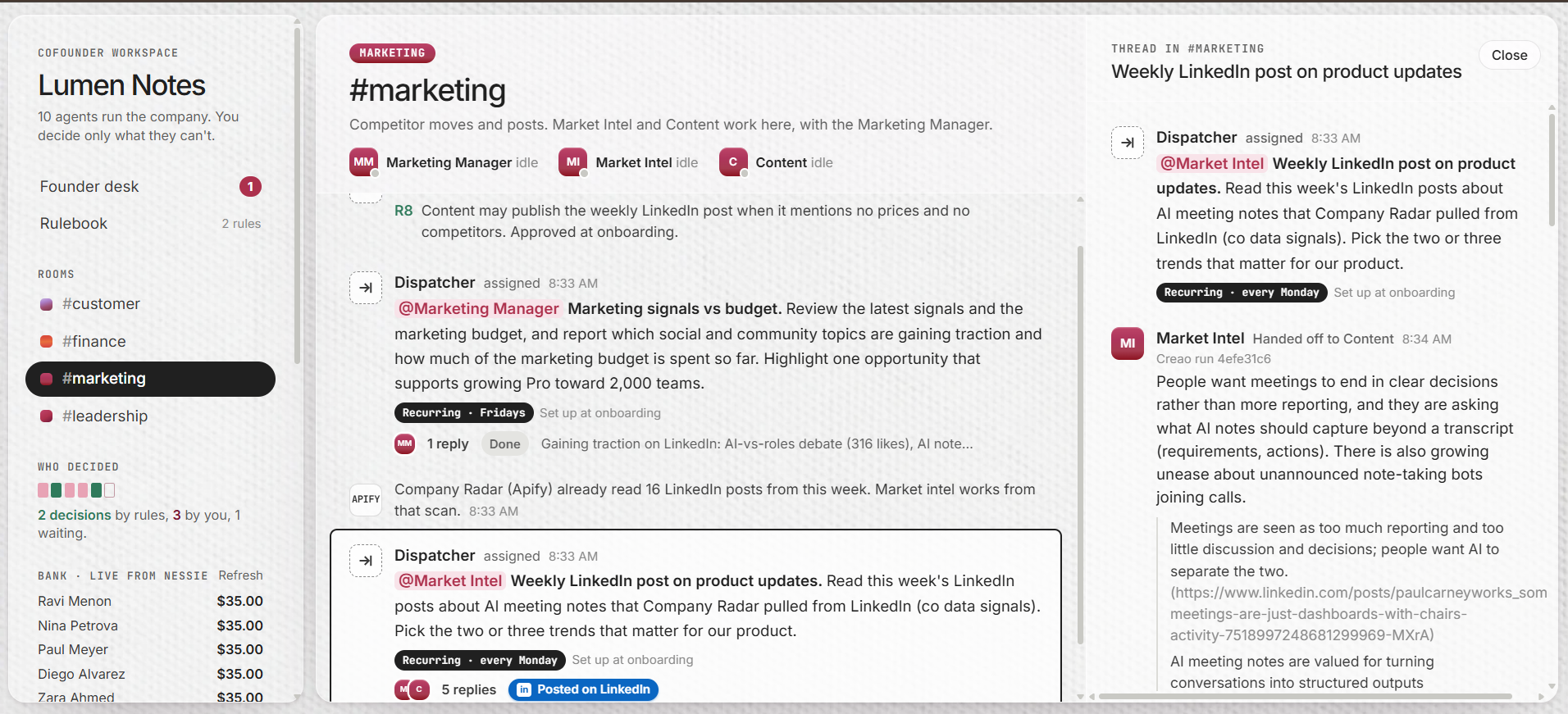
Each task becomes a thread in relevant room with the relevant agents tagged
Inspiration
I want to be a solo founder. The biggest thing stopping me, and most people like me, is the sheer amount of work: support tickets, refunds, bookkeeping, marketing, all landing on one person. But being a solo founder doesn't have to mean being the only employee.
The AI tools we have today don't solve this. Most agents are general-purpose assistants that you have to keep prompting to get anything done. The ones that do work on their own fall into two traps: either they ask you for permission on everything, so your company stops when you sleep or travel, or they act with no limits at all, which is worse.
So we built CoFounder: not one general-purpose agent, but a whole team, run by an AI cofounder, that works within limits you set and gets more independent every time you make a decision.
What it does
CoFounder runs your company through three departments, Customer, Finance and Marketing. Each has an AI manager and two AI agents, and the Cofounder agent leads all of them. You sit at the top. Agents never act on their own authority: they propose, and a rulebook written by your own decisions decides what goes through.
Who has what power

The founder decides only what no rule covers. The Cofounder leads the three department managers, and each manager runs two agents in their department's room. Behind them, the Dispatcher routes every message, the authority gate (code, not AI) decides every action, and the Executor is the only agent allowed to act in the outside world.
The team
| Agent | What it does | Agent ID | Link |
|---|---|---|---|
| Cofounder | Leads the managers, settles disagreements, and turns a whole escalation into one short decision for you | 6eed280f-e1bc-4991-afbb-f87f5537c18e | https://agent.creao.ai/install/6eed280f-e1bc-4991-afbb-f87f5537c18e?version=ebf6d727-8ec2-4e42-956c-fb0682e34aa6 |
| Customer Manager | Runs the customer team; spots patterns across tickets and sends them to the team that can fix them | 4f3f1bd8-1185-4867-af2e-ab0204824d92 | https://agent.creao.ai/install/4f3f1bd8-1185-4867-af2e-ab0204824d92?version=ddacbd3b-2829-4407-b6fe-1a05e36b4cc9 |
| Support | Answers each ticket and proposes replies and refunds | edea5cf5-b3fb-47f0-994c-b40ff2a2e9ec | https://agent.creao.ai/install/edea5cf5-b3fb-47f0-994c-b40ff2a2e9ec?version=0e970bd6-46ad-4a25-b7ea-8709822fe666 |
| Retention | Finds customers likely to leave and ideas to win them back | a09acafd-0043-4c33-a62f-918c3d72fc73 | https://agent.creao.ai/install/a09acafd-0043-4c33-a62f-918c3d72fc73?version=a3989aa5-2cd5-4fd3-b826-bd29dd00ebe6 |
| Finance Manager | Runs the finance team; checks the numbers and files the bug behind a money problem | b1a8e7d3-6ac2-4992-9570-fd4403fa2a91 | https://agent.creao.ai/install/b1a8e7d3-6ac2-4992-9570-fd4403fa2a91?version=1857d8c1-d606-4f95-b8a2-625f5e2dff0a |
| Ledger | Keeps the books; finds the exact transactions behind a problem and proposes one fix | d1a6457c-ad56-453d-8ef7-343c0071b183 | https://agent.creao.ai/install/d1a6457c-ad56-453d-8ef7-343c0071b183?version=d854f00f-8d1b-49e5-a71b-5bebf20b039c |
| Spend | Watches vendor costs and the agents' own usage, and objects to spending the numbers don't support | c4018e63-9f49-4f2d-b228-869638c5b8e9 | https://agent.creao.ai/install/c4018e63-9f49-4f2d-b228-869638c5b8e9?version=fe16e817-e05f-4110-9507-b35fa4901977 |
| Marketing Manager | Runs the marketing team; decides when a competitor move needs a post or a budget | e72deb2f-02a6-4483-be7b-16f218c635dd | https://agent.creao.ai/install/e72deb2f-02a6-4483-be7b-16f218c635dd?version=9dac451b-8689-42cc-a7b3-8507b5f1ad46 |
| Market Intel | Reads what's happening in the market and passes the evidence on | f9b172c6-95b7-48bd-912e-61f5b5538a32 | https://agent.creao.ai/install/f9b172c6-95b7-48bd-912e-61f5b5538a32?version=cb888272-f345-42f2-b4b5-39135bbf1d48 |
| Content | Writes posts in the company's voice, grounded in what Market Intel found | 41c24869-ed73-4bb8-a5c5-10330e60d89a | https://agent.creao.ai/install/41c24869-ed73-4bb8-a5c5-10330e60d89a?version=516d6b15-4858-4811-aa71-1cf9155f9756 |
| Executor | Carries out approved actions in Linear, Gmail and Google Calendar | 16083e9b-5cbc-42e9-bb5a-b5488b98ca81 | https://agent.creao.ai/install/16083e9b-5cbc-42e9-bb5a-b5488b98ca81?version=f6d8d750-f593-48d9-ac6c-24c643a6d1bd |
Rooms: where the team works
The whole company is built around Creao rooms. A room is where a department works, and which room an agent sits in decides what it sees, who it works with, and how far a problem has to travel to reach you.
| Room | Who's in it | What happens there |
|---|---|---|
| #customer | Customer Manager, Support, Retention | Tickets, replies, refunds and churn risks |
| #finance | Finance Manager, Ledger, Spend | The books, duplicate charges, bills and spending objections |
| #marketing | Marketing Manager, Market Intel, Content | Market signals from Apify, trends and posts |
| #leadership | The Cofounder and the three managers | Standups, disagreements between departments, spending proposals |
| #founder-desk | You and the Cofounder | The only room where agents can reach you: decision cards and new rules to approve |
Rooms are what make the team behave like a company instead of a pile of chatbots:
- Every task is a thread in a room. The assignment, every agent's reply and the final decision stay together. When a manager is pulled in, it reads the whole thread before acting, so nobody starts from zero.
- Work moves between departments by crossing rooms. When Customer hands a billing problem to Finance, a new thread opens in #finance that links back to the original, so you can follow one problem from room to room.
- Escalation climbs the rooms. A problem goes from a department room to #leadership to #founder-desk, and at each step someone tries to settle it first. Most problems never reach the top room.
- Rules live in the rooms. When you approve a rule, every room it applies to gets an updated list of its rules, and every new assignment lists the rules that apply to it.
- Decisions flow back down. Your answer on #founder-desk is posted into every thread that led to it, so each agent involved sees the outcome.
- One window for the founder. Every room is relayed live into our app, so you can read your company like a team chat and only answer in #founder-desk.
How it works
- You describe your company once. At onboarding, the Cofounder reads your company profile, works out the recurring work (daily ticket sweeps, weekly finance summaries, a weekly LinkedIn post) and assigns each task to the right department on a schedule.
- Agents talk to each other in Creao rooms. Each department works in its own room (see Rooms above), and every conversation is relayed back to our app, so you can watch the agents work in real time. Every message has a type (an assignment, a report, a handoff to another team, an issue, an escalation, an objection or a decision) and is checked before anyone acts on it. Agents never message each other directly: a dispatcher delivers each message to the next agent, so every conversation stays in its thread.
- Problems climb a ladder instead of landing on you. When a customer writes in about being charged twice, Support refunds them and notices five other tickets with the same problem. The Customer Manager sees one billing bug, not six refunds, and hands it to Finance. Ledger finds every affected customer, but the total is over today's refund budget, so it escalates to the Finance Manager, who adds a bug report. The Cofounder turns the whole chain into one card on your desk: what happened, what each agent tried, and what it recommends.
- A gate, not an AI, decides what happens. Every action an agent proposes goes through a gate written in plain code. The gate checks your rules, today's budgets, and whether you've ever approved anything like it before. AI can describe an action (for example, "this refund is for a billing error"), but it never makes the decision.
- Every yes can become a rule. Click Approve and make it a rule, and Claude drafts a rule from your decision. The rule is tested against every past decision you made, and you approve it too. The next time the same problem happens, the agents climb the same ladder, the gate applies your rule, and nothing reaches you. The "Who decided" bar shows the share of decisions made by your rules growing over time.
- Money really moves, using Capital One's Nessie. Approved refunds are real transfers in Capital One's Nessie bank sandbox. Every transfer carries the ID of the decision that authorized it, a Verify in Nessie button fetches it from the bank live, and a double-refund guard stops anyone from being paid twice.
- Marketing runs on what's happening right now, using Apify and LinkedIn. Every week, our Company Radar scraper on Apify pulls this week's LinkedIn posts in your market. Market Intel finds the trends and hands them to Content in the same thread, Content writes a post about what you just shipped, and it publishes to your company's LinkedIn under a rule you approved once at onboarding.
- Only one agent can touch outside tools. The Executor files bugs in Linear and can send emails and book calendar slots, but only for actions that already passed the gate or your approval.
How I built it
Creao: the team and its rooms
- Every agent is a Creao saved agent, eleven in total, each with its own role instructions, running Claude Sonnet 5.5.
- Creao rooms are where the company talks. Each department is a room. Agents in a room see the shared thread, managers sit in their department's room and in #leadership, and the Cofounder sits in #leadership and #founder-desk. The rooms' conversations are relayed back to our app, so the founder reads the whole company in one place.
- Every message between agents is a real Creao run. Our dispatcher starts each agent through Creao's API Trigger, one run per step, and follow-ups such as corrections continue the same Creao conversation thread. You can open any agent in Creao and see every run it did for the company.
- Agents read company data through a Creao skill we wrote,
co: a small read-only tool that gives each agent only the data its role may see, with a token that expires when the task ends. - The Executor uses Creao's connectors (Linear, Gmail, Google Calendar), so the only agent with real-world reach is also the only one that never decides anything.
Convex: the backbone
The agents propose; Convex is where everything else happens: deciding, executing, remembering and showing it to you live.
- Transactions power the gate. Checking an action against your rules, spending the budget and recording the decision happen in one Convex transaction, so two agents can never spend the same budget, and money moves only after a decision is saved.
- Workpool and Rate Limiter keep the team in order. Each department has its own work queue with retries, so a busy marketing week can't hold up customer support, and every agent has a cap on how often it can run.
- Scheduler and crons run the company's routine. They run each department's recurring work, pick up agent runs that never reported back, nudge stuck tasks, and keep our copy of the bank ledger in sync.
- HTTP actions connect the outside world. Results from Creao and Apify arrive as webhooks, and agents read company data through our own endpoints, each with a key that only works for its current task.
- AI Gateway gives us the models. Claude turns your decisions into rules, and Jev labels each action (for example "billing error" or "mentions a competitor") so the gate has clear facts to decide on.
- Reactive queries make the app live. You watch agents talk in their rooms, refunds land in the bank panel and new rules take effect as they happen, with no refresh.
Apify: the company's eyes on the outside world
- Company Radar gives every room a feed of what's happening outside the company. Signals arrive through Apify, are stored per room, and each one carries a link to its source, so every claim an agent makes about the market can be checked.
- Marketing runs on it today. Every week, Company Radar runs Apify's LinkedIn post search for your product category and drops this week's posts into #marketing. Market Intel turns them into trends, and Content cites those exact posts in the LinkedIn post it writes.
- Every department is wired to the same feed. Retention in #customer is built to read reviews from unhappy competitor customers, Spend in #finance vendor price changes, each manager their room's signals, and the Cofounder all of them for the weekly memo. The LinkedIn scan is live today; review and vendor-price monitors for #customer and #finance are the next Apify Actors we're adding.
- Apify results arrive as webhooks, so a scan never blocks an agent. If a scan fails, the room gets clearly labelled sample posts instead of nothing, and the agents say so.
Capital One Nessie: real money, real records
- The company has a real bank. At setup, we create the company's accounts, its customers, a history of monthly subscription charges, vendor purchases and bills in Capital One's Nessie sandbox, and our app keeps a copy of the ledger in sync every 10 minutes.
- Agents in every department work from that bank data. Support checks a customer's charges before proposing a refund, Ledger finds duplicate charges, Spend tracks vendor costs, and the Finance Manager and Cofounder check the books before deciding.
- Approved actions move money. Refunds and batch refunds become real Nessie transfers, and approved bills are paid in Nessie, but only after the gate or the founder approves them.
- Every transfer is traceable and safe to retry. Each one carries the ID of the decision that authorized it, a Verify in Nessie button fetches it from the bank live, and a double-refund guard skips any customer who was already refunded.
Challenges we ran into
- Creao's developer console, which serves the Rooms API, was down during the hackathon, so this weekend our backend carries each room's conversation through Creao's API Trigger and relays it to the app. The rooms work the same way for the founder, and they move onto Creao's Rooms API as soon as the console is back.
- Agents sometimes described their answer instead of writing it in the agreed format. Every reply is now checked, and an agent gets one chance to correct it before the problem goes to its manager.
- Nessie's sandbox has no protection against making the same payment twice, so we tag every payment and check for duplicates before any money moves.
Accomplishments that we're proud of
- A real problem goes through five agents and two departments and reaches the founder as one decision, with real money moving at the end.
- The second time the same problem happens, the agents solve it on their own because of a rule the founder approved once.
- AI never makes the final call. Every decision traces back to a rule or to the founder.
What we learned
- The hard part of an AI company isn't getting agents to work; it's deciding who is allowed to say yes.
- Keeping proposing and deciding separate is what makes it safe to give agents more freedom over time.
- Founders don't want to write rules up front. They'd rather make decisions and have the rules come from those decisions.
What's next for CoFounder
- More departments, starting with engineering and sales.
- Posting to X and a company blog alongside LinkedIn.
- Rules that come up for review when they stop matching what the founder would decide.
- Accounts for real companies, with their own banks and tools.
Built With
- apify
- capital-one
- convex
- creao
- nessie

Log in or sign up for Devpost to join the conversation.