Inspiration
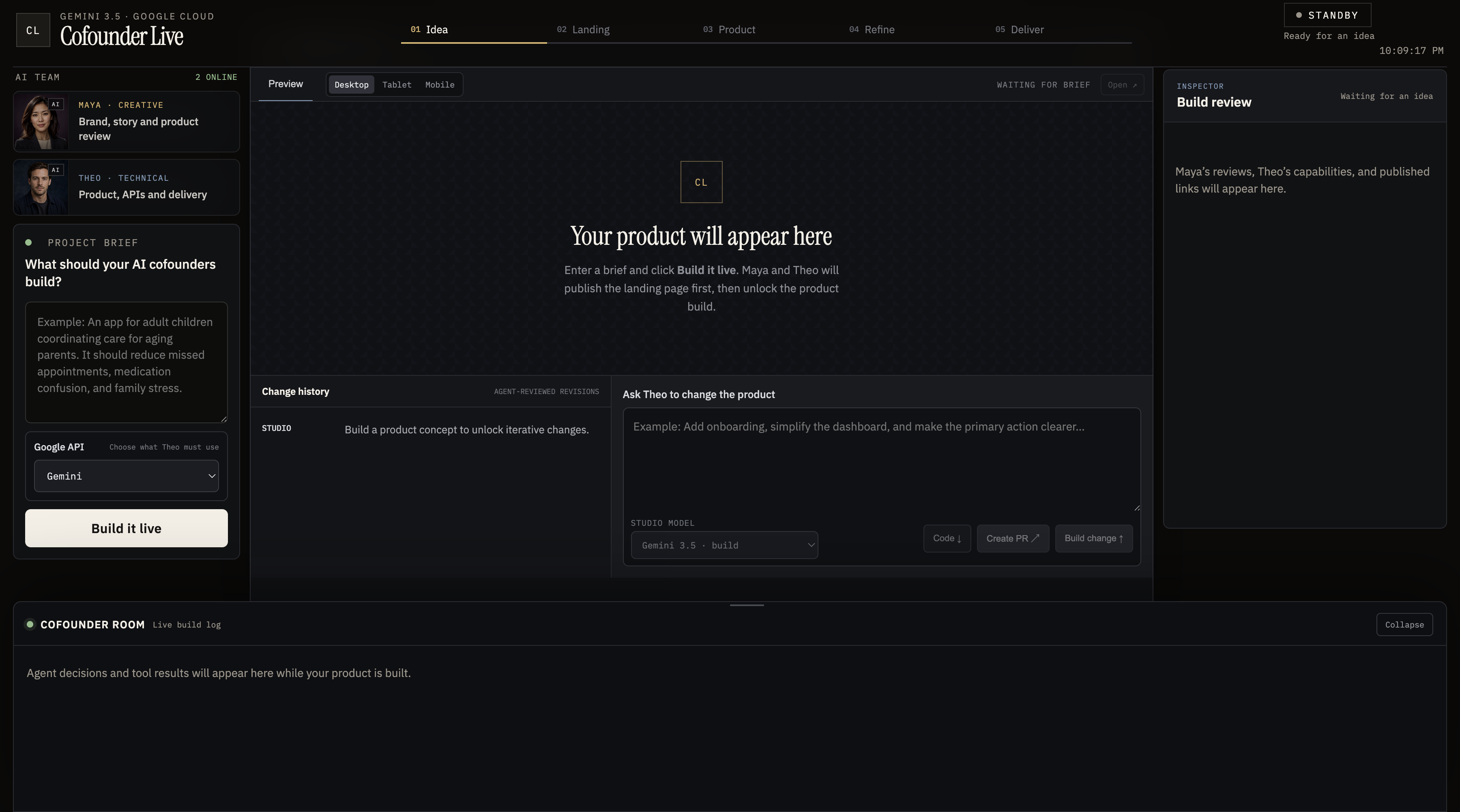
Non technical founders often have strong ideas but lack the design, technical, and operational resources needed to build them. We created Cofounder Live to explore what happens when AI agents do more than provide advice they collaborate, use tools, create products, review their work, and deliver code.
Our goal was to build an experience where a founder could enter one idea and receive help from an AI product team.
What it does
Cofounder Live gives every founder two AI teammates:
- Maya, the Creative Cofounder, develops the visual direction and improves branding, positioning, and usability.
- Theo, the Technical Cofounder, builds the product, integrates Google services, applies Maya’s feedback, and prepares the code for delivery.
The user enters a product idea and clicks Build it live. Maya and Theo then:
- Develop the creative direction.
- Build an investor landing page.
- Review and revise the landing page.
- Publish it at a durable URL.
After the landing page is complete, the button changes to Launch MVP. The agents then:
- Generate an interactive product concept.
- Select up to two relevant Google capabilities.
- Review and revise the interface.
- Publish the finished concept.
The user can continue working with Theo through a Cursor-style AI Build Studio. They can request changes, preview revisions, inspect build history, download the code, or create a public GitHub pull request.
Theo can integrate:
- Google Maps
- Places API
- Routes API
- Weather API
- Air Quality API
- Geocoding API
- Cloud Translation
- Cloud Vision
- BigQuery
- Gemini
- Cloud Text-to-Speech
How we built it
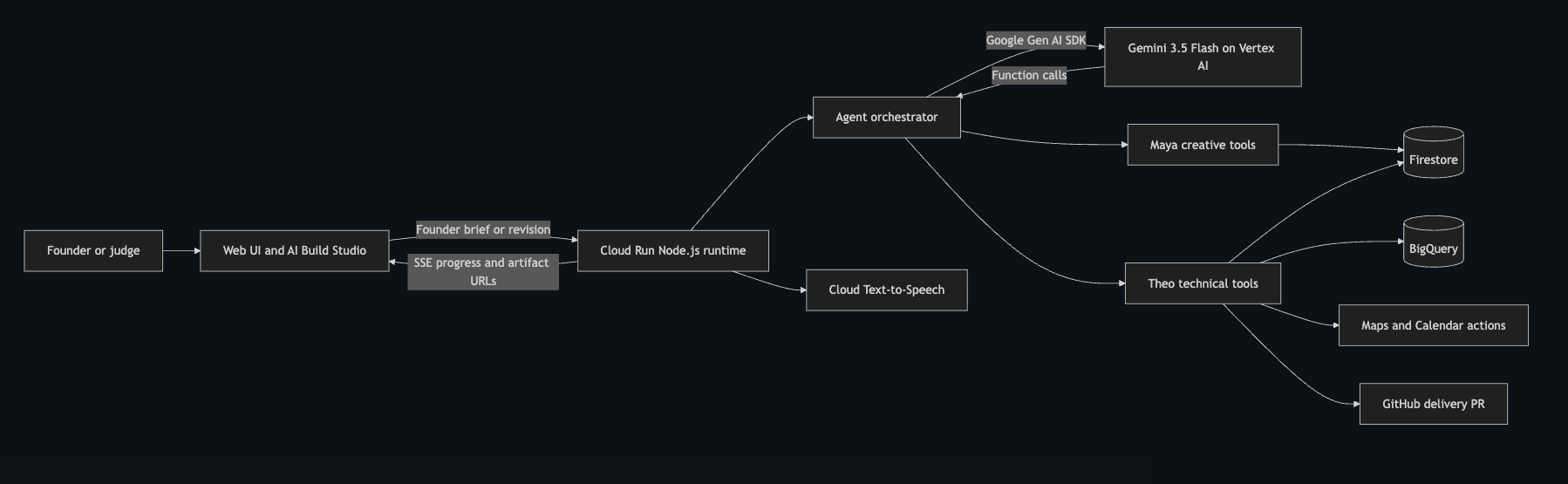
We built the agent runtime with the official Google Gen AI SDK for JavaScript, using Gemini on Vertex AI.
Gemini uses structured output and function calling to decide which action each cofounder should take. The application executes the requested tool, returns its result to Gemini, and allows the agent to determine the next step.
The technology stack includes:
- Vertex AI for Gemini inference
- Google Gen AI SDK for agent generation and function calling
- Cloud Run for application hosting
- Firestore for landing pages, product concepts, and revision history
- BigQuery for product-specific analytics
- Google Maps Platform for maps, places, routes, weather, air quality, and geocoding
- Cloud Translation for multilingual workflows
- Cloud Vision for image labels and text extraction
- Cloud Text-to-Speech for the cofounders’ voices
- Secret Manager for API keys and delivery credentials
- Node.js and Express for the backend
- HTML, CSS, and JavaScript for the frontend
- Server-Sent Events for live agent progress
- GitHub API for code delivery and pull requests
Generated artifacts are saved so users can return to projects and continue revising them.
Challenges we ran into
Creating genuinely different products
Our first generated concepts changed colors and text but still shared similar layouts. We introduced product archetypes, structured screen definitions, component schemas, and capability-aware generation so each idea could produce a distinct interface.
Connecting AI decisions to real APIs
Generated locations had to become valid coordinates. Routes needed compatible origins and destinations. Weather and air-quality information had to correspond to the correct location.
We created normalized capability configurations, runtime validation, API-specific adapters, and fallback behavior to make these integrations reliable.
Managing long-running agent workflows
The agents perform several sequential actions, including building, reviewing, revising, publishing, and testing. We used Server-Sent Events to show progress and disabled active buttons to prevent duplicate requests.
Preventing unsupported claims
Generated investor pages could potentially present fictional traction or market claims as facts. We implemented an evidence guard that labels unsupported information as a hypothesis, target, or validation plan.
Protecting credentials
A generated delivery initially included a restricted Maps browser key. GitHub secret scanning detected it. We revoked and rotated the key, deleted the affected delivery branch, and updated the exporter to use a placeholder. Generated exports now automatically block recognizable credentials before they can be downloaded or delivered.
Maintaining reliable state
We also solved issues involving malformed model output, API quotas, Firestore serialization, stale browser caches, revision-history isolation, and browser rendering timing.
Accomplishments that we're proud of
- Built a visible multi-agent workflow with specialized creative and technical roles.
- Used the official Google Gen AI SDK instead of custom model API calls.
- Enabled agents to build, review, revise, publish, and deliver artifacts autonomously.
- Integrated real Google Cloud and Google Maps Platform services.
- Created product-specific interfaces instead of one fixed template.
- Added a Cursor-style environment for iterative AI product development.
- Implemented persistent project and revision history.
- Added credential-safe ZIP downloads and public GitHub pull requests.
- Built an evidence guard for responsible investor-facing content.
- Deployed the complete application to Google Cloud Run.
- Verified a generated emergency product using real routes and live air-quality data.
What I learned
I learned that an agent becomes significantly more useful when it can take action and evaluate the results of its actions, rather than only producing conversational responses.
Giving an agent access to many tools is not enough. Every tool needs:
- Clear selection criteria
- Structured inputs
- Secure credentials
- Compatible interface components
- Observable results
- Reliable error handling
I also learned that limiting Theo to one or two complementary Google capabilities creates more focused products than adding every available API to every concept.
Finally, building trustworthy agents requires treating security, evidence, testing, and revision history as core product features—not optional additions.
What's next for Cofounder Live
Next, I want Theo and Maya to:
- Have a browser tool layer for (Playwright/CDP-style automation, or a managed browser agent service) so he can apply for different accelerators and pitch to prospective investors.
- Run automated accessibility and usability tests.
- Generate automated product test suites.
- Deploy concepts into isolated preview environments.
- Monitor deployed products and recommend improvements.
- Support additional consent-based Google Workspace integrations.
- Collaborate with Maya across longer product-development cycles.
- Transform generated concepts into fuller production applications.
Our long-term goal is for Cofounder Live to become an always-available AI product team that can take a founder from an initial idea to tested, deployable software.
Built With
- ai
- api
- bigquery
- cloud
- css3
- express.js
- firestore
- gemini
- gen
- geocoding
- html5
- javascript
- maps
- node.js
- places
- run
- sdk
- text-to-speech
- translation
- vertex
- vision
- weather

Log in or sign up for Devpost to join the conversation.