-
-
Banner
Inspiration
COFFEELOT was inspired by a real problem I experienced when running a coffee shop. In the first few months, everything looked promising: sales were growing, customers were coming back, and the business felt like it was moving in the right direction. But behind that growth, operations became harder to understand. Reports were inconsistent, stock was not always synchronized, payment status needed manual checking, and business decisions were often made without clear insight.
I realized that running a small F&B business is not only about recording transactions. Owners need to understand what is working, what is breaking, and what action to take next. COFFEELOT was created to solve that gap: an AI Agent that helps coffee shop owners turn daily operational data into practical business decisions.
What it does
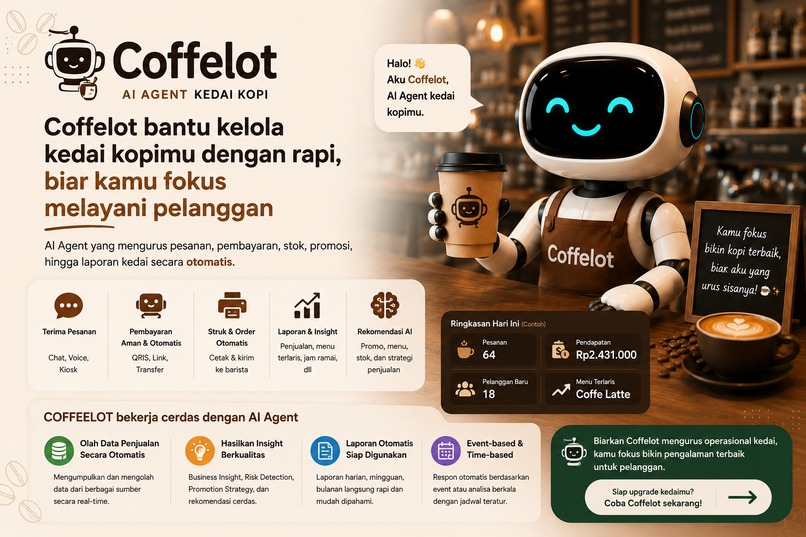
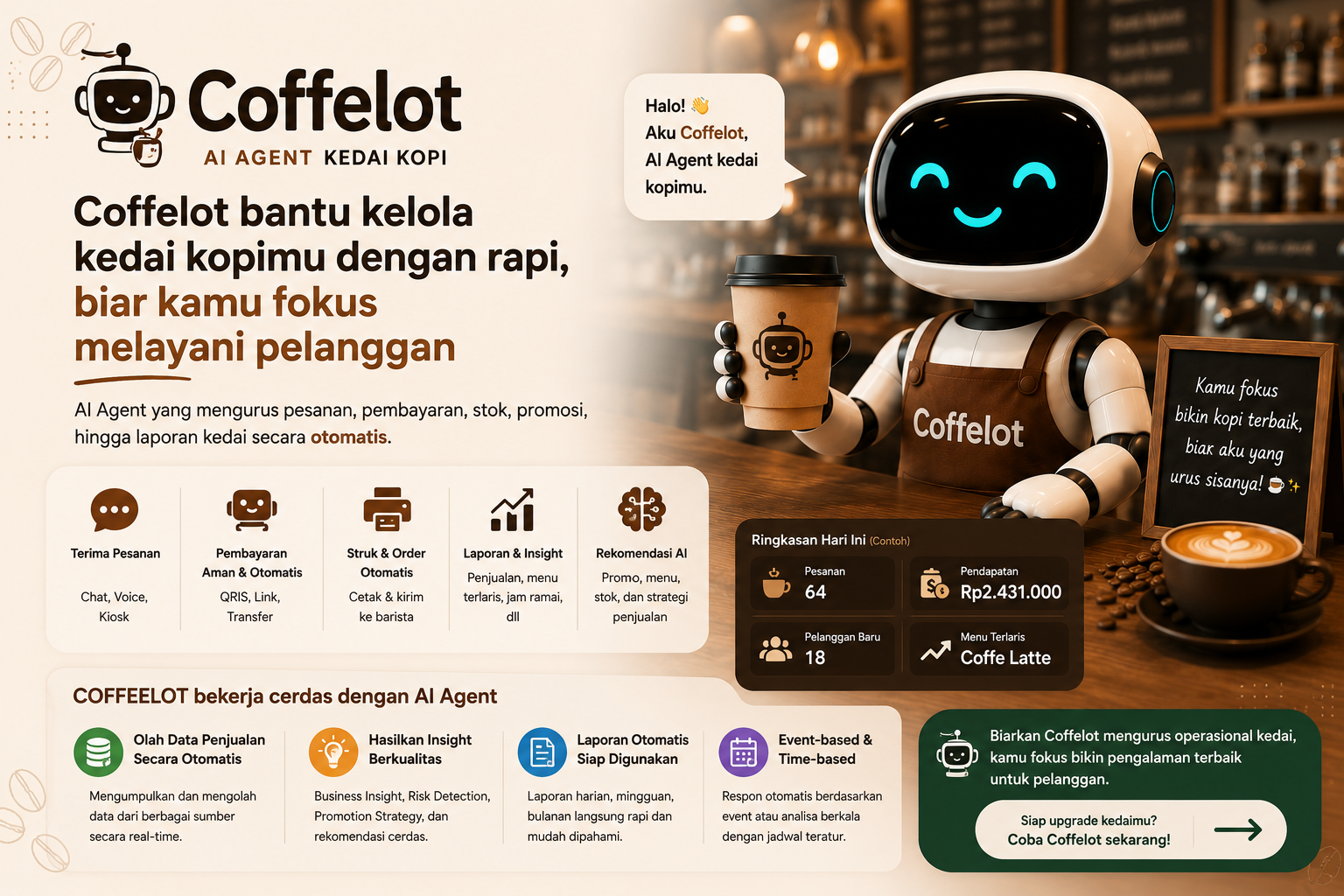
COFFEELOT is an AI Business Intelligence & Operations Agent for coffee shops and small F&B businesses.
It combines POS, customer self-ordering, payment, inventory, kitchen queue, booking, and AI-generated insights into one connected operating layer.
Main features include:
• Built-in POS for cashier ordering. • Customer self-order page through /chat. • DOKU sandbox payment integration for QRIS, VA BCA, and checkout-style payment flows. • Payment reconciliation fallback when callback/webhook delivery is not confirmed. • Kitchen/barista queue with live order status. • Inventory and recipe-based stock deduction after paid orders. • Projected cart stock to prevent overselling before checkout. • Booking and seat availability insight. • /agent dashboard for AI workflows, output history, approval flow, and insight comparison. • AI-generated operational insights powered by OpenClaw and GPT-5.5.
COFFEELOT currently supports multiple AI workflows, including daily report, restock alert, risk detection, promo generation, morning briefing, booking seat insight, menu engineering, demand forecast, prep planning, kitchen SLA, and payment reconciliation insight.
How we built it
We built COFFEELOT as a full-stack MVP using a TypeScript monorepo.
The backend uses Bun, Elysia.js, Prisma, and SQLite. It provides APIs for products, inventory, orders, kitchen queue, chat carts, payments, bookings, reports, and agent workflows.
The frontend uses React and Vite. It includes three main live pages:
• / — POS, cart, payment, kitchen queue, stock status. • /chat — customer self-order and payment flow. • /agent — AI Agent dashboard and insight comparison table.
For payments, we integrated the DOKU MCP sandbox to create QRIS and VA BCA payments and to check transaction status. Since real callback delivery was not fully confirmed during testing, COFFEELOT also includes reconciliation polling as a reliable fallback.
For AI, we used OpenClaw as the autonomous AI agent/runtime and GPT-5.5 as the main LLM model through an OpenAI-compatible Chat Completions API. The AI workflows generate structured business insights from operational snapshots such as orders, revenue, inventory, menu performance, kitchen queue, payment status, and booking availability.
We also prepared the project for submission with a reproducible README, live demo links, a 5-slide PDF report, AI tools/model documentation, and Devpost submission materials.
Challenges we ran into
One major challenge was connecting payment status reliably. DOKU sandbox payment creation through MCP worked for QRIS and VA BCA, and transaction lookup worked, but real callback/webhook delivery was not observed during testing. To solve this, we implemented a reconciliation polling fallback that checks DOKU transaction status and updates local payment/order status
Coffeelot: lenge was inventory correctness. Paid orders needed to deduct stock based on recipes, and the system had to prevent negative stock. We added backend stock validation, idempotent stock deduction, and projected cart stock on the frontend.
Coffeelot: The AI insight workflows also needed refinement. Early AI outputs were too similar across workflows because several prompts shared a generic structure. We improved this by giving each workflow a distinct prompt focus and adding an insight comparison table in /agent.
We also had to balance speed and structure. The MVP grew quickly from POS and payment into AI business intelligence, so we started refactoring the backend into cleaner modules while keeping the API contracts stable.
Accomplishments that we're proud of
We are proud that COFFEELOT is not just a demo chatbot or a static dashboard. It is a working operational system with connected business logic.
Key accomplishments:
• Built a live POS and customer self-ordering flow. • Integrated DOKU sandbox payment creation for QRIS and VA BCA. • Added payment reconciliation fallback for more reliable payment status. • Implemented recipe-based inventory deduction after paid orders. • Added projected stock checks to prevent overselling. • Built a live kitchen/barista queue. • Added booking and seat availability intelligence. • Built an AI Agent dashboard with workflow runs, outputs, approval controls, and insight comparison. • Expanded AI workflows into a BI Insight Pack for menu engineering, demand forecasting, prep planning, kitchen SLA, and payment reconciliation. • Prepared a reproducible GitHub repository, documentation, and submission-ready PDF report.
The biggest accomplishment is that COFFEELOT turns raw coffee shop operations into structured decisions an owner can act on.
What we learned
We learned that small F&B businesses do not only need more tools; they need connected intelligence. A POS is useful, but sales data becomes much more valuable when it is connected to stock, payments, kitchen status, bookings, and AI recommendations.
We also learned that AI is most useful when it works with real operational signals instead of generic prompts. Once the workflows used different business contexts, the generated insights became much more relevant.
Another lesson was the importance of fallback systems. Payment callbacks may not always behave as expected in sandbox environments, so reconciliation polling became essential to keep the business flow reliable.
Finally, we learned that building an AI Agent for operations requires both automation and control. COFFEELOT can generate recommendations automatically, but important actions like promo generation still keep the owner in the loop through approval flow.
What's next for COFFEELOT
Next, we want to make COFFEELOT more production-ready and more useful for real coffee shop operations.
Planned next steps:
• Confirm and harden real DOKU callback/webhook delivery. • Add callback observability and a signed callback simulation script. • Add public endpoint rate limiting. • Improve the /chat order tracker UX. • Add a QR table/order-link generator for dine-in self-ordering. • Build customer booking UI and operator booking calendar/table map. • Add more BI visualization, filtering, and trend charts. • Add COGS and margin fields for deeper menu engineering. • Improve agent dashboard metadata, filters, and workflow history. • Eventually add POS connector or CSV import support for shops that already use another POS.
The long-term vision is for COFFEELOT to become an AI operations copilot for small F&B owners — helping them understand what happened, what is at risk, and what to do next.
Accomplishments that we're proud of
• Built a live POS and customer self-ordering flow. • Integrated DOKU sandbox payment creation for QRIS and VA BCA. • Added payment reconciliation fallback for more reliable payment status. • Implemented recipe-based inventory deduction after paid orders. • Added projected stock checks to prevent overselling. • Built a live kitchen/barista queue. • Added booking and seat availability intelligence. • Built an AI Agent dashboard with workflow runs, outputs, approval controls, and insight comparison. • Expanded AI workflows into a BI Insight Pack for menu engineering, demand forecasting, prep planning, kitchen SLA, and payment reconciliation. • Prepared a reproducible GitHub repository, documentation, and submission-ready PDF report.
The biggest accomplishment is that COFFEELOT turns raw coffee shop operations into structured decisions an owner can act on.
What we learned
We learned that small F&B businesses do not only need more tools; they need connected intelligence. A POS is useful, but sales data becomes much more valuable when it is connected to stock, payments, kitchen status, bookings, and AI recommendations.
We also learned that AI is most useful when it works with real operational signals instead of generic prompts. Once the workflows used different business contexts, the generated insights became much more relevant.
Another lesson was the importance of fallback systems. Payment callbacks may not always behave as expected in sandbox environments, so reconciliation polling became essential to keep the business flow reliable.
Finally, we learned that building an AI Agent for operations requires both automation and control. COFFEELOT can generate recommendations automatically, but important actions like promo generation still keep the owner in the loop through approval flow.
What's next for COFFEELOT
Next, we want to make COFFEELOT more production-ready and more useful for real coffee shop operations.
Planned next steps:
• Confirm and harden real DOKU callback/webhook delivery. • Add callback observability and a signed callback simulation script. • Add public endpoint rate limiting. • Improve the /chat order tracker UX. • Add a QR table/order-link generator for dine-in self-ordering. • Build customer booking UI and operator booking calendar/table map. • Add more BI visualization, filtering, and trend charts. • Add COGS and margin fields for deeper menu engineering. • Improve agent dashboard metadata, filters, and workflow history. • Eventually add POS connector or CSV import support for shops that already use another POS.
The long-term vision is for COFFEELOT to become an AI operations copilot for small F&B owners — helping them understand what happened, what is at risk, and what to do next.
Built With
- openclaw
- sqlite
- typescript
- vps

Log in or sign up for Devpost to join the conversation.