Inspiration
Every coding tutorial cheers you on. "Great job!" "You're doing amazing!" We wondered what would happen if your editor stopped lying to you. Coding "Cheer Leader" is the cheerleader nobody asked for: it watches your face, reads your mood, and reacts to your code in the most unhelpful way possible. Feeling down? It kicks you while you're down. Feeling great? It makes sure that doesn't last.
What it does
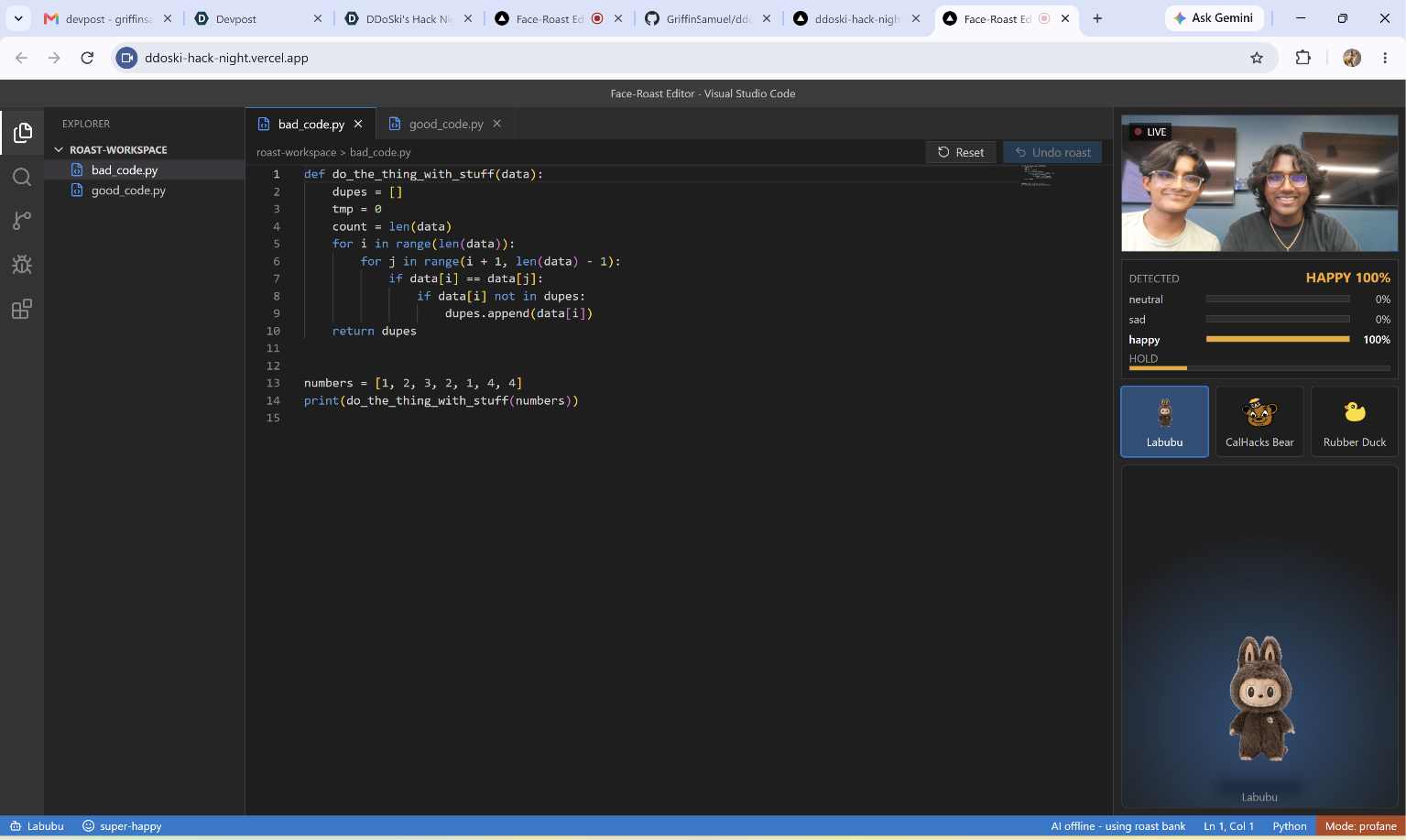
Coding "Cheer Leader" is a VS Code-style editor that runs in your browser and watches you through your webcam. You pick an avatar, start coding, and it reads your expression in real time.
- Sad: it roasts your actual code in comments, naming your worst function and variable choices.
- Happy: it deletes your code, replaces it with ASCII art, and your avatar mocks you while it happens. It never repeats a roast in a session and keeps at most three roasts in a file, so the insults stay fresh and the file stays readable. Each avatar has different roasts as well!
How we built it
The editor is Monaco (the engine behind VS Code), styled in VS Code Dark+ inside a Next.js 15, React and TypeScript app. Emotion detection runs entirely in the browser with face-api on TensorFlow.js, so no video ever leaves your machine. A FastAPI backend sends your code to a local AI model (qwen2.5-coder 7B through Ollama, on the laptop's own GPU) to write roasts about your specific code, with a built-in roast bank as an offline fallback. I built it solo using an orchestrated team of 13 Claude Code agents: one validated the idea, others designed the UI and the API, builders worked in parallel, and a prompt engineer tuned the roasts. My job was to be the director.
Challenges we ran into
The original idea was a real VS Code extension. Our idea-validation agent flagged that getting webcam access inside an extension could eat the entire event, so we pivoted to a browser editor that looks like VS Code, keeping the experience and cutting the risk. With no cloud AI key, we ran the AI locally on the laptop's GPU, which meant tuning it to answer within a few seconds so the roast lands while your face still matches the mood. The model we used doesn't necessarily detect sadness, rather it detects anger or disgust and we convert that into a sadness score using weights we decided to determine sadness. If the AI model takes longer to come up with roasts, we have a fallback to a bank of roasts while the model gets warmed up.
Accomplishments that we're proud of
It actually works: you frown, it roasts your real code by name; you grin, your code disappears. All of it runs on one laptop with no cloud AI and no video leaving the device. We're also proud of the workflow behind it. A solo developer directing 13 AI agents shipped a working editor, a vision model, and a local AI backend in under two hours. It's a fun and creative idea that fits the theme well!
What we learned
Planning beats typing. The time we spent setting up the agent pipeline before the event paid off, because changing the plan was one message, not a rewrite. And humor is hard to tune: a roast that's too generic falls flat, so tying it to your actual function names is what makes people laugh.
What's next for Coding "Cheer Leader"
- Ship it as a real VS Code extension, now that the core works.
- More avatars, and a "wholesome mode" that actually cheers you on (for the brave).
- Roasts that react to failing tests and error messages, not just your face.
- A "pair programming" mode where it roasts you and a friend at the same time.
Built With
- claude
- computervision
- markov
- ml
- python


Log in or sign up for Devpost to join the conversation.