Inspiration
I wanted to build an OS that actually boots — not a kernel that stops at a serial “Hello”. codexOS started from a simple bet: can Rust carry a full path from UEFI firmware through a resident kernel to a live GUI desktop, with a repeatable loop of build → image → QEMU → framebuffer → serial debug? The goal was one continuous system story: boot, memory, drivers, filesystem, networking, and signed updates.
What it does
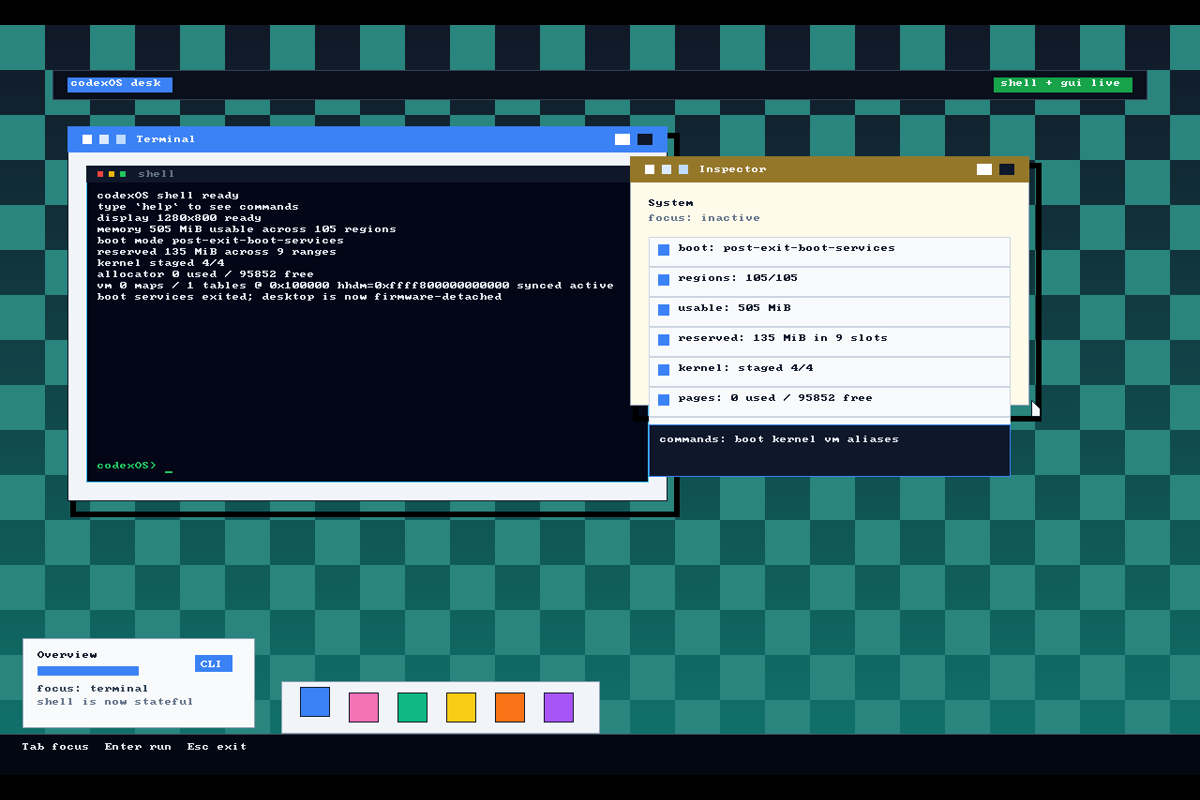
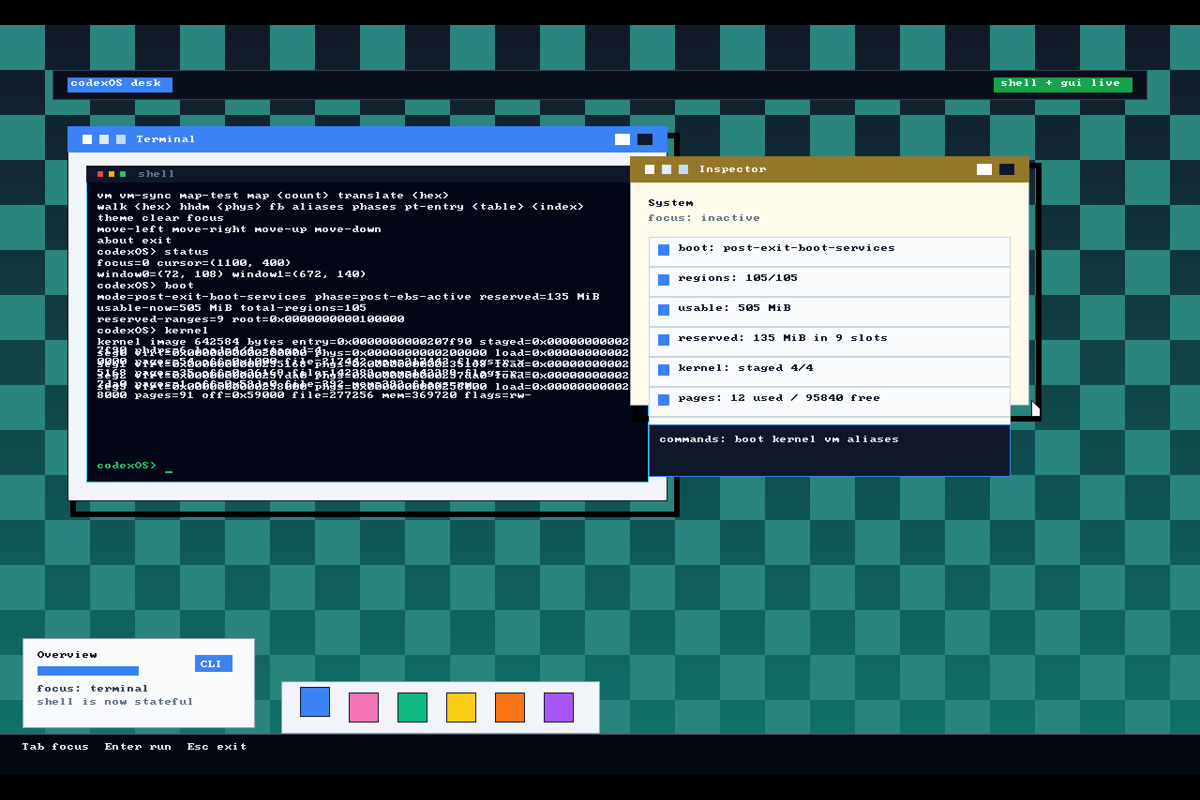
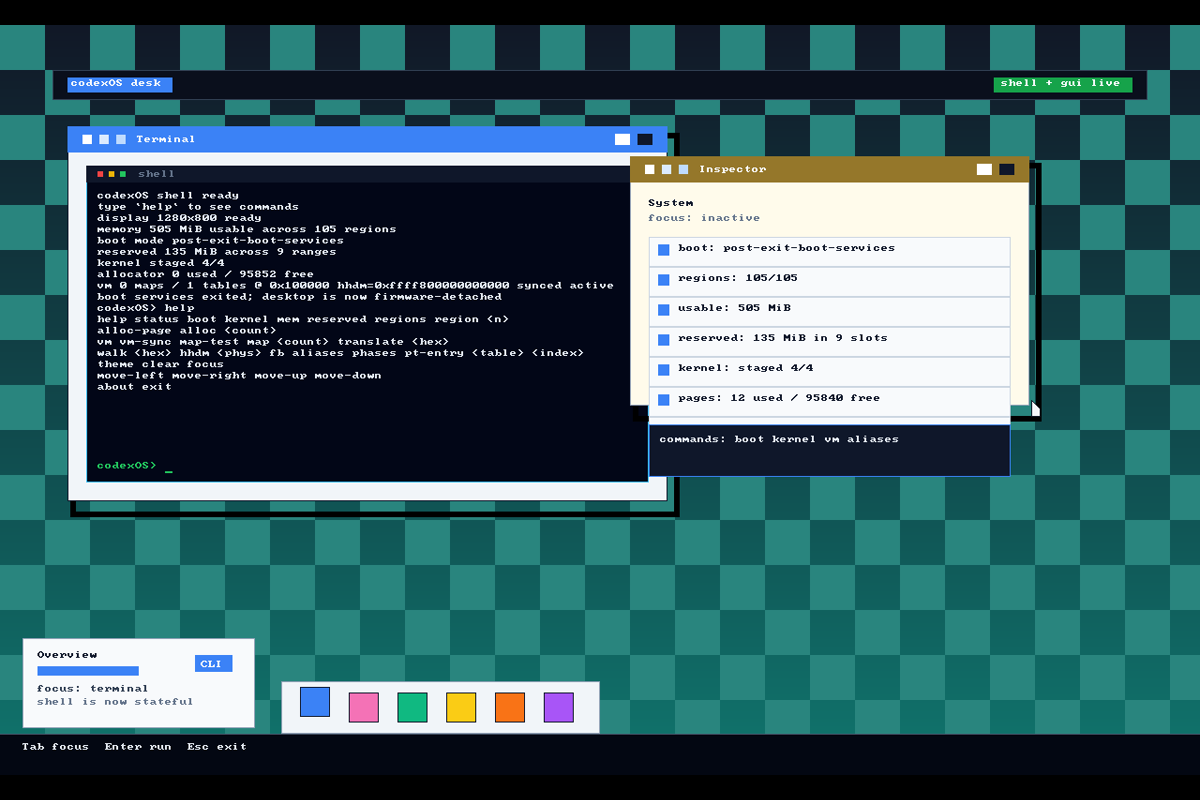
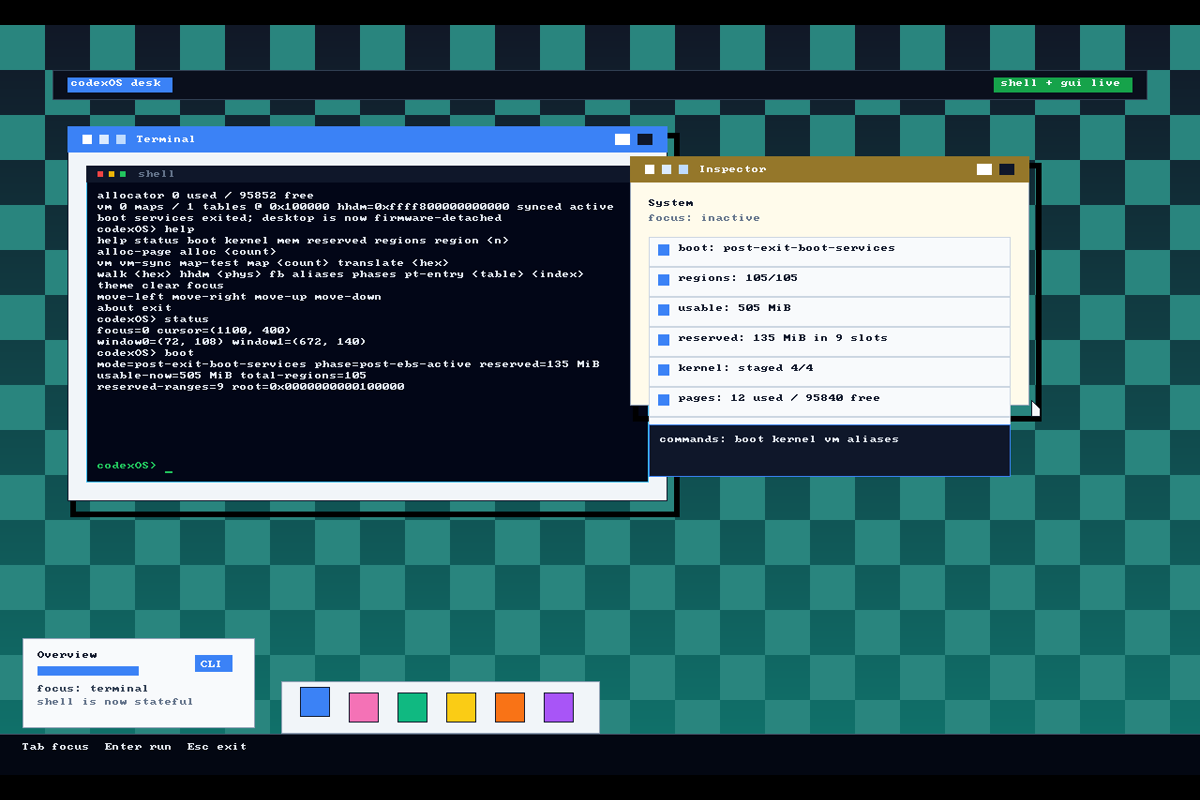
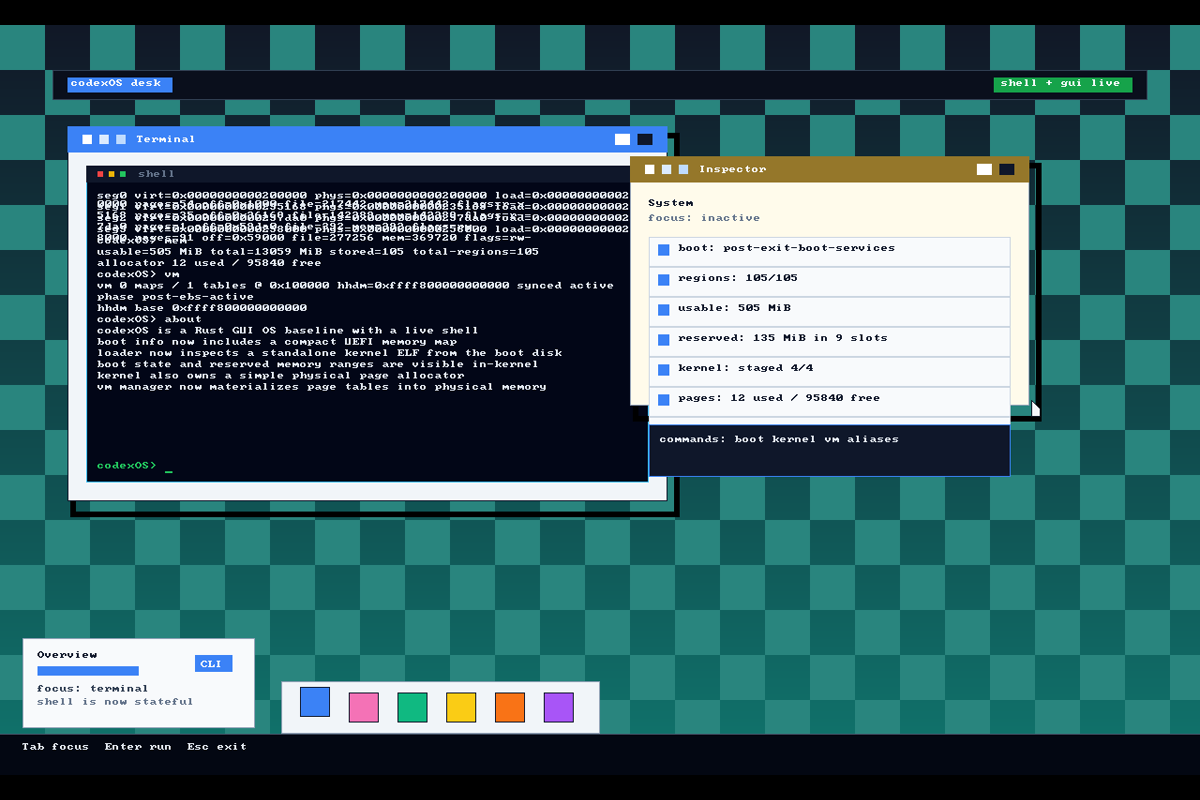
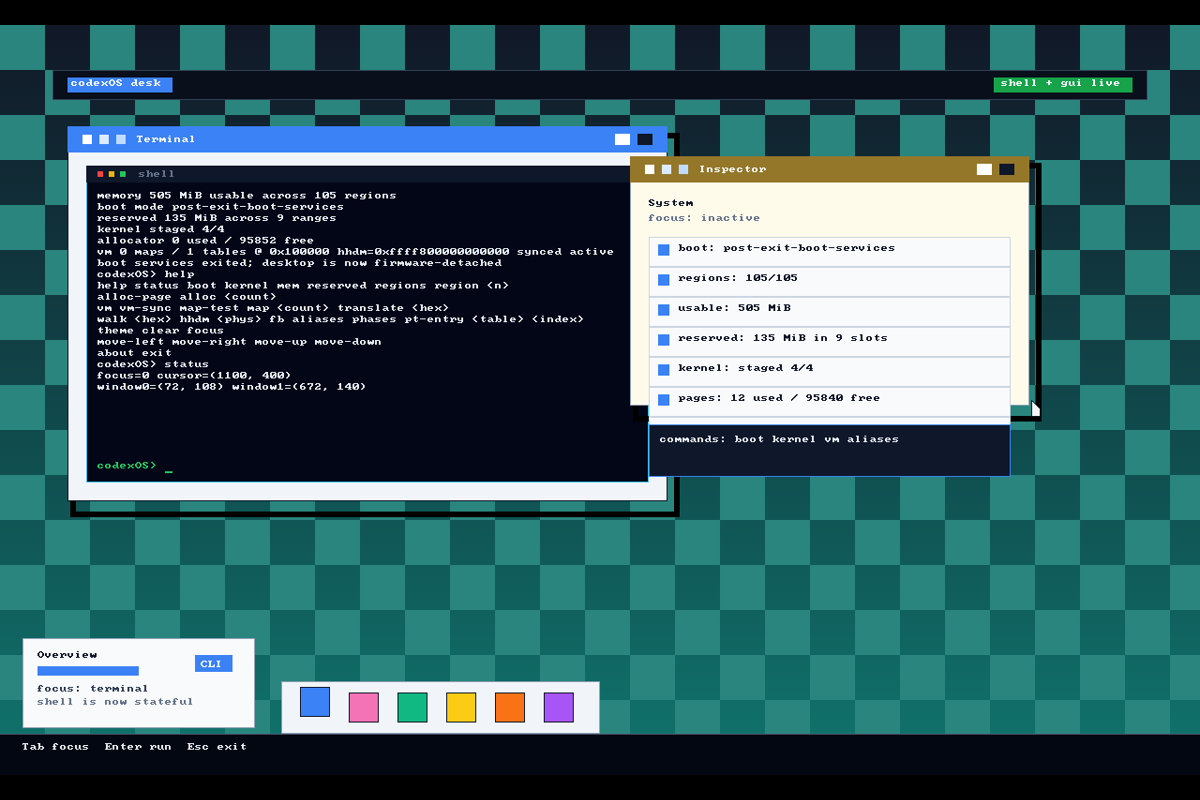
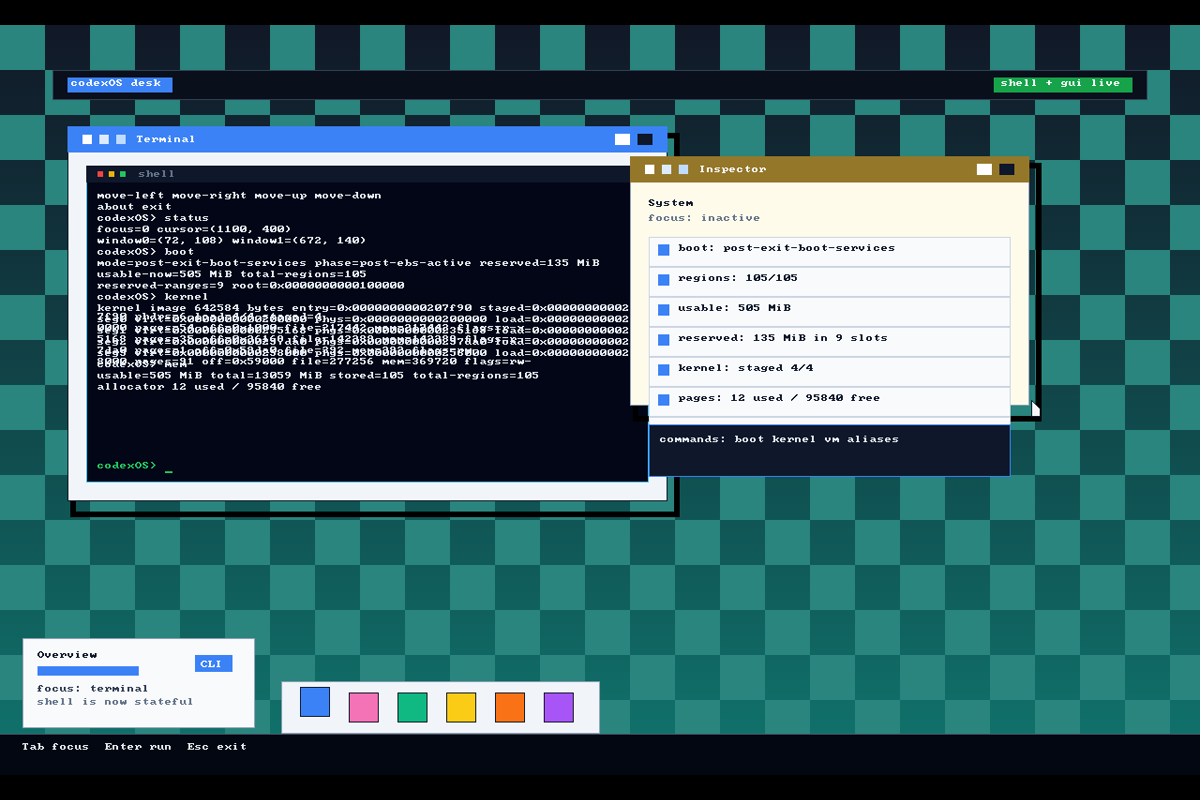
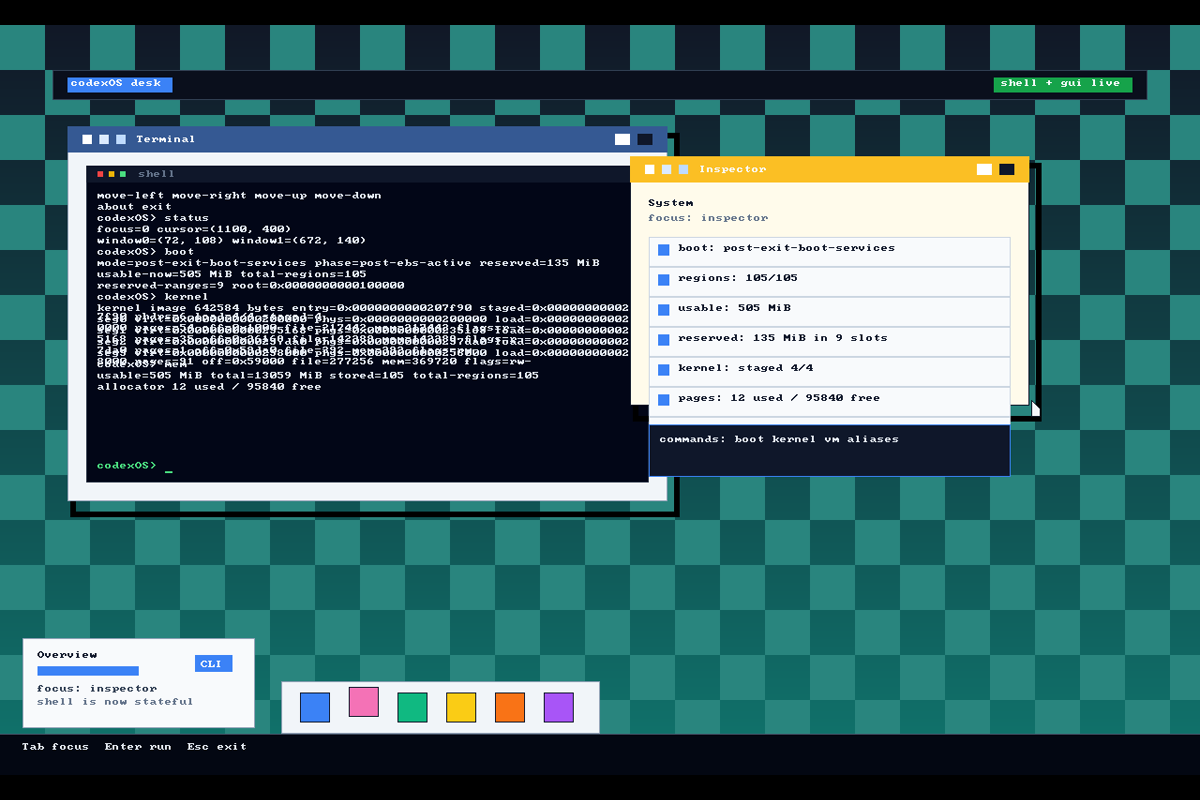
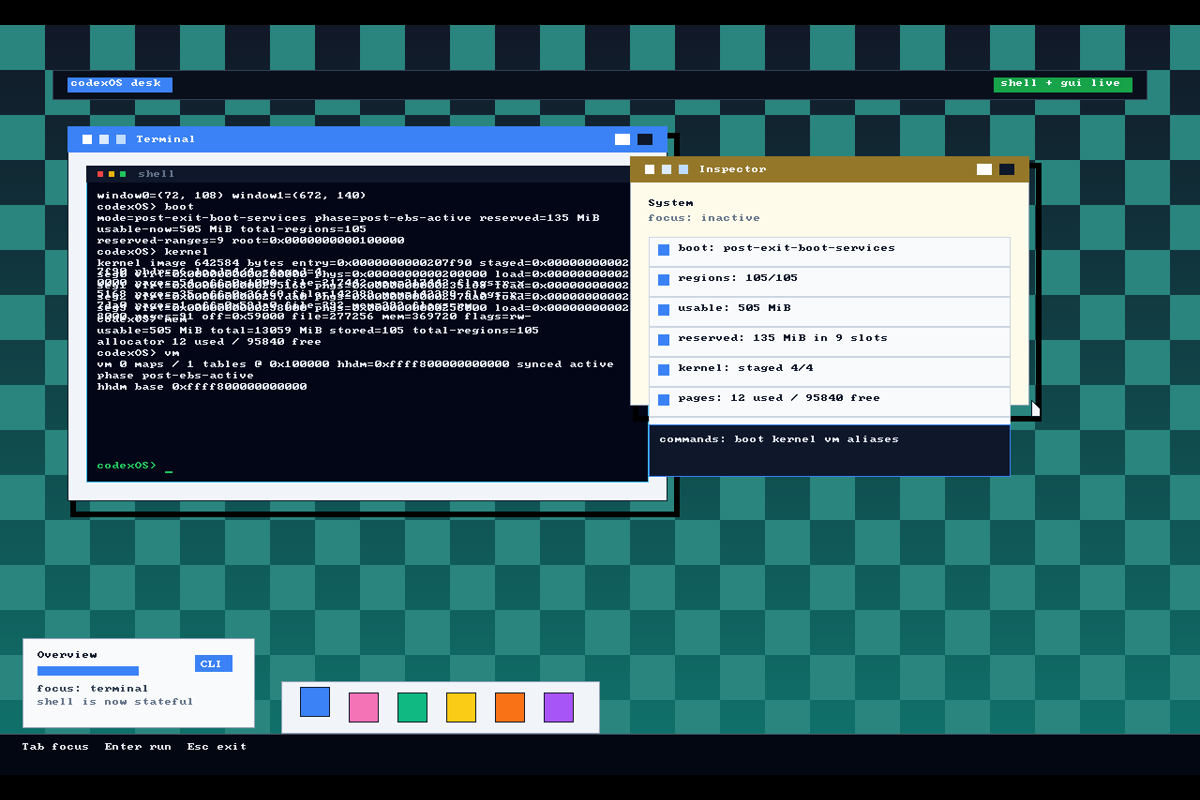
codexOS is a bootable Rust GUI operating system that runs under QEMU/UEFI. It:
- boots via a UEFI loader, stages a standalone
KERNEL.ELF, and chainloads into a resident kernel - renders an interactive framebuffer desktop with keyboard focus, mouse dragging, and a terminal shell
- manages memory with a reclaiming heap, physical pages, HHDM, and W^X page permissions
- runs isolated Ring 3 processes with syscalls, preemptive scheduling, and address-space reclamation
- persists data through virtio-blk and CodexFS (snapshots, CRC checks, dual superblocks)
- brings up virtio-net with DHCP, DNS, TCP/HTTP, and ICMP
- supports signed A/B kernel updates, GPT/ESP images, and automatic fallback recovery
How we built it
The repo is a Rust workspace with clear layers:
uefi-loader— builds the bootable image, stagesKERNEL.ELF, and supports handoff / chainload- Shared runtimes —
boot-runtimefor early serial, pages, and boot VM;desktop-runtime+gfxfor the desktop loop - Resident kernel — heap, page tables, interrupts (GDT/TSS/PIT), PS/2 input, PCI inventory, virtio-blk / virtio-net
- System services — CodexFS, Ring 3 ELF loading, scheduling, terminal shell
- Engineering loop —
xtaskunifies build / image / run / smoke; release tooling covers signed updates and recovery
Day to day we package with cargo xtask, boot in QEMU+OVMF, debug over serial, and gate regressions with smoke tests.
Challenges we ran into
- Loader → kernel ownership — heap, page tables, and
BootInfomust transfer cleanly; a bad handoff can still draw a desktop and fail later - Firmware-detached input — PS/2 keyboard and mouse had to work without UEFI helpers; QEMU monitor injection made that path testable
- Filesystem consistency — append-only snapshots, CRC, alternating superblocks, and flush-then-reread checks; cold-boot smoke tests require a continuous on-disk counter
- Network stack correctness — checksums, ARP, DHCP, DNS, and TCP handshakes fail quietly when any step is wrong
- Update and recovery — signed-slot fallback and boot-state scan recovery had to be proven together with the install path
Accomplishments that we're proud of
- A real UEFI → resident-kernel boot path with interactive GUI, not just a bootloader demo
- Ring 3 isolation, W^X mappings, and a versioned syscall ABI that survive smoke boots
- CodexFS with integrity checks and durable cold-boot verification
- End-to-end networking: lease, DNS, TCP/HTTP client and listener paths
- Signed A/B updates with anti-rollback, GPT/ESP layout, and automatic recovery
What we learned
Operating-system ideas only count when they become observable behavior. We learned how fragile firmware handoff is, how much discipline W^X and process isolation demand, and why persistence and update security belong in the boot path — not as late add-ons. The lasting lesson: if a smoke test cannot catch it, it is not done yet.
What's next for codexOS
- Broader physical-machine drivers (storage, network, USB HID)
- Richer filesystem allocation and access-control semantics
- A general socket API, multi-connection services, and TLS
- Application packaging and signing policy
- UEFI Secure Boot enrollment, hardware-backed signing, and independent security review
Built With
- cargo
- ed25519
- elf
- fat
- filesystem
- framebuffer
- gpt
- kernel
- networking
- operating
- ovmf
- pci
- ps/2
- qemu
- rust
- sha-256
- systems
- tcp/ip
- uefi
- virtio
- x86-64

Log in or sign up for Devpost to join the conversation.