-

Smart team
Inspiration
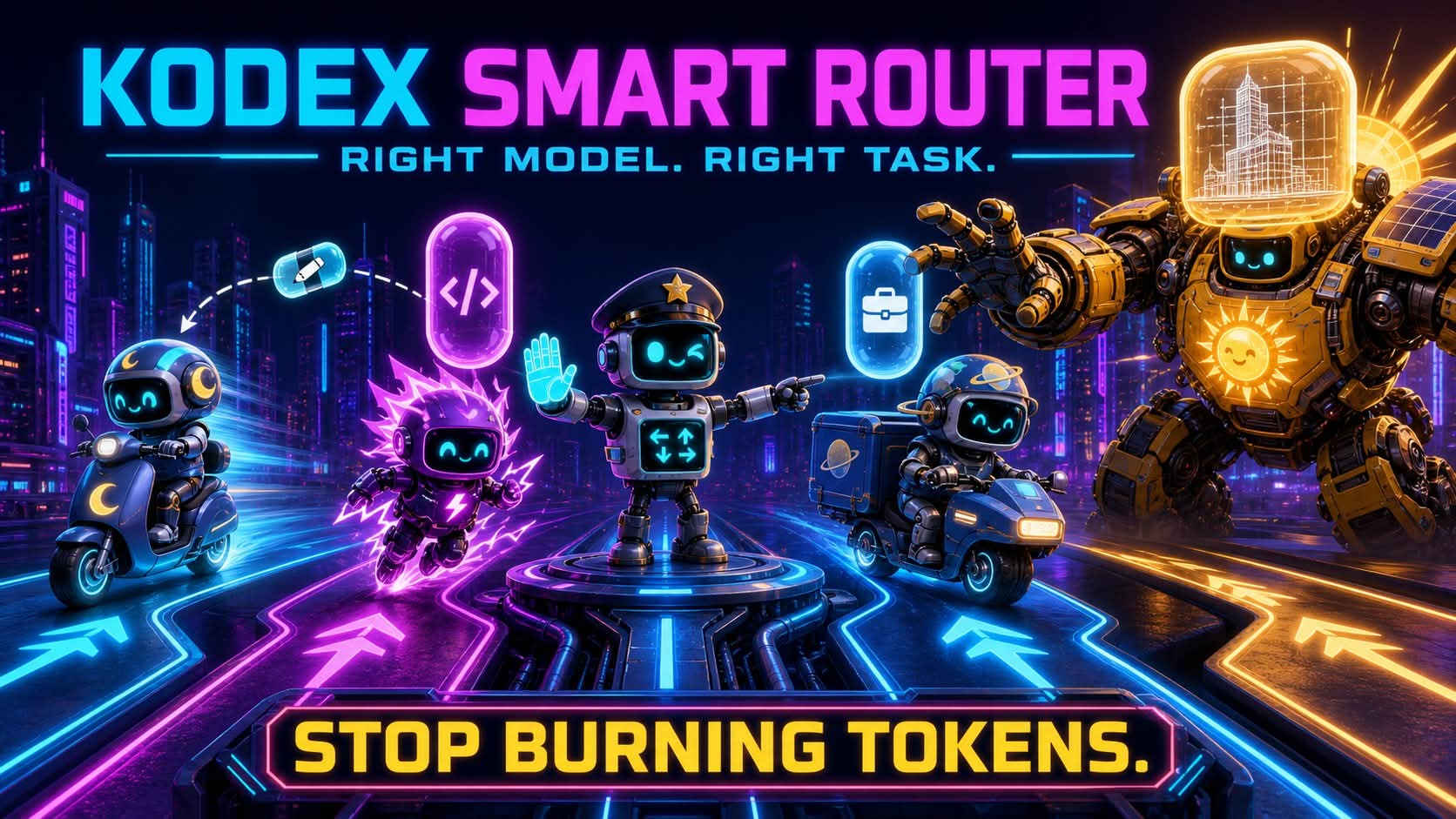
Codex Smart Router started from a practical problem: advanced AI systems are becoming more capable, but users still have to decide manually which model, reasoning level, and toolchain to use for every task.
That creates two common failures.
The first is overuse: powerful models are spent on simple work such as file inspection, documentation, repetitive maintenance, or small code edits.
The second is underuse: difficult architectural, debugging, security, or high-risk tasks are sent to a model or workflow that is too weak for the job.
Both failures waste time, capacity, and money.
Codex Smart Router was designed to make that decision explicit, explainable, and user-controlled.
Problem
AI model selection is usually treated as a manual preference rather than as an engineering decision.
Prompt length alone is not enough to estimate task difficulty. A five-line request may require deep systems reasoning, while a long request may only contain repetitive transformations.
A useful routing system therefore has to consider more than size.
It should understand:
task type; complexity; reasoning depth; context requirements; tool usage; expected cost; failure risk; security sensitivity; need for testing; need for an independent review; value of escalation to a stronger model.
Without this layer, users either waste their strongest models or discover too late that a weaker route was insufficient.
Proposed Solution
Codex Smart Router is a transparent decision layer placed before AI task execution.
It analyzes the task and recommends:
the most appropriate model class; reasoning depth; tools or execution environment; whether the task should be decomposed; whether verification or independent review is justified; whether escalation to a stronger model is worthwhile.
The router does not silently take control.
Its recommendation remains visible and explainable, and the user keeps final authority over the selected route.
The goal is not to always choose the cheapest model.
The goal is to use the correct amount of intelligence for the actual problem.
How It Works
The system classifies work into categories such as:
research and explanation; code generation; debugging; repository inspection; architecture; security review; documentation; testing; planning; repetitive maintenance.
It then evaluates the task against a routing model that considers complexity, risk, expected resource use, required capabilities, and the consequences of failure.
The result is a recommendation rather than a hidden decision.
A route can include:
model selection; reasoning level; tool selection; task decomposition; fallback strategy; escalation conditions; verification requirements.
This makes the routing process inspectable and allows users to understand why a particular workflow was proposed.
Innovation
Most AI routing approaches focus primarily on cost, latency, or benchmark performance.
Codex Smart Router treats routing as a broader decision problem.
It combines efficiency with risk awareness and human control.
A routing decision is not only:
"Which model is cheapest?"
It is also:
"How difficult is this task?" "What happens if the answer is wrong?" "Does this task need tools?" "Does it need testing?" "Should a second model review the result?" "Is stronger reasoning genuinely useful here?"
This creates a more practical foundation for real multi-model AI workflows.
Target Users
Codex Smart Router is designed for:
developers working with several AI models; teams operating under usage or token budgets; AI-assisted software engineering workflows; agentic systems that need model escalation rules; researchers comparing model capability against cost; small teams that cannot afford to route every task through the most expensive model.
Why It Matters
As AI systems gain more models, reasoning levels, tools, and agents, selecting the correct execution path becomes a problem of its own.
A good router can:
reduce unnecessary use of expensive models; reserve advanced reasoning capacity for difficult tasks; reduce repeated work caused by weak initial routing; make AI infrastructure easier to understand; create clearer escalation and fallback policies; improve transparency in automated workflows.
The larger idea is simple:
Better AI does not only mean better models.
It also means making better decisions about when and how each model should be used.
Feasibility
The project can be developed incrementally.
The current design is based on:
task classification; model capability profiles; weighted routing rules; complexity and risk assessment; model and reasoning recommendations; human-readable explanations; routing test cases.
Future versions can add telemetry from real tasks so predicted routing quality can be compared with actual outcomes.
This enables the routing logic to improve using measurable evidence rather than intuition alone.
Challenges
The hardest part is determining task difficulty before execution.
A short request can hide a difficult systems problem. A large request can be mechanically simple.
Cost also cannot be optimized independently from reliability.
Choosing a weaker model may save resources on the first attempt but cost more overall if the task has to be repeated.
Another challenge is preventing automation from becoming invisible authority.
For this reason, Codex Smart Router is designed around transparent recommendations and explicit escalation rather than silent control.
What We Learned
The strongest available model is not automatically the best choice for every task.
Useful AI orchestration requires understanding:
task complexity; risk; tool requirements; verification needs; cost of failure; value of stronger reasoning.
We also learned that routing explanations matter.
A recommendation is more useful when the user can see why it was made, challenge it, and override it.
Current Project Status
Codex Smart Router is an existing project and evolving product concept.
Its architecture, routing logic, and product direction were developed before any future challenge-specific submission. We will clearly identify any new work created for a particular competition rather than presenting earlier work as newly built.
Supporting Material
Repository: https://github.com/luciferprosun/Kodex-OpenAI-Custom-Skill
What's Next
The next development stages include:
improved complexity scoring; better token and capacity estimation; automatic task decomposition; adaptive fallback and escalation; comparison of predicted versus actual resource use; routing history and analytics; user-defined budgets and preferences; policy-based routing for safety-sensitive tasks; deeper integration with Codex and multi-agent workflows.
Long term, Codex Smart Router can become a transparent orchestration layer for multi-model AI systems: one that helps users spend capability where it matters most while keeping routing decisions understandable, auditable, and under human control.
Public contact
LinkedIn — Łukasz Żuchowski: https://www.linkedin.com/in/łukasz-żuchowski-807160316/

Log in or sign up for Devpost to join the conversation.