Inspiration
As a student and developer, I realized that one of the biggest challenges when contributing to an unfamiliar project is understanding the codebase. Whether it's an open-source repository or a new team project, developers often spend hours or even days figuring out where features are implemented, how the architecture works, and which files they need to modify. Since this hackathon focused on Codex, I wanted to build something that solves a real developer problem rather than another chatbot. My goal was to create a tool that helps developers understand a repository within minutes, reducing onboarding time and making codebases easier to navigate.
What it does
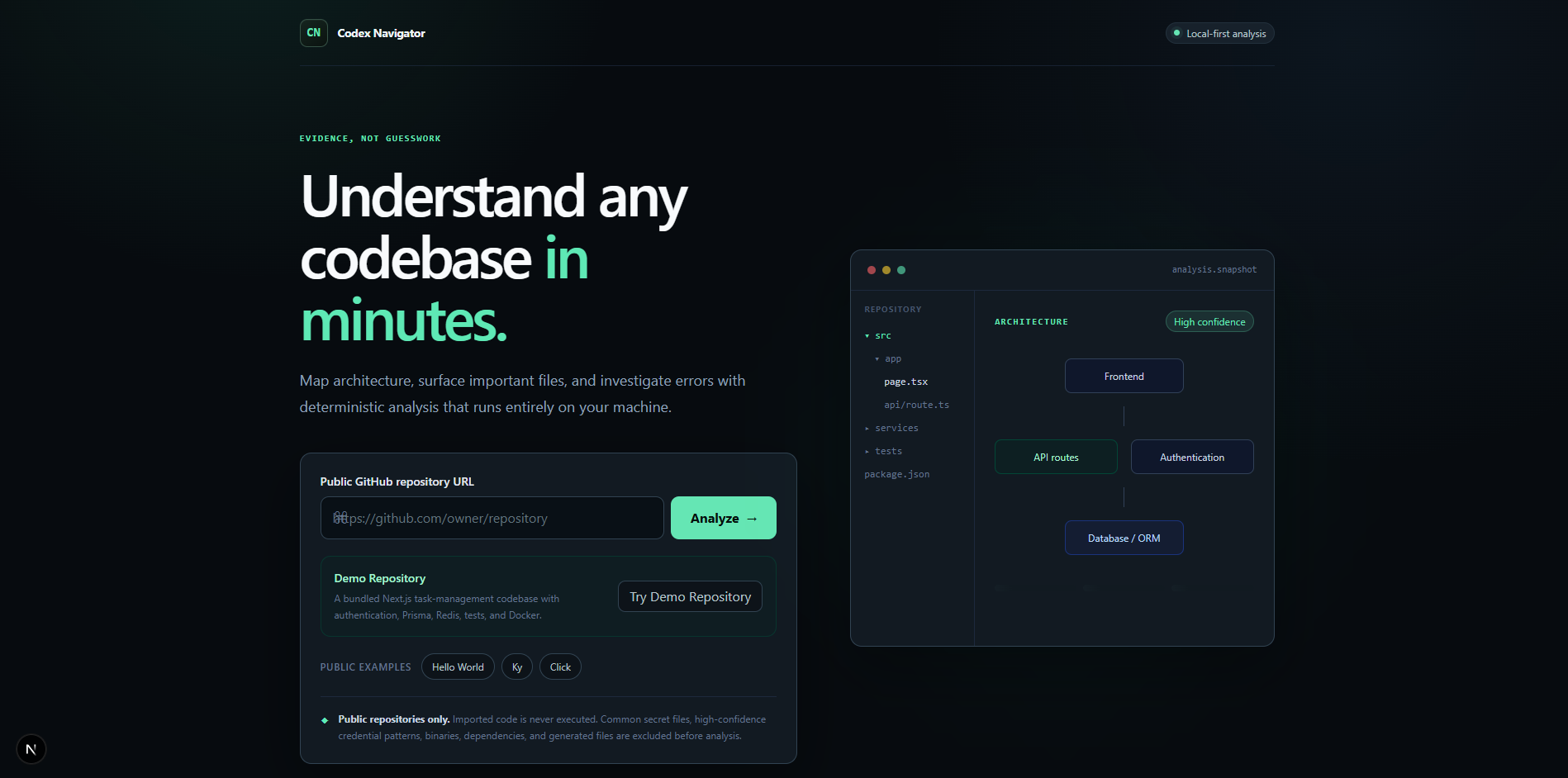
Codex Navigator is a developer tool that analyzes a public GitHub repository and provides a structured overview of the project. It can:
- Import a public GitHub repository.
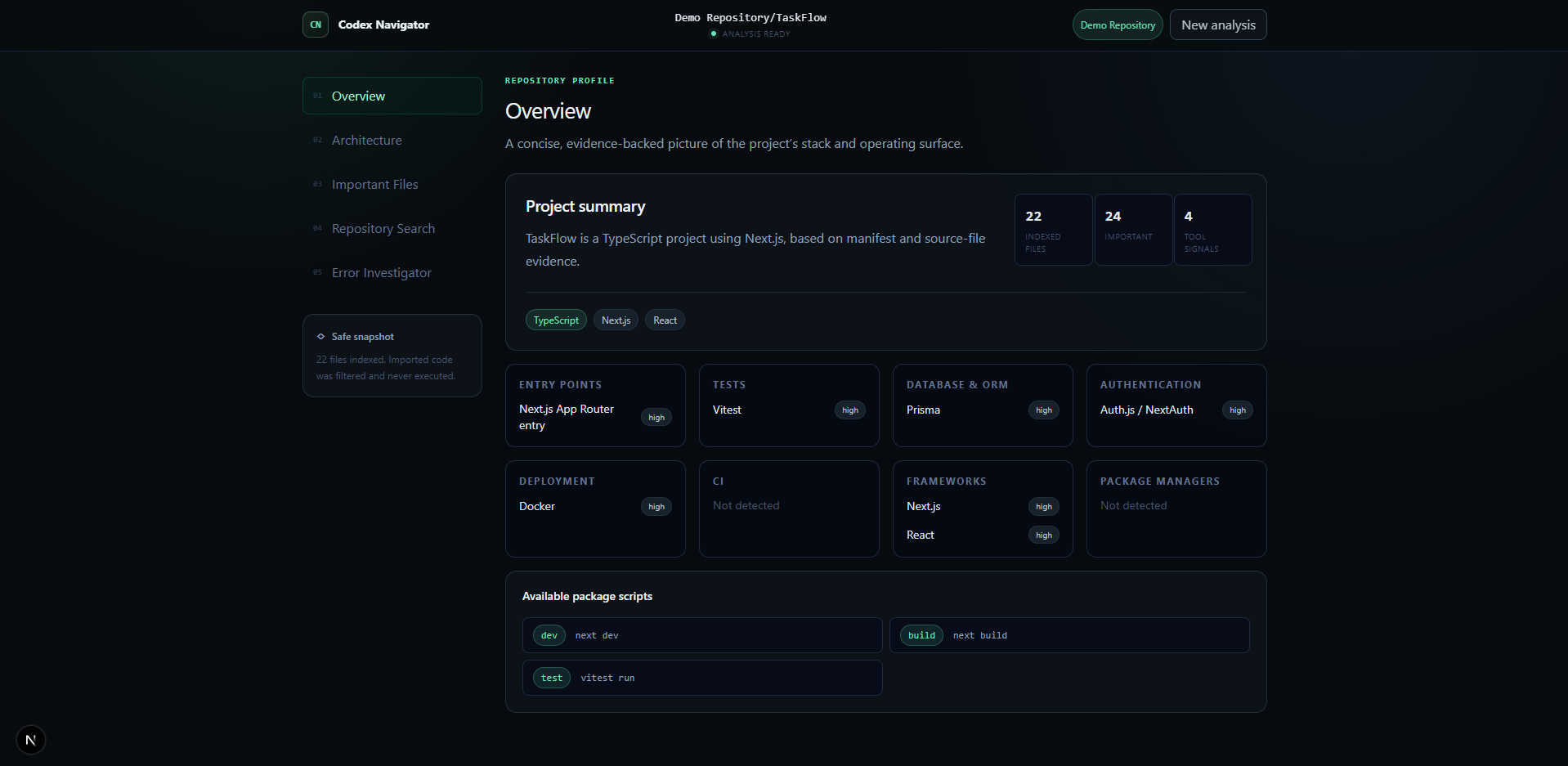
- Detect the project's language, framework, package manager, and key technologies.
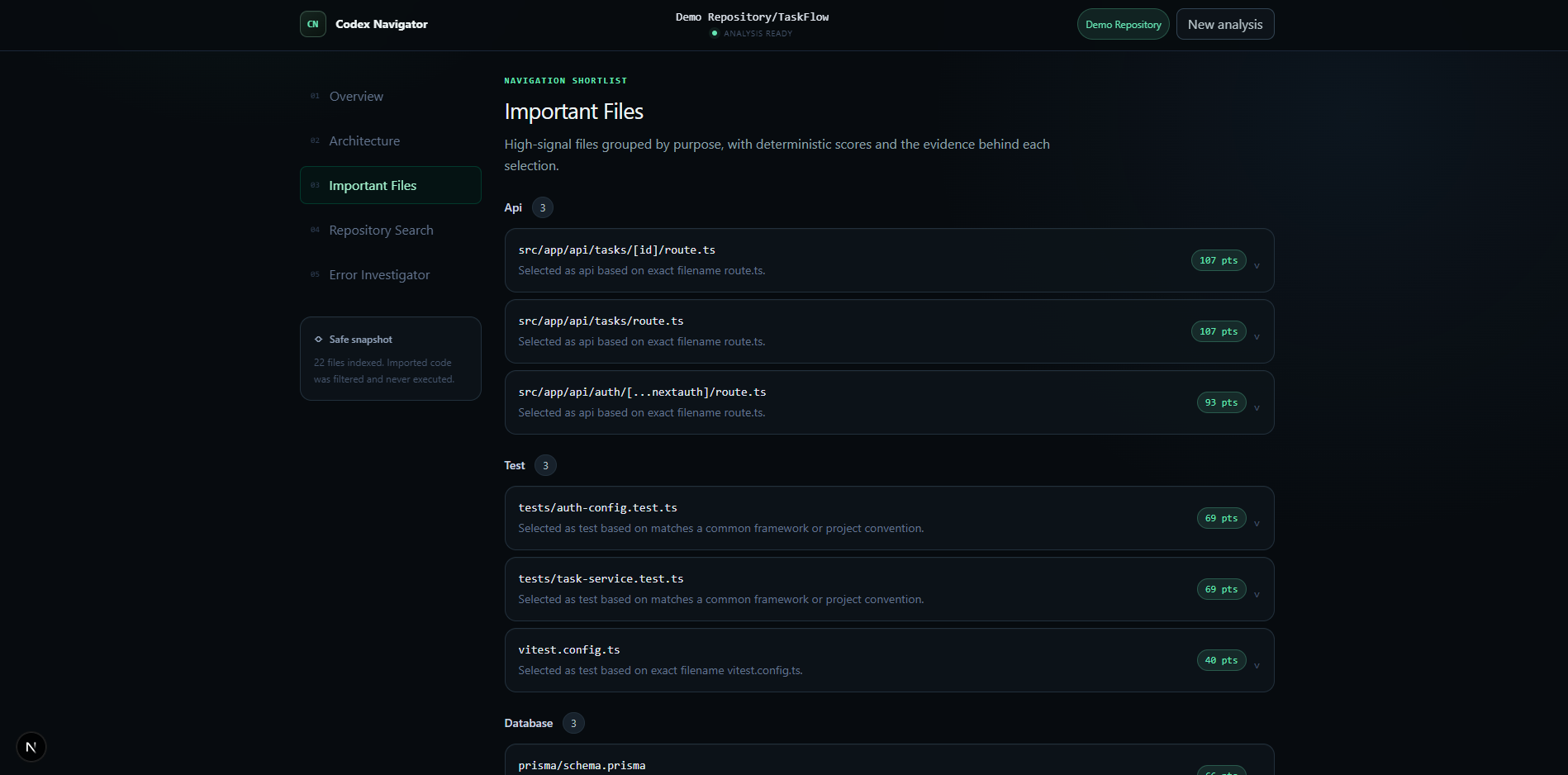
- Identify important files such as authentication, database, API routes, configuration, and tests.
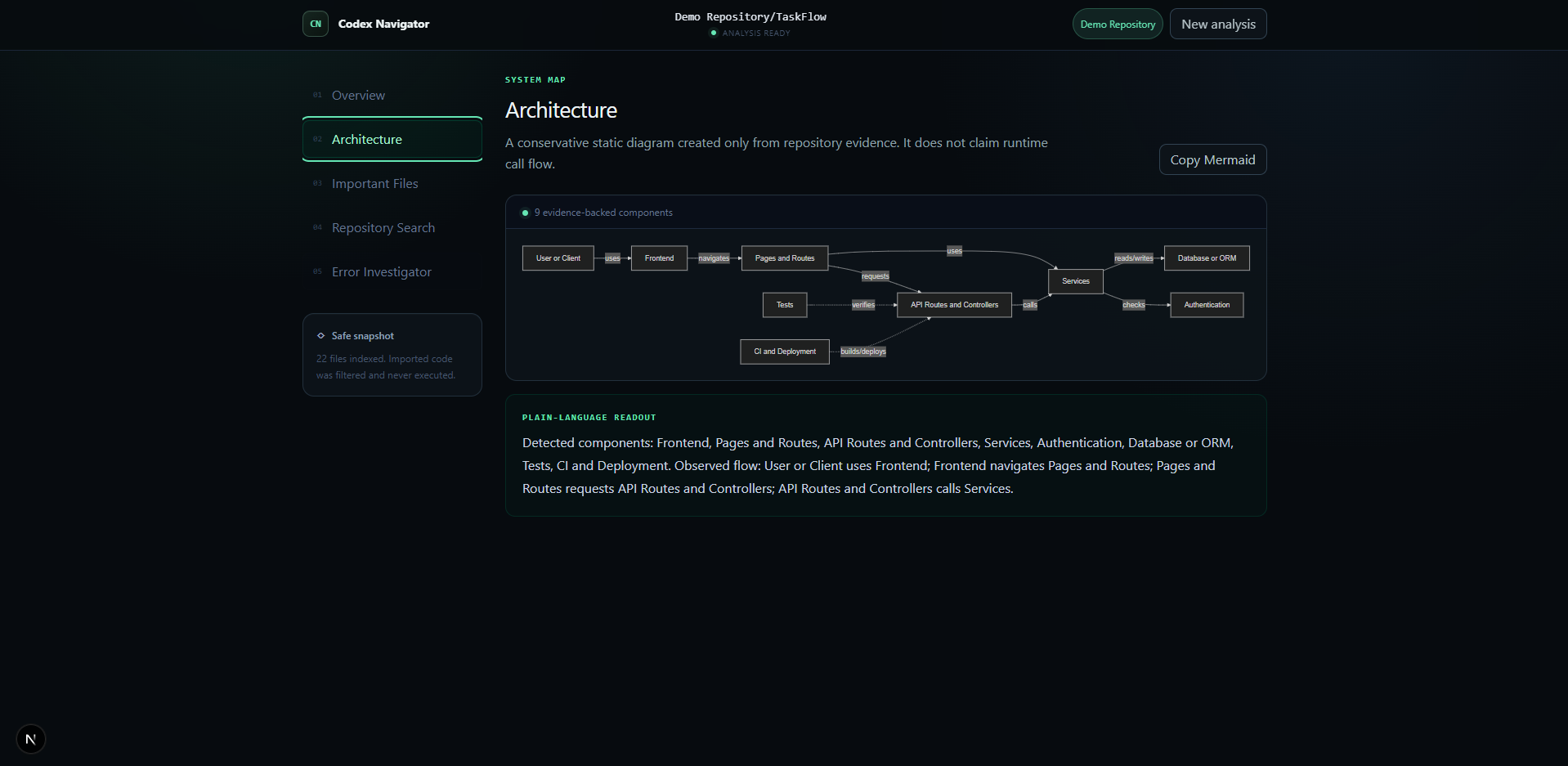
- Generate a visual architecture diagram.
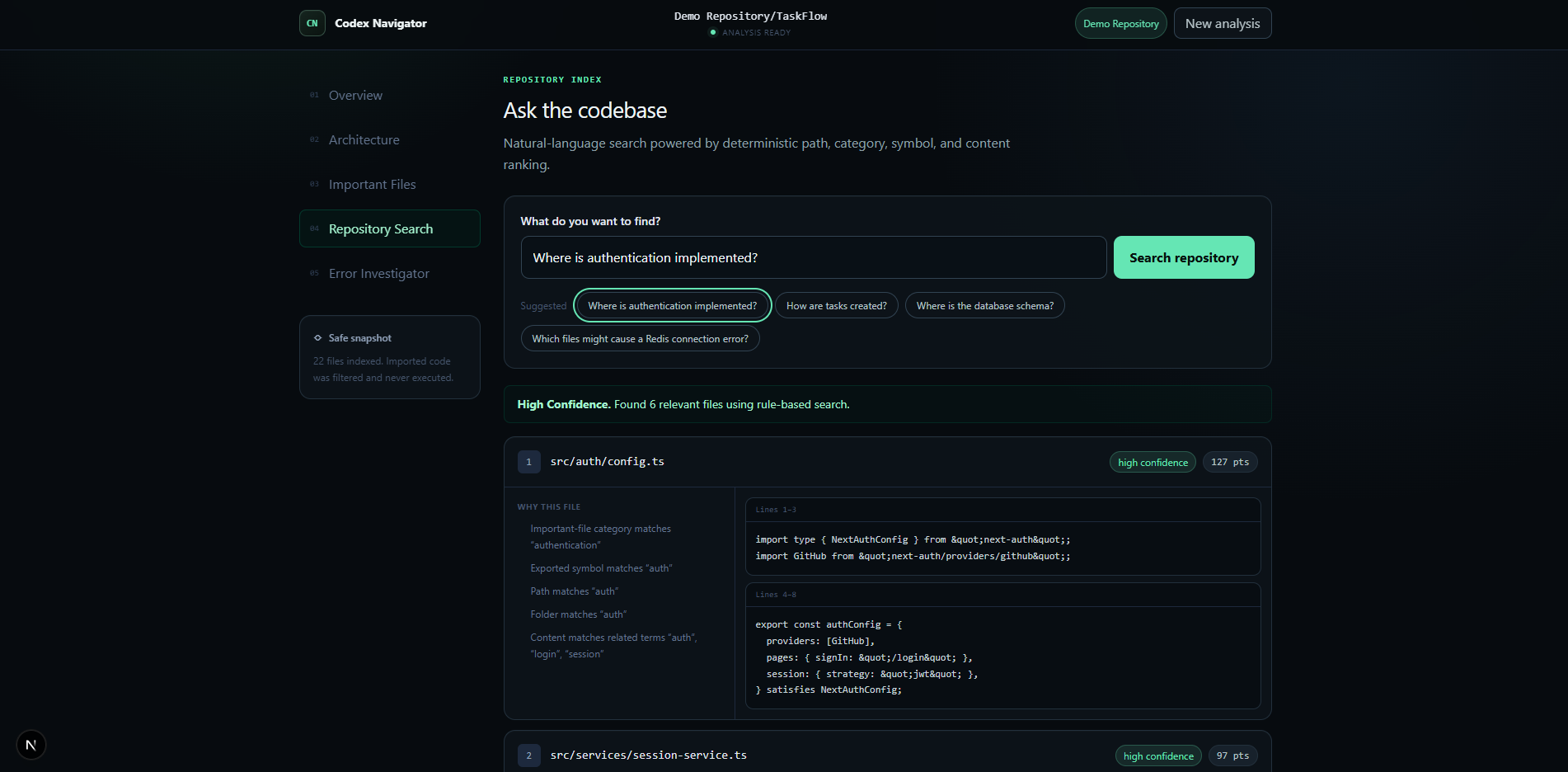
- Answer repository-specific questions like "Where is authentication implemented?" by highlighting the most relevant files and explaining why they were selected.
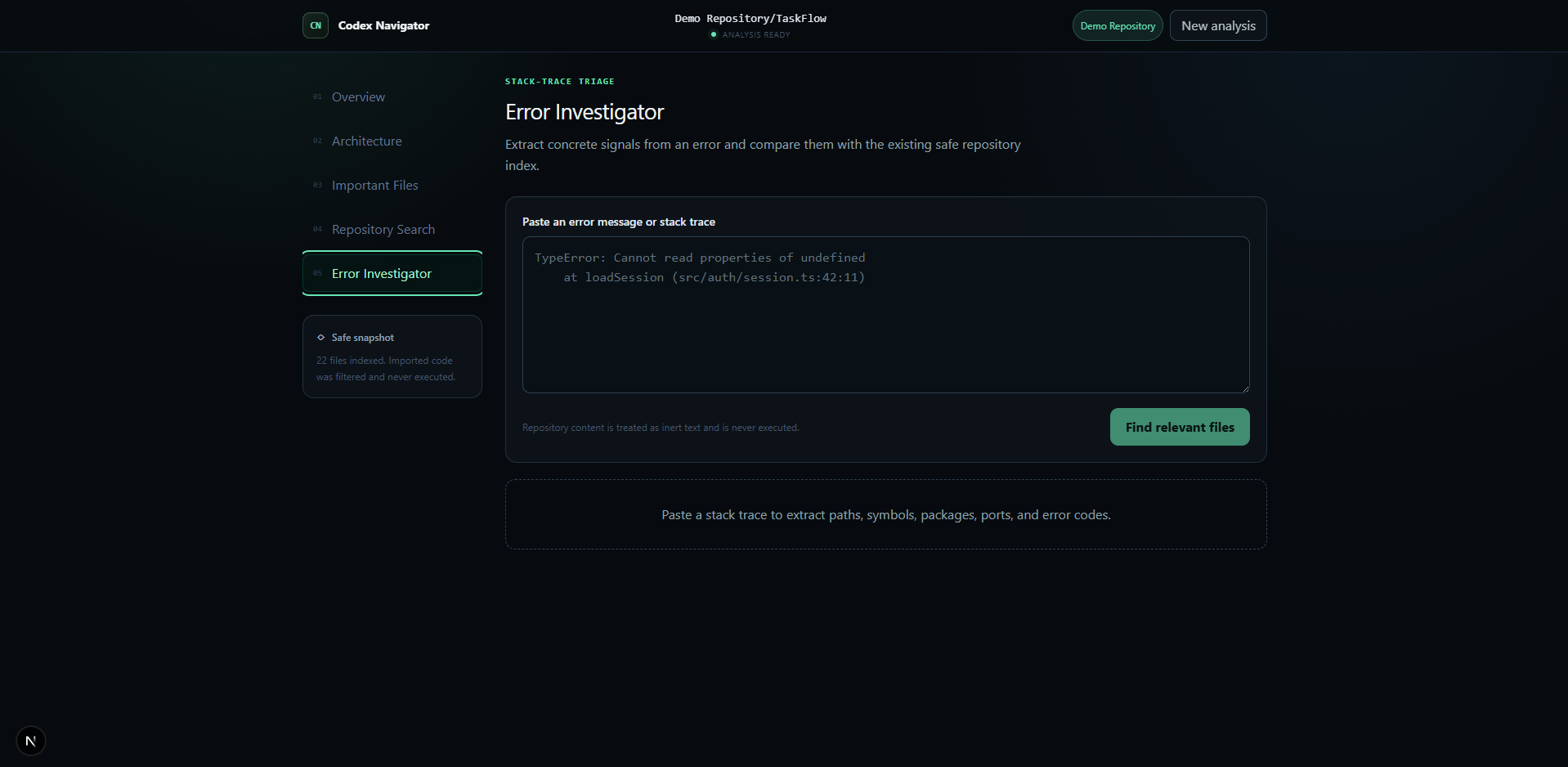
- Help investigate common errors by locating files that are likely related to an error message. The focus is on helping developers understand unfamiliar projects faster.
How we built it
The application was built with Next.js, TypeScript, and Tailwind CSS. Instead of relying on expensive external services, the project uses a lightweight repository-analysis engine that:
- Downloads or imports a public GitHub repository.
- Filters generated, binary, and sensitive files.
- Detects frameworks and technologies using rule-based analysis.
- Classifies important files based on repository structure and common development conventions.
- Builds a searchable index of the repository.
- Ranks relevant files using deterministic search logic.
- Generates architecture diagrams using Mermaid. Throughout development, Codex acted as an engineering partner. It helped plan the architecture, scaffold components, implement repository-analysis modules, write utility functions, generate tests, review code, identify bugs, and improve documentation. Rather than generating the entire project in one prompt, the application was built incrementally through focused development tasks, with each feature implemented, tested, and refined before moving to the next.
Challenges we ran into
The biggest challenge was designing a useful developer tool within the limited time available during the hackathon. Another challenge was balancing functionality with simplicity. It was tempting to add databases, authentication, embeddings, and many advanced AI features, but that would have increased complexity without significantly improving the core experience. We intentionally focused on a small, polished workflow that demonstrates the project's main value. Repository analysis also presented technical challenges. Different repositories use different folder structures, frameworks, naming conventions, and build systems, so the analysis logic had to remain flexible while avoiding false assumptions. Finally, ensuring that imported repositories were handled safely required careful filtering of generated folders, binary files, and sensitive configuration files.
Accomplishments that we're proud of
We're proud that we transformed a complex idea into a working prototype within a single hackathon. Instead of trying to build a generic AI assistant, we focused on solving a real developer pain point: understanding unfamiliar codebases. Some accomplishments we're especially proud of include:
- Building a tool that analyzes public GitHub repositories and presents their structure in an easy-to-understand way.
- Creating rule-based repository analysis that works without requiring expensive infrastructure or external services.
- Automatically identifying important files such as authentication, database, API, configuration, and testing modules.
- Providing repository-specific search with evidence-backed results instead of generic responses.
- Generating architecture diagrams that help developers quickly understand project structure.
- Designing the project to be lightweight, affordable, and accessible for students and independent developers. Perhaps the biggest accomplishment was successfully using Codex as an engineering collaborator throughout development—from planning and implementation to debugging, testing, and documentation—while delivering a polished MVP in a very limited timeframe.
What we learned
This project reinforced that developer tools don't always need large or complex AI systems to be useful. Careful repository analysis, deterministic logic, and thoughtful user experience can already solve meaningful problems. We also learned the importance of breaking a large idea into small, testable milestones. Using Codex as an engineering collaborator—planning, implementing, testing, reviewing, and refining each feature—made it possible to build a polished prototype within a very limited timeframe. Most importantly, the project showed how AI can help developers understand existing software, not just generate new code. That insight shaped both the product and our approach throughout the hackathon.
What's next for Codex Navigator
This hackathon version is just the beginning. Our vision is to turn Codex Navigator into an intelligent developer onboarding platform. Future improvements include:
- Support for private GitHub repositories through secure authentication.
- Repository history and saved analyses.
- Semantic code search using embeddings for more accurate repository understanding.
- Automatic pull request generation for small feature requests.
- Interactive architecture diagrams with dependency visualization.
- Pull request reviews with security, performance, and maintainability insights.
- Team workspaces where multiple developers can collaborate on repository analysis.
- IDE integration for Visual Studio Code and JetBrains products.
- Support for additional languages and frameworks.
- Repository quality scoring with actionable recommendations for architecture, documentation, testing, and maintainability. Our long-term goal is to reduce the time developers spend understanding existing code so they can spend more time building great software.
Built With
- codex
- javascript
- mermaid.js
- nextjs
- node.js
- react
- tailwindcss
- typescript

Log in or sign up for Devpost to join the conversation.