-
-
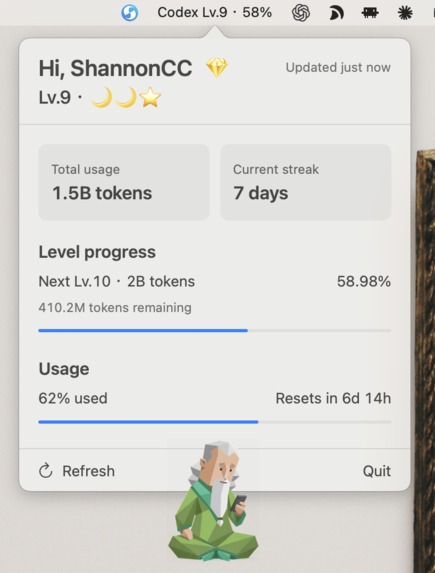
Preview!
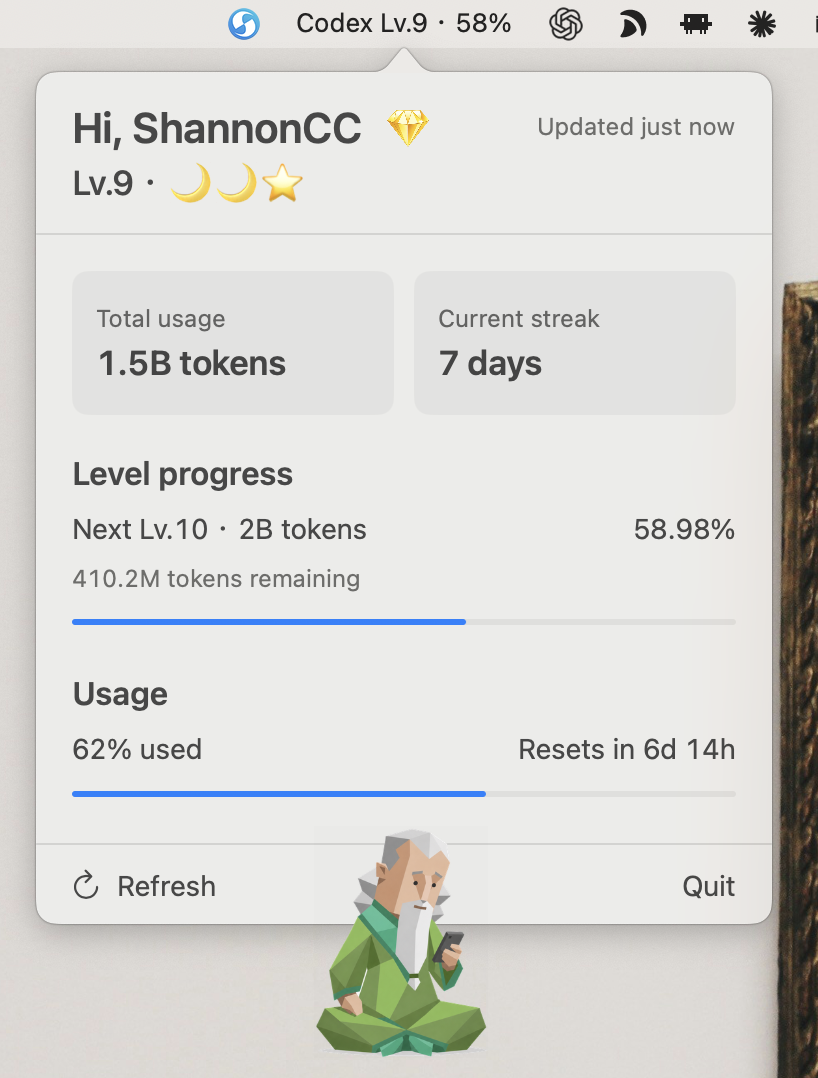
Codex Level
Faster usage access gets users to open it. A growing Codex Level turns every session into progress they will not want to leave behind.
Inspiration
Codex is becoming part of many developers’ daily workflows, but its usage information is still relatively hidden.
To check their current usage, users need to open Codex, click their profile in the bottom-left corner, and then navigate to the remaining usage page. For frequent Codex users, their remaining allowance and reset time can directly affect whether they start another task, which model they choose, and how they organize the rest of their development work.
This led to our initial question:
Why can’t checking Codex usage be as simple as checking battery life, network status, or system resources from the macOS menu bar?
However, reducing the process by one or two clicks was not enough to create a product with lasting value.
Most Codex sessions disappear from view once the task is finished. Users have no simple way to see how long they have been using Codex, how consistently they have worked with it, or how their AI-assisted development habits have evolved over time.
That inspired us to build Codex Level, a macOS menu bar application that combines immediate Codex usage information with a persistent record of personal growth.
What It Does
Codex Level brings Codex usage information directly into the macOS menu bar.
With a single click, users can view their current usage, remaining allowance, and reset time without interrupting their work or navigating through multiple account menus. We also plan to support a global keyboard shortcut, allowing users to open the status panel from anywhere on macOS.
Beyond immediate usage information, Codex Level transforms usage history into experience points, levels, streaks, and growth milestones.
These levels are not intended to measure a user’s absolute programming ability, nor are they designed to encourage unnecessary token consumption. Instead, they represent the user’s long-term engagement with Codex and the gradual development of a consistent AI-assisted workflow.
Our core product idea is simple:
Immediate usage visibility gives users a reason to open Codex Level every day, while persistent growth gives every Codex session lasting value.
How We Built It
Codex Level is designed as a lightweight macOS menu bar application rather than a full desktop client that users must keep open.
The current version is organized around three core modules:
- Usage status module: Retrieves and displays current Codex usage, remaining allowance, and reset cycles.
- Growth system module: Converts verifiable usage records into experience points, levels, streaks, and milestones.
- Menu bar interaction module: Presents the information in a compact popover and provides fast access without disrupting the user’s current workflow.
We deliberately limited the scope of the first version.
The MVP is intended to validate two questions:
- Do Codex users need a faster and more accessible way to check their usage?
- Can levels and growth records make otherwise abstract usage data feel more meaningful?
For this reason, the first version does not attempt to evaluate code quality or treat token consumption as a direct measure of programming ability. It only presents forms of progress that can be reliably supported by the available data.
Challenges
Accessing accurate usage data
The first challenge is obtaining Codex usage information accurately and consistently.
The core value of Codex Level depends on trustworthy data. If the data source is unstable, delayed, or accessible only through a fragile implementation, the menu bar display cannot function as a reliable work indicator.
We therefore need to balance data accuracy, refresh frequency, technical stability, and implementation cost.
Designing a responsible level system
The second challenge is creating a meaningful progression system.
The simplest approach would be to award levels directly based on token consumption. However, this could encourage unnecessary usage and incorrectly suggest that higher consumption means greater technical ability.
We need a more restrained system that combines sustained usage, consistency, and meaningful milestones without turning Codex Level into a simple token counter.
Controlling the product scope
The third challenge is preventing unnecessary complexity.
During the design process, we considered features such as automatic project recognition, skill evaluation, leaderboards, social sharing, and achievement systems.
These ideas could significantly expand the product, but they would not directly validate the core value of the first version. We therefore decided to focus the MVP on two capabilities: immediate usage access and personal growth tracking.
What We Learned
Our most important lesson is that gamification alone does not create retention.
A level number is not valuable simply because it increases. It becomes meaningful only when it represents a real, long-term, and personally relevant record of progress.
At the same time, a growth narrative cannot replace immediate utility. Users first need a clear reason to open the product during their daily workflow. Only then can long-term usage create a sense of personal history and identity.
Codex Level is therefore neither just a usage tracker nor just a gamification layer.
It combines two forms of value:
- Helping users understand and manage their Codex usage in the moment.
- Helping users see how their way of working with AI develops over time.


Log in or sign up for Devpost to join the conversation.