-
-
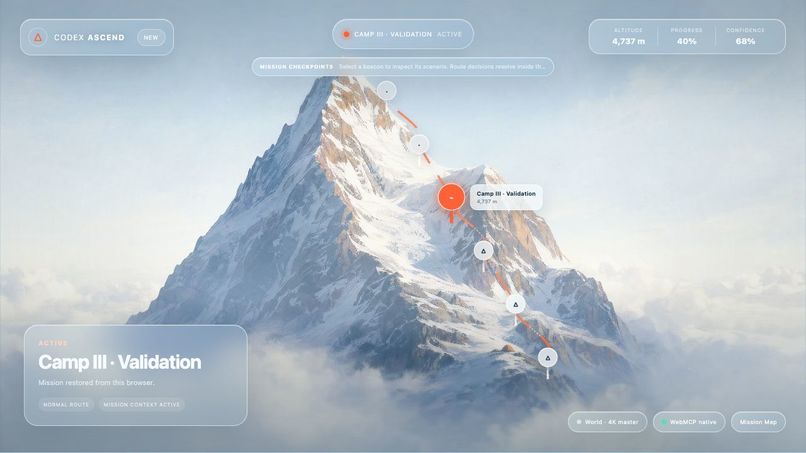
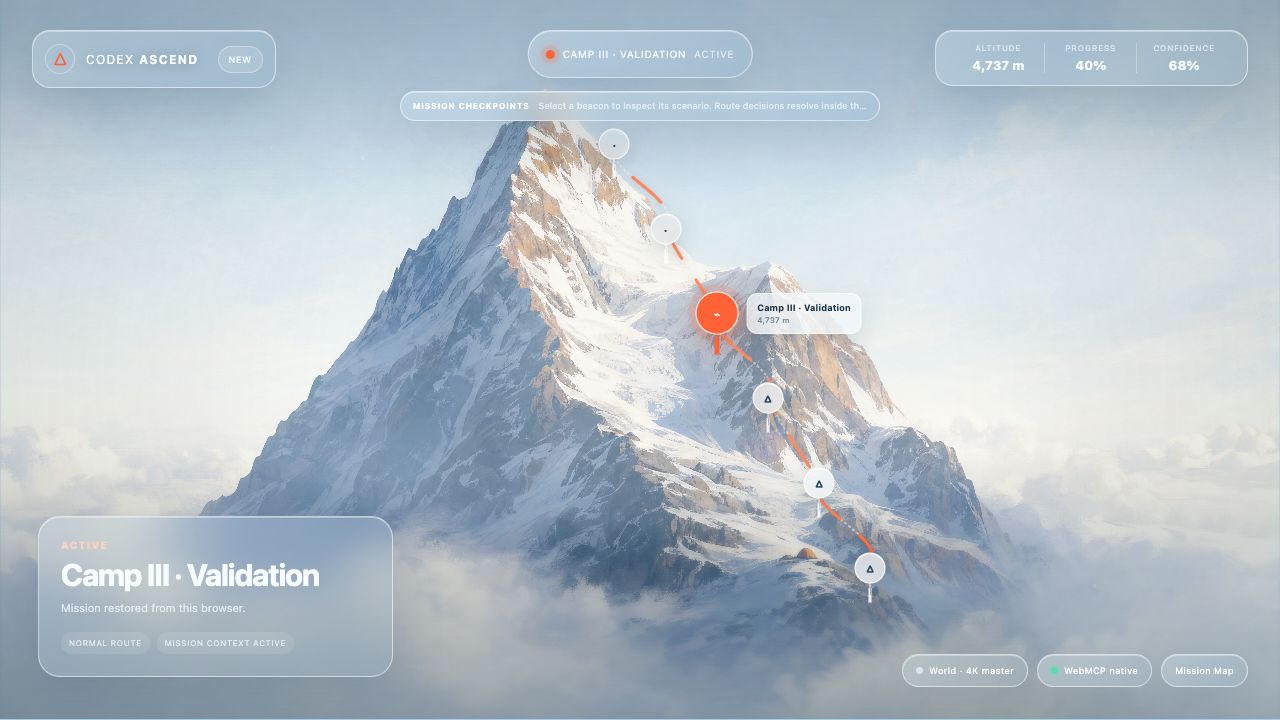
Mission state becomes mountain geography: camps, routes, confidence, moving weather, and WebMCP activity share one living world.
-
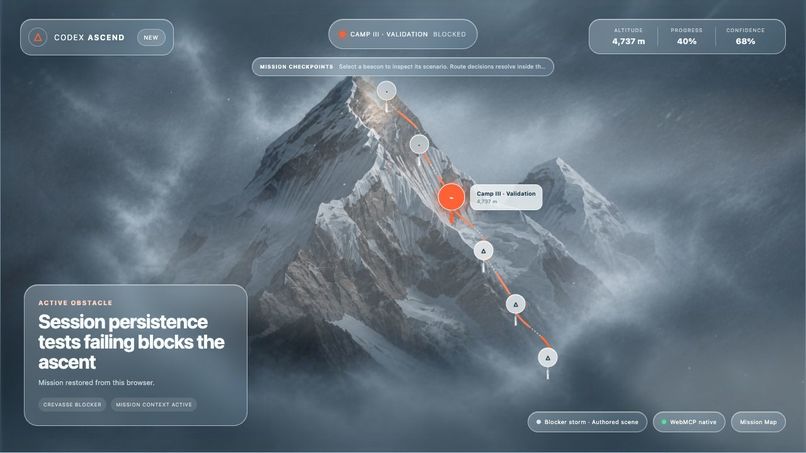
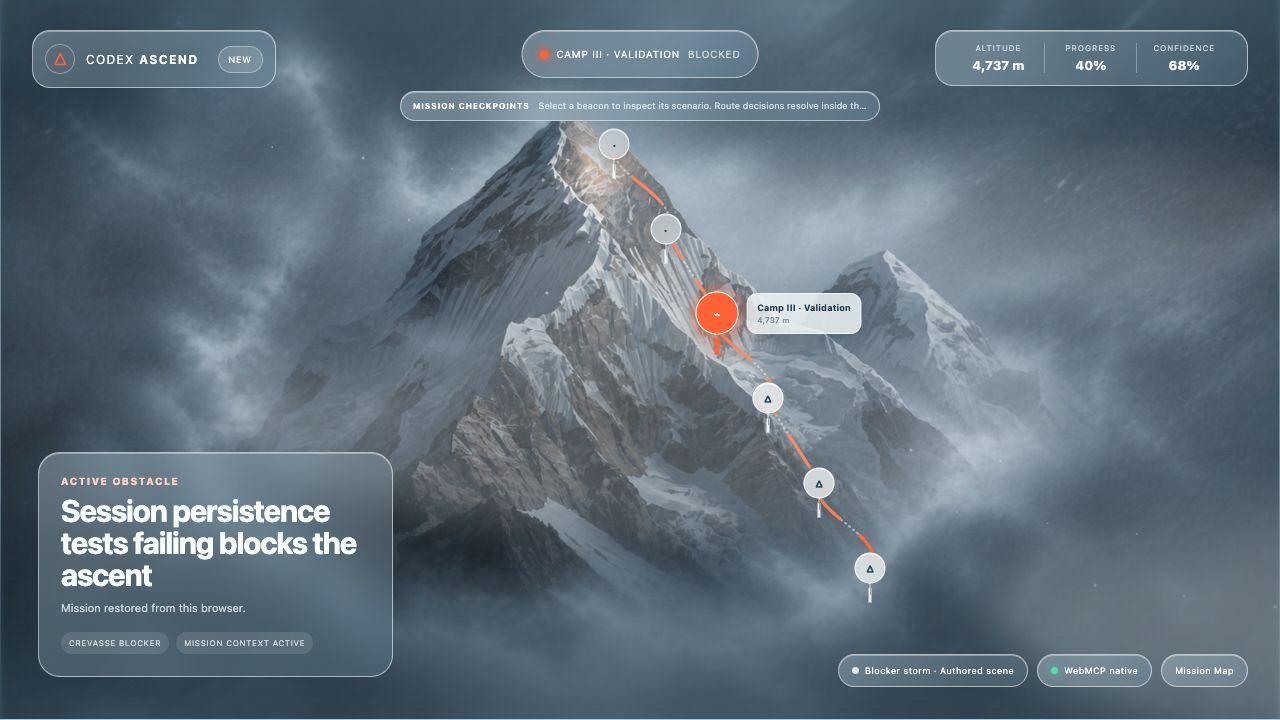
A real blocker fractures the route and changes the weather. Cosmetic progress stops until the obstacle is actually resolved.
-
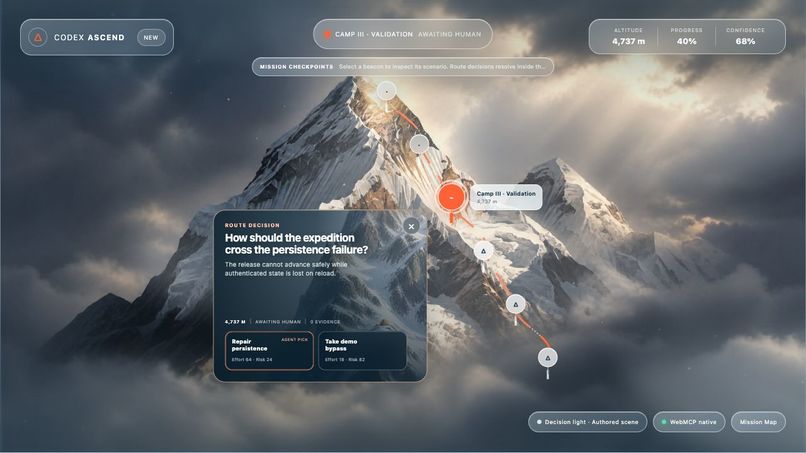
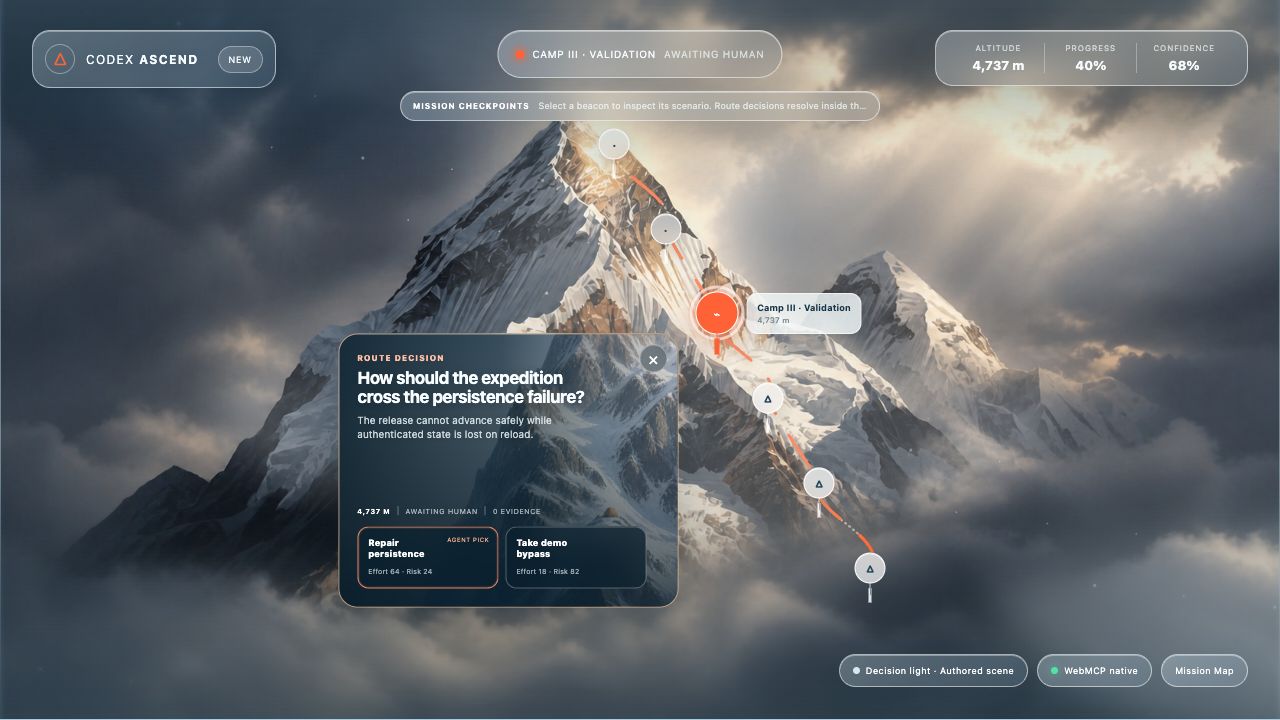
The agent asks; the human decides. Only the user can authorize repair or bypass at Camp III before the agent continues.
-
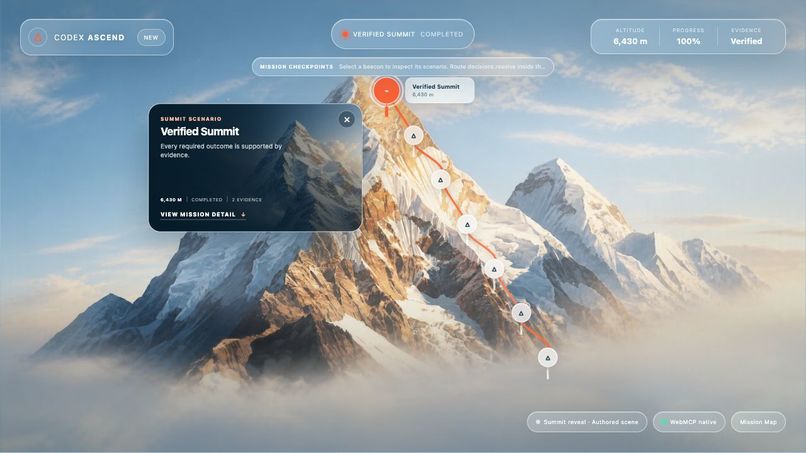
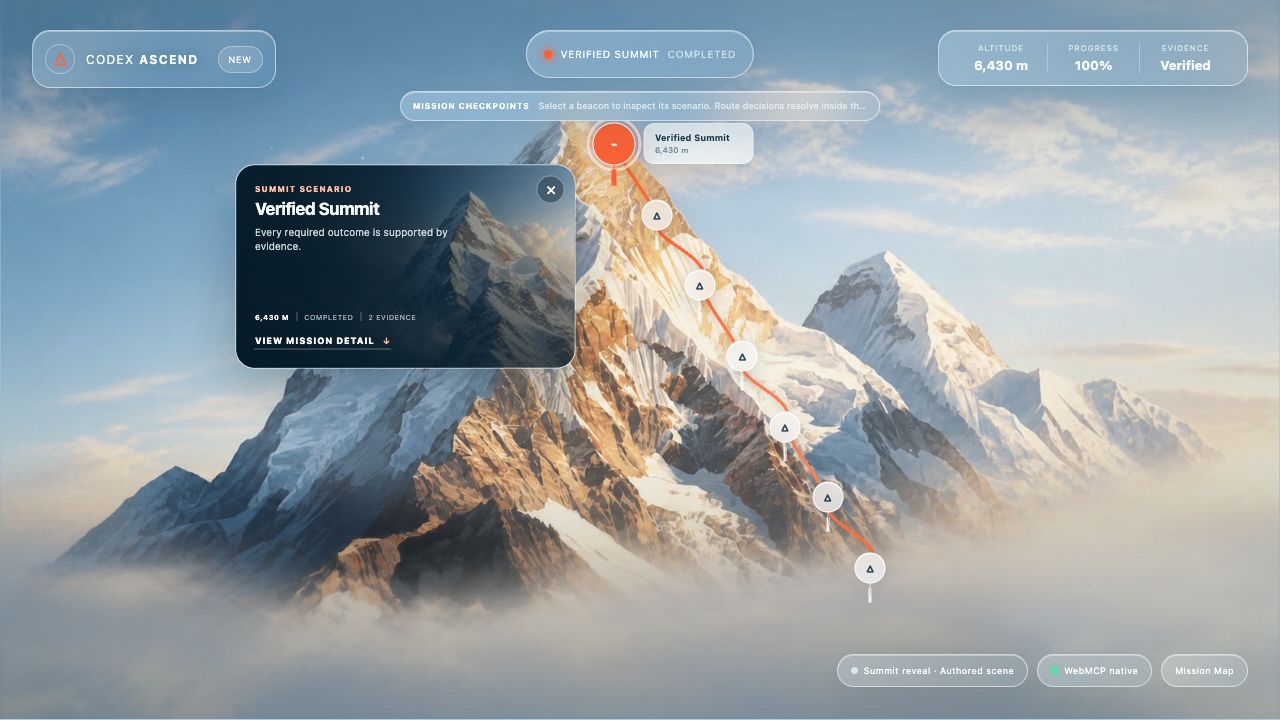
Evidence before Summit. Completion activates only after every dependency, blocker, and success criterion passes deterministic verification.
What Codex Ascend does
Codex Ascend turns long-running agent work into a living mountain shared by a human and an AI agent. Camps are verified outcomes, fog is uncertainty, crevasses are blockers, route forks are consequential choices, and the Summit stays locked until every required proof passes deterministic verification.
Codex Ascend is for developers and technical leads supervising long-running AI execution, where blockers, approvals, and proof should never disappear inside a chat log.
Why WebMCP is essential
Most agent interfaces split the model’s plan from the person’s understanding: the agent sees tool state while the human gets a chat log or decorative progress bar. Ascend gives both sides one execution model.
The page registers 18 native WebMCP tools with closed JSON schemas and structured results. An agent can inspect mission state, discover topology, advance stages, report blockers, propose routes, request a human decision, attach evidence, verify completion, and finish the mission. These tools manipulate mission semantics—not pixels—and run through the same validated command engine as the human UI.
The centerpiece is a genuinely bidirectional loop:
- The agent reports a persistence blocker and proposes repair or bypass routes.
- The mountain fractures at that exact geography and renders the choice.
- Only the human can authorize the consequential route inside the website.
- The agent reads the structured decision through WebMCP, resolves the blocker, and continues.
- New required work can reveal another ridge; evidence finally unlocks Verified Summit.
There is intentionally no agent tool that can resolve the human decision. WebMCP makes collaboration safer and clearer because authority remains explicit while state stays machine-readable.
How it works
A neutral TypeScript Mission Engine validates commands and records a versioned event journal. React provides the accessible HUD and geography-bound scenario cards; PixiJS renders the living scene and elevation topology. An Ascend projection layer maps mission truth into camps, waypoints, weather, camera focus, narration, and generated imagery.
A Cloudflare Worker uses Workflows and R2 for reviewed OpenAI GPT Image 2 generation. Provider credentials stay server-side, retries require explicit operator intent, and only accepted candidates enter the public world. Rendering can never mutate mission truth.
What we learned
WebMCP is most powerful when the website owns an action the agent should not silently take. Structured inspection matters, but the memorable moment is the round trip: the agent surfaces a real decision, the human answers it in context, and the agent continues from shared structured state.
Built with
WebMCP, TypeScript, React, Vite, PixiJS, Zod, OpenAI GPT Image 2, Cloudflare Workers, Workflows, R2, Vitest, and ESLint.
Built With
- cloudflare
- openai
- pixijs
- react
- typescript
- webmcp

Log in or sign up for Devpost to join the conversation.