-
-
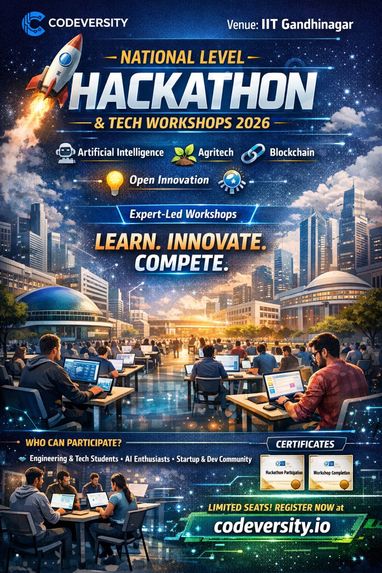
COMPETE
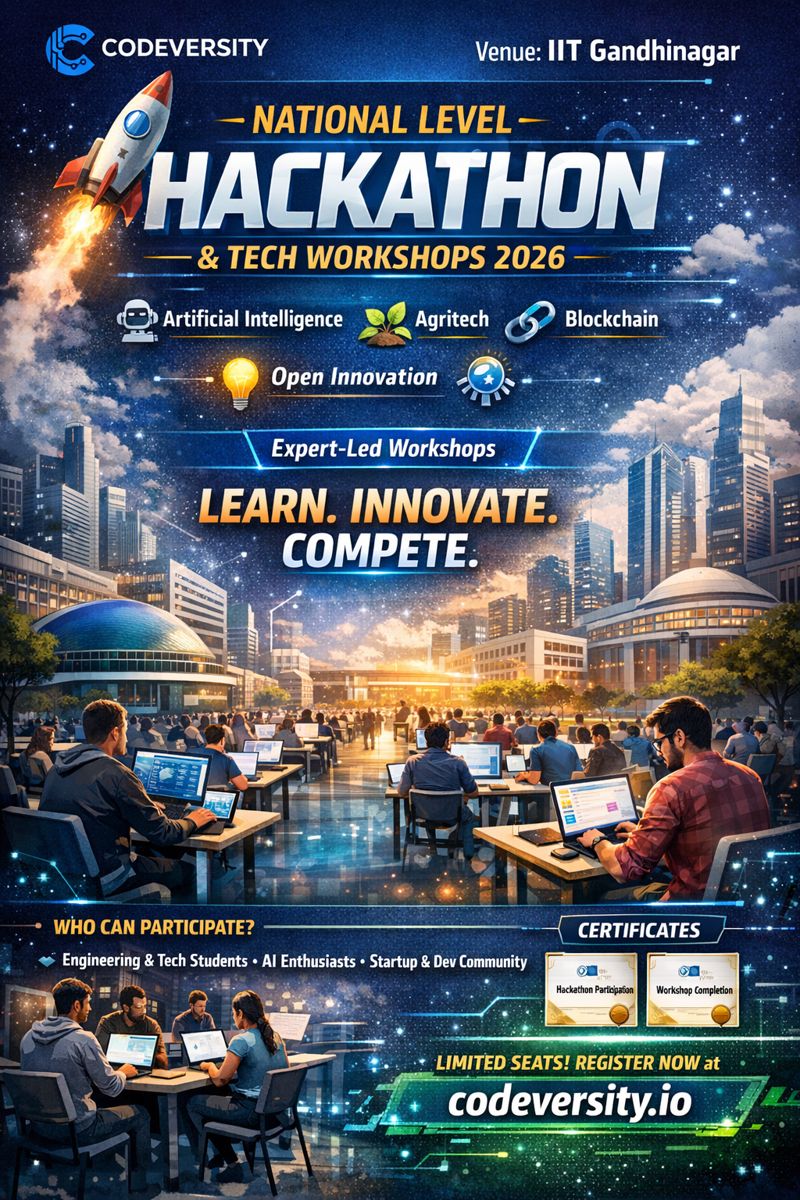
I. The Spark of Inspiration The inception of Codeversity 2026 wasn't just a byproduct of organizational requirements; it was born from a deep-seated observation of the current technological divide in student-led innovation. Walking through the corridors of IIT Gandhinagar, we noticed a recurring theme: brilliant minds sequestered in silos, working on profound problems but lacking a unified platform to showcase, iterate, and integrate their solutions.
Our inspiration was the "Zero-to-One" philosophy. We wanted to build more than a website; we wanted to build a digital gateway that mirrored the intensity of a 48-hour sprint. We were inspired by the open-source movement—the idea that collaborative intelligence far outweighs individual brilliance. This platform was designed to be the nexus where AI, Agritech, and Blockchain converge.
"Technology is best when it brings people together." — This quote became our north star. We envisioned a system where a student from a rural polytechnic could brainstorm an Agritech solution alongside a machine learning prodigy from a premier institute. II. Engineering the Platform: How We Built It Building the Codeversity platform required a delicate balance between bleeding-edge features and bulletproof reliability. We chose a modern tech stack consisting of React 19, Tailwind CSS for styling, and the Gemini API for our interactive AI components.
The core architecture relies on a modular component structure. We implemented a custom GeminiService to handle real-time project brainstorming. One of the most interesting aspects was the integration of a responsive AI Advisor. To ensure the model provided contextually relevant ideas, we engineered a sophisticated system prompt that acts as a guardrail, keeping the AI focused on our core domains.
For the mathematical enthusiasts, we utilized principles of Vector Space Models during our initial design phase for the AI Advisor's retrieval mechanisms. While Gemini handles the generation, we conceptualized the grounding metadata using the Softmax function for probability distribution across domain relevance:
$$ \sigma(\mathbf{z})i = \frac{e^{z_i}}{\sum{j=1}^K e^{z_j}} $$ This ensures that when a user asks about "Sustainable Farming," the model shifts its attention weights significantly toward the Agritech domain parameters.
III. The Learning Curve Every line of code written for Codeversity was a lesson in itself. We learned that User Experience (UX) is not just about aesthetics; it's about anticipation. By building the "Project Advisory AI," we delved deep into Prompt Engineering—learning how to provide a few-shot context to LLMs to minimize hallucinations.
We also mastered the art of Atomic Design. By breaking down our UI into atoms (buttons, badges), molecules (nav links, cards), and organisms (Hero sections, AI Chatbot), we created a design system that is inherently scalable.
From a mathematical perspective, understanding the Transformer architecture's Scaled Dot-Product Attention was crucial for setting the right parameters in our GeminiService:
$$ \text{Attention}(Q, K, V) = \text{softmax}\left(\frac{QK^T}{\sqrt{d_k}}\right)V $$ This insight allowed us to appreciate the computational complexity and the "thinking budget" required for high-quality responses, which influenced our choice of the gemini-3-flash-preview model for low-latency interactions.
IV. Overcoming Hurdles & Challenges The road was not without its potholes. Our primary challenge was State Synchronicity. Managing the state of a real-time AI conversation while ensuring the UI remained responsive on low-end devices required meticulous optimization. We solved this by implementing an asynchronous message queue and utilizing React's useEffect hooks to manage scroll-into-view triggers.
Another hurdle was the Responsive Typography challenge. Creating a "Futuristic" look using the Orbitron font while maintaining readability on mobile screens was a constant tug-of-war. We eventually settled on a fluid typography system using Tailwind's clamp utility equivalents.
Finally, the API Key Security and environment management within a frontend-only context presented a unique set of constraints. We had to ensure that the process.env.API_KEY was handled securely through the platform's injection system without exposing it to malicious client-side scripts.
In conclusion, building the Codeversity National Level Hackathon platform was a masterclass in modern full-stack development. We emerged not just with a website, but with a deep appreciation for the synergy between human creativity and artificial intelligence. We invite you to be a part of this story at IIT Gandhinagar in 2026.

Log in or sign up for Devpost to join the conversation.