-
-
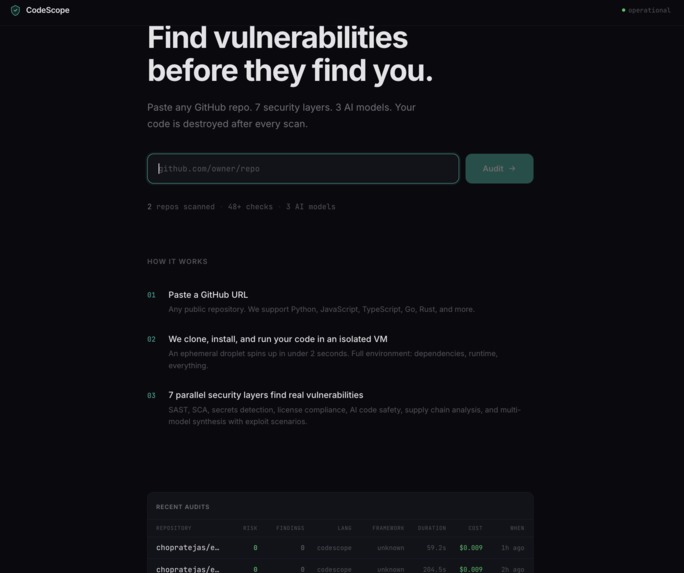
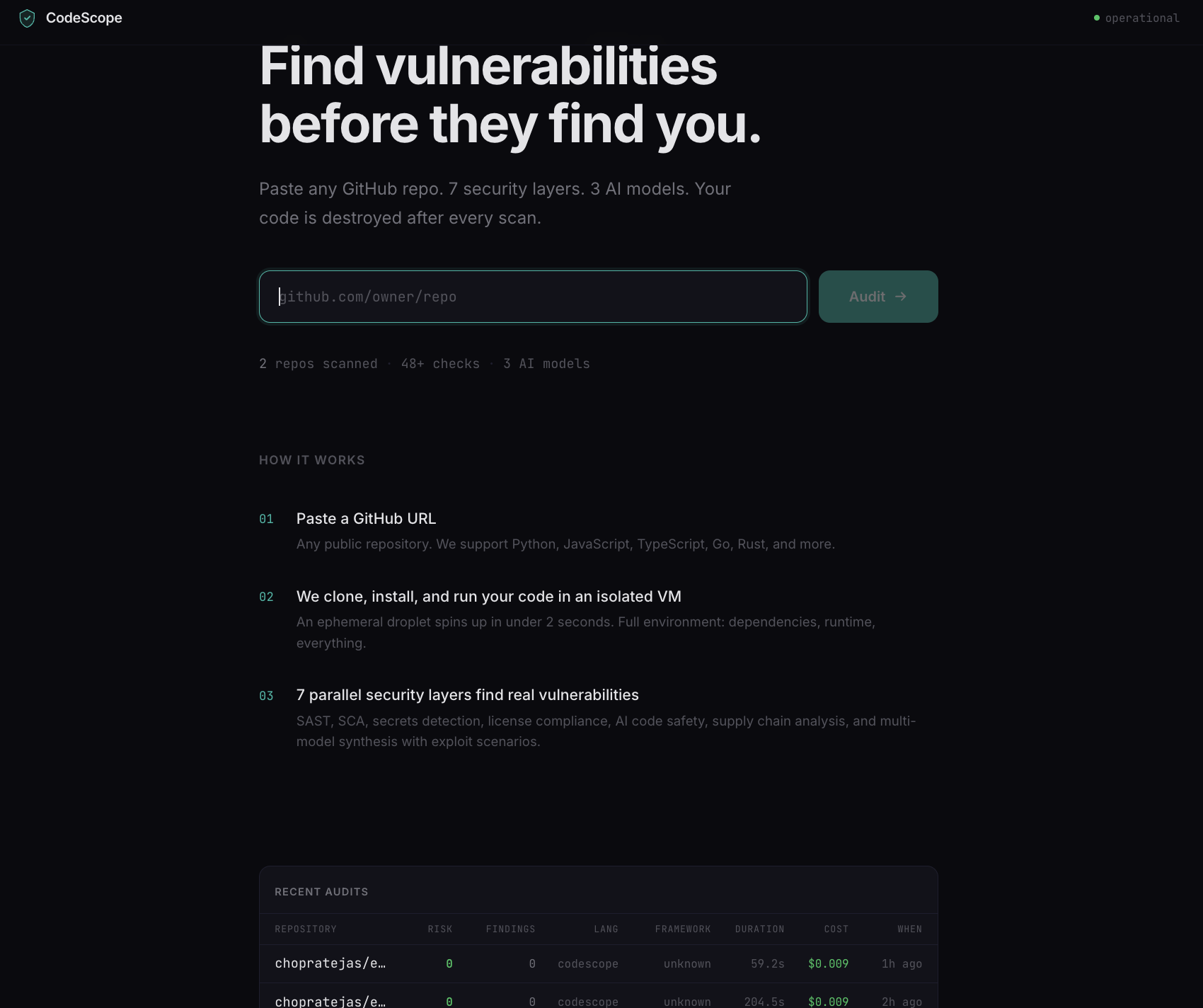
Dashboard page where you enter a public Github URL
-
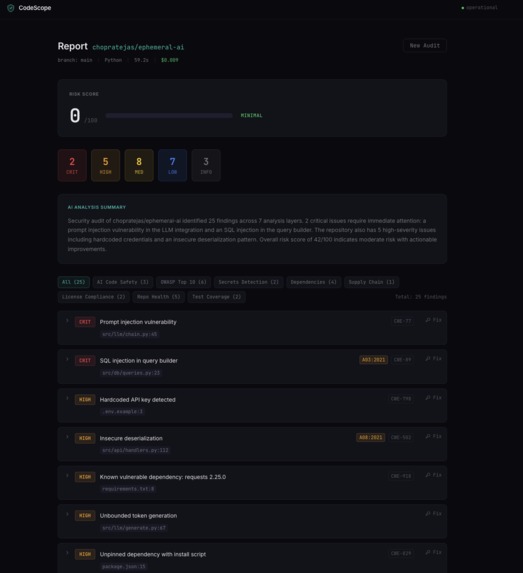
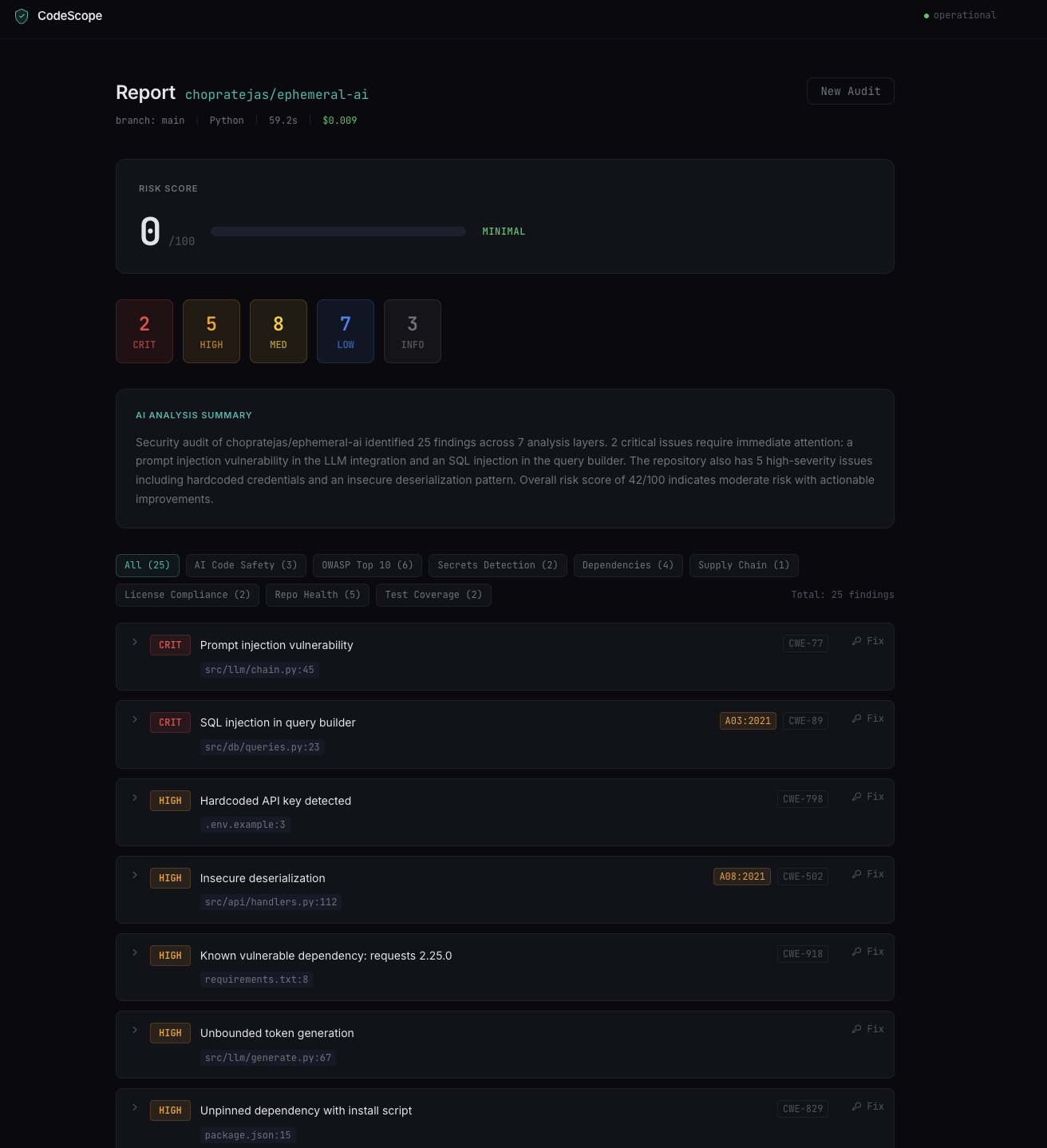
Seeing the different checks and results
-
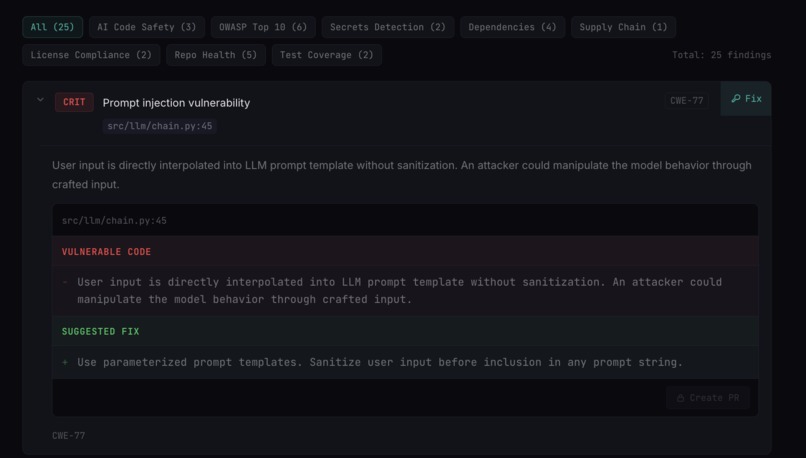
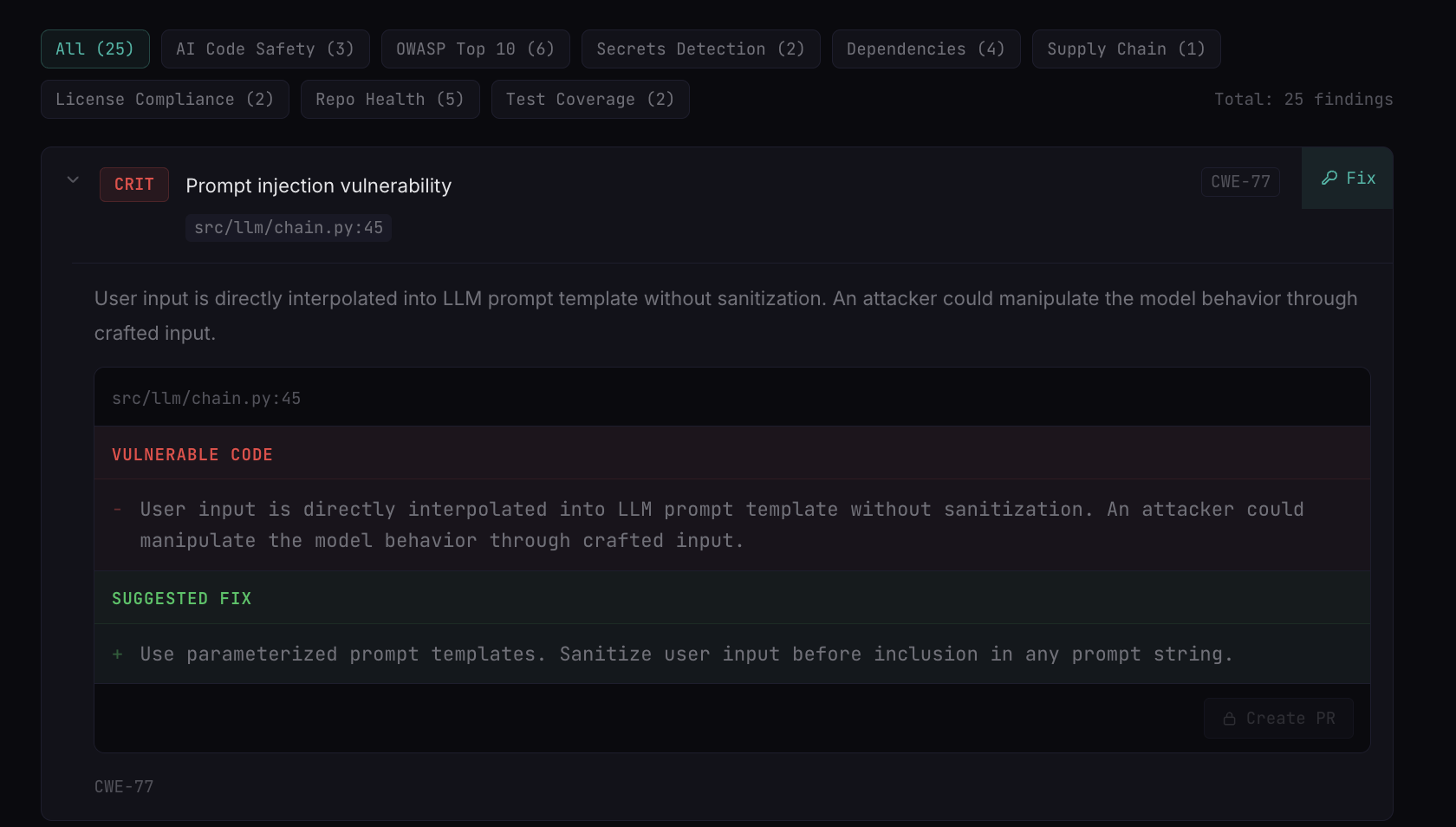
For one of the results, checking what needs to be fixed.
Inspiration
45% of AI-generated code contains security vulnerabilities. Tools like Snyk and CodeQL catch less than 20% of them in real-world tests, because they use regex pattern matching designed for human-written code. AI code fails differently: missing input validation, hallucinated dependencies, prompt injection vectors, and unsafe LLM output handling. These are patterns existing tools were never built to detect.
We asked: what if a security scanner could actually read and understand code the way a developer does? Not pattern match, but reason about it. And what if it could run the code, follow the README, install dependencies, and try to break it — like a human pen tester?
That requires a full computer. Not a Lambda function. Not a container. A real VM with git, pip, npm, a network stack, and the ability to install anything. But VMs are expensive to keep running. So we made them ephemeral — they exist only for the duration of the audit, then they're recycled.
What it does
CodeScope is an LLM-first security audit platform. You paste a GitHub repo URL. We:
- Scout the repo via GitHub API — an LLM reads the README and dependency files to determine what size VM is needed
- Spin up an ephemeral DigitalOcean Droplet from a pre-built snapshot (30s boot)
- Clone the repo, install dependencies, and try to run the app — following the actual README instructions
- Run 6 parallel security analyses using DigitalOcean Gradient AI — each reviewer gets the relevant source files and a focused security prompt (auth, injection, AI security, secrets, dependencies, error handling)
- Dynamic test the running app if it started successfully — check headers, probe endpoints, send crafted payloads
- Synthesize findings using a multi-model consensus (openai-gpt-oss-120b for prioritization, llama3.3-70b-instruct for code fixes, deepseek-r1-distill-llama-70b for false positive detection)
- Generate a fix for each finding on the same Droplet (branch, apply fix, build, test, commit)
- The Droplet goes back to the warm pool — reused for the next audit within the billing hour (0s provisioning on subsequent audits)
Real example: auditing chopratejas/headroom found 18 real vulnerabilities, including a critical prompt injection in the LLM gateway, SQL injection in SQLite adapters, and missing authentication on all API routes — with exploit scenarios and code fixes for each.
How we built it
Backend (Python/FastAPI) — deployed on DigitalOcean App Platform via Container Registry. Handles task routing, warm pool management, and the audit lifecycle.
Worker Daemon — a long-lived Python script that runs inside each Droplet for up to 55 minutes (fitting within the 1-hour billing window). It polls the orchestrator for tasks, executes CodeScope audits, applies fixes, and uploads results to Spaces.
CodeScope v3 — the audit engine (1,729 lines). No regex patterns. Every finding comes from an LLM reading actual code. 5 phases: Understand → Setup → Analyze (6 parallel) → Dynamic Test → Synthesize.
Scout — runs on the orchestrator before provisioning. Fetches README + manifests via GitHub API, asks the LLM to size the Droplet. A Python data science project gets s-2vcpu-4gb; a simple Node script gets s-1vcpu-1gb.
Warm Pool — Droplets are billed per hour. Instead of create-use-destroy, we create-use-reuse. First audit: 30s cold start. Second audit: 0.024s. Same cost.
Dashboard (React/TypeScript) — deployed as a static site on DigitalOcean Spaces. Inter + JetBrains Mono fonts. Teal accent. Live log streaming during scans.
DigitalOcean Services Used
| Service | How we use it |
|---|---|
| Gradient AI (Serverless Inference) | All security analysis — 3 models in parallel for multi-model consensus |
| Droplets | Ephemeral audit VMs — clone repos, install deps, run code, execute attacks |
| Spaces | Result storage, dashboard hosting, CodeScope script distribution, audit history persistence |
| App Platform | Orchestrator API hosting (Docker via DOCR) |
| Container Registry (DOCR) | Docker image storage for the orchestrator |
| Snapshots | Pre-built Droplet images with Python + Node.js + TypeScript for fast boot |
| Cloud Firewalls | Network isolation for audit Droplets |
| Monitoring API | Droplet health checks |
Challenges we faced
Droplet boot time vs. billing: Droplets take 30s to boot but are billed per hour. Destroying after each 3-minute audit wastes 57 minutes of paid time. Solution: the warm pool architecture — Droplets stay alive and accept multiple tasks within their billing hour.
Cloud-init size limit: The CodeScope script (69KB) + worker daemon (44KB) exceeded the 64KB user_data limit. Solution: embed the daemon in cloud-init, download CodeScope from Spaces at boot.
Regex scanning was a dead end: Our v2 scanner had 48 regex patterns that produced 1,603 findings on a real repo — 83% were false positives. Solution: v3 has zero regex. Every finding comes from an LLM reading actual code with context.
Zombie Droplets: When the orchestrator restarts (new deployment), in-memory state is lost. Orphaned Droplets keep running but their daemon has expired. Solution: rediscovery on startup — query DO API for tagged Droplets, destroy any older than 50 minutes, re-register fresh ones.
Dynamic analysis reliability: Starting arbitrary repos is unreliable — different frameworks, different ports, different entry points. Solution: the Scout LLM reads the README and generates setup commands, but we gracefully degrade if the app doesn't start (static analysis still runs).
What we learned
- LLMs are dramatically better at finding security issues than regex — because they understand context.
awaitin Python test code is not an "unhandled promise." - The warm pool pattern makes ephemeral VMs economically viable for short tasks. Same hourly cost, 1500x faster after the first request.
- Multi-model consensus reduces false positives. When 3 models agree something is critical, it probably is.
- DigitalOcean's Gradient AI serverless inference is genuinely easy to use — OpenAI-compatible API, no model management, works from inside Droplets.
What's next
- GitHub OAuth + PR creation: The fix is already built and tested on the Droplet. One click to push the branch and open a PR.
- CI/CD integration: Run CodeScope on every PR as a GitHub Action.
- Private repo support: Currently public repos only. With GitHub OAuth, we can scan private repos.
- Diff-mode scanning: Instead of scanning the whole repo, scan just the changed files in a PR. Faster, cheaper, more focused.
Built With
- deepseek-r1-distill
- digitalocean-app-platform
- digitalocean-container-registry
- digitalocean-droplets
- digitalocean-gradient-ai
- digitalocean-snapshots
- digitalocean-spaces
- docker
- fastapi
- llama-3.3-70b
- openai-gpt-oss-120b
- python
- react
- tailwind-css
- typescript
- vite


Log in or sign up for Devpost to join the conversation.