-
-
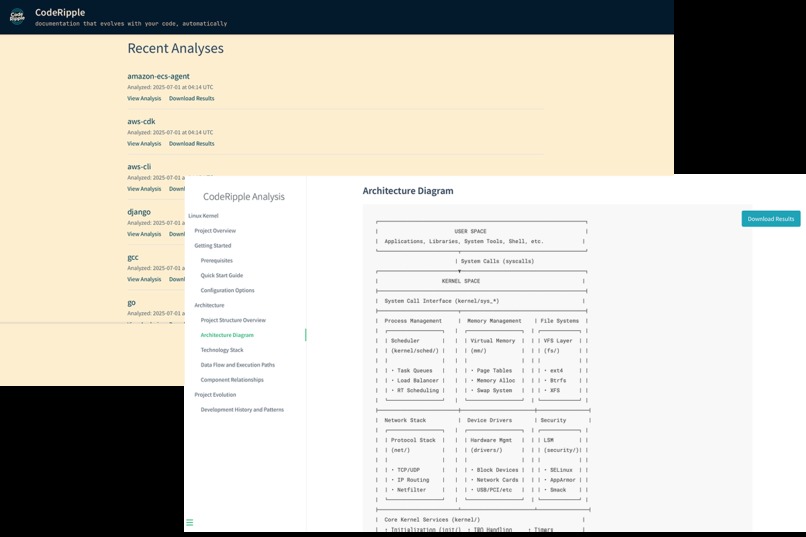
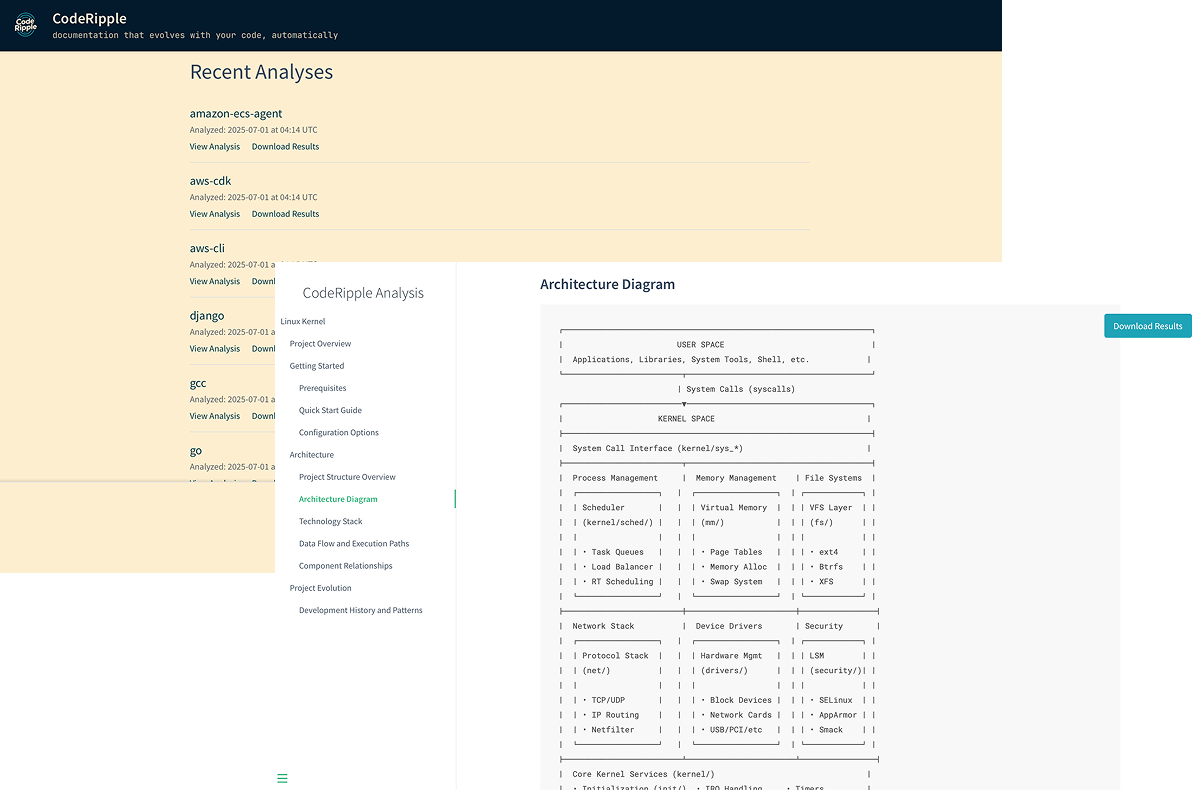
CodeRipple Displaying Auto-Generated Linux Kernel Documentation
Inspiration
Documentation is a silent tax on every development team.
We write it reluctantly, maintain it never, and desperately need it when onboarding new developers or debugging systems at 2 AM. It's the deliverable everyone knows matters but nobody wants to own - hard to quantify its value until that moment when you desperately need it and it's either outdated or nonexistent.
With AI everywhere, documentation has become even more critical. AI needs good docs to work well - clear context, current information, comprehensive coverage.
But what if we're thinking about this backwards?
Everyone talks about giving AI better documentation to consume. What if we flipped that completely? What if AI created the documentation for us?
That's the insight behind CodeRipple. Instead of struggling to feed AI our stale docs, we let AI generate living documentation that evolves with every commit. The pain point becomes the solution.
What it does
CodeRipple is an automated code analysis pipeline that generates comprehensive documentation and insights through direct delivery. Every commit triggers a sophisticated serverless workflow that analyzes your code through specialized perspectives:
- The Gatekeeper: Validates and secures webhook endpoints from GitHub
- The Receptionist: Processes commits and clones repositories for analysis
- The Analyst: Performs deep code analysis using Strands AI agents to understand patterns, architecture, and quality
- The Deliverer: Packages analysis results into structured reports with direct download access
One change, complete analysis, always accessible. The result? Documentation and insights that developers actually want to consume because it's comprehensive, contextual, and delivered instantly through public S3 storage.
Technical Architecture
Event-Driven Serverless Design
- Professional team metaphor with specialized AWS Lambda services orchestrated through EventBridge
- Direct webhook-to-Lambda pattern optimized for commit processing with comprehensive event logging
- S3-based storage architecture with public delivery mechanism eliminating external API dependencies
- Cross-platform dependency management solving ARM64 development vs x86_64 production challenges
Service Orchestration & Integration
- Gatekeeper (API Gateway): Webhook endpoint security and validation
- Receptionist (Lambda): Repository cloning and processing with git archive for clean working copies
- Telephonist (EventBridge): Event routing and service coordination across the pipeline
- Analyst (Lambda): Real AI-powered code analysis using Strands Magic Mirror deployed via Lambda Layers
- Deliverer (Lambda): Analysis packaging and public S3 delivery with direct download links
- Hermes (Lambda): Comprehensive event logging and pipeline monitoring
- Drawer/Showroom/Cabinet (S3): Multi-tier storage for private processing, public delivery, and audit logs
Production-Grade Implementation
- Lambda Layers architecture achieving optimal cold start performance for AI dependencies
- Platform-targeted dependency installation (manylinux2014_x86_64) for cross-platform compatibility
- Comprehensive task logging standard with EventBridge events for complete observability
- Resource tagging strategy across all AWS components for project organization
- Public S3 delivery with structured paths eliminating GitHub API complexity
How we built it
I built CodeRipple with a deliberate AI-first approach—100% of the code was generated via Amazon Q CLI through systematic orchestration using Micromanaged Driven Development (MDD), a method that emerged as a byproduct of the project.
The development followed systematic unit breakdown:
- Units representing major development phases (architecture, implementation, deployment)
- Subunits capturing discrete build moments within each unit
- Chronological tracking enabling AI-assisted development with clear context
- Files following naming convention:
<sequence>_<unitname>[_subunit<number|name>].md
MDD proved essential when dealing with The AI Contradiction Problem - occasions where the model suggested conflicting architectural approaches simultaneously. The three core principles became critical:
- Maintained decision control - AI generates options and recommendations while human judgment drives all final choices
- Documentation-driven context - Systematic recording of decisions and rationale creates foundation for consistent AI collaboration
- Iterative validation - Small, incremental changes allow for continuous verification and course correction
The systematic approach removed information overload, improved flow, and made LLM outputs deterministic. Building with agentic AI reinforced that documentation isn't just nice-to-have for humans - it's essential for AI context and agent-to-agent communication quality.
For more information about MDD, read Code with AI: Micromanagement is all you need.
Challenges we ran into
The Cross-Platform Dependency Challenge: Development on macOS ARM64 vs Production on AWS Lambda Linux x86_64 created binary compatibility issues. Solution required platform-targeted dependency installation using
--platform manylinux2014_x86_64 --only-binary=:all:to ensure ARM64 development machines install x86_64 binaries compatible with Lambda's runtime.The Service Discovery Challenge: CodeRipple evolved into a complex ecosystem requiring orchestration of Lambda functions, EventBridge rules, S3 buckets, API Gateway, and IAM roles. The number of interconnected services made discovery and integration more complex than initially anticipated, requiring systematic resource tagging and careful event flow design.
The Foundation Model Learning Curve: While picking Bedrock models was straightforward, learning Bedrock itself from scratch required significant investment. The AWS Documentation MCP Server in Amazon Q accelerated understanding of observability patterns and service configurations significantly.
The GitHub Actions Blind Spot: No GitHub MCP Server available meant breaking the smooth AI-assisted development flow established with AWS services. This led to the strategic pivot from GitHub PR delivery to S3 public delivery, eliminating external API dependencies.
The AI Contradiction Problem: Multiple occasions where the model suggested conflicting architectural approaches simultaneously. This made Micromanaged Driven Development essential - stepping back, rethinking approaches, and guiding AI more systematically led to better outcomes than initial approaches.
Accomplishments that we're proud of
Delivering a production-grade serverless application written almost entirely with AI. The system includes comprehensive event logging, cross-platform dependency management, Lambda Layers optimization, proper error handling, resource tagging, and complete observability - features expected from enterprise systems, not hackathon prototypes.
Real AI-powered analysis engine with Strands integration. Successfully deployed Strands Magic Mirror via Lambda Layers, achieving actual intelligent code analysis rather than mock implementations. The system performs genuine AI-powered code insights through specialized agents.
100% completion of complex event-driven architecture. Eight specialized services orchestrated through EventBridge with comprehensive task logging, public S3 delivery, and complete pipeline observability. This represents work typically requiring specialists across multiple disciplines.
Solving the cross-platform development challenge. Successfully implemented platform-targeted dependency installation enabling seamless development on ARM64 while deploying to x86_64 Lambda runtime - a common but complex serverless development challenge.
Strategic architectural pivot improving system design. The decision to pivot from GitHub PR delivery to S3 public delivery eliminated external API complexity while maintaining all core value, resulting in cleaner serverless architecture and better scalability.
What we learned
Event-driven architecture requires systematic logging for observability. Implementing comprehensive task logging through EventBridge events across all components proved essential for debugging, monitoring, and audit trails in distributed serverless systems.
Cross-platform dependency management is critical for serverless development. The ARM64 development vs x86_64 production challenge taught us that platform-targeted installation isn't optional - it's fundamental for Lambda compatibility and deployment success.
Strategic pivots can improve architecture quality. The shift from GitHub PR delivery to S3 public delivery wasn't a compromise - it resulted in cleaner serverless design, eliminated external dependencies, and improved scalability through AWS-native services.
Lambda Layers are essential for AI workloads. Deploying Strands dependencies via Lambda Layers achieved optimal cold start performance while maintaining clean separation between application code and AI dependencies.
Micromanaged Driven Development scales to complex systems. MDD principles proved effective across eight interconnected services, maintaining code quality and architectural consistency throughout a sophisticated event-driven pipeline.
Documentation-first development enables AI orchestration. Systematic documentation of decisions, rationale, and context became the foundation for consistent AI collaboration across multiple development phases and service implementations.
What's next for CodeRipple
From Analysis to Development Ecosystem: CodeRipple proves that commit-driven AI orchestration works for code analysis. The same event-driven architecture could expand to generate tests, security reviews, performance analysis, and deployment automation - all triggered by the same webhook integration.
Multi-Platform Repository Support: The current GitHub webhook integration could extend to GitLab, Bitbucket, and other git hosting platforms, leveraging the platform-agnostic S3 delivery mechanism for universal code analysis access.
The Documentation-First Paradigm: The biggest insight from building CodeRipple is the validation of documentation-first development. The next evolution could generate code from documentation commits - making documentation the source of truth and code the generated artifact, completely inverting traditional development workflows.
Enhanced AI Agent Specialization: Expand beyond general code analysis to specialized agents for security auditing, performance optimization, accessibility compliance, and architectural decision recording - each triggered by specific commit patterns or file changes.
The Vision: Transform software development from a code-centric to an analysis-centric process where intelligent agents provide continuous insights across the entire development lifecycle. CodeRipple demonstrates that AI-powered analysis can be seamlessly integrated into developer workflows through serverless event-driven architecture.
Try it
--
CodeRipple. AI-powered code analysis that evolves with your commits, automatically
Built With
- api-gateway
- bedrock
- cloudwatch
- github
- iam
- lambda
- parameter-store
- strands
- strandsagents
- terraform


Log in or sign up for Devpost to join the conversation.