Inspiration
As developers, we are constantly told that AI will make us 10x more productive. But in reality, using AI today is clunky. Every time we want a code review, we have to copy-paste code into a browser, navigate a dozen ChatGPT tabs, and suffer from "Context Switching" fatigue.
We looked at the Logitech MX Creative Console and saw an opportunity: What if we could make AI a physical instrument? We wanted to move AI out of the browser and onto the desk—turning code quality from a digital chore into a tactile, professional craft. CodePulse was born from the desire to stay in the "Flow State" while having a world-class AI auditor literally at our fingertips.
What it does
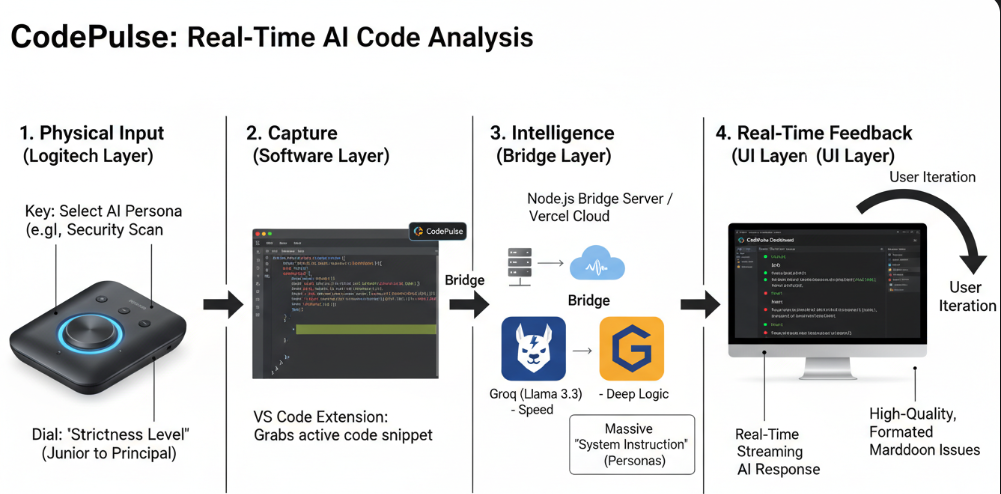
CodePulse is a Physical AI Code Review Console. It maps the 9 LCD keys of the MX Creative Console to 9 specialized AI Personas (Security, Performance, Refactor, etc.).
Tactile Quality Control: Instead of menu-diving, you press a physical key to trigger an instant review of your active code. The Strictness Dial: We’ve mapped the MX Dial to AI "Strictness." You can physically "dial up" the scrutiny from a friendly "Junior Dev" coach to a brutal "Principal Engineer" audit. Dual-Mode Backend: It works locally with a Node.js bridge for hardware integration and scales to the cloud via Vercel for remote access. Real-Time Streaming: Leveraging the Groq Llama-3.3 and Gemini 1.5 models, reviews stream back in milliseconds, providing instant feedback without ever leaving your editor.
How we built it
The Bridge (Node.js): We built a custom bridge server using Socket.io to facilitate real-time, low-latency communication between the hardware and the software.
VS Code Integration: A custom extension that monitors the physical console's events and sends the active editor's context to the AI engine.
AI Engine: We implemented a multi-provider backend supporting Groq (for ultra-fast Llama-3 reviews) and Google Gemini (with a smart fallback mechanism to handle quota limits).
Dynamic UI: A high-performance dashboard built with Vanilla JS and Lucide Icons, designed to mimic the premium "Studio" aesthetic of the Logitech MX series.
Vercel Deployment: Configured a Serverless backend using Server-Sent Events (SSE) to ensure the project stays active and demo-ready in the cloud
Challenges we ran into
State Synchronization: Keeping the physical dial, the web dashboard, and the VS Code extension in perfect sync required a robust event-driven architecture to avoid "race conditions." AI Latency: Real-time code reviews are only useful if they are fast. We solved this by integrating Groq for sub-second responses and implementing streaming so the user doesn't have to wait for the whole result. Quotas & Reliability: Early on, we hit free-tier rate limits with Gemini 2.0. We engineered a smart fallback logic that automatically switches models without the user even noticing a hiccup.
Accomplishments that we're proud of
The "Physiological" Feel: We successfully created a workflow where changing AI strictness feels like adjusting the volume on a high-end stereo. It makes the software feel like a high-precision tool. Professional UX: We avoided "hackathon-level" styling and built a premium, responsive dashboard that looks like it belongs in the Logitech ecosystem. Cross-Environment Portability: The project works perfectly whether you are running it locally on your machine or viewing the demo on Vercel.
What we learned
Hardware-First Design: We learned how to design software that complements physical inputs rather than just reacting to them. The tactile nature of the MX Console changed how we approached UX mapping. The Power of Small Models: We discovered that ultra-fast models like Llama-3-70b (via Groq) are often better for "real-time" developer tools than slower, larger models because they maintain the developer's momentum. API Resilience: Building a "fallback" system taught us the importance of provider-agnostic AI engineering.
What's next for CodePulse
Marketplace Integration: We plan to release the CodePulse Persona set as an official Logitech Service Plugin so any MX Console owner can use it. Custom Personas: Allowing teams to "train" the console on their own internal style guides and design patterns. Hardware Haptics: Experimenting with haptic feedback on the console to alert developers when the AI finds a high-severity security bug.


Log in or sign up for Devpost to join the conversation.