Inspiration: Every developer remembers the frustration of writing their first lines of code. We often get trapped in "tutorial hell"—reading generic documentation that is either too complex for beginners or too simple for intermediate developers trying to learn a new stack.
We realized that learning to code isn't a one-size-fits-all process; it's a dynamic equation. We wanted to build a platform that acts as a personalized, 24/7 senior developer. Our inspiration was to democratize technical education by shifting from static, search-based learning to Agentic, on-demand mentorship tailored perfectly to a user's specific goals, language, and experience level.
What it does: CodeMentor AI is an intelligent, multi-agent educational platform that acts as your personal, on-demand senior developer.
Aspiring coders often get trapped in "tutorial hell" because traditional documentation is static, generic, and filled with heavy jargon. CodeMentor AI solves this by generating highly personalized, step-by-step learning roadmaps and syntax guides in seconds.
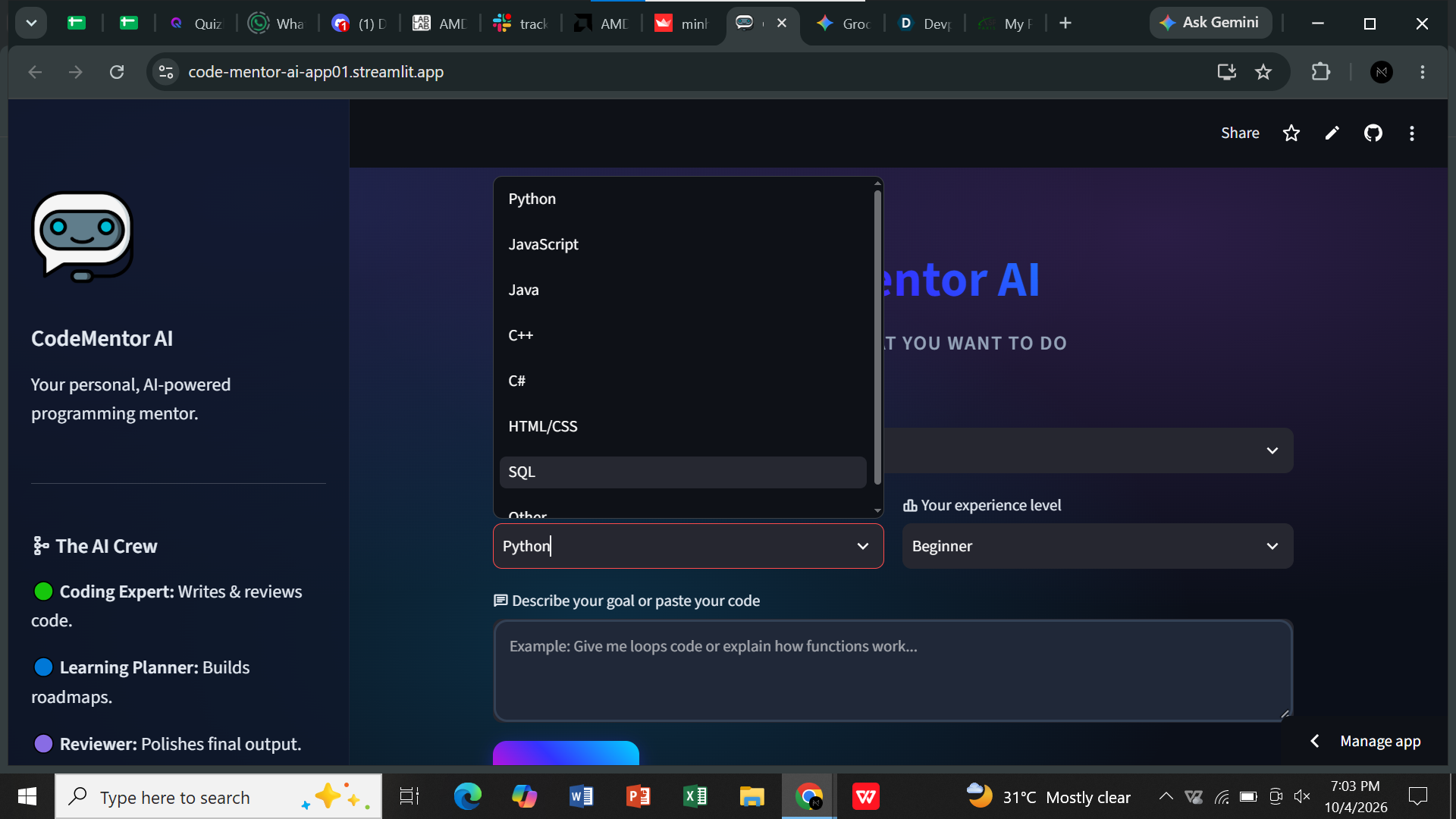
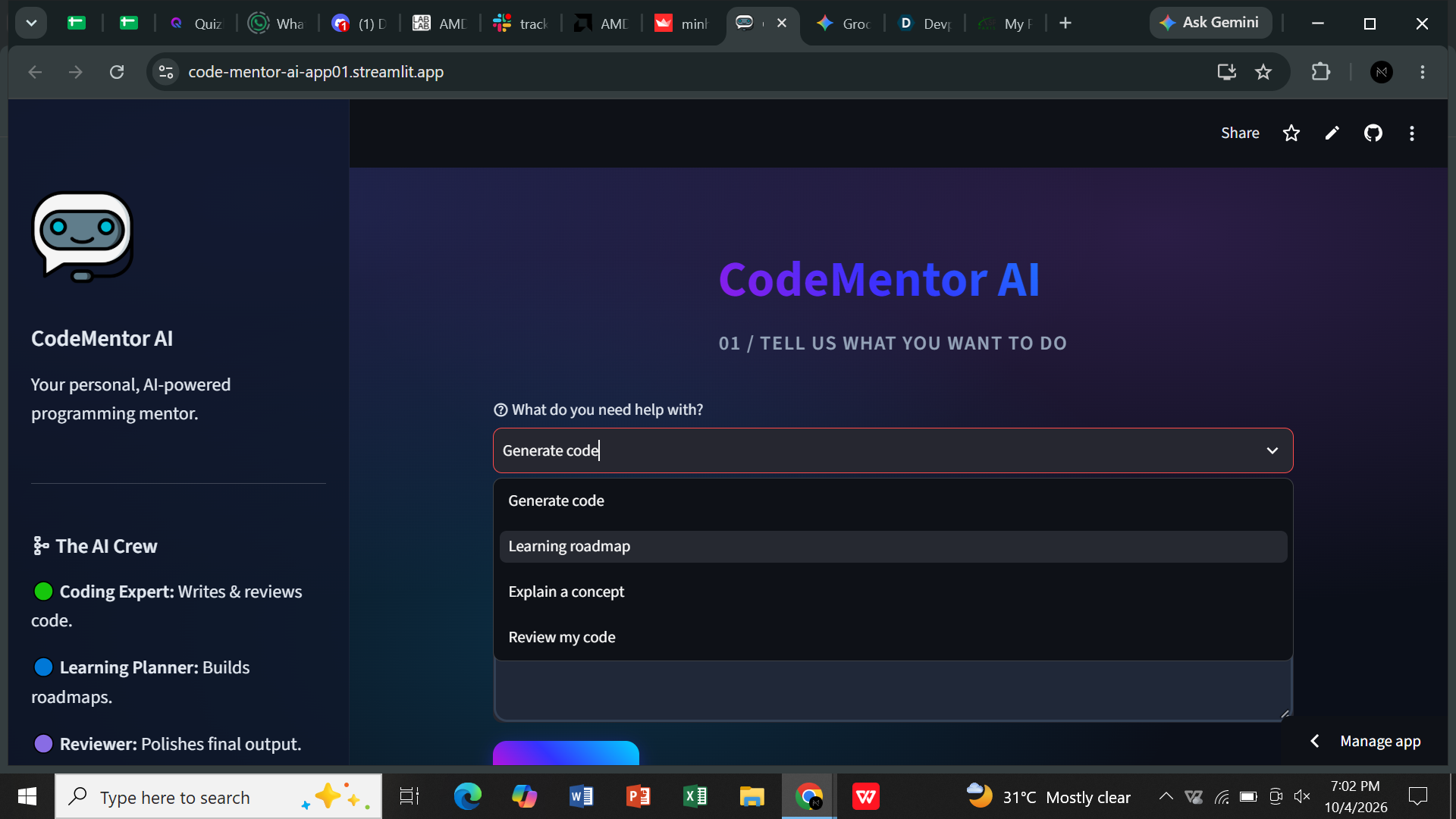
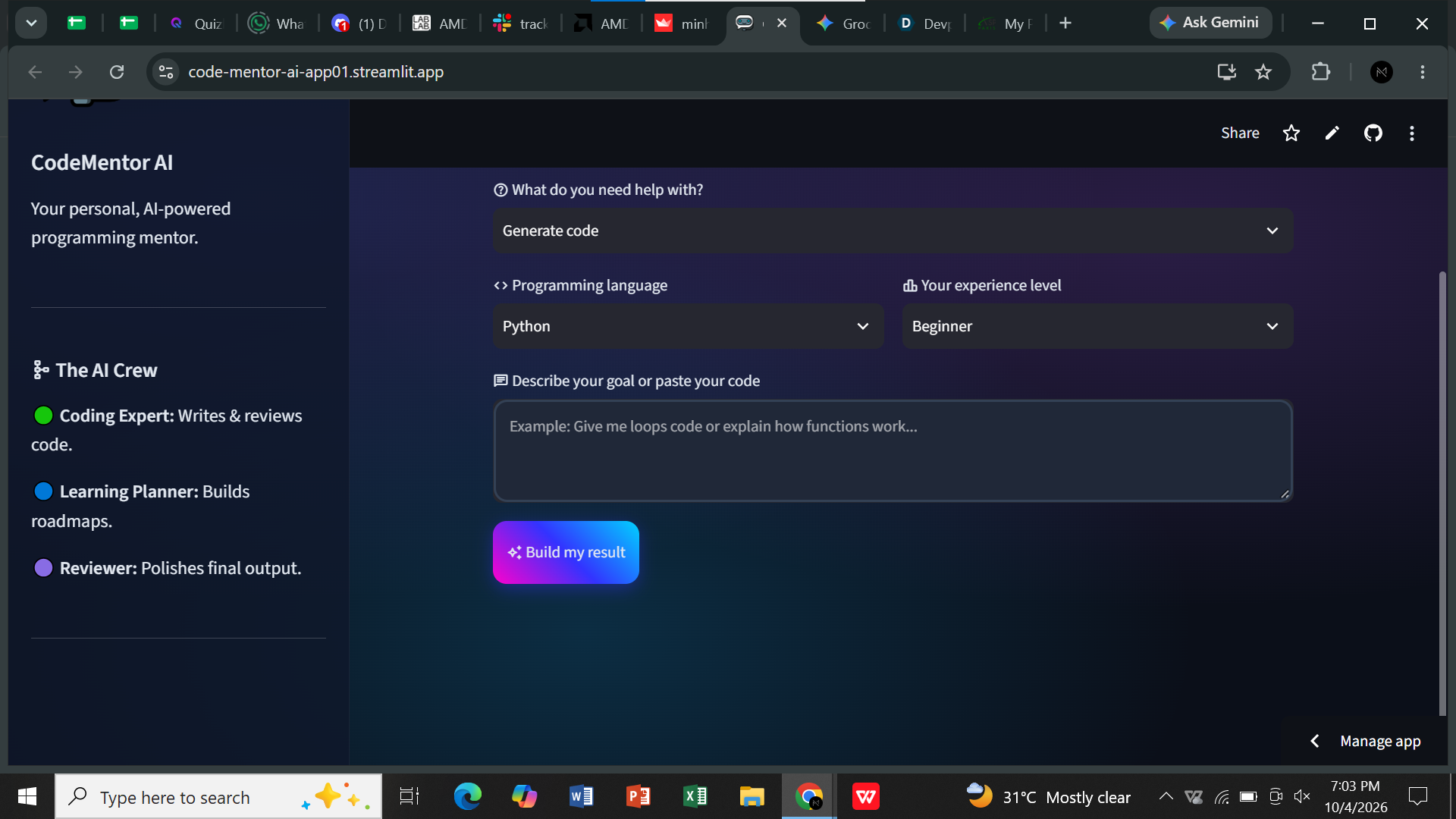
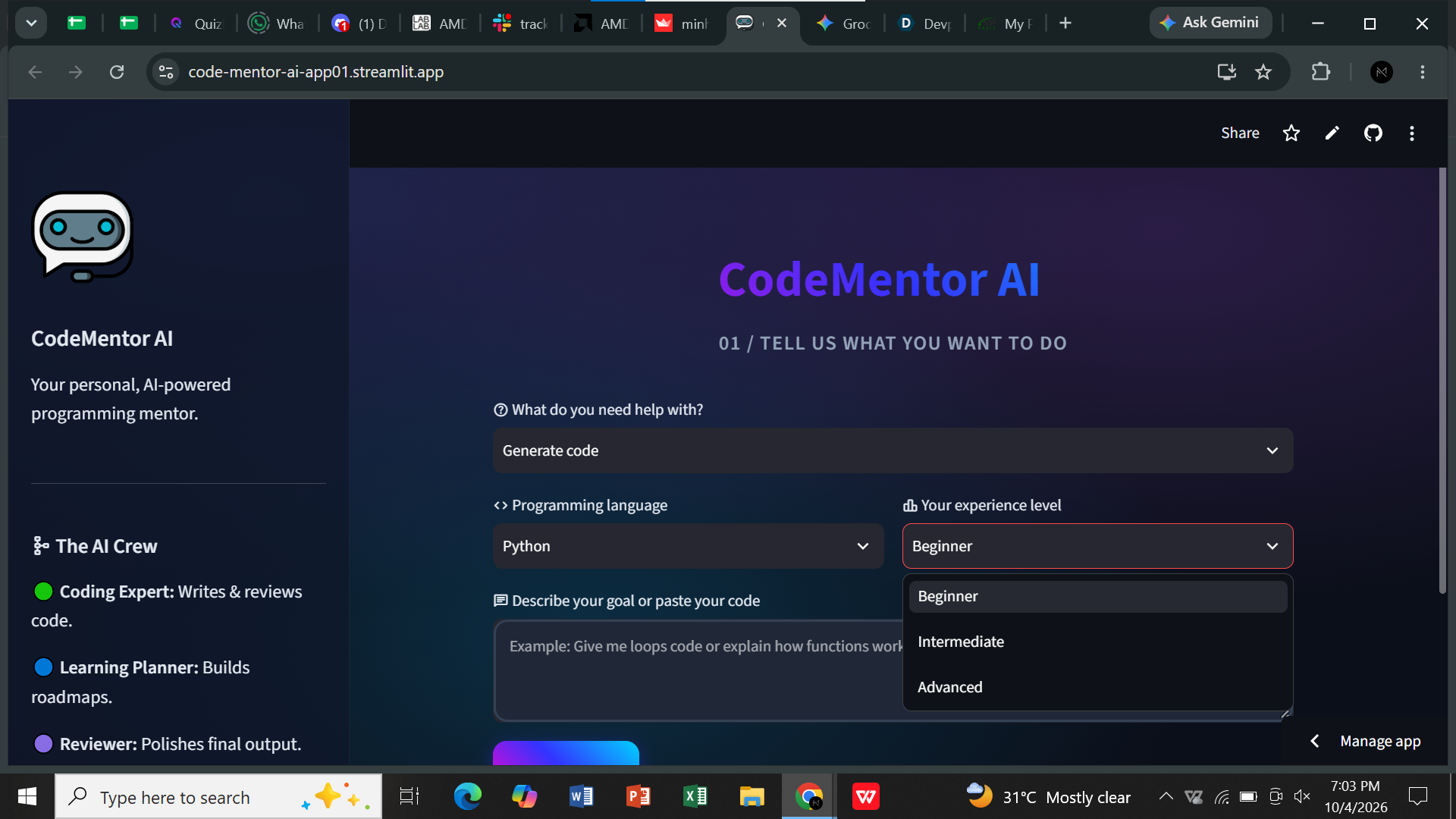
Users simply select what they want to do (Generate code, Build a learning roadmap, Explain a concept, or Review code), pick their target language, and set their experience level. Instead of a generic response, the app orchestrates a team of specialized AI agents to build a custom curriculum—complete with easy-to-understand explanations and actionable code snippets—and allows the user to download the final masterclass instantly as a Markdown file.
How we built it: We built the application using a modern Python stack, focusing on Agentic AI workflows rather than single zero-shot prompts:Frontend (Streamlit & Custom CSS): We used Streamlit for our core UI, but injected heavy custom CSS to override the default layout. We implemented a premium, dark-themed glassmorphic design featuring mesh gradients, animated hover states, and Google Material Icons to give it a true SaaS feel.Orchestration (CrewAI): We utilized CrewAI to create a sequential processing pipeline. We defined three distinct AI personas: a Coding Expert, a Learning Planner, and a Technical Reviewer.The Brain (Google Gemini): We integrated the Google Gemini 3.5 Flash Lite model. We specifically chose the Flash Lite version for its blazing-fast inference speeds, ensuring our multi-agent pipeline completes in seconds during live demos. Our Pipeline Model:Our architecture follows a mathematical sequence where the final output $\mathcal{O}{final}$ is the composite function of our three specialized agents acting on the user's input $\mathcal{U}$: $$\mathcal{O}{final} = \mathcal{A}{reviewer} \Big( \mathcal{A}{planner} \big( \mathcal{A}_{coder}(\mathcal{U}) \big) \Big)$$
Challenges we ran into: Agent Context Bleed: Initially, the AI agents would sometimes forget the user's exact experience level (e.g., explaining a concept using advanced terminology even when "Complete Beginner" was selected). We solved this by strictly defining the Task expected outputs and passing the user parameters as explicit context variables to every single agent in the Crew.
API Rate Limiting (503 Errors): During testing, we occasionally hit Google's server traffic limits. To protect the user experience, we built a custom error-handling wrapper in our app that gracefully catches 503 Unavailable exceptions and presents a clean "Retry Request" button rather than crashing the application.
Pushing Streamlit's UI Limits: Streamlit is great for data apps, but making it look like a highly polished, consumer-facing product was tough. We spent hours manipulating CSS to create our vibrant gradient themes and custom input focus rings.
Accomplishments that we're proud of: Successful Multi-Agent Collaboration: We successfully got three distinct AI personas to pass data sequentially, review each other's work, and output a perfectly formatted final product without hallucinating.
Exceptional UI/UX: We transformed a basic Python script into a visually stunning web app. The live status tracker that shows exactly what the AI agents are "thinking" provides an incredible user experience.
High-Speed Execution: By optimizing our prompts and utilizing Gemini 3.5 Flash Lite, we managed to get a complex, 3-agent CrewAI sequence to run flawlessly and quickly, making it perfect for a live hackathon presentation.
What we learned: Agentic Workflows vs. Standard LLMs: We learned the massive quality difference between asking a single LLM to do a large task versus dividing that task among specialized, role-playing agents. The quality of output from the Reviewer Agent editing the Coder Agent's work was mind-blowing.
Prompt Engineering is Software Engineering: Defining the exact persona, goal, and backstory for an AI agent requires precise, algorithmic thinking to prevent edge cases.
Team Synergy: Working together under the tight deadline of the Generative AI Hackathon taught our team how to effectively divide UI design, Backend logic, and Prompt Engineering tasks and merge them seamlessly.
What's next for CodeMentor AI: Interactive Code Execution (REPL): We want to embed a lightweight compiler directly into the Streamlit interface so users can immediately test the syntax examples the AI generates for them.
Session Memory: Upgrading the CrewAI implementation to support conversation history, allowing learners to ask follow-up questions to the Reviewer Agent if they get stuck on a specific step of their roadmap.
Automated Exporting: Integrating webhooks (via n8n) to automatically convert the Markdown output into a beautifully branded PDF and email it directly to the user's inbox.

Log in or sign up for Devpost to join the conversation.