-
-
codeguardian
🛡️ CodeGuardian AI – Multi-Agent AI Code Reviewer
Inspiration
Modern software development is moving faster than ever, but code reviews often become a bottleneck. Developers spend valuable time identifying bugs, security vulnerabilities, performance issues, and architectural flaws before a pull request can be merged.
I wanted to build a platform that could automate the first level of code review using AI. Instead of replacing human reviewers, the goal was to help them by providing instant, actionable feedback so they could focus on higher-level design decisions.
This idea was inspired by the growing adoption of AI-assisted development tools and the need for a centralized code review assistant that works with both uploaded source files and GitHub repositories.
🚀 What it does
CodeGuardian AI is a multi-agent AI-powered code review platform that analyzes source code and public GitHub repositories.
The application can:
- 📂 Review uploaded source code files
- 🔗 Analyze public GitHub repositories
- 🐞 Detect potential bugs
- 🔒 Identify security vulnerabilities
- ⚡ Suggest performance improvements
- 🏗️ Evaluate software architecture
- 🧪 Recommend testing strategies
- 📊 Generate an executive release-readiness report
Instead of a single AI response, the system coordinates multiple specialized AI agents that collaborate to produce a comprehensive review.
🏗️ How I built it
The project consists of a React frontend and a Node.js backend connected through REST APIs.
Frontend
- React
- Vite
- React Router
- Tailwind CSS
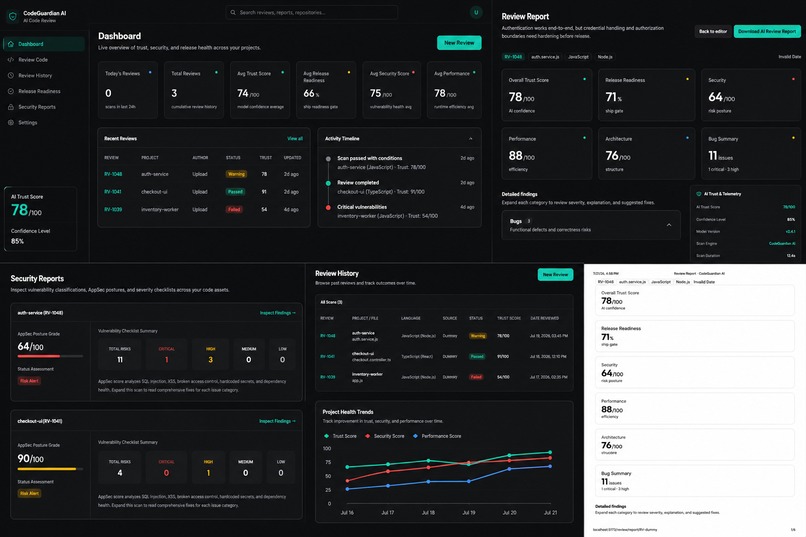
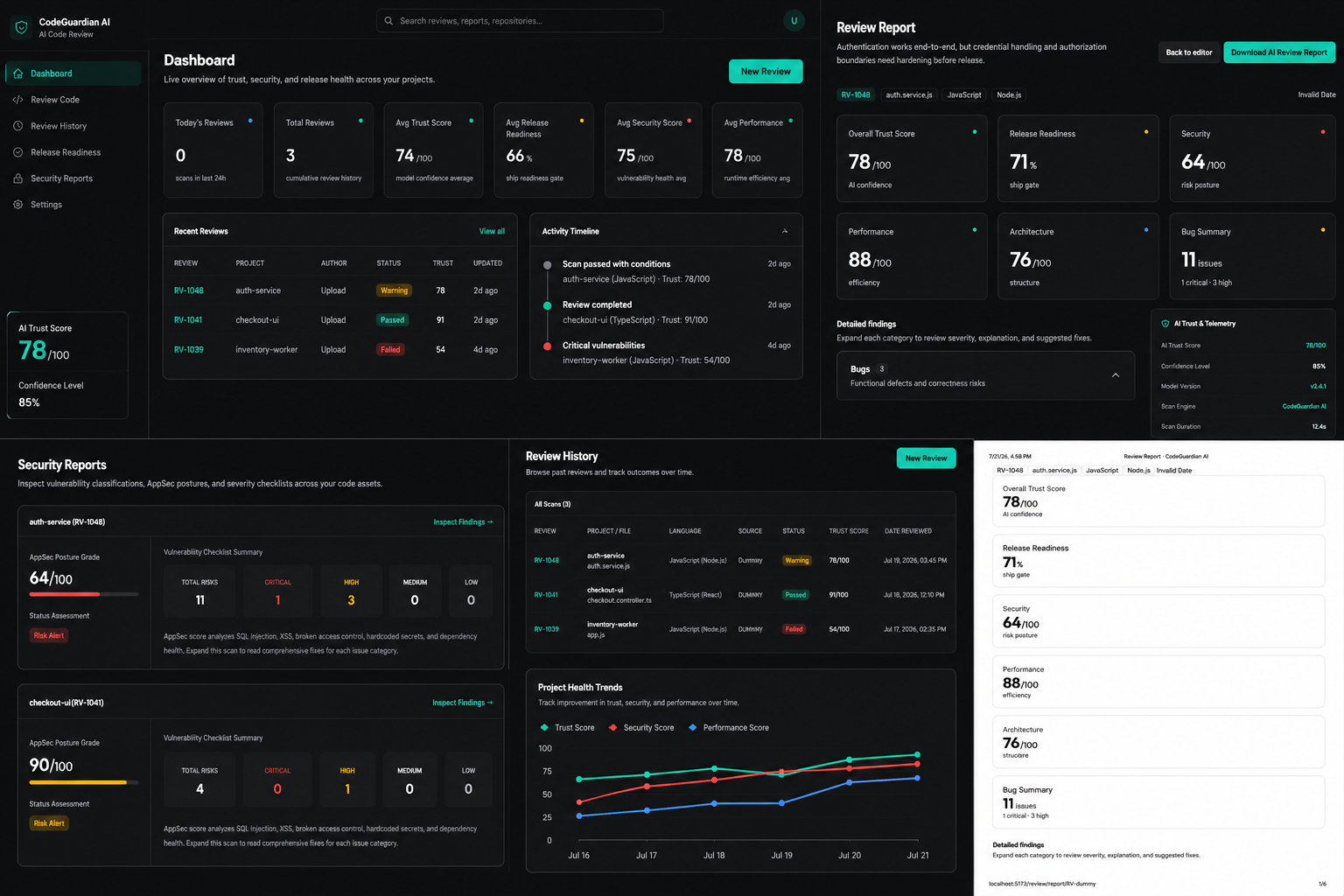
The frontend provides an intuitive dashboard where users can:
- Upload code files
- Submit GitHub repository URLs
- View AI-generated reports
- Track review history
- Monitor release readiness
Backend
- Node.js
- Express.js
- REST APIs
- GitHub Repository Downloader
- Repository Context Engine
- Google Gemini API
The backend processes uploaded code or GitHub repositories, extracts relevant project information, and orchestrates multiple AI agents to generate detailed review reports.
Multi-Agent Architecture
The review process is divided into specialized AI agents:
- 🐞 Bug Detection Agent
- 🔒 Security Agent
- ⚡ Performance Agent
- 🏗️ Architecture Agent
- 🧪 QA/Test Agent
- 👨💼 CEO Agent (Executive Summary)
Each agent focuses on a specific aspect of software quality before the CEO Agent consolidates the findings into a final release-readiness report.
Challenges I ran into
Building the project involved several technical challenges.
One major challenge was implementing GitHub repository analysis. The application needed to validate repository URLs, download repositories, extract their contents, detect project structure, and prepare meaningful context for the AI model.
Another challenge involved handling asynchronous AI workflows. Coordinating multiple AI agents while maintaining responsiveness and error handling required careful backend design.
I also encountered issues with GitHub API rate limits, repository downloads, and long-running requests that occasionally caused timeout and connection reset errors. Debugging these issues improved the stability of the backend.
Finally, designing a clean frontend capable of presenting large AI-generated reports in an organized and user-friendly manner required several iterations.
What I learned
Through this project, I gained practical experience with:
- Designing scalable REST APIs
- Building React applications with modern routing
- Integrating Google Gemini AI
- Working with GitHub repository APIs
- Backend orchestration using multiple AI agents
- Repository context extraction
- Error handling and debugging asynchronous systems
- Production-oriented project architecture
Most importantly, I learned how multiple AI agents can collaborate to produce more structured and reliable software engineering insights than a single AI response.
Accomplishments that I'm proud of
- ✅ Built a complete full-stack AI application
- ✅ Integrated GitHub repository analysis
- ✅ Designed a multi-agent AI review pipeline
- ✅ Created a modern interactive dashboard
- ✅ Generated executive release-readiness reports
- ✅ Implemented modular backend architecture
- ✅ Successfully deployed the complete project to GitHub
What's next for CodeGuardian AI
Future improvements include:
- GitHub Pull Request integration
- GitHub Actions automation
- Persistent database for review history
- Support for private repositories
- Team collaboration features
- PDF and shareable report exports
- Multi-language code analysis
- CI/CD integration
- AI-powered automatic fix suggestions
- Inline code annotations similar to GitHub reviews
Tech Stack
Frontend
- React
- Vite
- Tailwind CSS
- React Router
Backend
- Node.js
- Express.js
AI
- Google Gemini API
- Multi-Agent AI Pipeline
Integrations
- GitHub Repository API
- Repository Context Engine
Vision
CodeGuardian AI aims to become an intelligent code review assistant that helps developers ship safer, cleaner, and more maintainable software by combining specialized AI agents into a single collaborative review workflow.


Log in or sign up for Devpost to join the conversation.